
At the risk of sounding like a broken record, I must start by pointing out that we all engage regularly in all of the activities of life. So we’re not actually Pioneers or Stewards or Cultivators (Settlers) or Curators or Regulators (Town Planners) or Scouts. We just put on their hats and pull out their tools.
The Kairotic Flow Archetypes represent phases of activity, not personality types.
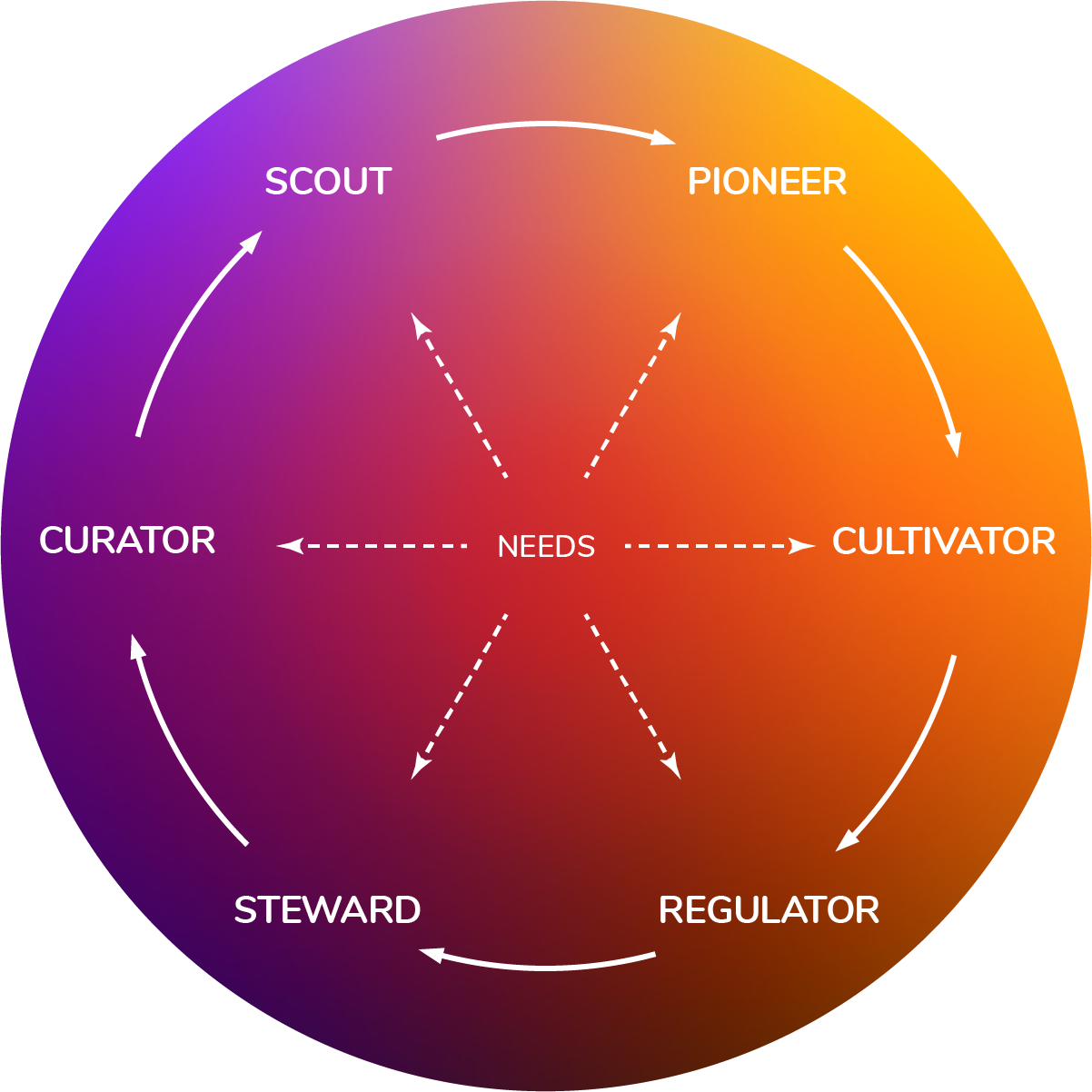
We humans do typically have preferences about what activities we enjoy doing, though. And habits of perception, and areas of fear and trauma. Some Archetypes’ hats and tools are well-tended and comfortably familiar to us, while others hide out in the corner collecting layers of dust and rust.
Plus, of course, the work we get paid for typically requires us to focus on one or two Archetypal Phases of activity over others. Generally speaking, if we can get paid to do what we enjoy doing, we’ll gravitate to it one way or another, but life being the way it is nowadays we tend to get pretty good at the activities we’re paid for and develop some attachment to those hats and tools, even if we don’t much like them.
It’s worth remembering, too, that there are other forms of payment than money, e.g. appreciation, feeling useful, or feeling that one is somehow contributing in a way that matters.
Upton Sinclair famously said, “It is difficult to get a man to understand something, when his salary depends on his not understanding it.”
Applying this as a general principle to Kairotic Flow, it’s easy to see why the Regulator (name change from Town Planner) and Steward Archetypes, especially, might have tremendous difficulty with admitting to not knowing something. These two ‘solid’ Archetypes really depend on knowing, on expertise. Without it, they can’t really do their work, and if they can’t do their work, they won’t get paid.
Regulator’s business is standardisation and distribution of the infrastructure we all rely on. Can you imagine trying to build a bridge through completely unknown territory, or write a book in an alien language? What a nightmare!
Steward is no better off. Steward’s job essentially involves selecting and applying multiple different forms of infrastructure (which includes expert knowledge, by the way) to nurturing and protecting the wellbeing of whatever whole (or more accurately, holon) Steward is taking on responsibility for. Steward’s realm is that of fiduciary duty. We do not want Steward to be taking random risks with our lives! “Yes please, let the first year resident perform my open heart surgery without supervision,” said Absolutely No Sane Person Ever.
‘Liquid’ Cultivator (name change from Settler) is not quite so dependent on knowing as are Regulator and Steward — this Archetype depends on feedback from the environment it is growing in more than anything else — but Cultivator definitely needs some evidence that whatever it’s working on has some proven merit, otherwise it has no way of measuring improvement. (Getting that initial proof is Pioneer’s job.)
Curator, also a ‘liquid’ Archetype, is even less dependent on already knowing than Cultivator is, but has a penchant for investigation and drive for integrity that makes “I don’t know” sound suspiciously like an incomplete sentence, just waiting to be tied off with “yet”. Curator will typically admit “I don’t know” readily enough, and then head off to do the research and fix that annoying situation. If the knowledge is there to be found, Curator will find it. An “I don’t know” that comes after doing the research is less comfortable, but when Curator is healthy and able to let go, it’s still not a huge deal since at this point, Curator’s work is done and it is time for Scout to pick up the reins.
Right at the other end of the expertise-dependency spectrum from ‘solid’ Regulator and Steward are the two ‘gas’ Archetypes of Scout and Pioneer. These two, from the perspective of all the other Archetypes, seem to almost get a perverse kick and sparkle of glee out of declaring, “I don’t know!” Those who prefer one of these Archetypes but have been traumatised by that preference (common enough in today’s world, especially for Scout) might also be a wee bit defensive about not knowing, but ultimately, not knowing is precisely what justifies their work.
If Scout feels even a hint of potential resonance in the question, it’s likely to be haring off down a bunny trail or diving into a dumpster before it’s even finished saying “I don’t know.” But don’t get too excited. That quick leap to start discovery doesn’t mean you’ll get the answer you’re looking for, let alone any time soon. Scout is unlikely to assume that the question is adequately framed as is, and may well turn it inside out and upside down several times during its explorations of the possibility landscape. (Indeed, this little piece of writing is a Scout response to several questions I’ve encountered over the past 6 months about topics such as “Why do people vote for confident-sounding politicians rather than those who admit they don’t know and seek advice?” and “Why do my lecturers avoid saying they don’t know the answer to my questions?” and “Why doesn’t real exploratory science get funded any more?”)
A direct answer to a question initially prompting an “I don’t know” response is more likely to eventually come from Pioneer, although unless Pioneer is between opportunities or the question itself looks particularly shiny, this Archetype might need to see a little more of a potential relationship with its current obsession before rushing off to the lab. Pioneer might just shrug and leave it at that.
Clearly we need all the Archetypes. There are things we know, and also much we don’t know and may never know. Living requires continuous learning. That’s really what the Cycle of Kairotic Flow is about — the learning cycles of life.
We run into trouble when we try to impose one Archetype’s hat and tools on another Archetype’s realm of learning activity, or — actually saying the same thing another way — when we blame people for behaving the way the conditions they are in require them to behave.
Why do some find it so hard to say “I don’t know”?
Because they’re experiencing conditions which make it hard for them to say it.
Comments
Nothing yet. Say the first thing.
Sign in to join the conversation.