
A pretty common trope nowadays is that if you get to use a product you do not pay for (such as social media), then guess what?… you are the product. But to be honest, I think the situation we’re in is much worse than that. Individual so-called “consumers” of digital information and online platforms are not only the product, but the food being consumed.
Metaphorically speaking, of course. Literal materialistic cannibalism is frowned upon. But I promise I’m not making things up here… the “product” you are — to that which is consuming you as “food” — is your time and attention, the experiencing of your life that creates your being and becoming and doing of you, as a conscious, living human being.
At first glance, this distinction between merely being a product and being food may seem unimportant or unnecessarily dramatic to you, especially if, like me, you already go out of your way to avoid spending your money where the marketing machine suggests you should spend it.
Satisfying as it may be to thwart advertisers’ expectations in this way — and I admit that trying to be an expensive and annoying ‘product’ for advertisers is one of my little F-you joys in life — the sad truth is that when it comes to being food, whether or not you purchase something that is advertised to you doesn’t matter in the slightest. The benefit gained by the advertiser from consuming human time and attention is cumulative and distributed throughout society. Even negative attention is better for the advertiser than no attention at all, given that the most important thing for the advertiser to achieve is visibility, to become an ‘option’ in our minds and in the collective consciousness of our culture.
However, from the point of view of the consumed — you and me — the cost associated with the advertiser achieving that benefit of becoming visible is borne by everyone in society, both directly and indirectly. And yes, when I say everyone, I do mean everyone, including the human owners and employees of the advertiser.
In direct terms, each person who sees or hears even a split second of an advertisement they did not request bears the costs of distraction, wasting time and cognitive processing on ‘information’ that is of no relevance or benefit to them in that moment, and fouled conditions for taking action on whatever it was they were trying to do at the time.
For those who can afford to pay to filter out some of those demands on their attention (e.g. by having paid ‘ad-free’ accounts or setting up ad blockers), there are still costs in terms of money and time required to set up the filters. And for those who can’t afford those costs of filtering, there is an insidious, compounding loss of choice and sense of agency in life.
Either way, everyone’s experience of their own life degrades and shrinks, as they use up their cognitive processing capacity on irrelevant information. Our personal possibility space is necessarily constrained by the amount of fuel available in our cognitive tanks.
In conditions of scarcity, we are all more likely than we otherwise would be to give up our real creative power of choice (which requires more cognitive effort) in exchange for the lower-energy-cost, illusory ‘agency’ of deciding from limited, all unhealthy options listed on someone else’s menu — options which aren’t really even about what you consume, but what type of food you ‘choose’ to be, and for ‘whom’?
Which social media platforms do you use? Do you spend time you don’t really have on discussions regarding which platform is better or worse (for whatever reason), or click on some notifications in your inbox because otherwise you can’t see what they are, and who knows, maybe they’ll be interesting? Do you ever ‘like’ a post (say from a friend or an “influencer”) because you want to be supportive or show you’re noticing their activity, but without even looking properly at whatever you ‘liked’ because you just don’t have the time or maybe the interest to do that? When you perform a Google search, do you scroll past all the ads and click onto the second page of results? Or did you download a different browser to use? Or maybe an ad blocker or two? Food, food, food.
Indirectly, others’ loss of their time and attention costs you, too, through all the ways you are interconnected with the world. The ripple effects are everywhere.
Think of any person you care about who is overwhelmed, stressed, or becomes distracted from your relationship at times. Or anyone you interact with who becomes impatient, frustrated, or reactive in your conversations. Consider the time and attention you spend on avoiding or participating in or resolving misunderstandings and conflicts that arise due to those pervasive conditions of other people constantly riding the edge of being overwhelmed and ‘out of juice’.
Or maybe think of how first impressions are formed. Some of us might like to believe that we’re immune to being directly influenced by the brand of clothing someone wears, or the car they drive. But even if that’s true, how about indirect influence? Are we influenced by picking up on the signals our friends, family or community transmit regarding their first impressions of another person or brand or situation? For me, introspecting on this, I’m uncomfortably aware that even though I do not wish or intend to be influenced in this way, and certainly attempt to keep an open mind, energetically my desire to engage and find out for myself ebbs when I realise that I’d likely be stepping into a relational minefield by doing so. I’m blessed with enormous energy for what interests me, but in the absence of desire, energy budgeting kicks in and the truth is, I’m unlikely to engage if I don’t have to.
Or consider a work colleague’s loss of focus or competence or care for what they’re working on, and what the impacts of what they’re failing to do effectively might be for you and others who rely on their work. Creativity, critical thinking, executive function, and collaboration all require part of our cognitive and emotional budgets — time and attention. What happens if we’re wasting those budgets on putting out fires and repairing bridges? How much time, energy and attention do you spend on picking up pieces, finding bandaids or workarounds, and engaged in experiencing and regulating your emotional reactions?
And then there’s the seemingly endless fighting over which option is better on a menu of utterly toxic ideologies, political parties and virtue-signalling identity tribes. It’s exhausting. Even if you don’t participate in those fights, they cost you — avoidance also requires time and attention. There’s no escape unless you close off much of your interconnection with the world, and for a social being, that’s a totally foot-shooting move.
So whether we individually recognise it or not — culturally, collectively, we’re all in a horribly insidious double-bind, caught between a rock and a hard place.
It may be an urban myth that frogs boil to death rather than jumping out of water that slowly rises in temperature, but it’s still a good metaphor for the human tendency to accept, as “just the way things are”, the increasing toxicity of conditions that are undermining our health and will eventually kill us.
This so-called ‘attention economy’ has us all swimming in cultural waters that are thoroughly polluted with irrelevant and attention-diverting ‘information’ that not only feeds off our attention, but simultaneously undermines our individual and collective ability to make sense of reality. Worse, the more confused we get, the more nonsense (pollution) we ourselves generate into the collective information pool. We are slowly but surely — and exponentially — driving ourselves insane.
Can you remember… or even imagine… swimming in healthy, clean waters for sense-making, without all that toxic crap?
As far back as I can remember, I’ve always felt annoyed by advertising, especially when some stupid jingle turned out to be an earworm — “why do I have to have this useless and super-annoying thing camping rent-free in my head?!” — but there’s no question that the information environment of my 20th-century childhood was much less invasive and “off” than the information environment of today. And while there’s no turning back the clock, I can easily imagine much better going forward.
Yes. Absolutely we can. (Not easily, perhaps, but it’s possible.)
Humans created this mess; humans can clean it up.
The first step toward making any change is recognising that there is a need for it, that there is something that we wish to change for the better.
In the Cycle of Kairotic Flow, this happens at the Steward Archetypal Phase. Or to be more precise, it happens when Steward realises that it can no longer successfully perform some maintaining, guarding or nurturing activity, and lets go of its attempt to do so while communicating an ‘account’ of what has happened.
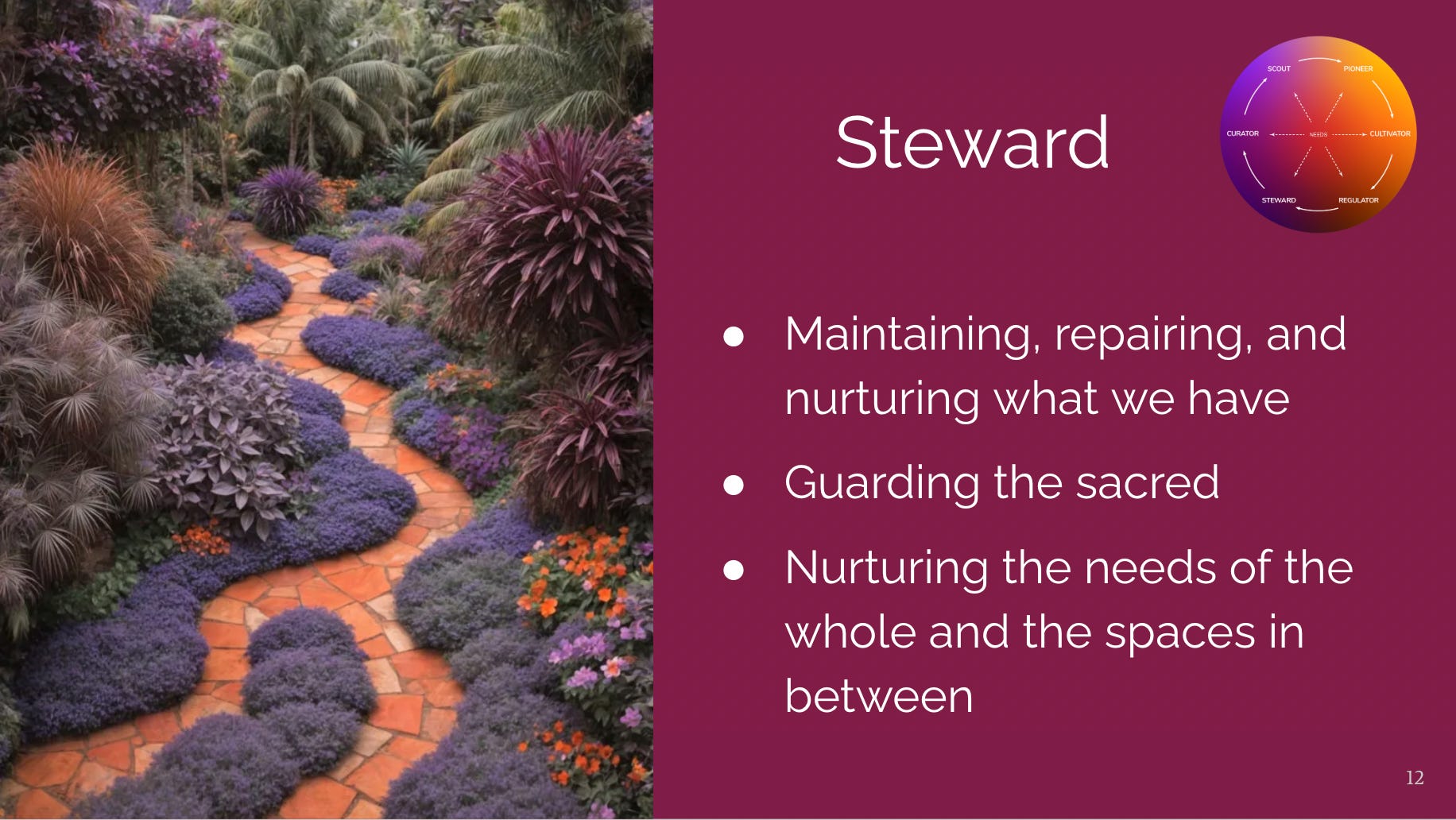
(By and large, at present, at a civilisational level, we’re not really doing this. Instead, we’re clinging to zombies and insisting on feeding and guarding them as if they are sacred, just because they’re what we ‘know’. I’ll get back to this, but for now, please just assume we can get over this hurdle…)
In the information environment (context) that exists now, we are unable to effectively guard our sacred attention and time (our life force and experience).
We are unable to effectively apply the cognitive, emotional and energetic resources we have to nurture life and meet life needs, at every level. Individual, family, community, and planet.
And we cannot fix this problem within the constraints of our existing conditions. The systems and institutions humanity has already collectively created can no longer be effectively applied to meet our needs. They are beyond repair.
Steward has done everything it can, and failed.
After recognising there’s a problem, and providing an account of it, healthy Steward lets go of trying to do the impossible.
It quits wasting resources on trying to keep zombies ‘alive’, refrains from the useless activity of allocating blame and ‘scapegoating’ (which doesn’t fix the problem either!) and focuses back in on what it can do — tending to life needs as best it can in its context.
One very visible concrete example of this natural triage process occurs every year in autumn/fall, when deciduous trees stop sending resources to foliage, because it is more energy efficient for them to go dormant over winter. The green chlorophyll in the leaves fades away, and we see a bright show of colour before the leaves die and fall away from the tree.
It’s no coincidence that Steward’s kairos season in the Earth year is autumn/fall.
Another example (which we usually take preventative measures against) is frostbite. Unable to keep the entire body sufficiently warm in too-cold conditions, Steward maintains critical core warmth for as long as it can by sacrificing the extremities.
In the Kairotic Flow cycle, when Steward fails (whether it willingly lets go or not), the next Archetype in the sequence, Curator, takes over. Curator is the ‘death’ phase — in seasonal terms, the end of autumn/fall and the beginning of winter.
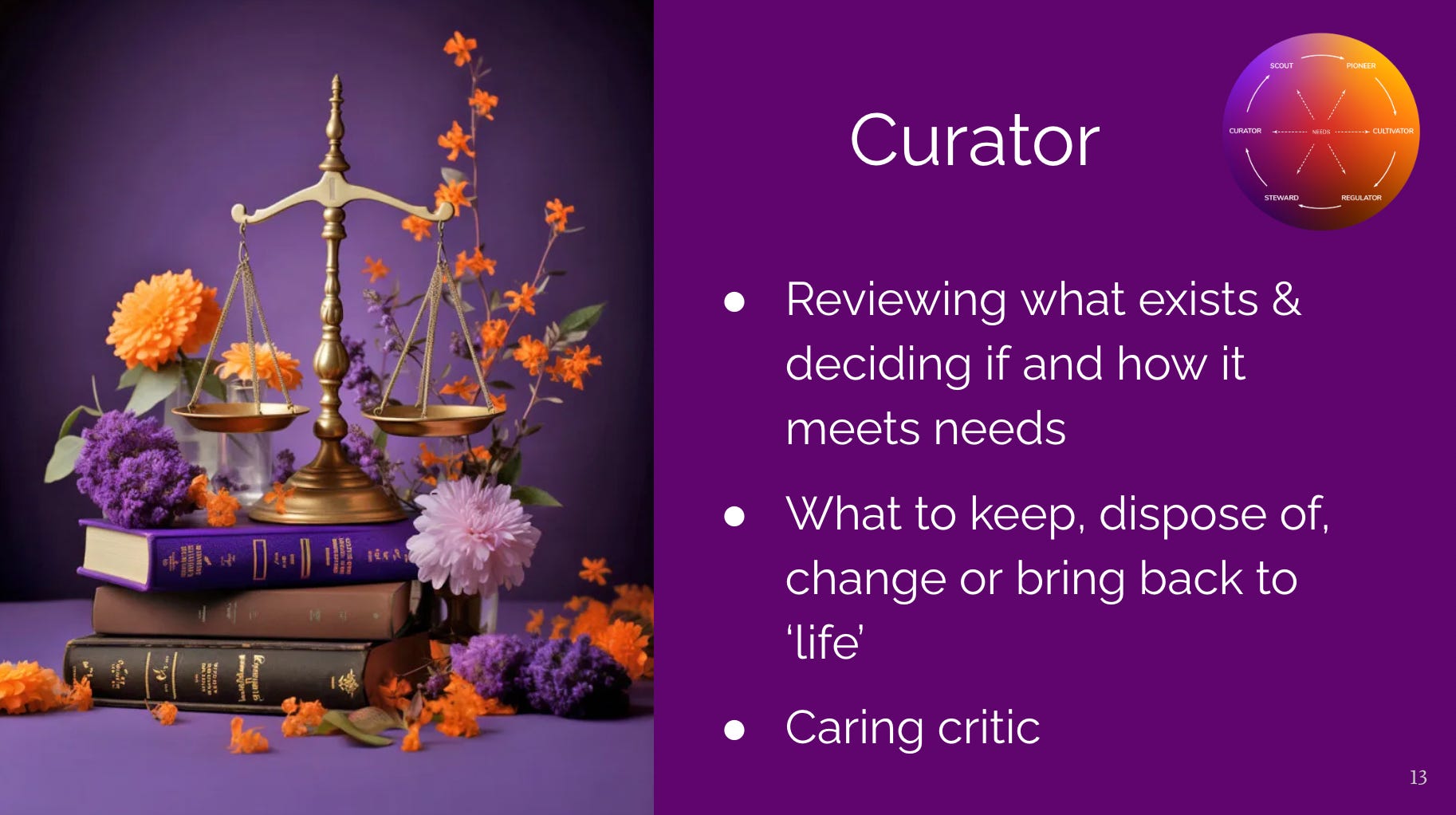
Looking to the natural world again to get our bearings, it’s obvious that Curator can’t be avoided. Winter comes, whether we like it or not.
Our global civilisation is in Curator Phase now, too. And on some level, frustrated as we are by the constant attentional overwhelm of irrelevant crap, many of us know that we are in desperate need of Curator’s perspective. From complaints about “fake news” and mis/dis/mal-information, to docudramas like “The Social Dilemma”, the influence of the information ecology on our ability to make sense of the world and exercise healthy agency in our lives is a hot topic. We’ve even taken to intuitively (albeit often sloppily) waving around terms like “curation” and “curating” and “curator”!
While I admit to occasionally feeling a tad irritated by that sloppiness (because, thanks to Kairotic Flow, the distinction I will make below seems obvious to me!) I still like to think of this surge of interest in Curating as a really good sign for our future sanity because, as mentioned above, Step #1 requires recognising the need for change. This kind of realisation nearly always starts off a bit fuzzy, so that’s ok.
Anyhoo. Let’s see if we can bring a little more clarity to the situation now, by considering what healthy Curation actually involves (and requires) at a collective level.
To begin, please take a moment to compare the above snapshot of Kairotic Flow’s Curator Archetype with the following snapshot of the Cultivator Archetype.
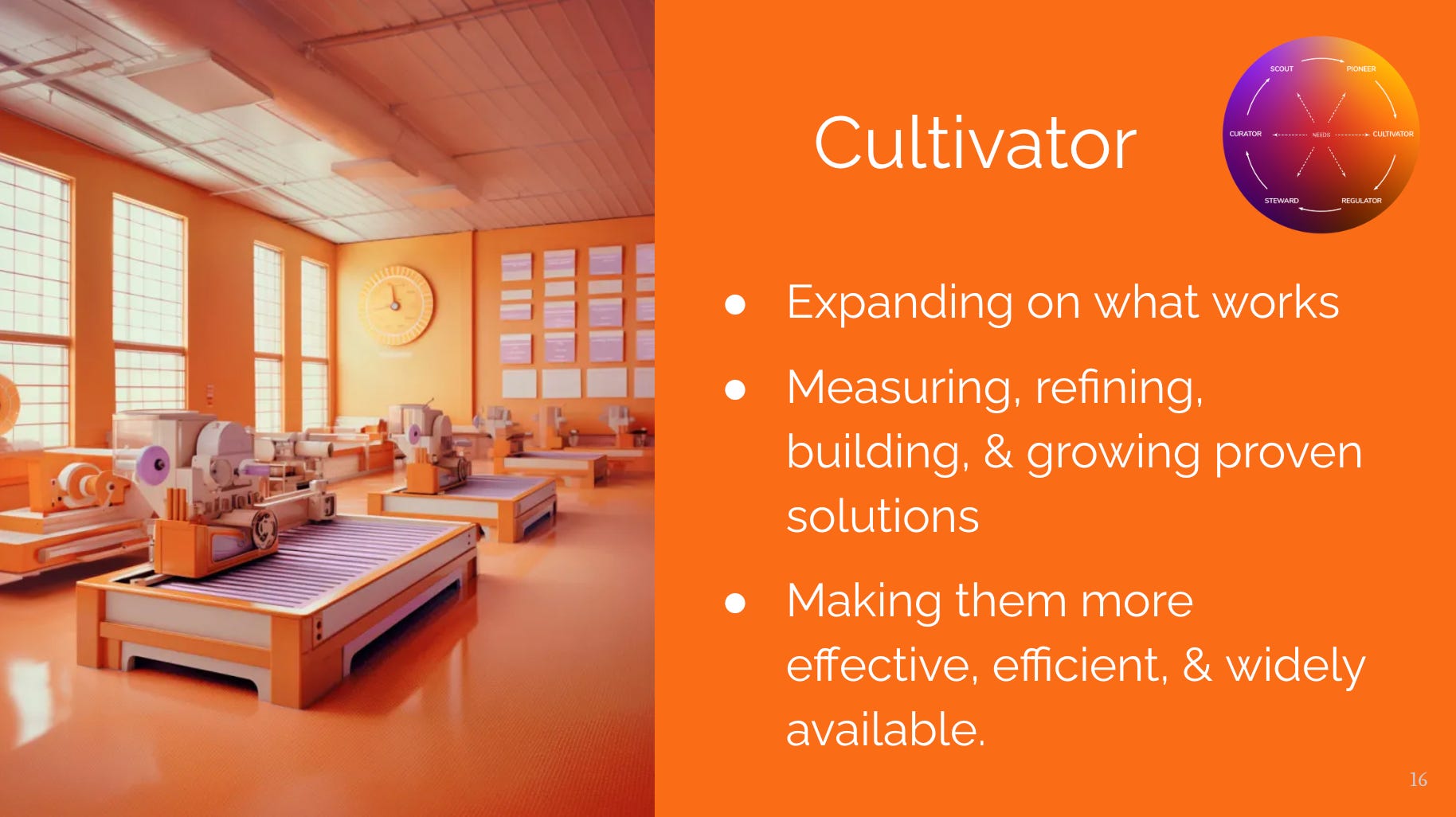
Through the Kairotic Flow lens, I see most of the word-usage-sloppiness arising from conflating these two Archetypes, with “curating” often used to talk about activities that (at least in Kairotic Flow terms) are actually “cultivating”.
The conflation is understandable, I think…
#1. Our civilisation privileges Cultivator
I’d guess that the main driver of this pattern of conflating Cultivation activities with Curation activities is that most of our current civilisation’s social and economic systems effectively perma-privilege the highly visible, growthful, joyful Cultivator Archetype. Consider how pervasive ideas around capitalism, GDP, neoliberalism, neoclassical economics, ownership, consumerism, the Protestant work ethic and so on are in our society, and how deeply they are embedded in our everyday lives, belief systems, narratives, and institutions.
It can be extremely difficult to see beyond this cultural water we’re all swimming in, let alone clearly think beyond it. The concept of ‘ownership’, for example, was an enormously sticky one for me personally. Even after realising how insanely delusional it is for our species to claim ‘ownership’ of a world we didn’t create, and to have that psychotic assumption underpinning all our legal and economic systems, it still took me another 18 months to properly Curate (disentangle) ‘ownership’ out of my mental ‘code’! I can think clearly past it now, but getting here took a lot of hard work. So-called “virtue signalling”, counterproductive though it may be, is much, much easier than genuine Curation in conditions that privilege Cultivator.
#2. Curator and Cultivator are opposing Archetypes
Further, Curator and Cultivator are opposing Archetypes in the Kairotic Flow cycle, and so to some extent always activate together. Opposing Archetypes depend on each other to keep their respective activities balanced — a crucial tension to ensure the right degrees of trade-offs, sacrifice, and opportunity costs. Curator needs some of Cultivator’s energetic activation in order to do its work well and not ‘kill off’ thriving parts of the entity as it hones the entity back to integrity. However, in conditions that already privilege Cultivator (and are necessarily toxic to Curator), that little bit of Cultivator activation can create a lot of confusion, e.g. the aforementioned “virtue signalling”.
#3. Curator and Cultivator both have a ‘liquid’ nature
Adding to that confusion, I suspect, is the fact that Curator and Cultivator both have a liquid energetic nature, making them highly interactive with each other, as well as comparatively difficult to distinguish from one another. (Steward~Pioneer and Regulator~Scout hold solid~gas tensions, making it easier for us to quickly sense which Archetype’s energy takes precedence at their kairos time of activation.)
The difference between Curator and Cultivator is discernible, though, and here’s a good rule of thumb to use:
Cultivator extracts resources and uses them to grow an entity (e.g. process or product or company or person or plant)
Curator stops resources being used on what is no longer fit for purpose, and so shrinks the entity (e.g. process stopped, product line stopped, company downsized or shut down, person or plant releases dead cells or dies, idea fully discarded)
Cultivator increases; Curator decreases. This is a tension of ebb and flow, like the tides. To discern the direction of movement, we just need to take some time to pay a bit more attention (ha!) to what’s going on.
Curator is presently activated at the level of our global civilisation, because it must be at this kairos time, but it is really struggling to do what it must do in the conditions it is trying to operate in — conditions which, as mentioned above, are consistently privileging the Cultivator Archetype’s perspective of maximum growth.
That struggle is creating a lot of unnecessary conflict and suffering for all of us, and especially for those who are really trying to Curate well. The blowback and backlash that whistleblowers and those questioning the status quo must deal with in our present culture is no joke. This conflict and suffering would not occur to anything like the same extent if the conditions we had in place were a better match for Curator’s activities… if we were not insisting on clinging to zombies or blithely assuming that Cultivator’s perspective is the only/best one for all circumstances.
In the Introduction to Kairotic Flow video (post embedded below), I talk about the difficulties of trying to effectively Curate items in a storage room under Cultivator conditions, where 3 additional items are brought into the room for every item curated.
It’s a small example, of course, just intended to highlight, with a touch of humour, the essential difficulty Curator is facing. Trouble is, at a global civilisation level, we’re not just curating a little storage room, and the situation is deadly serious. If we don’t get this right, and soon, we’re in for a very nasty collapse. We can’t kick the can down the road indefinitely, and skipping Curator is not an option. Ever. No matter what we would “prefer” or how nice and virtuous-sounding the narratives we create for ourselves and each other… these “choices” we seem to think we have are completely illusory. The real bottom line — not just the number at the bottom of some financial spreadsheet — is that every form and structure changes, decays and dies over time. We either quit feeding zombies, or risk losing the lot.
You see, Curator’s job is to stop whatever is generating the problem, as precisely as it can to minimise waste (and, ideally, not kill off what still works in the process). This clean-up Curator does clears the way for something new to be possible, and frees up the resources required to discover those possibilities and manifest them. When it’s the kairos time for Curator — as it is right now (cos we have a problem, right?) — we cannot know what those new possibilities might be. All we know is that what is needed is not presently on the menu of available options.
This is really important to understand, and bears repeating.
When what is needed is not on the menu of available options, the act of selecting any option from that menu is only an illusion of agency.
The option that is really needed, which provides real agency to meet needs not currently met, is not possible until Curator clears the way for it to emerge from the unknown.
Another important thing to understand is that Curator (like every Archetype) can only do what is possible for it to do in the conditions it is operating within. The less time, care, and discerning attention Curator is able to bring to its task of separating baby from bathwater and wheat from chaff, the greater and more wasteful the death and destruction will be.
The conditions Curator needs are briefly discussed in the introductory video, and will be covered in more depth in the book I’m presently writing. (For coaching or consulting, please visit my website.)
Many of the ideologies and memes of this Cultivator-friendly water we’re swimming in sound great on the surface. Cultivator is youthful and energetic and positive and exciting and super, super attractive. The Cultivator Archetype’s rapid growth phase feels amazing! So it’s not at all surprising that our species, wanting more of that, unwisely “set” conditions that privilege Cultivator. And having done that, it’s also not surprising that we’ve — even more unwisely — doubled down on those conditions with (doomed zombie-washing) initiatives such as “multiple capitals”, SDGs, DEI, “green growth” and ESGs.
I fully acknowledge that my adjectives and judgments there might sound a bit harsh or intolerant, but —I’ll say it again — putting more and more useless options (that still don’t meet underlying needs) on the menu only reinforces the illusion of agency, whilst making real choice and agency harder and harder to achieve. Cultivator’s conditions are perfect for Cultivator activities, and also utterly toxic to the activities of not only Curator, but of all the other Archetypes. The motivations and intentions are understandable and totally forgivable, but that doesn’t make the actions we’ve taken based on those intentions any less stupid. The road to hell is paved with good intentions.
Insofar as we buy into the delusional idea that Cultivator conditions are the only (or always the best) conditions possible, they’re also holding us hostage. Like a monkey stuck in a monkey trap, we’re convinced that somehow we can have that attractive fruit in the trap and be free.
It seems to me that the most compelling fruit our Cultivator-driven civilisation conditions us to cling to is ‘knowledge’… or to be a little more accurate, what we think we know. Most of us don’t have a problem with learning more, per se, but we do tend to expect that we can always build on top of what we already ‘know’. We might need to refine it a bit, we think, but we assume that we’re already on the right track, and can just progress further and further along it.
And so we hold on to institutions and systems and ideologies that are already zombies, years past their use-by date, not accepting that until we completely detach from them and the chains with which they bind us, nothing new is possible.
Having one’s (fruit) cake and eating it too really isn’t a thing.
As I’m writing this, I keep thinking about Ender’s Game. The protagonist, Ender, plays a (computer) mind game, in which a Giant sets down two potions and tells Ender’s character (a mouse) that he has to guess which one to drink.
The Giant explains that one potion is poison, and the other potion will send Ender to Fairyland. Like all the other players of the mind game, Ender remains stuck at this point for a long time, because no matter which potion he chooses, he guesses wrong and his character dies. Eventually, angered by the double-bind he’s trapped in, Ender makes his mouse knock over both of the potions and attack the Giant instead. Ender’s approach to the Giant’s Drink problem is violent, in line with a key theme Orson Scott Card was exploring in “Ender’s Game”, but it is also necessary in an important way that we would do well to acknowledge and understand. Ender gets past the Giant’s Drink in the mind game only by breaking the rules and refusing the proffered (and illusory) “choice” altogether.
This is the kind of move Curator has to be able to make. To do its job and clear space for the possibility of new, real agency and life, Curator must question the menu (or the game) itself. The degree to which this ‘death’ of the old unfolds in a violent and/or destructive way depends on the (actual and perceived) conditions at hand. As a general rule, the greater the constraints and barriers in the way, the more force (and hence, shrapnel) is required to get past them.
On that note, I must ask that those arguing for more rules (like legislation — Regulator) or more stringent enforcement of rules (like policing - Steward) pause and think very carefully about the nature of the conditions those rules require people to contend with. When life perceives itself as placed in a double-bind, the outcome is unlikely to be pretty.
This is, surely, one of the most important Curation questions of today. Our time and attention are all we really have, the source of all of our agentic power and lived experience.
In thinking about that crucial question, I’d suggest that we might also ask ourselves some other related Curator questions, Ender-style, because the rules of this game we’re all playing stink to high heaven.
Why do we allow advertising to pollute our information ecology at all, when we already have all the technology required to create excellent directories and to search for what we need only when we need it?
Why do we allow tech companies to effectively ‘own’ and ‘mine’ our data at all?
Why do we attribute all of the surplus (or harvest) generated by the entire cycle of life activities — all of the Kairotic Flow Archetypes — only to those Archetypes doing the harvesting?
On that last question, and to wrap up, here is an excerpt I published from the Kairotic Flow book-in-progress:
Comments
Nothing yet. Say the first thing.
Sign in to join the conversation.