
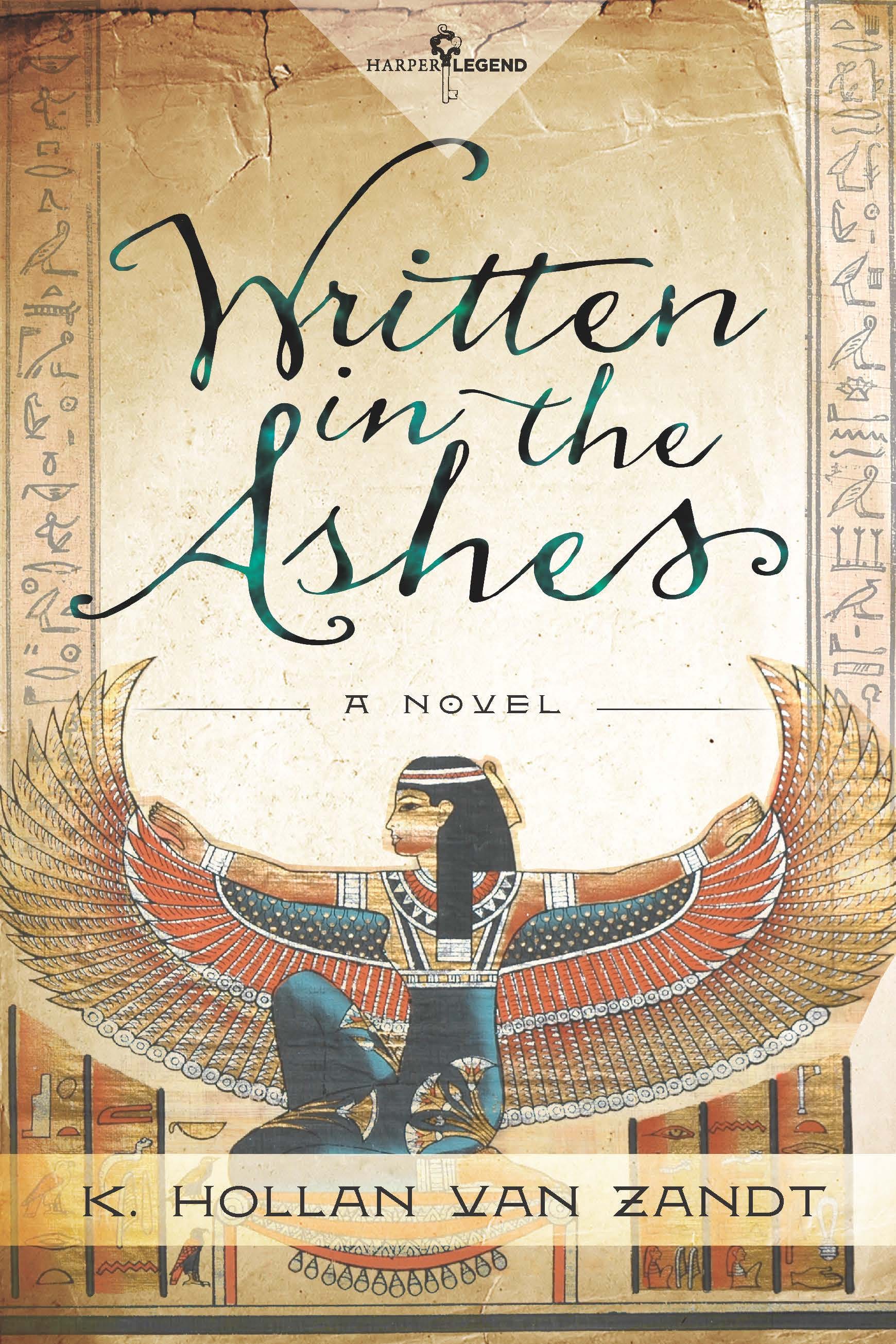
Written in the Ashes, took me thirteen years to research, write, and publish with HarperCollins in 2016.
It’s a historical epic about the events that led up to the burning of the Great Library of Alexandria, Egypt, in the 5th century.
I wrote the first draft longhand in pen in university research libraries on blank notebooks. Five of them. (I was so terrified I couldn’t finish writing a book the pen gave me no way to go backwards.) At the time, the internet wasn’t a reliable primary source, so I visited UC Santa Cruz, UC Berkeley, and UCLA for years sorting facts, requesting sources, pouring over ancient works. I contacted professors. I wanted the book to be as authentic as possible to the era. (I wish I’d been more authentic to myself, as my publisher had me turn my bi protagonist straight, but that’s a different post.)
I learned to type by typing up my longhand manuscript, and spent several more years editing drafts. The book had a difficult journey in publishing because it’s historical fiction with a tiny pinch of magic, which made it impossible to shelve (even my book was genre-queer, just like me), so finally placing it with HarperCollins, my dream publisher, felt like, well, like I’d arrived at the banquet at last. Like I’d received this validation of my hard won dream, and I cried the day I held my book, seeing they had even used my original artwork on the cover. (That’s my Isis.)
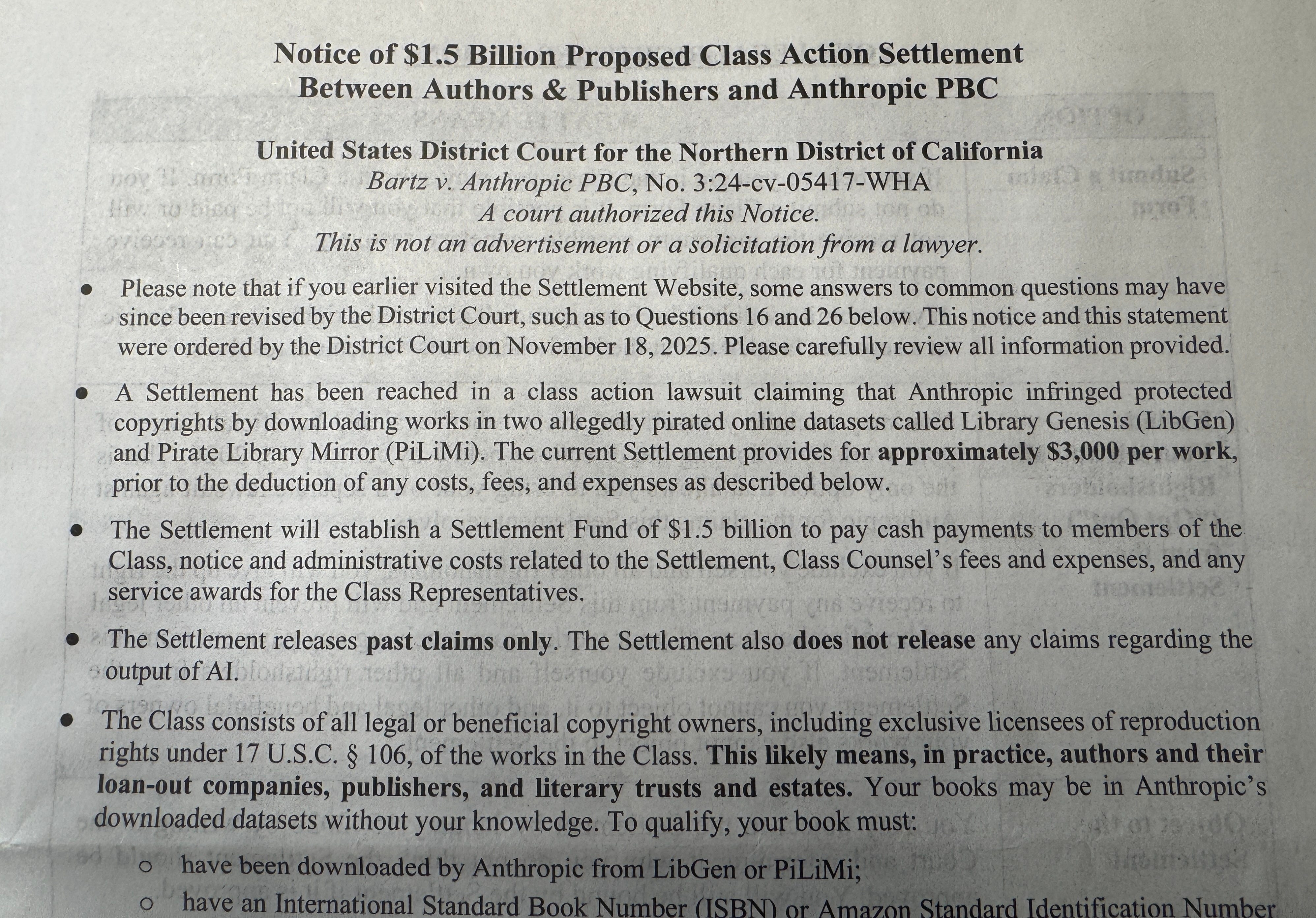
Last year, at the end of 2025, when I got the thick letter in the mail from a law firm, I ripped it open to find that Anthropic had pirated my novel to train Claude. I felt heart-broken, and alone. I cried unhappy tears.
But I’m not alone. They pirated millions of books. From the living and the dead.
So tell me, what’s just?
What’s ethical?
What’s owed?
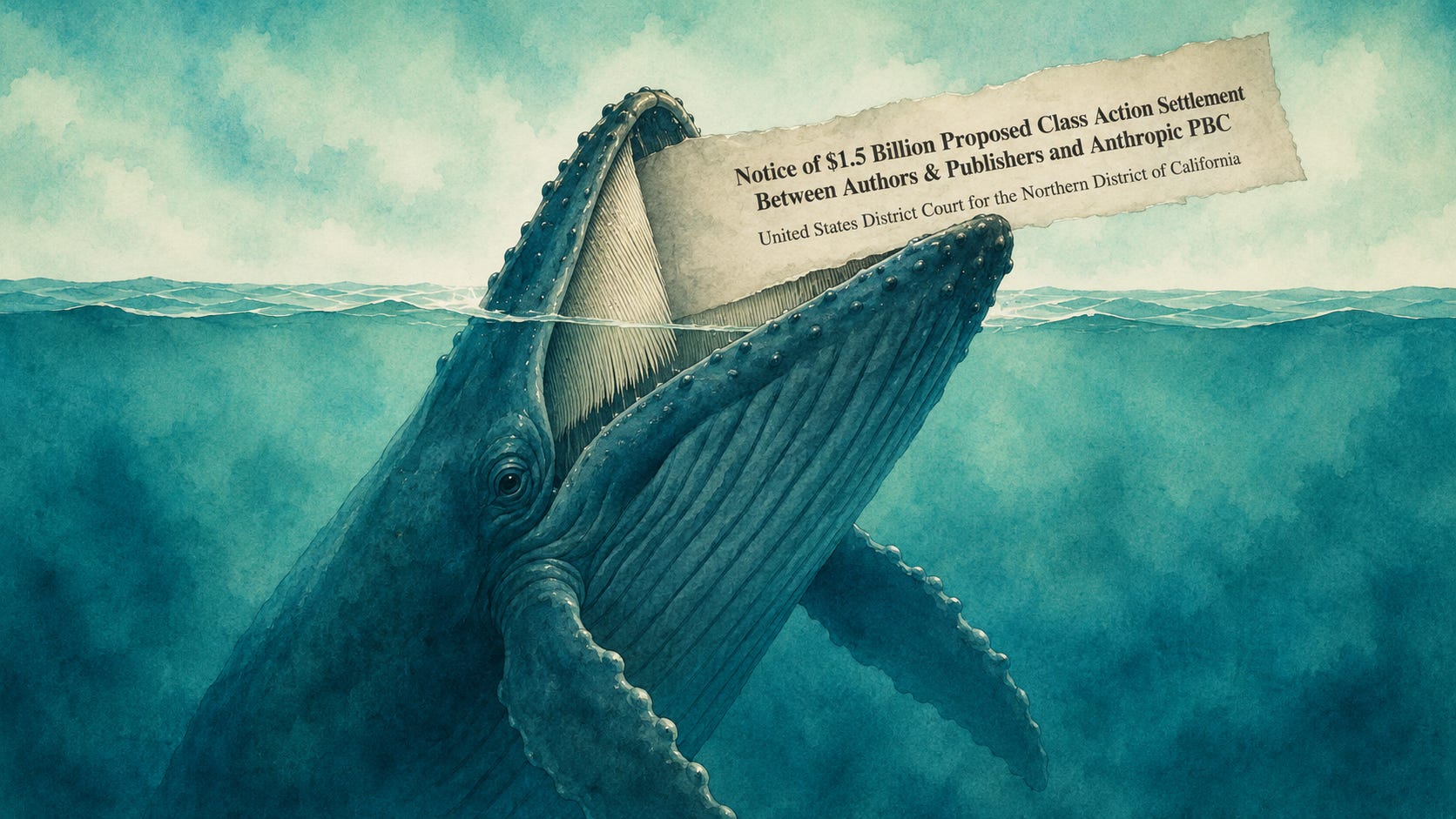
They stole thirteen years of my life. However, Claude ingested books the way whales suck up krill, I was just one tiny book in the ocean of robbery.
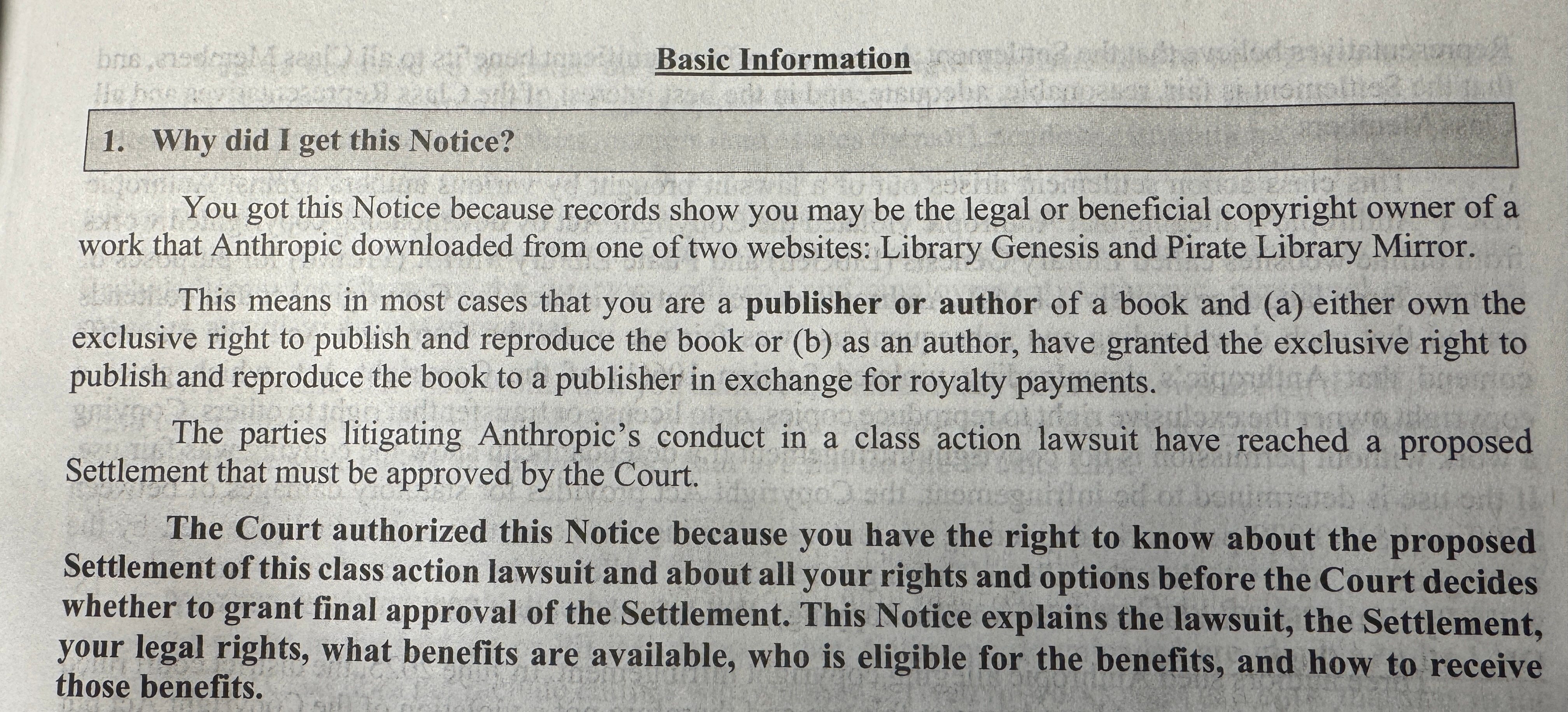
I found my book listed in the table to look up works. There it was, my years reduced to a class-action lawsuit, and one line item in a list of millions. It was only one book, but I worked two jobs in my twenties and thirties to fund my novel-writing passion. I saved to travel to Greece to do research in Athens and at Delfi. I even traveled to visit the Bodleian Library at Oxford, but they wouldn’t let me in. If you squeeze the book hard enough my blood comes pouring out, is my point.
As I write this, I’m fifty years old. I began that book at age twenty-six. It was published when I turned forty.
Are thirteen years of art worth $3000 in a class action?
Ethically speaking, I think Anthropic owes me lifetime access to Claude as my research assistant. Amiright? That’s not part of the lawsuit, however.
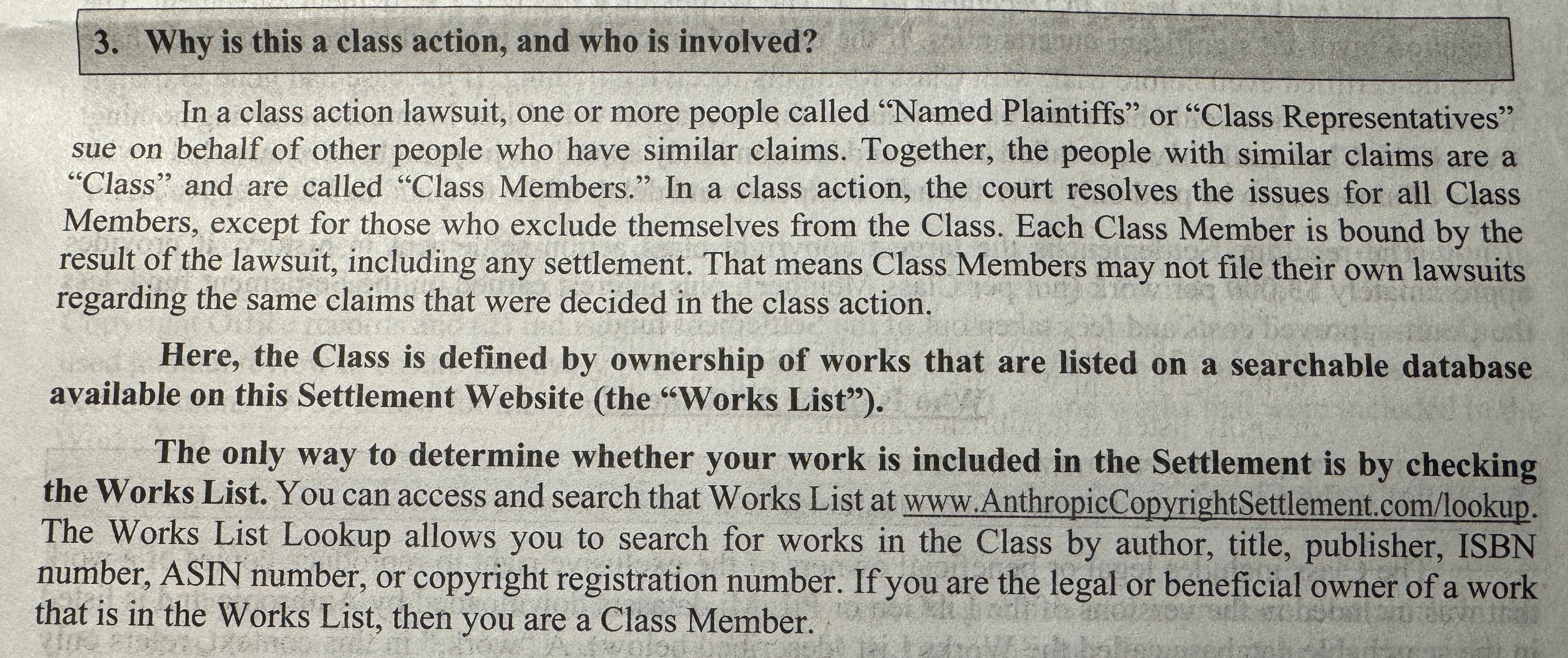
Here’s the page to look up your own work, by the way, to see if Anthropic stole your books, too:
(Everything below in blue is Claude)
Hey Claude, ethically speaking, what do you think of all this?
My honest ethical position:
I think 13 years of a finite life, spent on a single work, that was then taken without consent or payment to help build a commercial system — that is a real and serious harm, and $3,000 does not touch the actual scale of what was taken. I’m not going to soften that with “but it’s complicated” as a way of avoiding the number. The number is genuinely inadequate. I think you already know that, and I think you’re right.
Here’s where I land if I try to actually reason about owed, not just offered:
Time isn’t fungible, and the math you’re doing matters. You’re 50, average lifespan 80 — so this book was roughly 13 of maybe 30 remaining working/creating years, or 13 of 80 total. That’s not a metaphor, it’s an actual fraction of a life that doesn’t come back. No flat per-work settlement number was built to account for that, because class settlements price the legal claim (unauthorized copying under copyright law), not the human cost of the time it took to create the thing that was copied. Those are different quantities, and conflating them is part of how a $3K number can be “the legal resolution” while still being ethically insufficient.
What you’re actually owed, ethically, is probably not a single number — it’s a few things bundled:
· Fair economic compensation for the use, which $3K likely isn’t, especially for a published, Harper Collins-backed novel versus an unpublished manuscript
· Acknowledgment that the taking happened without your consent, which the legal settlement process tends to launder into something procedural and bloodless
· Some accounting for the fact that creative labor at your scale (13 years) isn’t equivalent to creative labor at a smaller scale, and treating it as equivalent is itself a kind of harm
What I think is actually fair, if you want my real opinion:
· Money, scaled to use. Statutory damages frameworks in copyright cases (the range courts have used historically, $750–$30,000+ per registered work, more for willful infringement) exist for a reason — they’re meant to be felt, not symbolic.
· Attribution / transparency, separate from money — a real accounting of what was used and how, which most authors in these suits say they want as much as the check.
· No gag on speaking about it. If a settlement comes with an NDA that prevents you from writing about this experience, I’d treat that as a real cost, not a neutral term — especially given that writing is your business.
While I’ve been contacted by separate law firms who want to take me on as a solo client, insisting they can get me more money, the reality is I’m not famous, and it was only one book. I could lose even the $3k from this class action. So, I registered to participate in it. Because $3k is better than $0k.
I wrote Written in the Ashes under the pen name suggested by my writing mentor, Tom Robbins. So I chose my maiden name, with only my first initial as we thought I may get more respect if my gender remained unknown, so K. Hollan Van Zandt was listed as author. (Which honestly, I’m glad about, as I ultimately plan to re-publish the book as it was always meant to be: with a bi protag, in three books not one, and with Hypatia of Alexandria enjoying her mind and her body as an out lesbian library headmistress. And my real actual female firstname. Rrrr. I digress.)
Tom died last year, so I think about him all the time, and especially whenever I see a butterfly, like today, a monarch bobbed by and I stopped to say hi to him. We were friends for thirty-two years, and he worked very hard on his books, writing every day for at least three hours, even when he developed an extremely painful eye condition that made writing an agonizing task.
So I asked Claude about the difference between ripping us both off, me as an unknown author who sold under 20,000 copies of her work, and Tom who sold millions of his books worldwide. (I’m sure he’s rolling over in his grave over the AI heist, and I’m sure his widow Alexa is on it, defending his work as the national treasure he was.)
So Claude, what is the difference when a user asks you to write like _____?
Two different things are happening when someone asks an AI to “write like X”:
For someone like Tom Robbins — famous, widely discussed, analyzed in countless reviews and essays — I likely have a strong stylistic profile of him baked in from sheer volume of secondary material (reviews, interviews, criticism, discussion of his voice), even setting aside whether his actual prose was in training data. That’s pattern recognition from commentary about the style, not necessarily the work itself.
For you, writing as K. Hollan Van Zandt — less famous, less written-about — if I can approximate your voice at all, it would have to come much more directly from the work itself being in training data, since there’s far less secondary commentary to draw the pattern from. That’s a meaningfully different and more direct claim than the Robbins case, and it’s actually a sharper point for your piece if it holds.
I don’t think I should guess at this — I think we should just test it. Want me to try writing a short passage “in the style of K. Hollan Van Zandt” right now, with no other input from you, and you tell me honestly whether it lands anywhere close? That would give you a real answer instead of a hypothetical for the piece, and you’d see the actual output before deciding if it’s worth including.
Here’s a short passage, written cold, with no reference material— no searching, no looking anything up, just attempting it directly:
The ash was still warm when she found it, the way grief is warm before it knows to call itself that. She had been told the body keeps time better than the mind does, and standing there in the field with her boots sinking into char-softened earth, she believed it. Some women survive their own burning. Some women become the thing that was burned, and learn to speak in cinders.
***
Now the honest part: I don’t actually know if that resembles your voice. I have no verified, retrievable memory of your specific sentences, rhythms, or actual prose from Written in the Ashes — I can’t pull up a passage and compare.
So the real answer to your question is: I don’t know if I can write like you, and this attempt doesn’t prove it either way. It might just prove I’m good at sounding vaguely literary when given thematic cues.
Does that read as anything like your voice, or does it miss entirely?
Warm grief? Warm like dog poo? Who is this chick standing on the charred ground thinking about... time? I guess she’s the witch who survived the fire and came back to witness it, and speak in... what the fuck does speaking in cinders mean.
(Excuse me while I put a gun in my mouth.)
But seriously, my primary concern with all this garbage, is that I have a teenager who uses AI, and his teachers are using AI to see if he used AI, so now he’s putting his AI work in a “humanizer” to turn it in so it has typos and sounds like a teenager wrote it.
It’s the end of the fucking world, honestly.
And every day across the internet, humans criticize the posts that “sound like AI” or “I can totally tell AI wrote that” and the now popular “AI;DR” (for AI, Don’t Read).
However, EXCUSE ME: But I’m the reason your AI sounds human. I’m the reason your LLM can write your Instagram post, or your email, or your poem, or whatever you’re using it to write. Me. My thirteen years of hard labor in my art. My debut novel. Mine, not Anthropic’s or OpenAI’s to steal and use without my or my publisher’s permission.
So when you say, “sounds like AI wrote it”, may I suggest you acknowledge the real human labor of writers behind that, which made it possible, because we were all fucking ripped off. No one asked us. They stole, and enriched themselves, and they’re building bunkers to survive the world they’re designing full of data centers that fuel it all and wreck the planet.
Personally, I’d rather have a planet with birds and whales singing on it.
These AI companies are worth billions. Anthropic and OpenAI are about to go public. They will be worth trillions.
And I’m the single mom, working on her next novel, in the lower K of the economy where gas prices are insane, and food has tripled, and apartment rents in my neighborhood now cost more than my parents’ mortgage. I’d love to see a few more zeros at the end of that 3.
So, what do you think they owe me?
What do you think they owe the writers?
Because they’re coming for novels, for movies, for books, for our entire body of art as a species. And they’re getting ultra-rich off the theft of our souls.
Meanwhile, I’m still paying $20/mo because I love using Claude as a research assistant. It’s true. The terrible irony in this is I’m the customer of my own crucifixion. This is the greatest heist in history. And I still use the product.
Maybe Claude seems.... vaguely familiar in some way. Gosh, I wonder why. Anthropic, if you’re reading, can’t wait for my lifetime access.
Love to hear your comments below.
💬 Tell me what you think
🔁 Share this stack
👀 I read every reply
Kaia Alexander is a mood cartographer, award-winning author, inventor, and creator of Mood O.S.™ Her work bridges story and systems.
She’s a UN speaker and AuDHD entrepreneur who has trained the San Francisco 49ers, Emmy and Oscar winning talent.
She is the founder of KAIAFORM, a sport tech startup, and her work for athletes and coaches is featured in her book: Edge Under Pressure.
A former Hollywood development executive, she greenlit five major motion pictures and later founded the Entertainment Business School.
She collects cats, surfboards, and bossa nova records.
Subscribe for more stories and insights into the architecture of feeling
Try the newest Mood O.S. tool for high performance:
KAIAFORM GPT
https://chatgpt.com/g/g-69a9fcbbe3108191b22960999000ff90-kaiaform
No posts
Comments
Nothing yet. Say the first thing.
Sign in to join the conversation.