
On the 26th of April 2026 at the TCS London Marathon, something insane happened.
On that day, Sebastian Sawe of Kenya crossed the finish line in 1:59:30, followed eleven seconds later by Ethiopia’s Yomif Kejelcha in 1:59:41, becoming the first humans to run a marathon under 2 hours.
The significance of this feat cannot be understated.
Some scientists even called it a physical impossibility in our lifetimes, stating that there would need to be drastic changes in technology and human physiology to sustain the VO2 max required for such a feat.
But on that day, 2 men did it. 2 men did the impossible.
Humanity is changing. It’s happening faster than we would like to admit, but athletics seems to be the best way to showcase this.
This is not the first time that a barrier deemed physically impossible has been broken. In 1954, Roger Bannister broke the 4-minute mile and just 46 days later it was broken again.
It has since been surpassed by 2,000 other people.
The question was never whether the ceiling could move, no, the question is whether you stop climbing before it does.
That is what i call the Non-peaking principle.
Through advancements in technology, we are able to improve our performance drastically in mere decades.
But this is the sunny side of our evolution. What is happening on a much larger scale is de-evolution.

Join the readers who support independent, deep-dive writing
Humans are the only primates who can endurance run.
Our bodies evolved and optimized for persistence hunting… we outlasted prey instead of outrunning them.
Those same bodies are the ones that we have today, and not only did our exterior physiology evolve under these conditions but also our internal regulatory systems and, more prominently, our mental systems.
The biggest problem with today is that technology and society has advanced so fast and given little time for our bodies to adapt to these new hunting grounds.
Most of us now find ourselves in a “recursive loop” driven by short-term gratification, sitting in offices all day, working towards weekly and quarterly reports.
We have built ourselves into cages that reward short-term problem solving over the long-term endurance mentality that we evolved into.
Central to all this is dopamine, which is not a signal of pleasure but a Reward Prediction Error (RPE).
Midbrain dopamine neurons are activated by rewards that are better than predicted (positive RPE), remain at baseline for fully predicted rewards, and are depressed when a reward is worse than predicted (negative RPE).
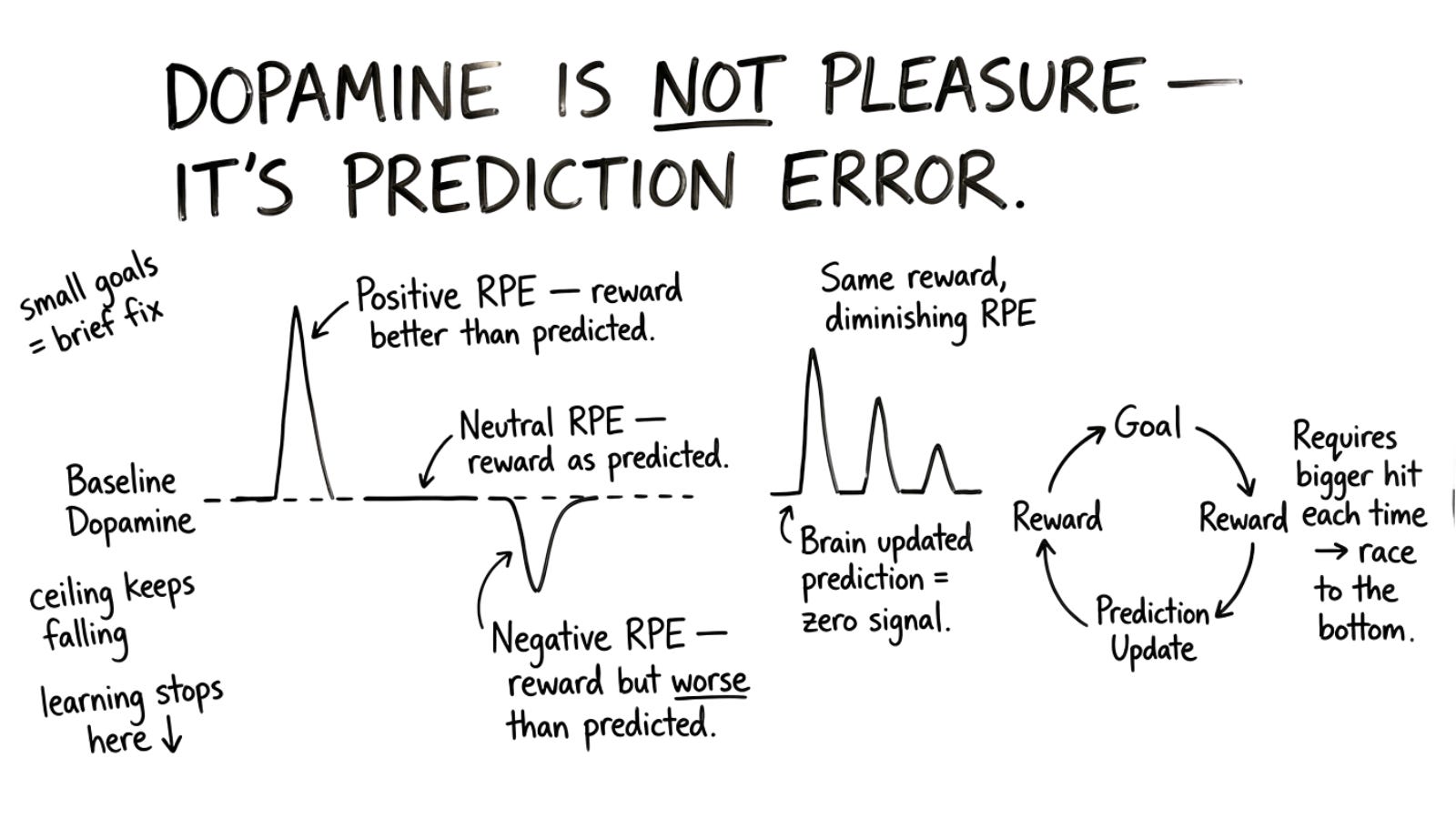
When an individual focuses exclusively on small, achievable goals, the dopamine hit from completion is intense but brief.
More importantly, because the brain updates its predictions based on past success, receiving the same reward again yields a zero RPE.
To get the neurochemical reinforcement again, the person is pushed toward a cycle of “reward-RPE-prediction iteration,” requiring increasingly better rewards to trigger the same signal.
This ends up being a race to the bottom, searching for new small goals to get our fix but then abandoning that endeavor when it’s no longer rewarding.
Failure becomes something to avoid instead of a data source.
Learning stops.
The ceiling for what counts as impressive keeps falling.
And here is where age becomes the accelerant. At around 25-30, the prefrontal cortex reaches full maturation... the seat of long-term planning, impulse regulation, and abstract goal-setting finally comes fully online.
Simultaneously, baseline dopamine levels begin their slow decline. The brain becomes harder to excite and easier to bore.
For most people this is where the plateau solidifies into permanence and their fate is sealed.
The antidote is not discipline or some off-the-shelf peptides.
It's the size of the target
Imagine two medical school graduates. One has a dream of opening a small practice in his local area back home and helping them out, noble and achievable.
The other dreams of building a national chain of hospitals, harder and much more unattainable.
Both of them have a problem in front of them: actualizing their dreams. The way they go about it will be completely different.
One will focus on localized workflows and stability, and the other is forced by the magnitude of the goal to develop systems of scale, delegation, and rapid capital deployment from the first day.
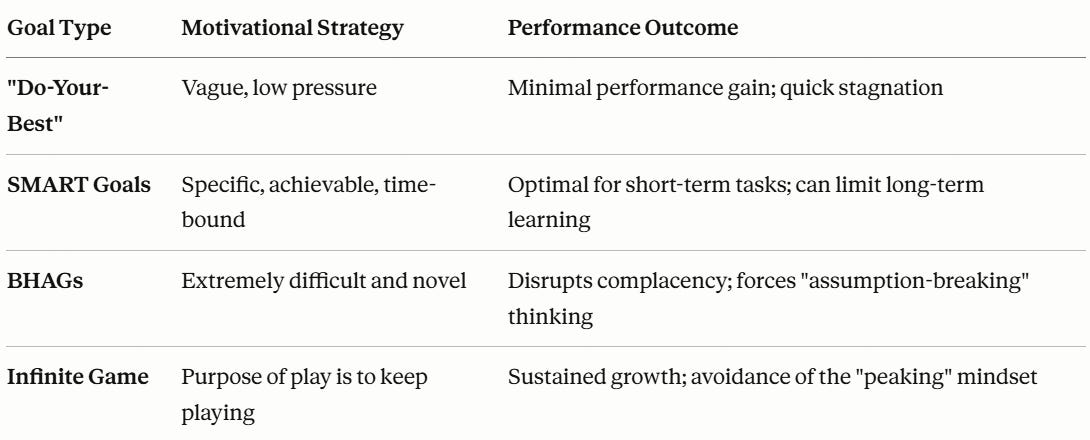
Big Hairy Audacious Goals (BHAGs) act as governmental devices for the self.
They collapse the available options down to the most optimal path because less efficient strategies simply cannot support the weight of the objective.
Sure, a high and specific goal can have negative effects on affect and self-esteem, but it also prevents the complacency associated with “do-your-best” goals.
The ever-evolving person uses high-magnitude goals as a mechanism to force the adoption of superior behavioral tools, and not strictly as a terminal destination.
But that’s not enough. Simply dreaming big won’t help you with anything. It won’t change your current situation overnight or turn you into an ever-evolving person… let alone the fact that the magnitude of goals is subjective and contextual.
For that, you need something more actionable.
One of the most critical sections of the ever-evolving architecture is switching up the baseline environment. Social Baseline Theory basically says that the human brain evolved to assume proximity to social resources.
Everyone will tell you: your network is your net worth, or hang around money and you will become rich, or whatever. But they never explain why. This is why.
To the brain, social relationships are construed as bioenergetic resources, much like oxygen or glucose.
When you are alone, the predicted cost of the environment increases.
Hills literally appear steeper and distances appear further because the brain perceives a lack of shared load and risk distribution.
By putting yourself in an environment where elite performance is the baseline, your brain automatically adjusts its internal calculations for what constitutes “safe” or “mid” effort.
That tall mountain stops looking so steep and becomes infinitely easier to climb.
This is another thing that technology took away from us.
Every passing day it’s becoming harder and harder to meet people in real life, let alone form social bonds that would be necessary to initiate social contagion.
The workaround is you need to become intentional. c
You have to engineer proximity now… the mastermind group, the co-working space, the conference you fly to specifically to be in a room with people who make your current ceiling look like a floor.
This is one of the craziest concepts that I learnt from Nassim Taleb.
The fragile breaks under pressure, the robust resists it, but the antifragile actually improves when exposed to volatility, randomness, and stressors.
Antifragility is the opposite of reaching a plateau. It is the quality of things that benefit from shocks.
Take your muscles, for example. Whenever you exercise, you create micro-tears in them, and they grow back denser every time.
That’s how you should treat yourself and your growth… be extremely safe and defensive in one area (e.g., maintaining a “floor” of financial or physical stability) while simultaneously taking multiple small, aggressive risks in another (e.g., experimental learning, new ventures, “crazy” physical challenges).
This approach limits the downside while keeping the upside open-ended.
Neural plasticity and antifragility are the biological engines of non-peaking.
By intentionally depriving yourself of comfort (through exercise, cold exposure, or intellectual struggle), you trigger the body’s internal self-regulation mechanisms to overshoot and over-prepare for future demands.
The final step of the ever-evolving architecture is changing from finite to infinite play. Finite games are played for the purpose of just winning, but infinite games are played for the purpose of continuing to play.
I wrote about this more HERE.
Essentially, if you become a finite player, you play characters and roles that have preordained outcomes… chemist, teacher, entrepreneur, CEO, etc.
When you reach your predestined outcome, you win, and so you stop playing.
But the game continues still, and leaves you behind.
Infinite players view roles as optional and rules as changeable. Above all else, what they want to do is play the game.
The ever-evolving person is an infinite player who treats every victory as a threat to the play itself, a finite outcome that must be circumvented by changing the rules or expanding the boundaries of the field.
This playfulness is the highest form of resilience you can have, because it allows you to remain open to surprise rather than fearing the unpredictable consequences of a long game.
None of this denies biology. We still age, our reaction time slows, and our recovery takes longer.
The body has a ceiling and eventually, regardless of what you do, it moves downward.
But where that ceiling starts… how high it sits when the decline begins, is built across decades of small decisions.
How much discomfort you sought out.
How large were the goals that forced better tools?
Who you put in your immediate environment.
Whether you played finite rounds or kept the infinite game running.
Sawe crossed the line in 1:59:30. When they asked him how he felt, he said: “I feel good. I’m so happy. It is a day to remember for me.”
He wasn’t talking about being finished.
The scientists who called it impossible were not lying. They were working with the best data they had. But the data changed, and the ceiling was moved.
Don’t peak in high school.
— Kaguura
No posts
Comments
Nothing yet. Say the first thing.
Sign in to join the conversation.