
Children born in 2015 will one day look back and wonder why each of their first 12 months were marked with cardboard “1 month,” “2 months,” “6 months” prop photos (or, later, counted out in slices of pizza). We parents posted these staged photo ops to our Instagram grids—the flimsiest possible way to attempt to capture the hugeness of a new person being here in life with us. (I tried to do a second-a-day video for Scout’s first birthday, but it was more like a second or two every few weeks.) There’s something delusional about posting. My hubs, Noodles, left Instagram years ago, yet I continue to document our family life there.
Kathryn Jezer-Morton’s new book, The Story Of Your Life: How Social Media Shapes the Way We Experience Everything (out TODAY from Viking) looks at why. KJM is ofc a must-read columnist at New York Magazine (kicking myself i didn’t think of “Brooding” as a name) and, as a PhD, comes at things with an academic openness and detachment that you don’t get from takes-based media. In the book, she explains the power of narratives to shape our lives. Kathryn grew up on the Total Loss Farm commune in Vermont:
“Without our stories, we were just a group of random people sharing a filthy living space.” Instead, she was raised “with the belief that I was born among visionaries who had the courage to approach life as an art project.”
Family storytelling has taken many forms — songs, oil paintings, 3D laser-cut crystal portraits — and now, in the age of posting, we tell ourselves stories quite publicly in order to live signal things, make sense of our shonky paths, brag, make money. To chart the vibe of it, KJM talks to regular people the country across, flying in and using mom networks to get time with people, asking them frank questions about what they post and why, and building a picture of what stories work on social, and which don’t: ambivalence or “flat stories.”
From the book: “I am a big fan of the flat story. I think I seek it out in art and among my friends. I love people who are understated or who don’t toot their own horns, and I love people who have been knocked around a bit by life but remain stalwart in their own ways.”
It’s also an energy KJM brings: she’s a terrifically funny writer, and smart as hell about getting past obvious answers without ever seeing herself as an Important Voice (tho I think she is). She was gracious enough to answer some of my qs about the book — questions like “should I be worried that Japhs is filming Lego unboxing videos for no one?* — and where storytelling is going now we’ve basically reached Dead Internet.
Today, KAFKA’S is blessed indeed with a KJM chat. Buy the book (and also come see us both August 28 at Northshire Bookstore in Manchester, Vermont, on the book tour), and enjoy the below!
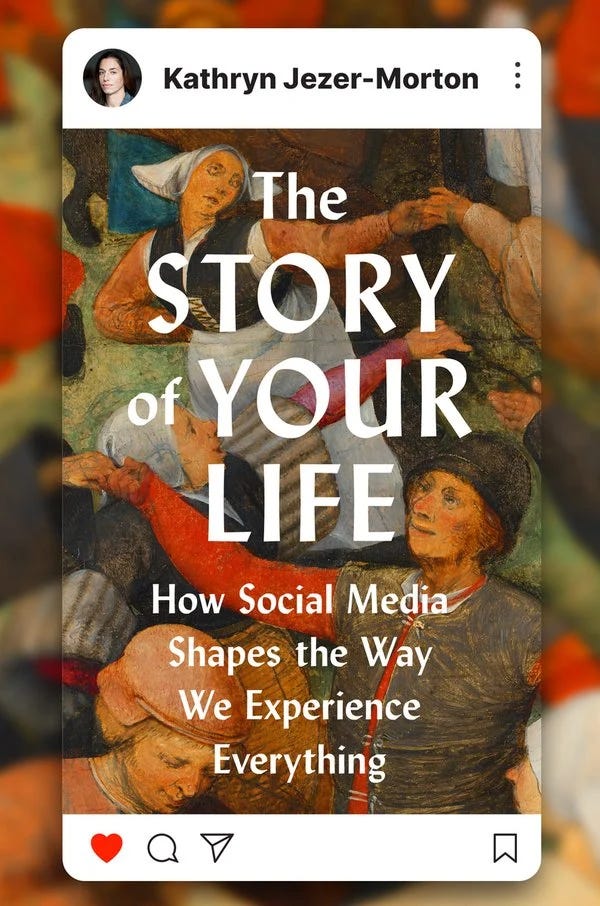
KAFKA’S BABY: You give content creators (and normal people who post) a lot of credit for being intelligent about how and why they’re doing it. I think it’s easy to dismiss as thoughtless trash, but what would you emphasize as important for audiences to understand about where this work is coming from when viewing content? Are we all smarter about this than we’re willing to admit? (thinking of the “accidentally used persona #2 with group #3, my work friends” comic setups)
Kathryn Jezer-Morton: I think that when you’re doing something as much as we’ve done social media, you just naturally become an expert in both creating and consuming it. One of my favorite things while writing this book was asking strangers to tell me about something that bothers them about the way people in their community post. I found that people LOVE to talk about this and EVERYONE has a grievance. Like, taking out their phones to show me. Really got people going. Every “civilian” I spoke to — non-influencer — was extremely self-aware about their posts, and had impressive critical capacities when it came to other peoples’ posts. I just think we don’t talk about this stuff with each other. We’re not like, “hey, wanna like, talk about what message you’re trying to send with your posts about your kids?” Like, it would be rude and insane to ask a friend that. It would be cruel, even! But everyone has something going on in the background, some little thing they’re working on or working out.
As content gets shorter, and attention spans shrink, the kind of story we can tell about ourselves has to shift, yes?
Yeah it’s funny, some people have been like, “but what about how now you can make really long Reels? Longform content!” Yeah, no non-influencers is making five minute Reels. It’s all about shorter and shorter, for the average person. I mean, what I really think is that bots are going to crowd us all off social media anyway, and it’s just going to be AI influencers posting and engaging with bots. I think our storytelling medium is going to change in the next decade. People are going to keep wanting a way to share photos and clips and make memes and whatnot. We love doing this!! I don’t think our attention spans are ever going to shrink to the point where we can’t enjoy a little carousel of pics, you know? I believe in us and our desire to be nosey about each other, and to show off.
As a kid, I was really aware of and down on what I saw as “precocious behavior” from other kids. You note that some kids seem to have learned to exaggerate their reactions for the YT eye. Can I ask how you view this with a (perhaps) more sympathetic parental lens? (i.e., in your own children)
I am not sympathetic to this, haha. I am totally critical of it and it gives me the ick, which is terrible, because these are children and they are fundamentally blameless. I see this all the time. My own kids have heard me talk about this enough that I think they self-censor the YouTuber style of behaving around me. But I bet they do it around their friends!!!!!
One really fascinating thread is the idea that we’ve evolved to begin to want to tell stories to please the algo. Think most people are also familiar with putting public content expressly to reach an audience of one person: what is the power of creating with an audience in mind/did you have an ideal reader in mind writing this?
There is something so powerful about communicating to a specific person. I think it’s so human and such a real impulse at work when people are posting. I mean, just on a personal level, I basically don’t write anything that I don’t eventually try to publish, no journal, no diary — so what does that say about me? No audience, no urge to do anything at all!!! I think it’s the same with social media. The idea of an audience compels us and spring us into creative activity. As far as my ideal audience for this book, I think the person I had in mind was maybe along the lines of the people I interviewed: Not people who think of themselves as media-savvy but who are in fact in possession of a lot of knowledge that they’re not totally aware of. Ideally someone who doesn’t know me personally, too. I would love it if someone who I have never met bought the book. :)
Obsessed with your interest in “flat narratives”!! Tangent, but any comment on our interest recently on circular stories like On the Calculation of Volume, Emily Lebarge’s Dog Days (another Groundhog Day-esque one), even Yesteryear? (ETA: I’d also include Gwendoline Riley’s ouevre (which I love))?
Well I do think that novels are the medium where the flat story has always thrived and always will. Think about how The Age of Innocence ends, or The Remains of the Day! Frigging To The Lighthouse? These are some of my all-time faves, and they all end on this note of like, Damn. Well, OK. Shit. Life goes on I guess. The flat story is WHERE true life EXISTS. It’s where so much of the actual meat of life is located. I am obsessed with it too.
Do you SEE? She’s so great, and I’ve barely scratched the surface of her whole thesis. For the record, some of my favorite Brooding columns are:
The one about the power of family curses
The one about engineering core memories for your kids

apparently a Troy artist (couldn’t find name) made a bunch of baby heads and hid them around town for people to “collect.”
Spoiler: No one wanted those baby heads. These are being used as paper weights at the local framing shop.
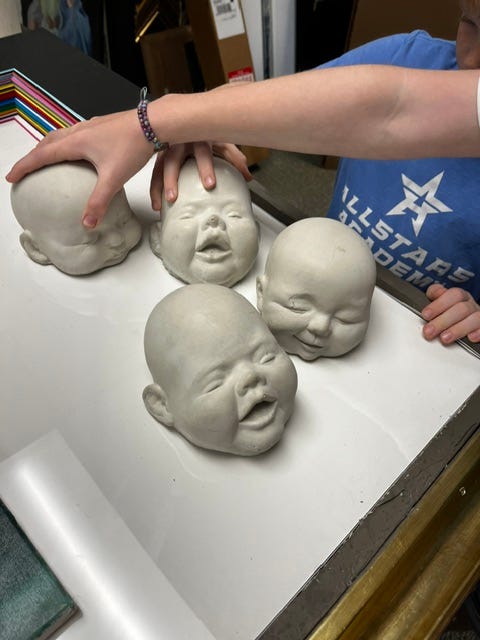
Go to Boston, and there are some giant baby heads.

Things I Bought While I Was Insane
Hermione Hoby on Gwendoline Riley:
In short, the pain and burning (Esther’s “so romantic and furious all the bloody time”) do, eventually, subside—and in time are replaced by the more muted, mellow emotional currents of middle age. There is melancholy here, but also humor, fellowship, peaceableness.
Interlude about the Odyssey:
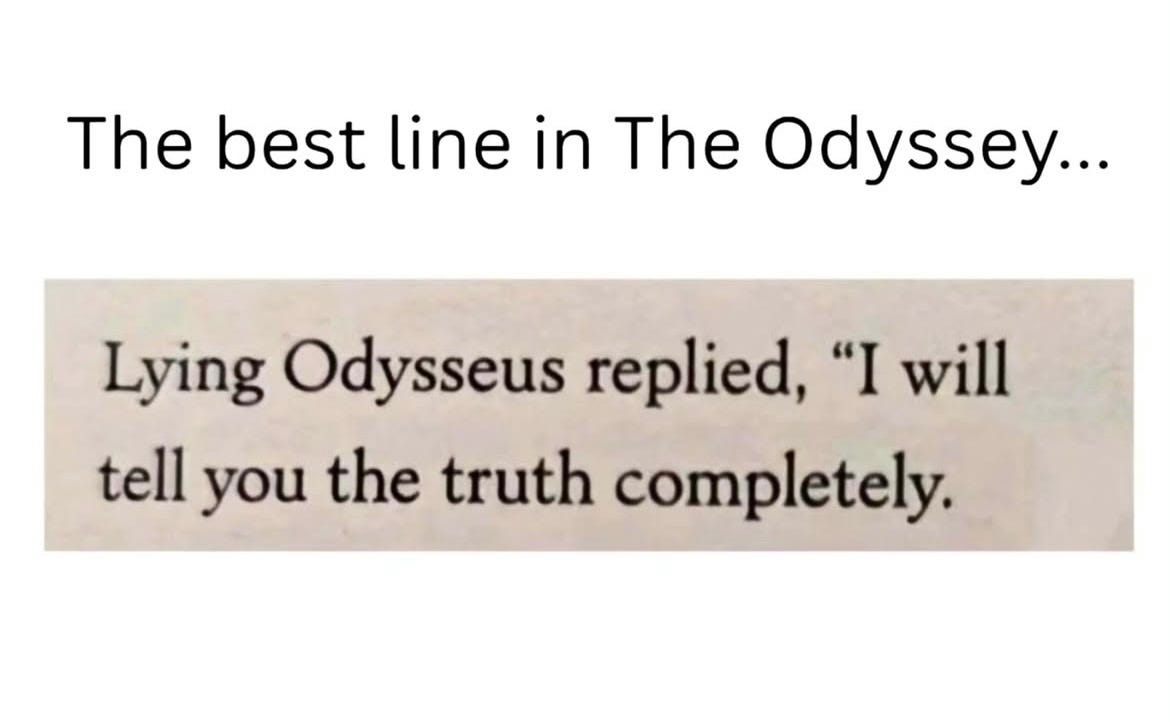
So, I really enjoyed The Odyssey (I loved RPatz and obviously Samantha Morton), even tho the line about the sheep (“wait! —they come in flocks”) was a proper laugh, but there is something about Christopher Nolan that gets my goat, and it’s that I think he’s just too heavy handed with the big existential stuff. This is why I hated Interstellar — the time lost and the longing nearly broke me in half on the couch, just excruciating, but I got the sense Nolan thought he was using the paintbrush gingerly. Same thing for Odysseus coming home to his dog (for about 1 second of screentime).
Christopher Nolan, screaming while tied to a mast: IT’S BEEN TWENTY YEARS!
Virginia Woolf, meanwhile:

Back to social media, the hell was this whole moment about?
Comments
Nothing yet. Say the first thing.
Sign in to join the conversation.