
I grew up in a close-knit extended family that shared resources according to who needed what. As a kid, that’s just how life worked. Everyone went to Costco together, and if Auntie A was having a hard financial month, Aunties B-C picked up bits and pieces of her shopping. No questions, no reimbursement. And a few months later, when B or C was having a hard day, A would take their kids out for a day or two so she could catch her breath.
On a smaller scale, my house had a spot or two where, if you needed to buy something, you could always find some cash. Anyone could grab what they needed when they needed it. Then, the next time you had a little extra, you just put what you could into that spot so that it would be there for the next person. Money was the means and, as such, took a back seat to the end goal.
I’m not saying this to brag about my family’s privilege—although I fully recognize that it’s there. I say this as an attempt to illustrate my initial encounters with doughnut-shaped social circles. Or, maybe it makes more sense to say that this was my initial interaction with systems where the relationship was far more important than resources.
Now, privilege makes this much easier to see. Resources become the end-all, be-all in a world where scarcity reigns. I think it’s possible that scarcity is also a tool to create a world in which resource accumulation is percieved as disproportionately powerful. After all, having a massive number of resources at your disposal is not nearly as impressive when every community has the resources they need to achieve their goals. After all, what is the point of a surplus of resources when no one needs to use them? And in such a world, what happens to those who have relied on the power given to them by their surplus of resources? I think it’s possible that those powerful people might be invested in maintaining scarcity for the communities they currently lord over. A surplus of resources is only impressive in a society where resources are scarce.
“A surplus of resources is only impressive in a society where resources are scarce.”
When I went to get my undergraduate degree, I suddenly discovered a world where money split friendships apart. Watching from the outside, it always seemed a little silly to me. Surely the two feuding college students would eventually discover that the emotional and social support they gave each other was far more important than a few bucks here or there. And yet, they didn’t. Because, to them, survival meant having money. Cash created freedom, and only once they had their financial independence could they worry about their emotional and social wellbeing.
For a long time, I couldn’t put any of this into words. Sure, I recognized that part of the equation was that resources were scarce and therefore worth fighting over, but the larger part of my experience suggested that the same people who were fighting over resources would not find them to be so scarce if they merely pooled their resources together. In essence, they were fighting over resources when sharing them would have solved the problem.
As such, I viewed people as…weird. Of course, faced with a situation where I had a relative surplus of resources, I pooled them with my community. I offered access to those resources alongside my friendship. College friends came to stay over at my family home for weekends and holidays, and it worked (9 out of 10 times). They thought I was just as weird as they were and, in hindsight, a few of them cultivated their friendship with me because of my resources rather than because they wanted me as a friend, but it mostly worked out. I achieved my goals of building emotionally fulfilling friendships, and they achieved their twin goals of having emotionally fulfilling friendships while having to worry less about resource scarcity.
Then I started sitting down to analyze social structures through the lens of literature.
In previous essays, I’ve talked about pyramidal social structures as ones where power flows from the masses at the bottom to a few wealthy, powerful individuals at the top. Most of the world’s governmental and social structures fit into that category. Someone has to be in charge, the person in charge needs disproportionate power (in this case, power is synonymous with resources—although it probably shouldn’t be, and wouldn’t be in a circular society) in order the implement their authority, and the goal of life is to climb closer to that power nexus and therefore gain the ability to either control others beneath you in the pyramid or shield yourself from control by those upstream.
That picture of a pyramid is normal for most people. And honestly, it’s normal for me in many contexts. But in the context of family and friends, it seems utterly wrong. I expect a relationship-centered social structure to be far more circular.
Now, what do I mean by circular (or, more specifically, toroidal)? I’m primarily using the shape as a contrast to the hierarchical geometry of pyramidal social structures and triangular interactions. In this case, I’m talking about a society where resources are held in common, and power has been detached from resources (money, food, oil) and is instead a sum of personal relationships, developed personality traits, and contribution to the common pool. This contribution might take the form of childcare, it might take the form of art, or it might take the more classically economically viable form of technology development, administration, service, or manufacturing.
I’ve had glimpses of this society, where each person’s responsibility is to spend resources in order the strengthen the emotional, physical, and social wellbeing of others. Where resources are never to be hoarded. Where the goal is to strengthen relationships and to be happy rather than to hoard resources to increase power within the system.
Now, this shape is only possible in an environment where an outside oppressor has not made defense a person’s first priority. It’s only possible in a situation where resources are not scarce, so long as everyone works together. It’s a community approach, not an individual approach.
In other words, it’s a sketchy sort of doughnut.
In the last two issues, we’ve spent a lot of time with pyramids. A pyramid has a vertical axis — power is siphoned from the individual people at the bottom, and the equal and opposite reaction of that upward pulling force holds people down in their designated place. The social norm of drama triangle interactions keeps people from banding together and reinforces the scarcity mindset. Every interaction inside a pyramid is oriented toward that vertical axis, whether you’re climbing, being pushed down, or eating the waste that cascades onto the masses from those at the top as they wield power, re-shape the globe, and studiously ignore the protests coming from below them. Even the acts of resistance — the saviors, the protests, the revolutions — tend to play out inside the same geometry. The pyramid gets a new person at the top. The shape remains.
A pyramid’s invisibility is one of its biggest advantages, because if the majority of people can spot the geometry, they can begin to ask what other geometries might look like. However, that requires a creative mind. After all, can a fish truly imagine what it’s like to live on land? Surely, they can talk about the problems in the ocean’s ecology. They can point a fin at rising ocean temperatures (if they’re a very, very smart fish), and they might even be able to point the other fin to the human-based source of the problem. But how could even this genius fish imagine the taste of the air or the burn of exhausted leg muscles as they finish their first marathon?
In the same way, it is much easier to describe what’s wrong with our current social structures than it is to describe what a better shape might look like—let alone the step-by-step plan of how to get from a pyramidal social system to a circular social system.
Let’s go back to the fish example, shall we?
We’re all like fish swimming in the ocean. We might struggle to see the water, but even once we’ve identified this salty fluid, the air outside is so alien that we can’t imagine growing legs and walking on land. We’ve all grown up inside layers upon layers of pyramidal structures; however, even once we identify the social structures that surround us, it’s near-impossible to look around, identify an alternative, and set about growing legs.
To extend the simile into metaphor, I think what we need are frogs.
Frogs spend the first part of their life in the water, but they eventually grow legs and begin to live on land. Fish might be able to watch those frogs adventure out onto land and ask themselves what it might be like to live that sort of life. They may not be able to identify the water and the land while they are worried about swimming around in the ocean, but let a frog catch their attention, and they might watch long enough to discover that something else exists.
This begs the question of what frogs might look like in real life. I think that, to some extent, my childhood provided a tadpole-like existence. Not a perfect one, given that I still spend most of my time swimming inside a pyramidal ocean (ok, the metaphor’s starting to break down…), but it did provide some level of exposure.
Recently, I’ve been watching Instagram videos by @browngirlpride, where she talks about the different value systems indigenous cultures use, how they implement an economy, and how they interact(ed—in most cases) with other indigenous cultures. She, I think, and the cultures she talks about, make really good frogs.
To move this out of metaphor and into a more grounded reality, let’s examine the shape of a doughnut to see what we might be able to extrapolate for ourselves.

The shape I’m describing isn’t a flat circle — a circle still has a center, and centers accumulate power as naturally as pyramids do. The shape is a torus. A doughnut, if you prefer your geometry delicious.
A torus has no top and no bottom. It has no central person of power that everything else orbits around. What it has instead is a current fueled by relationships that moves through and around the whole structure, carrying everything with it. Nobody is above anyone else. Nobody is below. And when someone is knocked off their feet, the current (the relationships they have with their immediate community) holds them until they find their footing again.
“A torus has no top and no bottom. It has no central person of power that everything else orbits around. What it has instead is a flow — a current that moves through and around the whole structure, carrying everything with it. Nobody is above anyone else. Nobody is below. And when someone is knocked off their feet, the current (the relationships they have with their immediate community) holds them until they find their footing again.”
Rather than centralizing resources, we’re decentralizing them. (Yeah, kind of trite… But true! Does that make it better?)
Let’s have a quick picture, shall we?
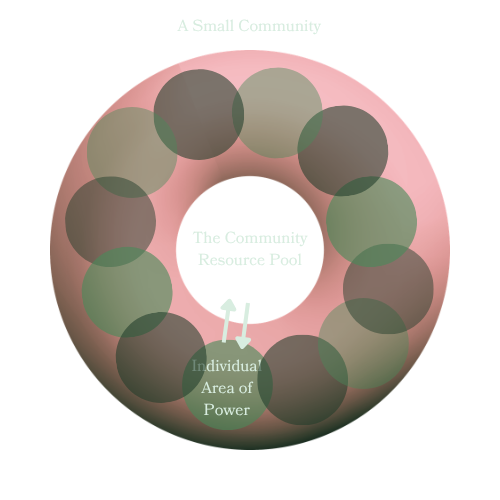
In this shape, each individual person supports and is supported by the people around them (see the overlaps?). Each person takes the resources they need for their own good and the good of their community. They contribute what they don’t need to the community’s resource pool. Thus, resources become a shared bond rather than a competitive wedge used to turn erstwhile college buddies into erstwhile college enemies.
I’m not going to pretend this model is perfect. It’s not going to work on everything—and I’d love to hear where you think the system is going to fail. I have never experienced an indigenous gift economy, I’ve never helped run a time bank or even been part of the whistle groups trying to protect their communities from “immigration enforcement” raids. If you’ve done any of these things, please please please drop a comment. If you’ve done something similar, I’d love to hear about it.
But here’s today’s takeaway. Ready?
When power is defined positionally and supported by a surplus of resources that have been siphoned from those on the bottom of a hierarchy, we will never disengage from the toxic social dynamics that support our society. Sexism, misogyny, homophobia, nationalism, racism, and all the other -isms operate on the same logic our society was built on. In order to fix the -isms, we must first fix the foundational logic that allows it to be normalized.
“Sexism, misogyny, homophobia, nationalism, racism, and all the other -isms operate on the same logic our society was built on. In order to fix the -isms, we must first fix the foundational logic that allows it to be normalized.”
We start by changing the logic we use in our stories. Then, we change our interpersonal relationships. Eventually, the normal logic will become more circular, and then we will have grown our baby land legs. This all starts with conversation.
Do you have a story about circular logic working in your personal life or in your community? Chime in!
In about three weeks, we’ll dissect Brownie Removal Service to see how stories can teach circular logic. If you haven’t joined my mailing list to receive your free copy of the story, now’s the time!
No posts
Comments
Nothing yet. Say the first thing.
Sign in to join the conversation.