
In Animal Crossing you can catch little fish all day long, but if you want to catch a big one, a great white shark, an oarfish, a hammerhead, you have to go load up on some apples to get your energy up to pull the big guy out of the water. That was how I prepared to write this piece because I feel really strongly about this topic, and I have a lot to say; I had a big breakfast for my big brain thoughts. Fingers crossed I make some points.
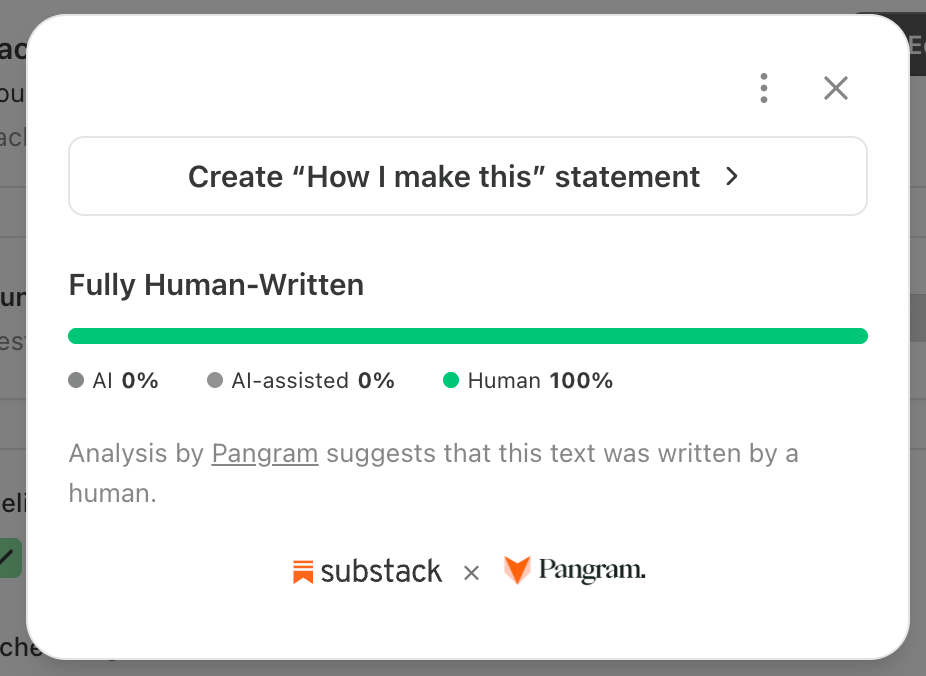
Earlier this week, the current Mercury Retrograde in Cancer and Pluto in Aquarius quincunx took exactly no prisoners when the Substack team announced they’d be integrating an AI tool called Pangram to detect AI writing in posts over 100 characters published on the platform from July 21st, forward. I only knew this because my feed was suddenly flooded with outrage. As usual, I’m going to really piss some people off with my stance on this: I think this is not just the right choice, but the only choice the platform has right now.
I admit I’m a tad naive. I am literally always surprised when a framework isn’t built on a foundation of meritocracy. When I do find out, usually far too late, that a subtext exists where a group of people has figured out how to game a system, I’m bewildered anew every time. However, almost 40 years of being me has sharpened my justice awareness, and I do lean in favor of measures that make things more fair in almost any case. I incorrectly assume everyone feels this way. That’s admittedly my bias here.
The way my brain has changed since the introduction of AI-generated content is frustrating. I’ve gone from being discerning about the content I enjoy to feeling unsafe enjoying anything for fear that what I’m watching is engineered garbage churned out to bloat the internet with more opportunities to drive ad revenue. Now we are being asked to discern between AI that is slop and AI that someone used to write coherently. I consider that an upgrade, and something we as intelligent humans are fully capable of. In the age of everything being enshittified, we should be grateful that a platform is prioritizing any efforts to discern the human element in a piece of creative output so that the reader doesn’t feel that disgusting betrayal of being duped by phony garbage.
The main angle I see criticism taking in commentary against this decision is to interrogate the nature of the tool itself rather than examining whether this is a logical or ethical move. One accusation is that using AI to detect AI is dystopian. That’s true, I’ll concede to that. But I also think that we’ve been crying out for regulation on AI slop for ages, and this, whether we like it or not, is what that looks like, or at least this is what the beginning of that looks like. People police people (imperfectly for sure), AI thinks faster than people; logic implies that AI would be needed to police AI. I’m not sure what people who want more transparency online expect in terms of an alternative to this approach.
Then there’s the angle that this is ableist. I saw a claim that people who have certain disabilities around neurodivergence and nonlinear thinking have found agency through AI writing and that this infringes on their rights. First of all, we have written without robots for thousands of years. Coherently. Effectively. The bar for entry has always been learning how to write coherently and effectively. I feel strongly, as someone who is PLENTY ADHD, that if you want to be a writer, it’s your job to overcome your challenges, and your duty to write from your point of view. If you have trouble writing because of your challenges, that is your point of view, and it’s extremely important to share it. To use an AI tool to write like everyone else flattens your unique experience. The world needs to read what you think, not what you think worded pleasingly through a virtual assistant.
The matter of infringing on rights is also hilarious to me. One time, I had a lot of people balking in my comments on a YouTube community post that they hated that I was using the “instant premiere” function (it plays the video from start to finish at a scheduled time with a live chat) to publish my videos because if they didn’t show up on time, they couldn’t participate in the chat in real time. They found it annoying that they couldn’t have it both ways — access to the chat, and being able to show up on their own schedule. One glorious commenter stuck with me so hard that day when she said, “Let’s not overstate the inconvenience we’re suffering by having access to free content.” Louder for the people in the back. Your right to use AI without criticism or detection can exist elsewhere. Substack is merely placing guardrails for their platform. Not the whole internet.
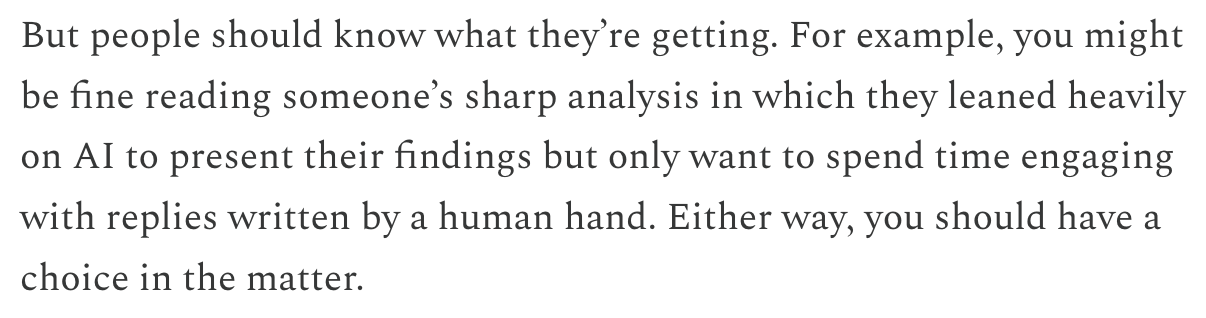
Substack also isn’t telling you you can’t use AI. “Another purity test,” wrote one commenter in response to the announcement. Yes. And we need it. They’re not telling you you’ll be kicked off the platform or taken down for copyright infringement the way YouTube would. They’re simply saying that people deserve to know, and I agree. That’s where the quiet part needs to be said out loud: Everyone criticizing this move is telling on themselves. Why would you be mad if you didn’t mind someone knowing you’re using AI to write your posts? Do you feel that it delegitimizes your writing? If you’re insisting that it doesn’t, then why are you so mad if people know?
Face it, you didn’t want people to know you were using AI to write. I don’t use AI to write. I did use something called Speechify to read my 31,000-word book back to me while I followed along because I have reading comprehension issues from having ADHD. I’m bad at self-editing because I scan text too quickly and figure “it’s probably fine.” I’m looking for things that sound weird to my ear, overused words, anything that disrupts the flow for the reader. I don’t think AI on its face is useless, and I don’t mind people knowing that I use that tool. It helps many disabled people digest information more coherently, and it helped me self publish a book (which is still rife with typos unfortunately; proof I didn’t use generative AI to write or edit it. Joke’s on me, I guess). Speechify is also integrated into the Substack platform.
Another accusation is that this tool is doing a bad job. It’s flagging non-native English speakers and making accusations where no AI was used. I’m willing to endure the growing pains of regulation in this case in the interest of the greater good, especially when the other option is not to do anything. Often people oddly expect a perfect solution to an incredibly complex problem like this one, when the reality is that Substack’s action is really just saying, “we don’t know what the answer is yet, but we know it’s not this.” Not this is often the best option we have. It’s how we stick our ice pick in the side of the mountain and begin a tough climb. Criticizing a solution to a virtually impossible problem for being imperfect at the jump is to misunderstand the way real change happens.
I think it’s easy in this case to see Substack as an internet overlord akin to Meta or TikTok, forcing you to live within their rules so they can squeeze the most money out of you possible. In my mind this isn’t that. I’m not one to ascribe benevolence to an enterprise level company, ever, but in this case I don’t think it has anything to do with the goodness of their hearts because it doesn’t need to. For once, the greater good aligns with the best interest of the company: I’d be willing to bet there were people leaving the platform citing the infiltration of AI content as their reason. After all, the legitimacy of a platform like Substack thrives on the credibility of its contributors. If journalists and influential writers with otherwise very large platforms decide to leave Substack because they see it being enshittified by AI slop, Substack suffers greatly. I can absolutely see that as an extremely logical and well-intentioned reason to employ an integration like this one.
That’s the point I think a lot of people are missing. This is an effort to eliminate AI slop from Substack. There are a growing number of completely fake accounts eroding the authenticity of the platform because grifters do what grifters do; they try to game a new platform for short-term gain. They have no interest in the long-term vibe of the community. Substack chose to take action. In the process, your shortcuts (yes, I said it; AI writing is cheating) getting exposed publicly is completely reasonable. You can’t have it both ways. You can’t have regulation for AI slop and no regulation for other types of generative AI. If you think that’s unfair, then you clearly feel guilty about taking said shortcuts. It’s one or the other. Is it in your values to use a tool like AI proudly in making your writing process faster and easier? If so, stand up and say so. If not, admit that you’re criticizing this move because you’re ashamed that you’re taking shortcuts. Plain and simple.
And I’m going to say something even more divisive here: Generative AI is plagiarism. Period. In any higher learning institution, many trespasses are forgiven at their first infraction, but plagiarism is zero-tolerance. At Dartmouth, where my ex-husband went to college, I heard tell of young men getting harshly reprimanded for bringing a chainsaw to school and cutting up all their dorm furniture for firewood or flooding their fraternity floor to play ice hockey à la Real Genius, but if someone got caught plagiarizing, they were expelled, no questions asked. Same went for Alex’s boarding school. Found weed in your room? Slap on the wrist. Plagiarism was instant expulsion.
The fact that as soon as a tool was introduced to make this easier to skirt in real life, so many people set their credibility aside in the name of efficiency and the potential for online clout is incredibly human, and incredibly embarrassing. If you are having a tool like Claude or ChatGPT generate text based on the prompts of what you want to get across, that you then edit and call your own, you might not know the sources to cite, but you are plagiarizing the entire internet.
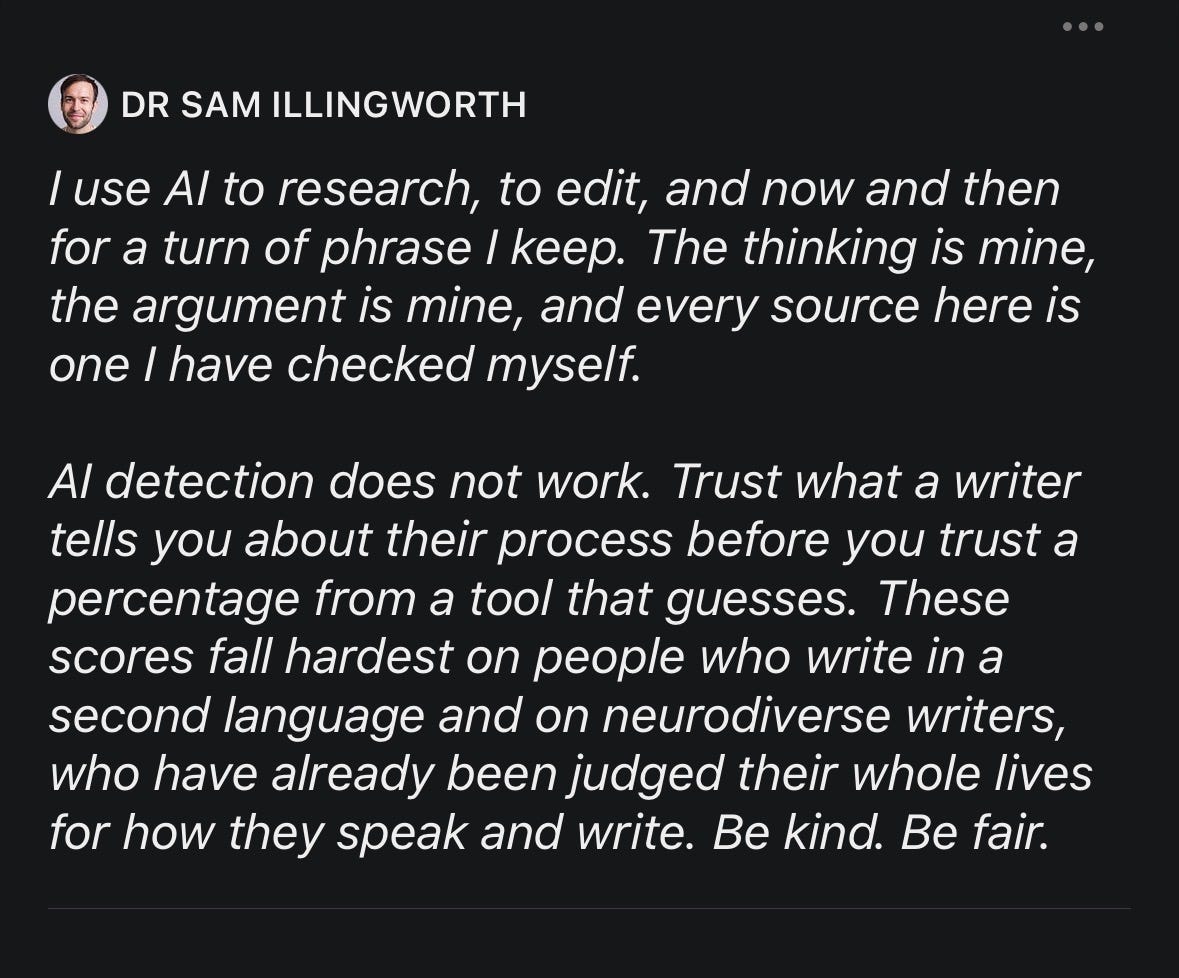
Take this example I ran across. Research, edit, a turn of phrase you keep? If that’s all it is, you shouldn’t have anything to worry about. In the Substack team’s piece, they are careful to articulate that it can only detect plagiarized text, not whether someone used AI to research, edit, or even to keep a turn of phrase. If the detection works properly (which it might not for a while, but I’m willing to endure the awkwardness of the process for the greater good), this man’s content shouldn’t be flagged. Perhaps, though sir, if you’re tempted to use more than a turn of phrase here or there to the point that your content would get flagged, you shouldn’t be draining bodies of water in underprivileged areas to mine your “argument.” Again, you’re telling on yourself.
TikTok notoriously lowered the bar for entry to zero to become a content creator with an audience. I will die on the hill that that was permanently damaging to the collective; some people’s thoughts need to stay inside their heads. TikTok is a prime example of what happens when we let technology’s increasing capabilities be the only measure of morality in our creative output. Even if there is great, thoughtful content there, it’s buried under the loudest voices saying the most unhinged things, rendering the app completely worthless. If the opportunity to exploit a platform is there, someone will take advantage of it, but the point is to live by your own values, not let your values be eroded by whatever cheat codes are available.
As humans we seem not to be able to internalize the greatest lesson, even though it smacks us in the face in every area, on every level, in every generation throughout time: Outcome without the process required to get there will always leave us feeling hollow. Using AI to write your essays on an essay writing platform should feel hollow, and it feels hollow to the reader, too. You are free to express yourself, that’s the promise of the internet. You are not, however, free to gain notoriety on the backs of great thinkers and turn-of-phrasers you didn’t bother to read or consult. You are free to use AI to write your Substack posts. You are not, however, free from being criticized for it. If you think there’s nothing wrong with it, I don’t know why you’re so mad about the tool being introduced in the first place.
I screen recorded the entire process of writing this piece. Time will tell if the AI detection tool thinks this is AI. You can find the screen recording here: I am not a robot.
No posts
Comments
Nothing yet. Say the first thing.
Sign in to join the conversation.