
Martin Scorsese just signed on as an advisor to Black Forest Labs, an AI image generation company. Boots Riley responded with characteristic bluntness, speculating that Martin Scorsese took the deal because they threw his family “a gang of money” and he figures AI will “fall on its face anyway, so he doesn’t give a fuck.”
Maybe. Probably, even. These companies do throw enormous sums at legacy credibility. James Cameron did the same with Stability AI. The pattern is familiar enough to have a name by now.
But the more interesting conversation is the one underneath that transaction -- because we’ve been here before. Many times.
The Painter’s Lament
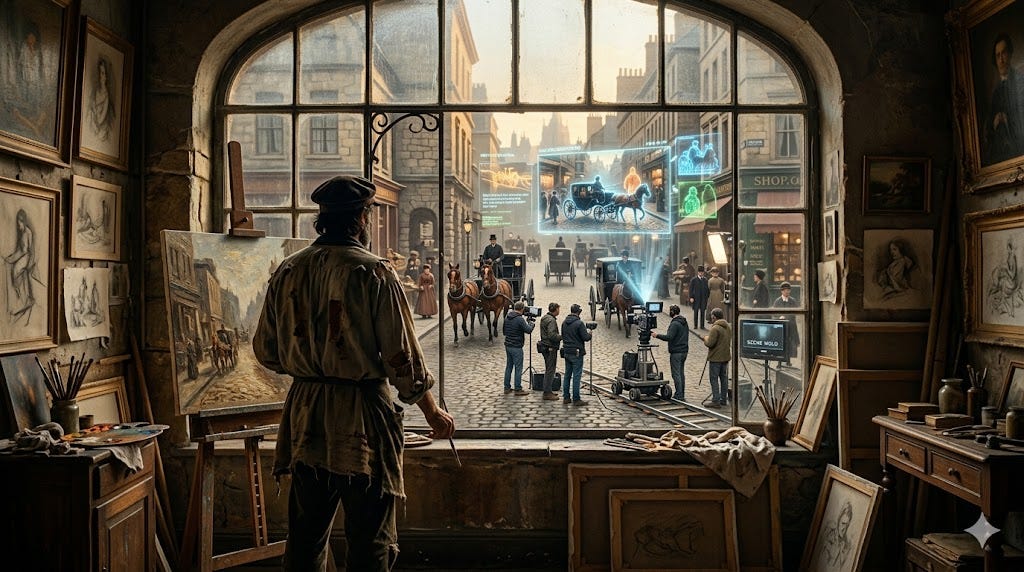
When photography emerged in the 19th century, painters were convinced their profession was finished. Why would anyone commission a portrait when a camera could capture a face with mechanical precision in minutes? The fear was rational, the grief was real, and the outcome was completely unexpected.
Photography didn’t kill painting. It liberated it. Freed from the documentary function -- freed from having to accurately represent the visible world -- painting became something more purely expressive. Impressionism followed. Then Post-Impressionism, Cubism, Abstract Expressionism, everything that came after. The constraint removal forced a creative identity crisis that produced more interesting art, not less.
We’ve watched this same arc play out across every major communications and creative technology since. The telegraph, the telephone, radio, television, desktop publishing, the internet, social media, streaming.
Each wave generates the same sequence: genuine fear from working practitioners, real displacement of specific jobs and workflows, a brutal transition period, and ultimately an expansion of the creative and communicative surface area of human civilization.
That’s not a comfortable thing to say to the illustrator whose storyboarding income just evaporated. But it’s historically accurate.
The Social Media Warning
Here’s where it gets complicated, and where easy historical optimism runs into a wall.
The democratization argument for AI is real. Every one of those technological waves genuinely enabled people who had real things to say but lacked the resources to say them at scale.
Desktop publishing did it for print. ProTools did it for music. Final Cut did it for indie film. AI image and video generation is the next iteration, and some of what comes out will be genuinely remarkable work that couldn’t have existed otherwise.
But we just watched social media play out to completion, and we can see the full arc now. People without voices got one. That part worked. The problem is that the architecture optimized for engagement over quality, and outrage, tribalism, and simple messaging outperforms nuance at scale every single time.
The loudest, angriest, most algorithmically legible voices ate the ecosystem. We got genuine community organizing, but we also got anger, illiberal, democracy killing, autocratic voice weaponizing anything they could get their hands on with no care for reality, truth, or decency. We got citizen journalism, but we also got coordinated disinformation. Both things are true and you don’t get one without the other.
I knew a guy at my old job I retired from in IT after over 20 years who was weaponizing social media with bots, flooding the internet with anything he could think of, mostly lies, to support his side. I tried to explain to him how bad an idea that was, but he just laughed, “My side has to win.” But at any or all costs? America is about more than just you, your side, your party, your grievances. Yet, he continued and with that larger mindset, here we are today.
AI creative tools carry the same bifurcated promise. for good or bad. The barrier to producing volume collapses, so the ratio of signal to noise doesn’t improve -- it probably worsens. The specific failure mode for film and fiction is that AI optimizes on pattern recognition, which means it will industrialize the mediocre middle: competent-looking, emotionally hollow, statistically average storytelling at infinite scale. The genuinely weird, specific, personal work -- the stuff that actually matters -- still requires a human with something to say.
The Real Grievance
Riley’s most defensible position isn’t that AI will destroy cinema.
It’s that the models were built on artists’ work without consent or payment, and now those same tools are being sold back to the creative community while its most prestigious members lend their names to the sales pitch.
That’s a different ethical problem than “technology is changing.” Much like my former friend at my former job, there is the technology, then there is the ethical use of it.
The disruption may be inevitable and ultimately net positive across the long arc, but how you capitalize it and who bears the transition costs is a choice, not a law of nature. Every one of those historical paradigm shifts -- telegraph to internet -- involved real people caught in the gears of transition who didn’t get to benefit from the expansion they helped enable.
The railroad got built. That doesn’t mean it was built ethically, or that the people whose land it crossed were compensated fairly.
Where This Lands
Scorsese said cinema is a young medium and we have to be open to how it can evolve. He’s not wrong about that. Riley said a trillion dollars has been spent on generative AI and it hasn’t saved anyone or changed film yet.
He’s not wrong about that either. Both things can be true.
The technology will reshape filmmaking in ways we can’t fully anticipate, some of it genuinely expanding what’s possible for artists working without vast resources, some of it flooding the zone with industrialized mediocrity. The compensation question for the artists whose work trained these models is unresolved and legitimate. The fear is rational. The historical pattern suggests it’s not terminal.
We’ve been here before. It’s always painful. It’s usually necessary.
The crossing is the hard part, and we’re in it now.
Cheers! Sláinte! Na zdravie!
JZ Murdock is an award-winning author and filmmaker based in Bremerton, Washington. His horror novel Death of Heaven won the NYC Big Book Award in 2024. He publishes fiction and film under Last Good Nerve Press / LgN Productions. He is finishing up his upcoming film companion book for his award-winning Pvt. Ravel’s Bolero documentary.
If this resonated, please consider supporting the work here and elsewhere by JZ Murdock over at Ko-fi.
No posts
Comments
Nothing yet. Say the first thing.
Sign in to join the conversation.