
I’ve been collecting postcards for most of my life. Not the kind you buy for yourself in a gift shop and keep, I’m not a big fan of those. In this research I’ve found many of those, as we used to do that kind of thing. Better we thought, to have some professional shots of things we saw than our own pathetic ones. Seemed reasonable then. Now they are just chaff and useless. I can’t use them due to copyright issues, and they are not personal, so…
I’m talking about the kind someone actually sends you, postmarked, which matters more than people realize, the postmark is half the point in any real philatelic sense, proof of exactly where and when. Ones that arrive in your actual mailbox, written by someone who was somewhere you weren’t, thinking of you enough to find a stamp. My sister has said that in some countries, just finding a post office to mail them from turned into its own small adventure.
On the off chance she might do it, I asked my sister to send me a postcard sometime from a foreign country, back in the mid-1970s, when she first became a flight attendant, and I’ve been collecting them ever since.
She spent her whole career as a flight attendant, crossing the globe for decades, and from time to time a postcard would show up from wherever she’d landed. Sometimes we’d already talked face to face, her home, sitting across from me, and then weeks later a card she’d sent from some layover would finally catch up, arriving late—a message crossing paths with the person who sent it.
That happened once in a way I still think about.
A friend of mine while we were attending Western Washington University took time off school in 1983 to work a season with his girlfriend at McMurdo Station, Antarctica, of all places. He had a cold when I saw him. He said everyone who returned had a cold after spending months of no general public interactions and a vacation from one’s usual public infections.
I asked him what they did in their off time.
He said everyone had a VHS player in their room, and everyone had a copy of John Carpenter’s The Thing (1982). They loved to watch it all the time as it was set in Antarctica, though shot in Northern Alaska, and British Columbia, Canada.
For those who don’t know that film, it’s a fun horror show F/X extravaganza and long one of my favorite films (Carpenter being longtime filmmaking hero of mine), and a film that still holds up today (with Rob Bottin’s brilliant practical effects).
Before he left, I had asked him, only half seriously, if he’d send me a postcard from there. He said sure and he actually did it. Months later, back on campus, I ran into him in Red Square, and he asked if I’d gotten it.
I hadn’t. He looked genuinely confused, like the whole point of the effort had just evaporated. It eventually showed up, weeks after that conversation, the actual physical proof of a promise kept, arriving so far behind schedule that the person who sent it had already come home, already run into me, already half-forgotten he’d done it by then.
That’s most of what a postcard collection really is, I think. Not the images on the front. The proof that got delayed. Evidence that someone, somewhere, thought of you before the wondering was even over.
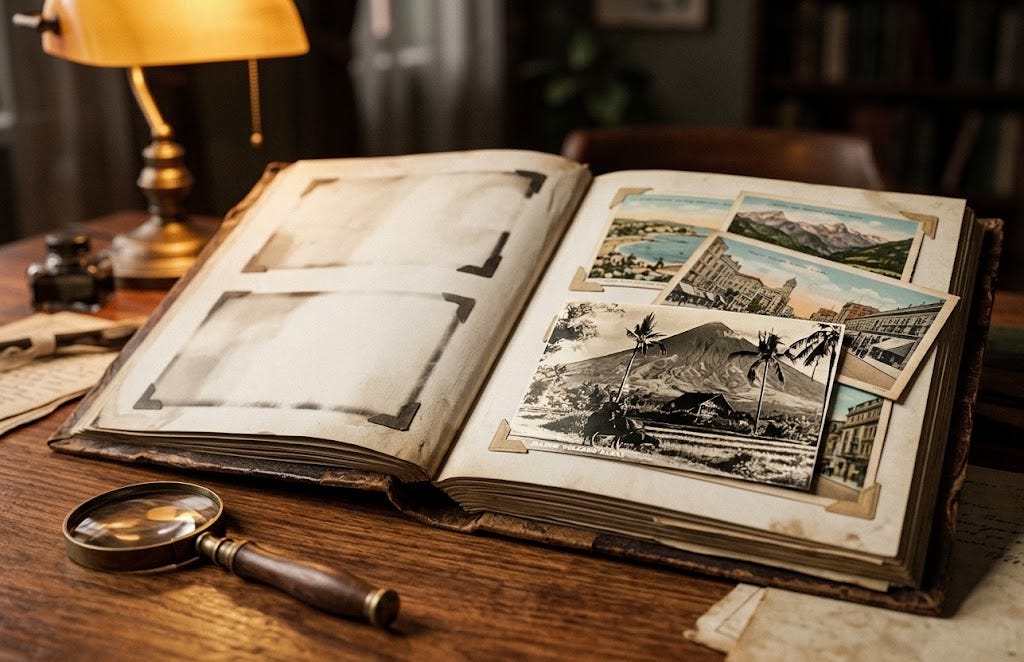
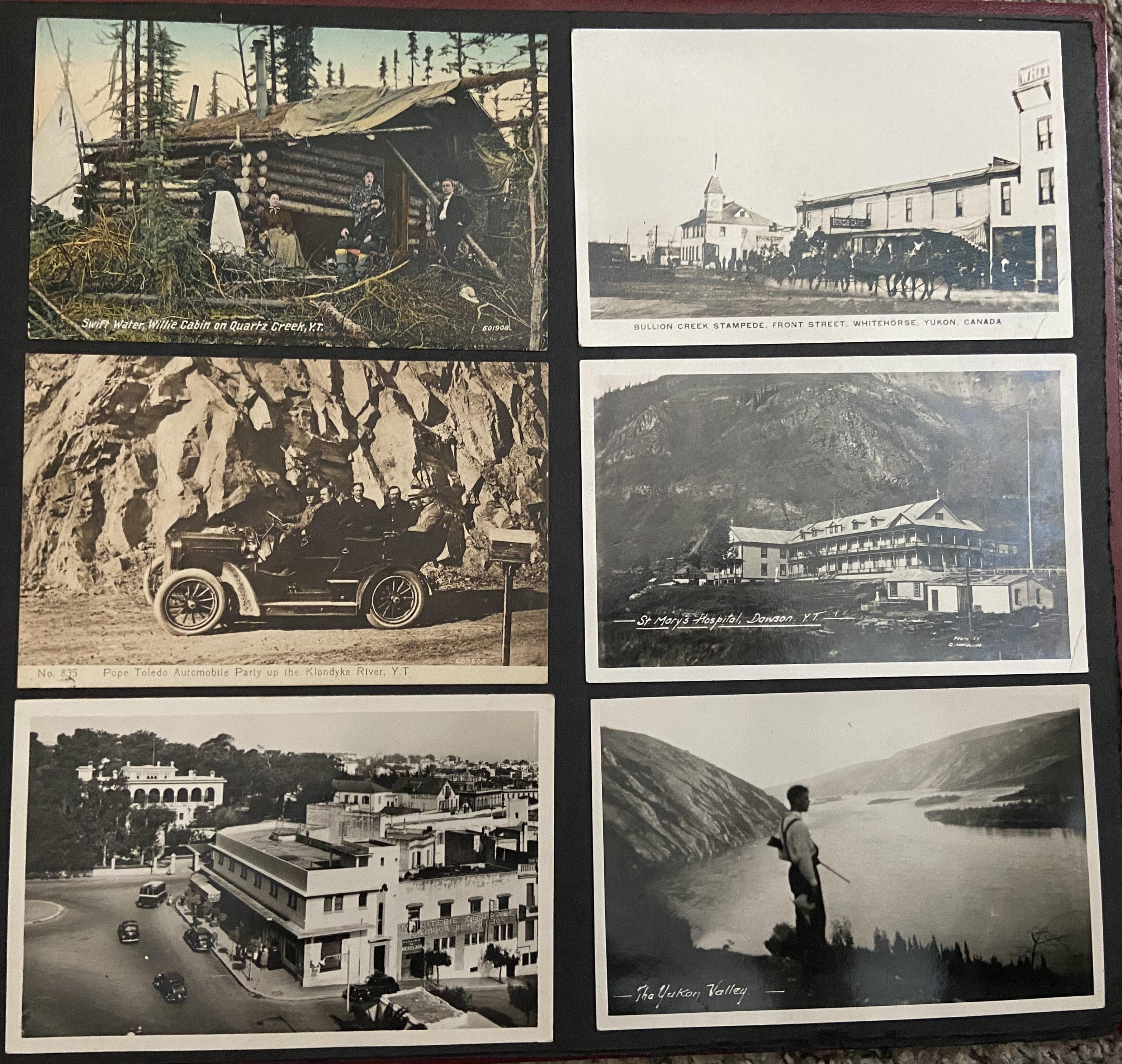
Sheryl recently gave me an old photo album that had belonged to our grandfather, and tucked into several of its pages was a small collection of postcards he’d bought himself. Zamboanga. Mt. Province. An “Ifugao Tribesman” with a spear, a barefoot Igorot girl outside a thatched hut, the kind of ethnographic tourist postcards that were common souvenirs from the Philippines in that era.
Frank was there through several stretches of his career, Subic Bay especially, and these cards are exactly the sort of thing a man might pick up between shifts.
He never mailed a single one.
They’re just sitting in that album, purchased, kept, arranged on the page, and never sent to anyone. No stamp. No address. No message on the back.
So why buy them at all, if not to send them?
I don’t know. Maybe there was no one he particularly wanted to send them to.
I didn’t expect that to land the way it did. I’ve spent my whole life on the receiving end of postcards, treasuring the ones that finally arrived weeks late, the tangible proof that somebody out in the world had paused to think of me. And here was my own grandfather, decades earlier, apparently doing the opposite. Buying the proof, and keeping it for himself instead of sending it anywhere at all.
I don’t know why. Maybe I already explained it above. Perceived as better shots than we could do as amateur photographers. Sometimes of scenes we couldn’t ourselves easily get to, if at all. As it turns our in my mind, it’s something we do for ourselves at the time rather than for later, though that surely fits into it. But I don’t know if he ever looked at them again.
Though the first few pages of the book are missing any postcards, or photos, or anywhere, where obviously there once were those things.
Maybe there was no one he particularly wanted to send them to. Maybe he liked them too much to give away. Maybe, and this is the version I keep coming back to, he simply wasn’t in the habit of telling people where he was or what he was seeing while he was seeing it.
That seems to fit so much about him. A man who worked on four continents across three decades and left almost no letters home describing any of it.
If Frank had ever sent one of those postcards to anyone in the family, it would have been the earliest, and maybe the only, direct correspondence any of us ever had from him while he was actually out there in the world.
Instead, they sat quietly in an album for something like seventy years, waiting perhaps for exactly no one, until Sheryl handed them to me and they became, in a strange roundabout way, the very thing they were never allowed to be. Something that finally reached his family, me, decades late, from somewhere he’d already gone and come back from a long, long time ago.
Or maybe he pulled it out and showed it to friends and family, often. But that doesn’t really sound like the man I know. But then, I’m really only getting to know him well…now.
I don’t know what to do with that yet, except notice it, and add it to a collection that’s spent my whole life being about exactly this.
Proof, arriving late, from someone who thought of the place enough to save something from it. Even if, in his case, the someone he was thinking of turned out to be himself.
A real postcard collector cares about the postmark almost as much as the image on the front, a clear one, stamped over the stamp itself, showing the date and place it was actually mailed from. That’s technically a philatelist’s concern, the stamp collector’s obsession with cancellations, but postcard collecting builds right on top of it. Without that mark, a card isn’t really documented at all, just old paper with a pretty picture.
I know that better than most. A few years ago my sister brought me a postcard home in person, no stamp, no postmark, nothing. I was disappointed, and I made sure she knew it, as these things only count if they’ve actually traveled through the mail to get to me, and the postmark’s what proves it.
She didn’t quite seem to get why that mattered so much. But she’d also told me before how one on occasion specifically, in one country, just how hard it can be to find a post card, or a post office to mail it from, at all. I understood that. I still do.
And still, an unpostmarked card, however it arrives, was never really the point. It is a piece of history for that country sent from, but also the care someone took to acquire it, to stamp it, to mail it, to have been there to do that. And overall, a history of journey’s around the world.
So, by every rule I’ve held myself to for decades, Frank’s postcards don’t belong in my lifelong collection at all.
And yet…they were grandpa’s. And I do find value in their being included there.
Na zdravie!
No posts
Comments
Nothing yet. Say the first thing.
Sign in to join the conversation.