
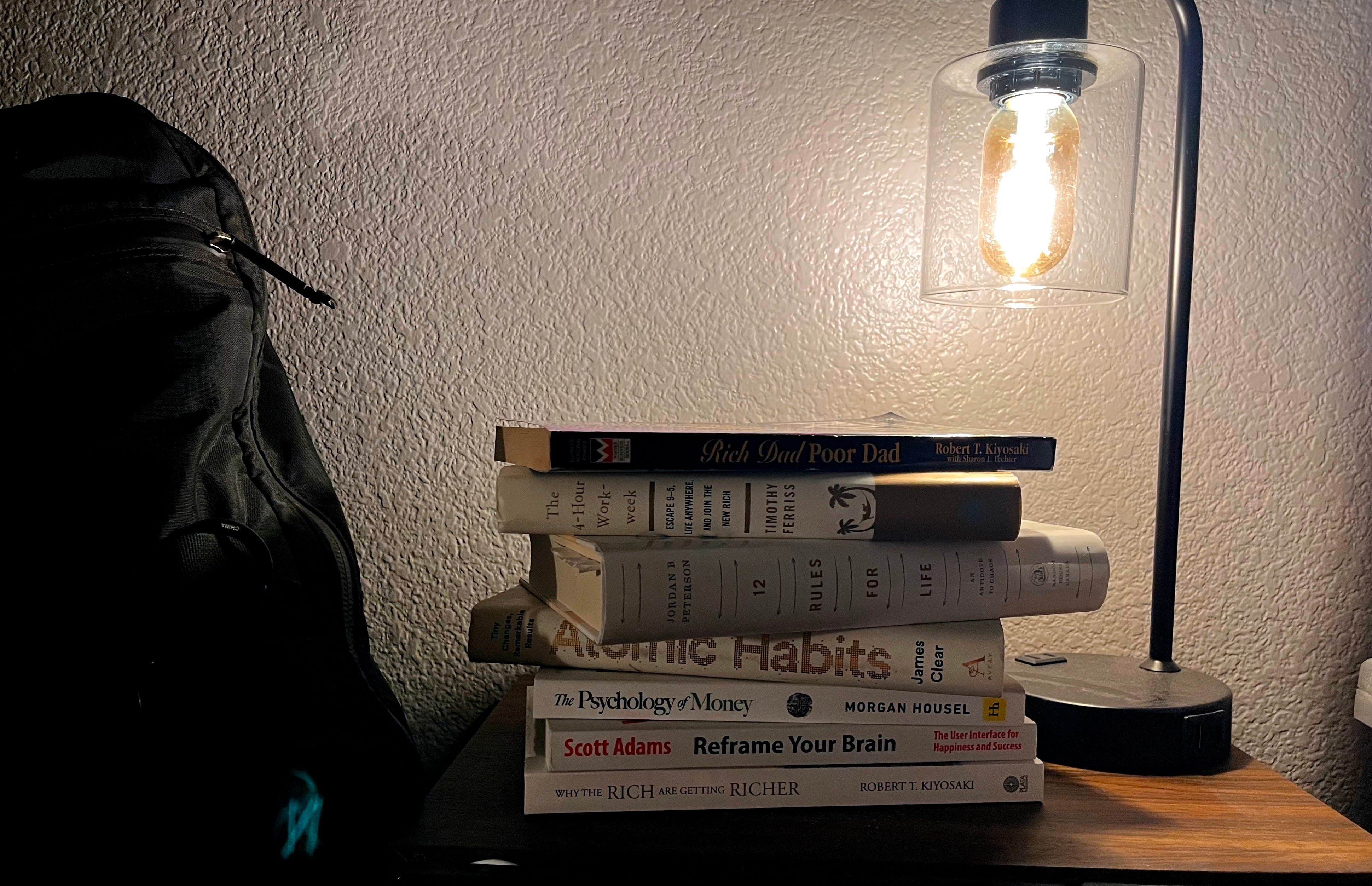
On a bit of a whim I decided to read a book a day for as long as I could keep it up and document my experience, that turned out to be seven days. I chose to prioritize the sort of books that people on social media say you should read to improve your life. Below you will find some of the things I learned from each of the seven books, after that I’ll go over my overall experience with this project, what it was like and whether I think you should do something similar.
But before we get into that I must be transparent with you and say that I did not finish three of these books, I do not believe in the sunk-cost fallacy of forcing yourself to finish a book you’ve started but don’t have the motivation to finish.That is how people grow to hate reading. If you’re reading a book that you aren’t excited to finish don’t, pick up a book that you actually want to read instead. Pushing through 100 pages of boredom just to be able to say you’ve finished a book is a waste of time that could be spent reading a book worth reading. There are other reasons not to finish a book too and each of the three here that I didn’t finish had a different reason which I will explain.
Page 2 of this book includes the statement, “Getting a good education and making good grades no longer ensures success, and nobody seems to have noticed.” We hear people say things like this all the time these days, it feels like most young people have heard this amd many believe it (despite rarely doing anything productive about it) but seeing the statement in this book shocked me because it wasn’t written in “these days,” this book is as old as I am. People complain about education not being the key to success today as if it is a new concept but it wasn’t even the key in the 90s.
Instead the key to success and wealth is in getting your money to work for you instead of living a life where you have to work for money. This book teaches readers a few things one needs to understand to do this with the most important of those things being the difference between an asset and a liability. People think that their house and their car are assets, they are not, they are liabilities. Simply put, an asset is something you own that makes you money, a liability is something that costs you money. Rich people prioritize acquiring assets like stocks, real estate, businesses and intellectual property, while poor people spend money on liabilities that they think are assets.
While that is the main lesson of the book there are many others in there that make it worth reading, like the mindset shift that occurs when you trade the phrase “I can’t afford that,” for “How can I afford that?” or seeing the difference between a best-writing author and a best-selling author, or the inspiring fact that opportunity is always out there you just have to look for it.
If you chose to read any of the books I talk about here this is the one I can most strongly recommend, it is well written, packed with important actionable information, and inspiring. It has inspired me to turn this article into a YouTube video because these days those are assets and rich people spend their time acquiring and producing assets, and you should identify as a rich person even if your bank account says otherwise.
If you’ve spent any amount of time in the productivity side of YouTube I’m sure you’ve heard of this book and seen many people praise it. I’m sure it is filled with lots of great information and ideas. The problem is it was written by a guy who only works four hours a week and it takes a bit more than four hours a week to write a book worth reading.
From the chapters I read it felt like Ferriss was more interested in bragging about his unique adventures and lifestyle than he was in teaching the reader anything useful. Was there some good information in the portion of the book that I read? Yes, it is important to understand the difference between relative and absolute wealth, but it felt like for every page of actual information in the book there was three pages of Tim Ferriss stories that were, at best, loosely connected to the lesson he was trying to teach. Maybe the book gets better further on but spending time reading a book that is 75% fluff just because the so-called productivity experts say I should doesn’t sound very productive to me.
I didn’t finish this book either but for the opposite reason that I didn’t finish The 4-Hour Workweek. From what I read of 12 Rules for Life I can tell that it is quite good and definitely worth reading, but it is very dense. After reading the first chapter I determined that this book was too dense to digest in one day as was my intention with reading it for this project. I plan on coming back to this book when I have enough time to give it the respect it deserves, but in the meantime I will remember to stand up straight with my shoulders back.
There are two famous books on habits in my library, and while I initially planned on reading Duhigg’s The Power of Habit there were two reasons I chose to read Atomic Habits instead. First Clear’s book is a bit shorter and I wanted the satisfaction of finishing a book after quitting two but more importantly Atomic Habits is wholly focused on improving the habits of the reader while Duhigg only dedicates a third of his book to the individual. I’m sure there are great things to be learned from studying the habits of businesses and societies but for this project I felt like the individual was the higher priority.
The biggest insight I gained from the book came from one of the first few chapters of the book. Any goals or new habits you set should focus on changing your identity, not achieving an outcome. You shouldn’t set a goal to run a marathon, you should set a goal to become a runner. You shouldn’t set a goal to write a book, you should set a goal to become a writer. You shouldn’t set a goal to save a million dollars, you should set a goal to become rich. If your only goal is to run a marathon what are you supposed to do after you cross the finish line? If your goal is to become a runner you’ll know that you still need to get up and run the next day.
The rest of the stuff in the book is stuff you and I have probably already heard. Learning the stuff found in the book won’t change your life but applying it will. It would be foolish to read this book (or any book in the self-help genre) and fail to apply anything from it. The two-minute rule is something Clear talks about that I plan on using to start doing some things that I should be doing but haven’t been. There are plenty more strategies in this book that will improve yor life if you actually use them, it wouldn’t be a bad idea for you to read this book and find a few to implement in your life.
The first chapter of this book is titled “No One’s Crazy” and that title is followed by the statement “Your personal experience with money make up maybe 0.00000001% of what’s happened in the world, but maybe 80% of how you think the world works.” I don’t fully agree with Housel on the whole nobody is crazy thing but it is something he repeats several times in the book, I see the repetitions of that statement as a reminder of the longer second one than anything else, and that second statement is one of the most important messages in the book.
Housel’s repetition of “no one’s crazy,” brought me back to Rich Dad Poor Dad. In that book there were multiple times when Kiyosaki recalled a story (multiple stories in fact) of him showing a friend a wonderful investment opportunity only for the friend to chose not to invest. In each of these cases Kiyosaki thought his friends were crazy for not taking advantage of such a great deal (Kiyosaki had enough experience to know a good deal when he saw one), and in each of these cases Kiyosaki’s friends probably thought he was crazy for suggesting such an investment (despite those exact type of investments being the reason he got rich). But no one’s crazy we all just do what makes sense to us based off our individual experiences.
Everyone has their own experience and understanding of money, and, Housel tells us, everyone has their own goals for money as well. What I found to be my most important take-away from this book is that we need to have an understanding of what our goals are, then once we have figured out our goals we need to be careful when hearing advice from people with different goals. A stock that looks attractive to a day-trader probably won’t be a smart buy for someone shopping for an investment to hold onto for thirty years. Housel tells us, “Define the game you’re playing, and make sure your actions are not being influenced by people playing a different game.”
Those of us who followed Scott Adams were not surprised last year when he announced his prostate cancer, and when he died early this year we were saddened as the world lost a great American. In the statement he had published at his death Adams mentioned that the last few books he wrote were the accomplishment he was most proud of in life because they helped many people. I had read most of his recent books but not all of them, I saw this project as a good opportunity to pick up Adams’ last book.
The premise of Reframe Your Brain is that you can look at things in your life through a different lens to give yourself a perspective that will greatly benefit your life. For example in one of his earlier books Adams reframed the common understanding that “Alcohol is a beverage” to “Alcohol is poison,” and that reframe enabled him and thousands of readers to stop drinking. This reframe doesn’t work for everyone, no reframe will, but there are certainly reframes that will work for you out there. Another important reframe that everyone should know is that your job is not to do what your boss tells you to do like most people think it is, your job is to get a better job.
I didn’t end up reading much of this book, to someone like me who has been a Scott Adams fan for a few years now the book felt like a glorified listicle of things that I’ve heard before, they’re all good things but I didn’t have the energy to get though it. One of the things Adams often advises people to do is to prioritize the things that you have the energy for and not to waste your time with the things that you don’t, so I’m only following Adams’ advice by choosing not to finish this book right now.
That being said this book is packed with good, classic Scott Adams wisdom and wit. It is worth the read for those of you who haven’t been exposed to much of his stuff but How to Fail at Almost Everything and Still Win Big might be the better Adams book to start with.
After trying to read something full of stuff I had already heard I decided to pick up another Kiyosaki book to dig into some stuff I hadn’t really heard before. Kiyosaki presents this book as “the graduate school version of Rich Dad Poor Dad,” and digs deeper into the financial education he introduced there. Kiyosaki shows us that the rich are masters of taking advantage of debt and taxes.
A lot of the important things he teaches are demonstrated in the story of Kiyosaki acquiring his first rental property (which he repeats often). After dropping out of an MBA program he saw as a waste of time Kiyosaki attended a seminar that taught people how to buy real estate with zero money down. At the conclusion of the seminar the instructor told students to spend the next 90 days researching 100 different real estate listings before taking any action. After doing that Kiyosaki identified an $18,000 condo that was a great deal (this was the 70s), the condo required a 10% down payment to buy so Kiyosaki got a credit card and paid the $1,800 down payment with that.
The rent the condo’s tenant paid covered the monthly credit card bill and the mortgage with $25 per month left over as profit for Kiyosaki. $25 a month wasn’t a ton of money but Kiyosaki invested zero of his own dollars into that property, it was free money. The $1,800 he used for the down payment was also $1,800 he didn’t have to pay taxes on because it wasn’t his money.
Years later Kiyosaki sold the property for $42,000. Usually one would have to pay taxes on the $24,000 profit he made from that deal but by taking advantage of the 1031 exchange rule Kiyosaki didn’t have to pay taxes on it as he used that money to buy more real estate. So, to go over everything, Kiyosaki used debt to acquire $42,000 worth of assets that he didn’t have to pay taxes on which generated monthly income which happened to be taxed at a lower rate than normal income.
Kiyosaki also explains that in doing that he is not cheating the system. He argues that tax avoidance (which is legal, unlike tax evasion) is patriotic. The government uses tax breaks as an incentive for people to do the things it wants people to do. If there was nobody like Kiyosaki out there providing safe and affordable housing for people the government would have to step in and do it themselves, and it would cost the government a lot more than the values of whatever amount of revenue they’re losing by giving investors like Kiyosaki tax breaks.
We may not be able to buy $18,000 condos with a credit card anymore but it is important to remember one of rich dad’s lessons, “Opportunity is always out there,” and I’ll be sure to keep looking for mine.
I found reading a book a day to be both easy and hard at the same time. It was hard because it takes a lot of time, I don’t do audiobooks because when I’m reading a book I want all of my attention to be dedicated to that book, but even if I did do audiobooks it would still have taken a lot of time. And had I not cheated by not finishing three of the books it would have taken even more time, time that I didn’t have. In order to finish the books that I did finish on schedule I had to be reading in times and places where people usually wouldn’t have a book. I read two chapters of Psychology of Money while standing at the end of my work truck waiting for my time to take a material sample.
It is also hard to force yourself to finish a book you don’t want to finish. I’m glad I didn’t do that, I already explained my reasoning behind that. Remember if you ever find yourself in the middle of a book you don’t want to finish there are millions of other books out there you could read instead, just grab a different one.
The thing that made this challenge easy was that the books I did finish were books that I wanted to finish. Reading those books was what I wanted to be doing. The first day of this challenge happened to be the Fourth of July and I spent a good chunk of that day hanging out with friends but as I was doing that there was a part of me that just wanted to go home to read my book. At the end of the night’s firework show I believe I said “Okay time to finish my book,” as I parted ways with them.
It was also quite rewarding to do all that reading. I mentioned that I read a few chapters while waiting around at work, had I not been doing that I would have been letting my brain rot scrolling through crap on my phone. Reading that much in that short of a period of time forced me to realize how much time I actually have in the day and how much time I waste doing things that aren’t productive in any way. That realization alone is worth the effort of reading seven books in seven days.
But, of course, that isn’t the only reward. I read over 1,000 pages in the last week. I’m not going to remember everything I read, studies show that we only retain about ten percent of the information we read (I learned that from one of these books), but, if that is true, I now have about 100 pages worth of new knowledge in my brain. That’s 100 pages more than I had last week. A jump in knowledge like that will benefit anyone’s life.
But all that information is worthless unless you put it to use. If you were paying attention reading through this article you will have noticed that I tried to include an idea or practice from each book that I plan on implementing in my life. Reading finance and self-help books without changing anything in your life afterwards is just mental masturbation. Rich Dad Poor Dad has sold over 44 million copies in the nearly 30 years it has been on store shelves but I think the world would look much different if 44 million people had actually followed its advice.
Do I think you should try to read seven books in seven days? Yes. While reading books this fast certainly isn’t the best way to learn from them I think this is the sort of challenge that everyone should try at least once in their life. I believe we should all seek learning out of the best books, and I’ve been slacking on that lately. This project has rekindled my love of reading and learning. I don’t plan on spending every ounce of free time reading like I have this last week but, because I did this challenge, I’ll certainly be back to reading at least an hour a day again. I believe if you commit yourself to a challenge like this you’ll come out the end of it a more dedicated learner as well, and as you apply the things you learn you will improve your life along with the lives of those around you.
Comments
Nothing yet. Say the first thing.
Sign in to join the conversation.