
Keywords: Race, rurality, politics, representation
Every time I visited my childhood home in rural Dorset, OH, I passed this familiar scene.
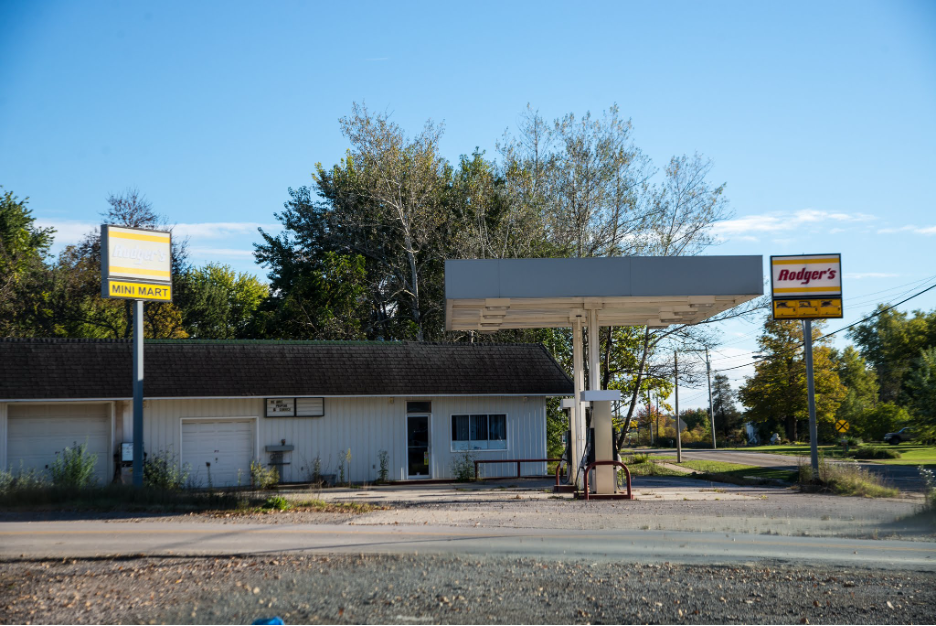
This abandoned corner gas station got a major makeover during its moment of fame in the 2023 Netflix film White Noise. When my parents sent a photo of the filming (Image 2), I was shocked to hear that my middle-of-nowhere town would be in an actual movie. Many people in Dorset were excited for something so big to happen to our small township.
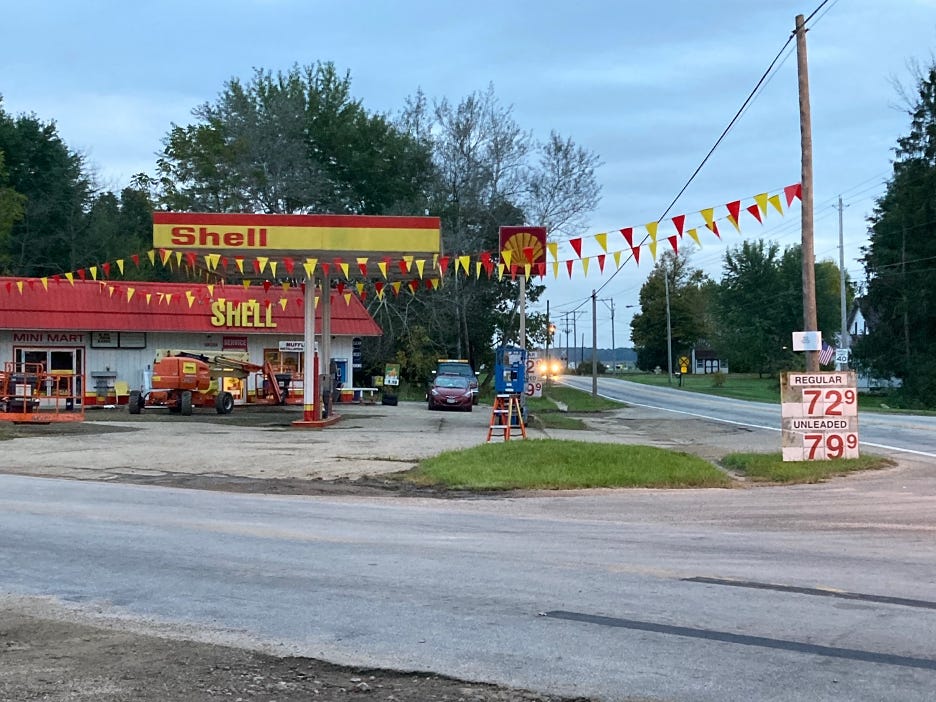
Based on a novel by Don DeLillo, the film features an “airborne toxic event” that forces the movie’s family to evacuate their small town. In one scene, Adam Driver’s character hurriedly pumps gas at Dorset’s (now) Shell station while his family shelters in their car. Less than a month after the film’s release, parts of this story became a real-life scenario for many people about an hour away in East Palestine, OH now almost 3 years ago. Some even worked as extras in this film.
DeLillo published his 1985 novel shortly after a chemical leak from American-owned Union Carbide Corporation (UCC)’s insecticide plant in Bhopal, India that killed 15,000-20,000 people, impacting 500,000 people or more. Almost 30 years later, people are still dying, while DowDupont (UCC parent company) fails to provide adequate compensation, despite overwhelming profits ($57 billion in sales in 2022). Instead of learning from Bhopal, including safety cutbacks of a US corporation, conservative media pundits/politicians with large rural audiences, described people from the Global South as “obedient citizens” replacing “white voters”, coming from “shithole countries,” or turning the US into a “third-world hellhole.”
I learned about Bhopal because I was the child of an Indian Tamil immigrant, but since 2016, conservative media have amplified xenophobic narratives. Narratives that somewhat derive from pre-2016 American media showing non-European cultures, people, or civilizations as backward, “exotic,” threatening, or uncivilized: think Indiana Jones and the Temple of Doom, or a host of other Orientalist tropes. These stereotypes don’t just ignore the role of European colonialism or US imperialism in creating issues blamed on the “third-world” and “’people over there.” They have real-life impacts on people living in the US.
Many people of color in rural areas have experienced the impacts of these stereotypes (discrimination, threats, racial slurs or jokes). Hate crimes and Islamophobia spiked significantly after 9/11 and again during and after the 2016 election. When anyone thinks about Dorset “locals,” they probably don’t think of brown, Black, or Asian folks. These stereotypes influence how people think about people of color as being “somewhere else,” even though many live in places like Dorset or even East Palestine. Greater nuance in covering connections between places like India and the US would benefit so many Americans, given that Bhopal’s Union Carbide (which became DowDupont, splitting into 3 specialized companies in 2019) is an American corporation and methyl isocyanate leaked numerous times in a West Virginia plant from 1980-1985, contributed to deaths in a West Virginia plant in 2008, and is also carried on trains in the US. Some have argued that the chemicals in East Palestine, like vinyl chloride, evaporate and are not as “toxic,” but with 43,000 dead animals and fish immediately following the incident and mounting human health impacts, it is nevertheless an eerie reminder of incidents like Bhopal.
‘Rural is white’ representations are not limited to conservative media; they run rampant across the political spectrum of rural media coverage. From 2021-2023, I interviewed 35 people about their experiences in the rural Rust Belt and found many of their stories missing from rural dialogues. With any rural Rust Belt issue, many forget that rural areas are not just home to white folks. News coverage (right and left) focused on the census data and racial makeup of East Palestine that emphasized its white makeup. This does not address that the 2020 census overcounted people who identified as “white,” while undercounting those identifying as “Black,” “Native American,” and/or “Latino”. And even so, 24 percent of rural Americans are people of color according to the 2020 census.
Stereotypes of rurality as exclusively white areas, also reinforce white nationalist views now running rampant under the current administration to exploit rural areas. In the response to East Palestine, white nationalism and unnuanced, simplified rhetoric (from mainly right wing news outlets) was front and center: from claims that Biden would respond faster if this were a primary Black area to Donald Trump Jr. using the disaster to demonize Palestinian people (while rural Ohio Republican politicians supported teaching the Holocaust from the perspective of the Nazis). Before trading morals for power, Vice President Vance once criticized Trump: “Trump makes people I care about afraid. Immigrants, Muslims, etc. Because of this, I find him reprehensible.”
But while such politicians focused on “race-baiting” during the disaster, corporate profits soared to record highs while wealth inequality, already higher than other “developed” nations, grew. Equity frequently benefits everyone, but white grievance destroys people – from banning US history, to an epidemic of white nationalism, increased hate crimes, election denialism, sliding democracy status, plummeting public health standards, costly impacts from climate change, decline in life expectancy (especially Black and Indigenous communities), decreased bodily autonomy and reproductive freedoms, guns laws resulting in more mass shootings, anti-LGBTQ hysteria causing death and injury, and outlawing gender-affirming care when it saves lives. Is it a surprise that mental health crises are rising with higher suicide risk in rural areas? Policies championed by the current Republican party contribute to creating “the third world” that American exceptionalism and European colonialism have exploited for centuries.
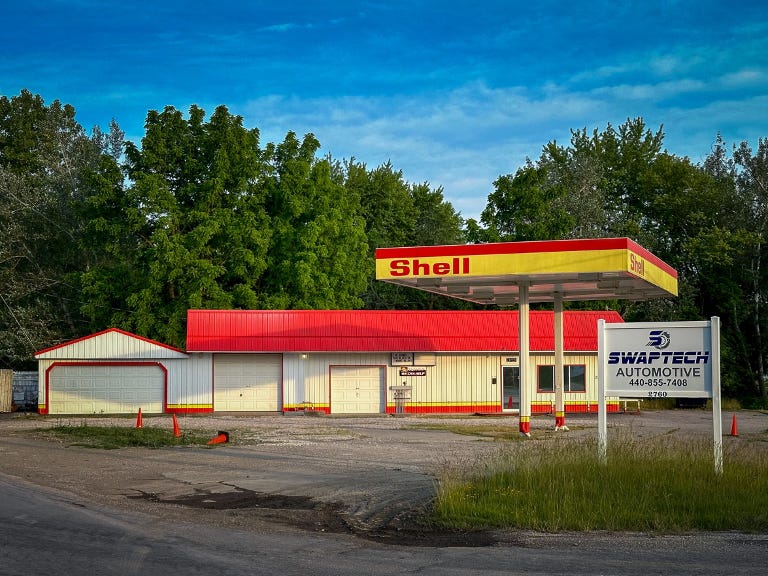
East Palestine, now forgotten by right-wing politicians, was just one stop on a path to use white nationalism to regain power. White grievance and rural as white narratives ignore people’s lives. These narratives are the epitome of exploitation that creates profit for some, but inevitably never fix systemic, structural problems for most - much like my hometown’s corner gas station. It had 15 minutes of fame with an exterior paint job, but in the end, it’s still abandoned.
— Christabel Devadoss
Author Bio

Connect with us at:
Thanks for reading Just Rural Futures! Subscribe for free to receive new posts and support my work.
Comments
Nothing yet. Say the first thing.
Sign in to join the conversation.