
Keywords: Human flourishing; Rural–urban divide; Spatial Equity; Labor Geography
The rural–urban divide in the United States is often told as an income story: opportunity concentrates in metros, rural areas fall behind, and the gap widens. Income matters, but it is not the complete story, especially if what we care about is human flourishing, not just earnings.
Flourishing is a multi-dimensional concept. It includes how people feel day to day (happiness), how they evaluate their lives overall (life satisfaction), and how they experience a major domain of adult life, work (job satisfaction), and more. When we measure these three pieces together, the rural–urban divide stops looking like a simple gradient into a complex geographic landscape with tensions, trade-offs, and surprises.
Let’s see what evidence we got from the analysis of 2.6 billion US geolocated social-media posts through the lens of a large language model (Iacus et al., 2025).
One of the most striking spatial patterns we document is an apparent rural–urban paradox: rural counties express higher life satisfaction, while urban counties exhibit greater happiness (Iacus & Porro, 2025).
This is not just wordplay; it aligns with a basic distinction in well-being research with clear geographic implications. Life satisfaction is more evaluative, i.e., a judgment about one’s life as a whole. Happiness is more hedonic, like a signal of affect, mood, and day-to-day emotional experience. These layers can diverge across space because they respond to different place-based conditions: stability, identity, and social ties embedded in local community structures on one hand, and the stressors, stimuli, and shocks concentrated in particular economic or urban environments on the other. Therefore, different geographies cultivate different dimensions of flourishing.
Seen through a geographic lens, the “paradox” is a clue that rural America is not simply “less well-off,” and urban America is not simply “better.”
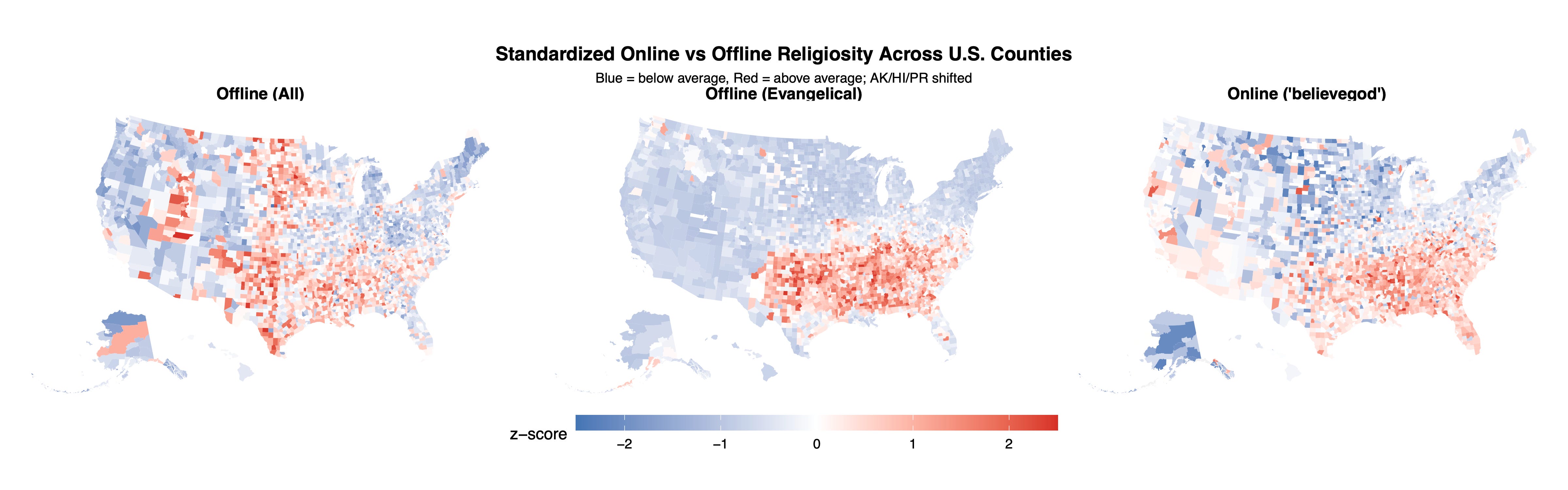
Instead, they represent markedly different places for flourishing, offering different mixes of meaning, stressors, social connection, or perceived progress. The rural–urban divide becomes less about a single deficit model and more a spatial composition of well-being shaped by local conditions. Place-based features shape these differences: local cultural and institutional environments, religiosity, belonging, and community ties, which vary across places and can anchor meaning and identity in geographically specific ways. Figure 1 illustrates one such spatial pattern: offline religious adherence and online religious discourse cluster in recognizable regions such as the Bible Belt, yet the diffusion of digital religious expression also reveals a broader communicative geography that extends beyond areas traditionally associated with high religious affiliation.
Time matters along with space: shocks hit happiness hard
Spatio-temporal analysis is crucial for understanding rural features. The two layers react differently to national disruptions and their trajectories vary across space. Through social media lenses, happiness drops sharply during 2020–2022, while life satisfaction shifts more modestly (Iacus & Porro, 2025).
If we only track one summary outcome, we risk missing the way communities geographically absorb shocks. A place may experience an emotionally punishing period even as residents’ overall life evaluations remain relatively steady, signaling forms of resilience rooted in local social structures and community ties. Flourishing is not a single dial, and its temporal dynamics are spatially uneven.
Work is not the whole of life, but it is one of the most important domains through which people experience dignity, autonomy, security, and purpose, and these experiences are deeply shaped by place. That is why we also study job satisfaction as a third component.
Here, the baseline spatial pattern is familiar: rural counties report lower job-satisfaction sentiment than urban counties. But the more policy-relevant and geographically revealing is how the gap changes. We find that the rural–urban difference in job satisfaction shrinks under tight labor markets, i.e., when unemployment is low, and workers have more bargaining power and outside options (Iacus & Porro, 2025)
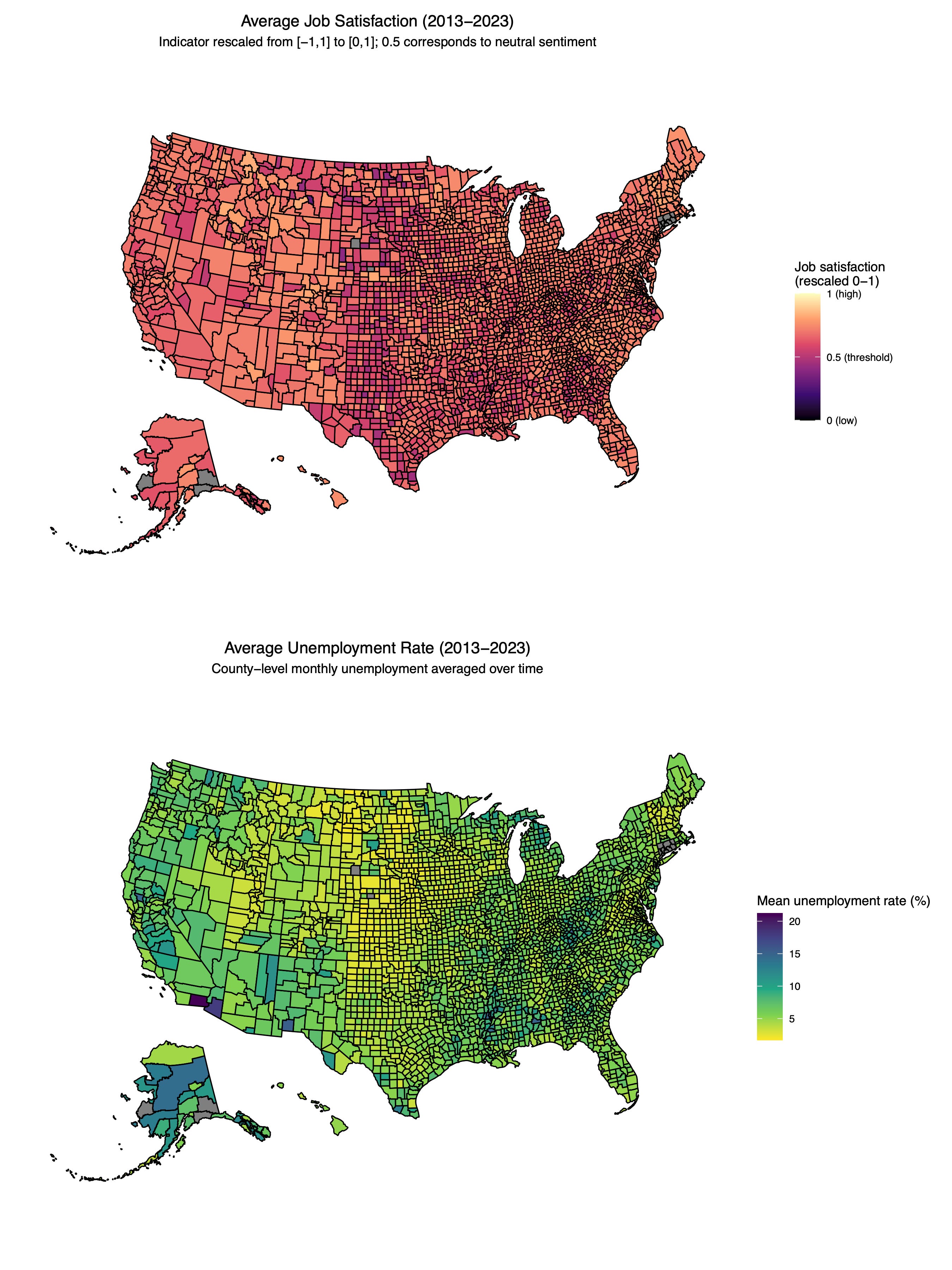
This is where “beyond income” becomes concrete. If job satisfaction improves relative to urban areas when labor markets tighten, then the rural–urban divide in work well-being is not only about long-run structural disadvantage. It is also about the conditions that determine whether workers can leave a bad job, negotiate, or find something closer to what they need. Labor markets shape flourishing not just by affecting wages, but by affecting agency, which is itself geographically contingent.
Traditional surveys are indispensable, but they are expensive and often lack the time frequency and geographic granularity needed to track how lived experience shifts over time and across counties. Large-scale language-based indicators are a complement: they help us observe how well-being is expressed across space and time (Iacus et al., 2025).
At the same time, social-media-based measures are not a perfect mirror of “the population.” They reflect who posts, from where, what they share publicly, and how platforms evolve. The right interpretation is not “true prevalence,” but spatial patterns in expressed well-being, which can still be useful for monitoring spatial disparities and identifying where deeper, local investigation is warranted.
Because flourishing is multi-dimensional, we released an open dataset designed to make exploration easier: the Human Flourishing Geographic Index (HFGI). It is a set of 48 human flourishing indicators, with monthly and yearly county- and state-level measurements, including happiness, life satisfaction, and job satisfaction, discussed here. The data is available through the Harvard Dataverse repository (Iacus et al., 2025). Data is open-source, so researchers, students, journalists, and communities can reuse it without restriction.
If the rural–urban divide is going to be discussed thoroughly, without stereotypes, then it has to be measured thoroughly too. The point is not to declare rural places “worse off” or urban places “better off,” but to ask sharper questions: Which dimensions of flourishing diverge in space and time? Which converge when conditions change? What improves when labor markets tighten, and what does not? How can this spatial-temporal divide be addressed? Due to its limitations, our dataset alone will not be the answer, but it is a step toward understanding more about the rural-urban divide in the US.
— Stefano Iacus, Giuseppe Porro, Devika Jain
Author Bios:



Comments
Nothing yet. Say the first thing.
Sign in to join the conversation.