
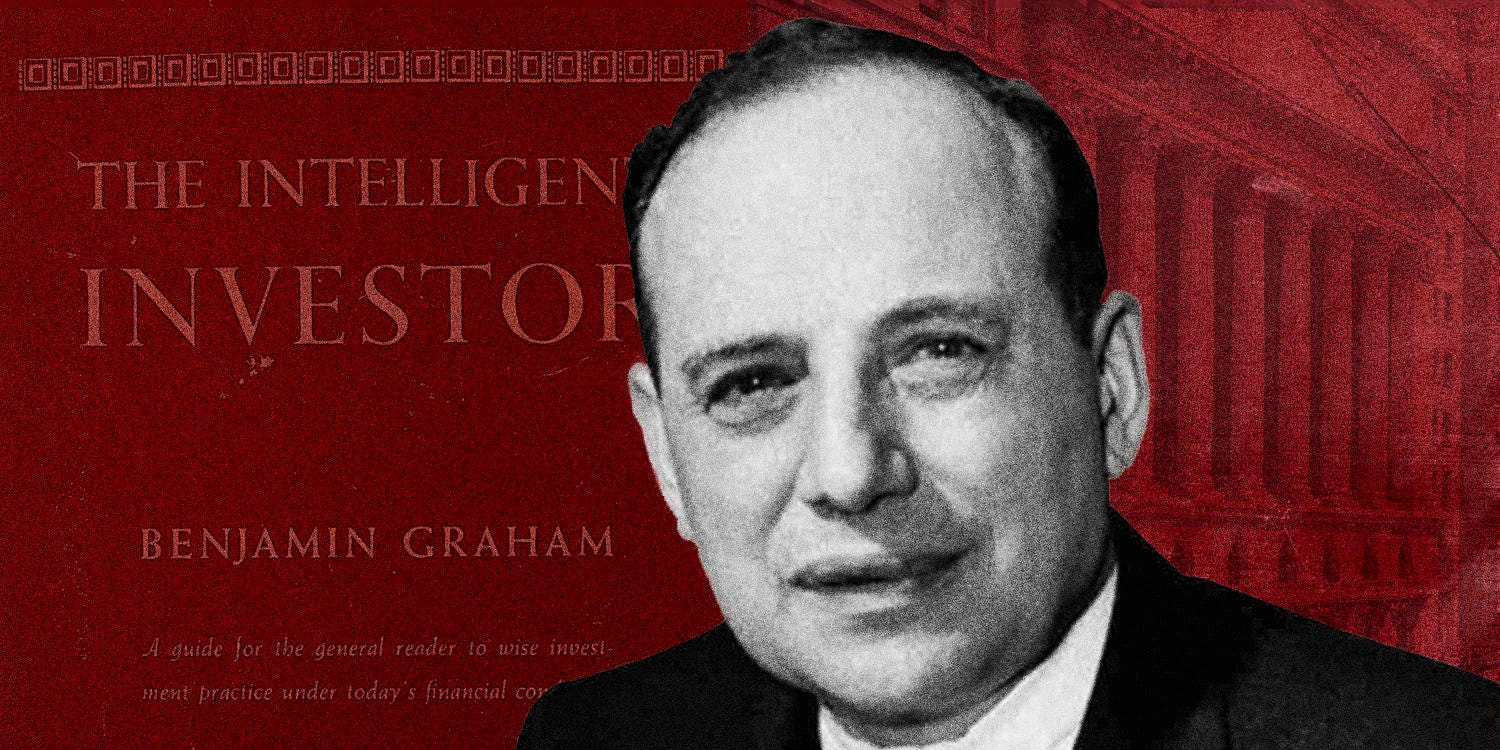
Those curious souls who inspect the finance sections of bookshops will have noticed one book is always there.
Still sporting its austere red cover, The Intelligent Investor by Benjamin Graham, the most influential financial writer of the 20th century, remains a best-seller more than 75 years after it was first published in 1949.
Celebrated for its practicable investment advice, worldly wisdom, and, certainly for a business book, elegant prose, Graham’s classic has served as a reference manual for generations of professional and private investors.
Described by another investment legend, Warren Buffett, as ‘by far the best book on investing ever written’, The Intelligent Investor has acquired something of the status of sacred scripture in the financial world.
Rather like an annotated Bible, the current ‘Definitive’ edition, supplemented with commentary by Buffett and others, now runs to more than 600 pages. And just as denominations dispute the interpretation of the Holy Book, rival investment schools continue to contest how Graham should be read, and thereby claim his legacy.
The Intelligent Investor has become gospel for active investors, famed for offering a rigorous methodology for consistently designing portfolios capable of beating the market. Graham is often referred to as ‘the father of value investing’. But, as the investment tide has turned towards passive, the book’s shadow side has been increasingly emphasised: its abundance of caution, shading into pessimism, regarding the sheer difficulty of identifying winning trades.
In one of his polemics for passive, The Little Book of Common Sense Investing, index-fund pioneer John Bogle confided, in somewhat hushed tones, that Buffett had given him his ‘personal assurance’ that Graham was, at heart, a fellow traveller:
Mr Buffett spoke these words directly to me at a dinner in Omaha in 2006: ‘A low-cost index fund is the most sensible equity investment for the great majority of investors. My mentor, Ben Graham, took this position many years ago, and everything I have seen since convinces me of its truth.’
Certainly, by time of his final interview, given in 1976 shortly before his death, the great man seemed to have shifted from active to passive, disclosing he was ‘no longer an advocate of elaborate techniques of security analysis in order to find superior value opportunities’.
So who is right? How should The Intelligent Investor be read? It’s a question that matters when so many investors continue to take their lead from the wise men of the trade, Buffett and Graham foremost among them.
What is clear is that a careful re-reading of the original edition reveals a profoundly conservative text. Graham is ever wary of the false gods of ‘speculation’, the conceit that ‘general trading - anticipating moves in the market as a whole - or selective trading - picking out stocks which will do better than the market in the short term - has any place in investment practice.’
The discerning investor resists the restless salesmanship of the metaphorical ‘Mr Market’, who each morning ‘tells you what he thinks your interest (in your business) is worth and furthermore offers either to buy you out or sell you an additional interest on that basis.’
Only ‘enterprising’ investors, that rare breed with the resources to conduct their ‘security operations as equivalent to a business enterprise’, might be able to summon the strength of mind to resist. In Graham’s blunt assessment, making no concession to modern sensitivities, the great majority of investors, without ‘the time, or the determination, or the mental equipment to embark upon such investing as a quasi-business’, should rest content with a ‘simple portfolio policy - the purchase of bonds, plus a diversified list of leading common stocks - which any investor can carry out with a little expert assistance.’ That sounds rather like what today would be called a passive portfolio.
Moving on to the heart of the book, he sets out his famous principles for the selection of these ‘large, prominent, and conservatively financed’ stocks, which include paying due regard to the need for ‘adequate though not excessive diversification’; selecting ‘a minimum of ten different issues and a maximum of about thirty’; respecting ‘a long record of continuous dividend payments’; and checking for prices not in excess of twenty times ‘average earnings for the last five years or longer’.
Despite setting out his principles in some detail, Graham was sceptical private investors would be able to follow them. He believed stocks should be chosen by ‘competently managed’ funds liable to make ‘fewer mistakes than the typical small investor’, and with access to resources ‘just about able to absorb the expense burden and the drag of uninvested cash.’
Graham’s severity should be set in context. He was writing for readers still scarred by the Wall Street Crash, for whom the notion of buying stocks at all was considered ‘little short of heresy’. Indeed, the only element of Graham’s highly defensive strategy that today’s passive advocates might have contested was his openness to the possibility of timing the market. He reasoned that ‘if the intelligent investor must not buy stocks at demonstrably high prices, the same minimum of prudence should lead him to sell at least part of his holdings when such levels are reached.’
Again, the advice was hedged with caution: ‘[A]ny endeavour to take advantage of market fluctuations must be thought of as taking the investor out of the category of the defensive and into the ranks of the enterprising’. A ‘formula timing plan’ should be followed to ensure profits are taken and repurchases made in accord with a disciplined schedule. Graham advised additional criteria for identifying these bargain stocks:
[I]f a common stock can be bought at no more than two-thirds of the working-capital value alone - disregarding all the other assets - and if the earnings record and prospects are reasonably satisfactory, there is strong reason to believe that the investor is getting substantially more than his money’s worth.
The ‘market is always making mountains out of molehills and exaggerating ordinary vicissitudes into major setbacks. Even a mere lack of interest or enthusiasm may impel a price decline to absurdly low levels.’
All of this, to be clear, was only for ‘enterprising investors’: ‘If you merely try to bring just a little extra knowledge and cleverness to bear upon your investment program, instead of realising a little better than normal results, you may well find that you have done worse.’
And yet for all his caution, Graham’s concession - it could hardly be called encouragement - that elite investors might be able to find grounds for returning to the business of stock picking, had an electrifying effect on a market that had been through 1929, the Great Depression, and a world war. The Intelligent Investor was taken as permission to start having fun again. And by following Graham’s rigorous methodologies, or at least noting them, investors could convince themselves they were doing so with due diligence.
The book’s underlying pessimism, clearer when read in retrospect, was underplayed. Graham was quite clear throughout that he considered the post-war environment to be a particularly benign period for value stocks. Observing that the ‘1931-33 depression … had a particularly devastating impact on companies below the first rank either in size or in inherent stability’, he suggested that ‘investors have since developed a pronounced preference for industry leaders and a corresponding lack of interest in the ordinary company of secondary importance’, thereby creating ‘innumerable instances of major undervaluation.’
As the world picked itself up after economic and political devastation, a window of opportunity had opened for picking value stocks. Graham noted that ‘whereas the leading stocks in the Dow-Jones Industrial Average had advanced only 40 per cent from the end of 1938 to the 1946 high, Standard & Poor’s Index of low-priced stocks had shot up no less than 280 per cent in the same period.’
But as the global economy shifted through the gears over subsequent decades, the window closed, and Graham became ever more hawkish. His final interview is notable for its hard-edged scepticism, and, at times, cynicism.
He thought the contemporary market resembled ‘a huge laundry in which institutions take in large blocks of each other’s washing’ - ‘a John Bunyan type of Vanity Fair, or a Falstaffian joke, that frequently degenerates into a madhouse’. He was emphatic that the average investor should be content with the market average, and that even fund managers were not capable of beating the index. Those who claimed to be able to do so should be required to record ‘such results over, say, a moving five-year average period as a condition for paying standard management fees to advisors and the like.’
Most strikingly, perhaps, Graham declined even to defend the famed stock selection methodologies at the heart of The Intelligent Investor:
In the old days any well-trained security analyst could do a good professional job of selecting undervalued issues through detailed studies; but in the light of the enormous amount of research now being carried on, I doubt whether in most cases such extensive efforts will generate sufficiently superior selections to justify their cost. To that very limited extent I’m on the side of the “efficient market” school of thought now generally accepted by the professors.
He died later that year, just a few months after the first index fund appeared. In the absence of Graham’s own words on the subject, John Bogle’s intimations notwithstanding, we simply don’t know whether he endorsed the passive products: Bogle was a salesman with something (big) to sell.
But the Vanguard founder’s words in the foreword to the reissued original edition of The Intelligent Investor seem fair:
[H]is classic book gives far more attention to the down-to-earth basics of portfolio policy - the straightforward, uncomplicated principles of diversification and rational long-term expectations - than to solving the sphinx-like mystery of selecting superior stocks through careful security analysis.
In the end, perhaps, Graham’s legacy is not the revelation of timeless formulae for selecting winning stocks, brought down from the mountain to reveal the way from those who will only listen and obey, but the attitude of timeworn common sense that runs through The Intelligent Investor. There is money to be made in markets, but only for those prepared to do their research, weigh the risks, design an exit plan, and recognise when others might be better qualified to act on their behalf.
Comments
Nothing yet. Say the first thing.
Sign in to join the conversation.