
Hi there, and welcome to The Next - my take on health, wellness, and company building.
I previously started leading bone broth brand Kettle & Fire, learned more about our how our food and healthcare systems incentivize illness, and decided to start a new company. I now work on Truemed, which allows qualified individuals to use HSA/FSA funds on lifestyle interventions that can treat, reverse, or prevent chronic disease. Previously, I worked in tech and had no experience in CPG, DTC, or any other 3-letter industries.
If you missed past episodes, I recommend checking out The Great American Poisoning, my take on the chronic disease crisis. Otherwise, let’s dive in!
My friend Jeremy Giffon (who had a great recent podcast) has this idea that everyone is getting exactly what they want, they just may not have the courage to admit it to themselves.
I share this viewpoint. And I think it happens because we have incorrect models of ourselves.
We think of ourselves as individuals, with needs and desires that are legible, hierarchical, and rational. Basically, we look like this: a bundle of desires, beliefs and preferences all moving in one direction, making up one self-concept:
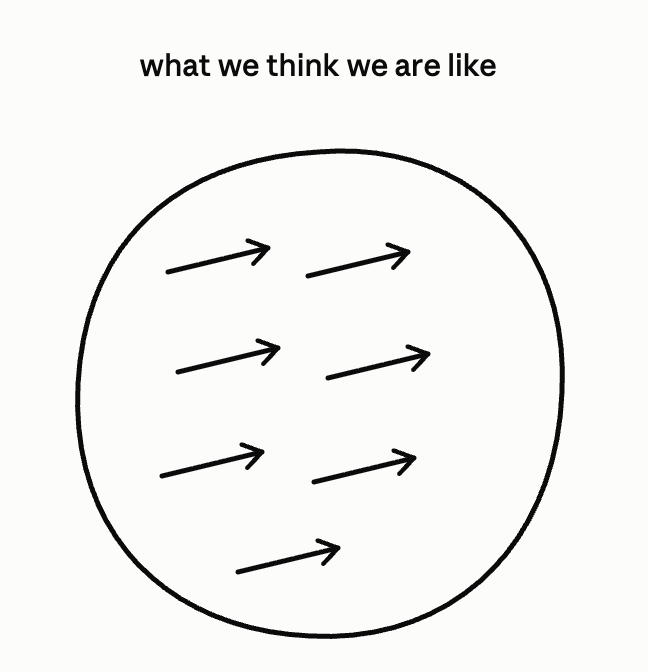
As nice as this might be, I suspect the reality looks something much more like this:
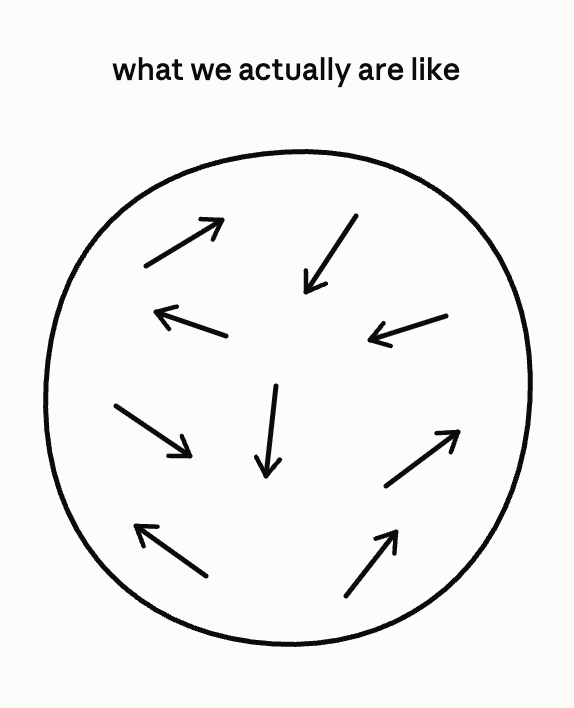
Where the concept we call “I” is but a mashup of differing, random, and often conflicting desires, patterns, and experiences. Or as Arram says, “You are not a single person. You’re an anxious committee that has agreed, for mostly legal reasons, to share a name.”
I recently-ish discovered an idea called Internal Family Systems (IFS) that is both fairly woo-woo, and an approach that I’ve found valuable in my own development. IFS is one of the first ideas I’ve come across that models your self-concept as a collection of parts. Some “parts” may want success and fame, others may be scared, others may hang out and judge other parts as they see fit.
I’ve found this “parts work” surprisingly effective. For whatever reason, for me it’s much easier to admit to myself that there are parts of me that want to be well known, to be successful, or to be well liked. And when I can admit that, it’s much easier to accept those parts exist, without the self-judgement that comes from not wanting to admit that “I” am this way or that. It’s a small (but effective) way to keep your identity small.
More and more, I feel like maturing is a slow process of accepting parts of you that you wish were different. Of accepting and surrendering to the reality that - for almost all of us - there are parts that we don’t love or are unhappy about.
I’ve found IFS to be surprisingly helpful in working through some emotional challenges in my own life. If you’re interested in learning more, I’d recommend the (fairly woo-woo) book No Bad Parts as a good starting point. This blog post is also quite a good overview!
Autoimmune diseases are exploding. Conditions like rheumatoid arthritis, POTS, Hashimoto’s, endometriosis… all have exploded in recent decades.
As I’ve learned more about our autoimmune conditions (basically, the body attacking itself) and the relationship between aging and inflammation, I’ve only gotten more confused. As far as I can tell, the immune system is a strange and fickle creature, one that we don’t understand.
At the same time, I’ve become more convinced that understanding and improving one’s immune function is among the single greatest levers you can pull from a health and longevity standpoint.
So - what is the immune system?
At a high level, the immune system exists to kill pathogens or other nasties that may harm you. The immune system functions like a security guard, roaming the body and checking ID to make sure that other cells belong. When they meet a pathogen that doesn’t belong, they attack.
But how does the immune system know what is “you” vs what is an external agent? It’s a surprisingly hard problem, and when it goes wrong you get a whole class of autoimmune conditions: conditions where your immune system attacks you!
An interesting fact I found in my research is that women are responsible for something like 80% of autoimmune disease. This likely is because women’s bodies are on the hunt for pathogens and other invaders that could harm a fetus. And their immune system is consistently more ramped up, hunting for pathogens.
Interestingly, women often see remissions in autoimmune conditions when pregnant. Once pregnant, the body significantly down-ramps its immune system so that the immune system doesn’t attack the half-foreign fetus. This is why rheumatoid arthritis goes into remission in something like 70% of pregnant women: the body is making sure it doesn’t attack the fetus!
The flip side of this coin is that the immune system fails to understand what is “you”, and allows harmful cells to grow unchecked (like in the case of cancer).
Frankly, given how hard this job is, it’s remarkable how well the immune system works. But it only works to the extent that your immune system successfully identifies what is “you” vs “not you”. And unfortunately for us, as we age that gets harder to do!
You see, every time a cell divides, it copies itself with tiny errors. After sixty years, practically every cell in your body is a slightly misspelled version of the original. This means that with enough time, from the viewpoint of your immune system, you stop looking like you. And when that happens, your own immune system starts treating you like the intruder, and attacking.
These constant, small attacks by your immune system on your own body is what scientists have started to call “inflammaging”. And I am more and more convinced that this idea is one of the core drivers of disease and rapid aging.
Which leads me to Dr. Vladimir Khavinson.
Back in Soviet-era Russia, researcher Dr. Vladimir Khavinson ran a study on 266 elderly patients, dosed them with two peptide extracts - Thymalin from the thymus and Epithalamin from the pineal gland - for a few years, and followed them for the better part of a decade. The 2003 paper was titled, and I’m not making this up, “Peptides of pineal gland and thymus prolong human life.” The reported results were staggering: up to a 4.1-fold reduction in mortality for the patients getting both peptides annually. If that were real, it would be the single most powerful longevity intervention ever discovered, by a mile.
Sadly, this trial has never been replicated (though honestly.. I would like to fund a 2nd crack at this). But what did stick from his research was the core idea that the thymus and immune system sit upstream of aging itself. And that by restoring thymus and immune function, you could significantly extend healthspan.
That premise is looking more right every year. In 2015, the far more rigorous Stanford TRIIM (Thymus Regeneration, Immunorestoration, and Insulin Mitigation) trial reversed epigenetic age by roughly 2.5 years by coaxing the thymus back to life. The TRIIM team is now running a much-expanded pilot, with results publishing later this year. If they still hold, it seems like focusing on improving thymus health may be one of the highest-leverage longevity interventions out there. And an incredibly strong proof of concept that the immune-aging thesis is a very strong hypothesis.
I’m still digging into exactly what this means for my life, and how (if at all) I should think about thymus-maxxing. I’ll keep you posted on what I learn.
But in the interim, I am extremely bullish on this thesis of “improve immune health, and improve aging”. If this is a problem you’re personally interested in working on, or know companies working in this area, please let me know. Would love to chat!
A big part of maturing in my career has been seeing something in the real world and connecting it to old quotes by someone like Charlie Munger. And then being like, oh. That’s what he was talking about.
Charlie is best known for his quotes on incentives, including bangers like:
“Show me the incentive and I’ll show you the outcome”
“”I think I’ve been in the top 5% of my age cohort all my life in understanding the power of incentives, and all my life I’ve underestimated it. And never a year passes but I get some surprise that pushes my limit a little farther.”
“Never, ever, think about something else when you should be thinking about the power of incentives.”
I’ve been thinking of Charlie’s quotes through the lens of regulatory capture. Increasingly, I’m convinced that regulatory capture is upstream of many of the biggest issues we have in society. Where I live (Austin, TX), we are within a 3 hour drive of Houston, Dallas, and San Antonio: the 4 most productive cities in Texas. For decades, groups in Texas have worked on legislation to get high-speed rail built that would connect each of these thriving metros. And for decades, these initiatives have been scuttled by intensive lobbying from Southwest Airlines (1).
Once you’re aware of regulatory capture, you see it everywhere. Intuit lobbying the government to make it impossible to file your taxes online for free (2). Private prisons that lobby the government to support policies that will put more people in prison (3). Or food lobbying groups who managed to get Congress to declare pizza a vegetable. It’s the tomato sauce that does it, apparently (a fruit, of course, but at this point who even cares).
This is one flavor of regulatory capture. The other flavor is something called the “Shirky Principle”, which effectively says that Institutions will try to preserve the problem to which they are the solution.
We’ve seen a lot of examples of this lately. The SPLC paying to stage hate riots (like the ones in Charlottesville), the Komen Foundation suing other charities searching for a breast cancer cure (5), or countless examples of more funding for homeless services leading to more homelessness.
This makes sense only through the lens of incentives. Any organization tasked with “solving a problem” will inevitably fail to solve the problem. After all, if the problem was solved, well, the organization would no longer have a reason to exist!
Now, this doesn’t always happen. But it happens enough that it’s very worth being aware of.
Things could be so much better. We have the resources, the will, and the ability to build high-speed rail, solve homelessness and drug addiction, and cure diseases like breast cancer. What we don’t have - and what I am increasingly interested in spending energy and resources on - are ways to govern and operate that are resistant to things like regulatory capture.

Arthur MacWaters@ArthurMacwaters
What blows my mind about the Roman Empire is that lack of technology is far easier to overcome than lack of freedom from bureaucrats Like unironically these guys built the most insane civic architecture and still hold the record We have to technology to build something a


𝐑𝐎𝐌𝐄 @ConsulofRome_
The Circus Maximus, to this day, holds the record as the largest sporting venue ever built by mankind. Image by @JCGolvin
2:49 AM · Jul 23, 2026 · 3.03M Views
587 Replies · 1.4K Reposts · 17.2K Likes
Some of my favorite things since the last newsletter (note: I don’t get paid to recommend anything here):
📰 Article - I really enjoyed this short and punchy story (h/t Andy Bromberg) by a random blogger I’ve never heard of. I absolutely love the form factor of well-written, funny blog articles: a form factor that (sadly) seems to be going extinct. If you have anything else in this genre, please let me know!
📚 Book rec - The Three Body Problem is one of my favorite books ever. I just finished reading The Wandering Earth, a book of short sci-fi stories by the same author. Though not as good as The Three Body Problem, I still hugely enjoyed it.
⌚ Cool product - I recently started to use the Intake breathing product (powered by Truemed!) to help me breathe better while I sleep. Early results are promising, and part of a longer protocol I’m testing to get my sleep in a better place overall. No, having a baby does not help 👶
🎵 Music - This set with Fred Again.. And one of the Daft Punk guys is amazing, but is pretty high energy. For work, I really enjoyed this new set by James Grant. Enjoy!
🏀 Random - A new study found that bright light exposure in the evenings was linked to a higher risk of macular degeneration and other major eye diseases. I increasingly think that macular degeneration is going to be a big deal in the coming decades (biz opportunity 💡), and suspect that our bright evening lights are a major cause. I know I’ve felt much better since switching all the lights in my home to circadian lighting from Healthy Home.
🔥Hot take - I think one of the biggest opportunities hiding in plain sight is building a health-oriented development (and eventually, a city). This is maybe not a hot take, but I keep thinking that our health is a reflection of our environment. And without fixing one’s environment, fixing the health of the population is going to be an uphill battle.
I’m increasingly interested in thinking more about what it’d take to build a health-oriented town or community.🙋♂️ Ask - Kettle & Fire is looking for healthy cafes, grocery stores, and restaurant partners to sell/promote bone broth by the cup this fall/winter. If you know of any places we should partner with, please let me know!
***
I’ll be in Italy (Florence, then Tuscany) in a few weeks for a wedding. If any of you have recommendations of unique things to do, please just reply to this email - I’d love to know and have very little planned just yet!
Justin
No posts
Comments
Nothing yet. Say the first thing.
Sign in to join the conversation.