
Hi there, and welcome to The Next - my take on health, wellness, and company building.
In the last few years I’ve founded 3 health brands (Kettle & Fire, Perfect Keto, Surely non-alc wine). I’m now working on Truemed, which allows qualified health and wellness brands to accept HSA/FSA funds. Previously, I worked in tech and had no experience in CPG, DTC, or any other 3-letter industries.
If you missed past episodes, I recommend checking out The Great American Poisoning, my take on the chronic disease crisis. Otherwise, let’s dive in!
Truemed recently announced our $34M Series A led by a16z, with Bessemer, Long Journey, Box Group, and Trust all participating.
As I’ve said many times, we are in the midst of a chronic disease crisis. Americans are the sickest population the world has ever seen: 50% of Americans have diabetes or prediabetes (25% of kids) and 73% of Americans are obese or overweight (45% of kids). 93% of Americans have at least one marker of metabolic dysfunction that signals future chronic disease, and chronic illness is up 300%+ since the 70s.
Historically, the average American was healthy. When they got sick, they’d go to the doctor, get patched up, and return to their mostly healthy lives.
Today, the opposite is true. The average American is sick, and ~90% of healthcare costs in the US go towards managing - not curing - the chronic conditions (cancer, heart disease, diabetes, etc) that afflict so many Americans (more about this in The Great American Poisoning.
If these trends continue, it will end the American experiment. Infertility, diabetes, cancer, dementia, heart disease… it is impossible to have a healthy society made up of sick humans. There is no world in which healthcare costs both go down and Americans continue to get sicker.
After I stepped down as CEO of Kettle & Fire, I thought about what I wanted to do next. I firmly believe that Americans are some of the sickest people in the world because we’re incentivied to be. The cheapest food is the worst for you, and wellness is expensive!
I started Truemed to get more people investing in True Medicine: exercise, dietary interventions, sleep, supplements, movement, toxin removal… things that treat the root cause of disease, or prevent sickness in the first place.
More than just prevention, lifestyle interventions are in many cases more effective than pills and surgeries to treat the chronic conditions that make up our healthcare burden today. Yet if you walk into a doctor’s office and tell them that you have high cholesterol, are they more likely to give you an exercise prescription or put you on a statin? Certainly, the latter:.
This is Truemed’s opportunity. To build the infrastructure that enables effective lifestyle interventions to become part of the healthcare system. Our vision is a world where individuals have more choice when it comes to healthcare. Yes you can get a statin, just like you can today. Incentivizing root-cause interventions like exercise or dietary changes may be what many individuals need to prevent or treat a chronic condition.
This is one of the most important missions in the world. If we do this right, we will save trillions in annual healthcare costs and add years of life for hundreds of millions of people. This funding is a big step towards achieving our mission, and I’m extremely excited about the work we’re doing.
We’re also hiring! If you want to play a role in fixing the chronic disease crisis, we’re hiring across marketing, product, and engineering!
I’m about to say something that might get me kicked out of the keto club: bread might not be the villain we’ve made it out to be.
Humans have been eating bread for roughly 10,000 years without the epidemic of obesity, diabetes, and chronic disease we see today. The ancient Egyptians ate bread. The Romans ate bread. Your great-grandmother ate bread, probably every single day.
Picture this: It’s 1850, and you’re a farmer in rural America. You grow wheat, harvest it, take it to your local mill, and walk out with fresh flour you’ll use in days.
Modern white flour is a wasteland. During industrial milling, we remove 80% of the fiber, 76% vitamins and minerals, and most of the phytonutrients and antioxidants that make grains easier to digest. Then (in the case of most white bread), we “enrich” it by adding back four synthetic vitamins and call it a day. It’s like burning down a house and replacing it with a cardboard box labeled “home.”
The wheat germ alone contains vitamins E and B, magnesium, zinc, and healthy fats. The bran contains fiber, minerals, and phytonutrients. These nutrients work together—the vitamin E protects fats from oxidation, B vitamins help metabolize carbohydrates, and minerals support enzymatic processes.
It gets worse! You may have heard of phytic acid, the “anti-nutrient” that binds to minerals and makes them harder to absorb. Modern nutritionists see this and say, “I told you: grains are bad!”
Ancient societies figured out how to handle the phytic acid problem: fermentation! When you make bread with long fermentation - like traditional sourdough - phytic acid is broken down. A study in the Journal of Food Science and Technology found that sourdough fermentation reduced phytic acid by 62-95% (depending how long it was fermented).
Traditional bakers knew bread made this way was easier to digest. Today, most commercial bread today ferments (and rises) for maybe an hour or two at most. There’s essentially no phytic acid reduction, no development of beneficial compounds, no improvement in digestibility.
Beyond fermentation, the process of milling has also changed a tremendous amount. When wheat is milled, you expose all its components to oxygen. And wheat contains polyunsaturated fats that are incredibly susceptible to oxidation.
Within 72 hours of milling, wheat flour begins to oxidize. Within a few weeks, those fats go rancid. And rancid fats are terrible for you: they create oxidative stress, damage cell membranes, and contribute to inflammation.
But wait - doesn’t store-bought flour last for months or years?
Yes! And that’s because modern milling removes the parts that would go rancid. The bran (fiber-rich outer layer) and germ (nutrient-dense core) are stripped away, leaving just the starchy endosperm. Shelf-stable, but nutritionally bankrupt.
I’ve been increasingly convinced that eating freshly milled, long-fermented bread is probably neutral-to-good for you from a health standpoint. Someone on the Truemed team even recently made bread using an at-home mill that was just phenomenal. One of her Celiac friends can even eat real-grain bread if freshly milled, with zero issues!
We often focus far too much on macros - protein, carbs sugar, fat - at the detriment of understanding sourcing, toxins load, the whole package. A piece of fresh sourdough made from organic, freshly milled whole grains is not the same as ultra-processed white bread made from oxidized flour and glyphosate-laden wheat. Yet unfortunately, both are “bread” when it comes to folks saying “bread is bad for you”.
We’re living in a time when practically everything in the grocery store has been degraded and adulterated beyond recognition. The appropriate response isn’t to declare all of something as “bad”. It’s to get really picky about sourcing and preparation, and to demand better.
Few understand just how much of the American food system is controlled by just a few players. Something like 80% of the food Americans consume today comes from 12 companies (1). Insane!
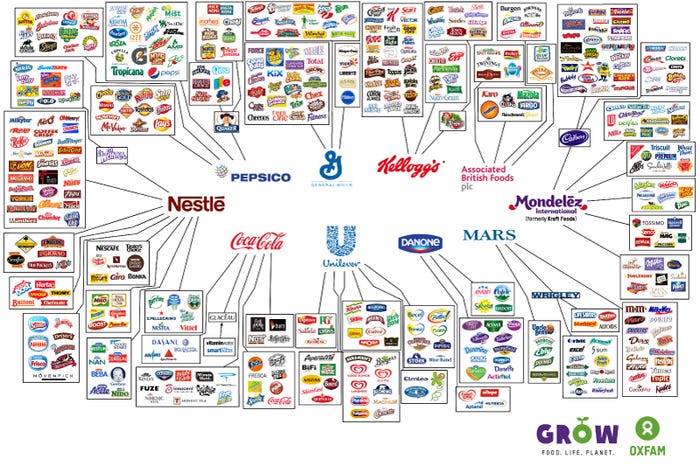
Today’s Big Food companies have been around for 100+ years and have advantages that are hard to compete with. They have scaled supply chains, distribution in every retail chain, and know how to do things like run global advertising campaigns, or lobby the CDC to ignore obesity!
These brands have historically also been very profitable. Returns to scale are real, and as companies like Kraft replaced a real ingredient with a new chemical here, watered down a product there, margins went up. This has worked pretty damn well since roughly the 1980s.
But the times, they may be a’changing. Today, the returns to scale from a sourcing standpoint are becoming more liabilities than assets. A large (and growing) number of consumers are now willing to spend more on food that’s well-sourced and healthy. Pretty much the only brands that have seen any growth in recent years are healthy ones: an area where Big Food is waaaay off the mark.
Big Food addresses this by buying brands. One of the unfortunate realities of the food/CPG space is that challenger brands spend decades building a company doing things the right way. And at the end of the journey, assuming all goes well, practically all of them sell to Big Food. There have only been 3-4 companies in the last 20 years that have gone an alternative route: Vital Farms (IPO), Chobani (rumored IPO), and a smattering of others that have both gotten big and not sold to Big Food (like GTs kombucha).
One of the biggest opportunities that exists today in the food world is building a competitor to big food. And doing so by turning their advantages (scaled supply chain) into disadvantages.
You see, Big Food has spent decades optimizing for a centralized and scaled-up supply chain. This has driven costs way down, sure, but it’s come with tradeoffs. When you source all your raw materials from a few centralized farms, it requires a supply chain where your raw materials are sprayed with a lot of pesticides, have to travel thousands of miles from harvest to sale (and thus are both less nutrient dense and less tasty), and - in order to maintain freshness over long distances - are often sprayed with pesticides and processing agents to make products taste good. Look no further than companies like Apeel, which are adding a seed oil coating to produce (including organic produce!) in order to make produce last just a few more days!
The food system I want to see is one that is local, nutrient-dense, and doesn’t require loads of pesticides and preservatives to make it work. Big Food is fundamentally, structurally unable to provide this. There is a huge opportunity to combine several better-sourced, better-for-you brands and really attempt to take on Big Food.
I’d love to invest in anyone who is seriously taking this on, as I think it’s a massive idea. But boy will it be a battle.
Some of my favorite things since the last newsletter (note: I don’t get paid to recommend anything here):
📰 Article - This post on the author overcoming her psychosis using metabolic therapies is astounding. Of all the mental illnesses, surely psychosis is one of those that is just bad luck of the draw… right?
I am increasingly bullish on the field of metabolic psychiatry: using metabolic therapies to address mental illness. Dr. Chris Palmer talks about this in his book Brain Energy, but I suspect that metabolic approaches to mental illness will be the most fruitful area in all of mental health in the coming decades.📚 Book rec - Conscious Accomplishment is likely the book that’s made the biggest impact on my life in the last year. In 2024, I got very into Michael Singer’s work (The Untethered Soul, The Surrender Experiment). Conscious Accomplishment feels like an applied version of Singer’s work, and resonates with me as someone who both wants to move down a spiritual path and do big things in the world. It’s the best book I’ve found that encompasses this “ambitious spirituality” idea, as a friend and I call it. Highly recommend!
⌚ Cool product - Kettle & Fire launched a beef tallow! I’ve long been a proponent of swapping seed oils (sunflower, canola, corn, and soybean oils) for tallow, as I believe it’s one of the best health upgrades you can make. And while you’re at it, be sure to try our wild-harvested venison bone broth (in my opinion, our best product).
🎵 Music - This new James Grant + Jody set would normally be a shoe-in favorite, but… I didn’t love it. Felt dark and a bit heavier than most of their stuff (but you still may enjoy). What I did enjoy this month was listening to this new Marsh set. Marsh has been one of my favorite finds this year, and is one of my top picks for someone who will be very big in the deep house scene in coming years.
🏀 Random - It seems that since 2010, because of blue light and smartphones, women’s menstrual cycles have gone out of sync with the moon. I haven’t dug deep into this study, but it’s another (possible) data point that we as humans are vastly underestimating the impact of light on our health. If you’re curious about the impact of light on chronic disease, here’s an 18 page google doc I randomly found that outlines their hypothesis as to why circadian changes are the driving factor behind the chronic disease criris. I disagree, but it’s an interesting idea nonetheless!
🔥Hot take - I suspect that a significant portion of our hyper-polarized politics is downstream of dating dynamics. Men and women naturally moderate one another politically: men tend to be more conservative, and women more liberal. The fact that men and women are marrying later is one of the reasons for our highly politically charged environment. I think you see it as well at the extremes in our culture today, where single women are much more liberal than ever, and there’s a strong contingent of very conservative men.
Whatever it is that will help us get through this period of intense political polarization, I suspect addressing the gender dynamics will be a key part of a solution.🙋♂️ Ask - My friend Andy is opening up applications for the tinkering club, a group of builders working (often solo) on a new business, art project, or whatever. If I was starting a company or kicking off something new, it’s the kind of social experiment I’d definitely check out.
Also, if you’re looking for a deep house track about seed oils, look no further than Show Me The Bottle. Truly exceptional.
***
It was fantastic to see that finally, after decades, the FDA removed the HepB vaccine from the infant schedule. I have been so tired of our vaccine debate: if it’s off the schedule, and you’re worried about your infant getting a disease that can only be contracted via sexual activity or a blood transfusion - get it! Otherwise, it seems like a positive step forward for the country, and puts the US more in line with countries like Switzerland and Finland that don’t mandate the HepB shot.
The vaccine conversation is exceedingly polarized, which is annoying. If you’re curious, I went deeper on this topic (after recently having a child) in my post here. Would love thoughts and feedback! Otherwise, Merry Christmas, see you all in 2026!
Justin
No posts
Comments
Nothing yet. Say the first thing.
Sign in to join the conversation.