
This week is about control.
Not control in the “pause every campaign and panic” sense. Control over the facts Google can read, the signals your ad accounts learn from, and the local proof that helps real prospects choose you.
Why your Google Business Profile needs an operating rhythm
How bad conversion signals can teach Google Ads the wrong lesson
What multi-location complexity says about every local business
A GBP appeals update worth knowing before you need it
A Reddit PMax warning that local advertisers should read twice
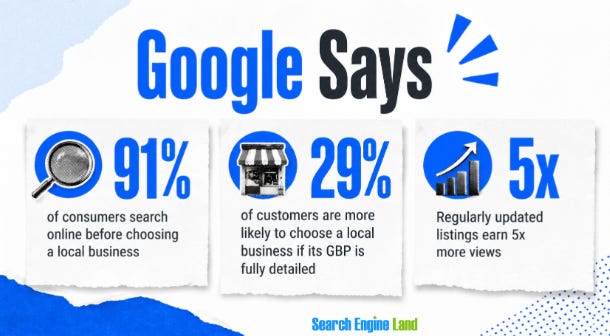
The reason this matters is simple: your Google Business Profile is not a digital business card. It is one of the places where propects, Google, Maps, and AI systems decide whether your business looks active, trustworthy, specific, and easy to choose.
Search Engine Land pulled together Google’s guidance for general businesses and service businesses. A few details should get every local owner’s attention. Photos can drive more direction requests and website clicks. Complete profiles, accurate hours, relevant attributes, review responses, and Google Posts all help people understand the business before they call.
That last part is the real point. Local SEO is not just “rank higher.” It is “make the next prospect confident enough to take action.” If your hours are stale, photos are old, categories are vague, services are incomplete, or reviews are unanswered, the profile is doing less work than it should.
The Real Reason This Matters:
Prospects often decide from the profile before they ever visit your website.
AI and local search features need structured, current business details to understand what you offer.
GBP neglect creates friction at the exact moment someone is ready to call, book, or ask for directions.
Key Takeaway: Your GBP should have a weekly maintenance rhythm, not a once-a-year cleanup.
Action Step: Pick one location this week. Update photos, services, attributes, hours, social links, review responses, and one Google Post. Then repeat that checklist every week.

WordStream published a fresh guide to improving Google Ads lead quality, and it lands right where most local campaigns struggle. The issue is rarely just “we need more leads.” The issue is whether Google is being trained to find people who become booked appointments and qualified calls.
If your primary conversion is a shallow action, like opening a contact page or submitting a weak form, the campaign can look productive while the front desk feels the opposite. Local advertisers need to measure the full path: keyword, ad, landing page, form, call, booking, show rate, and revenue.
The Real Reason This Matters:
Google Ads optimizes toward the signals you mark as valuable.
Cheap leads can still be expensive if staff time, no-shows, and bad-fit calls go up.
Lead quality problems often start in tracking, offer clarity, and follow-up, not the ad copy.
Key Takeaway: Volume is not the win. Qualified demand is the win.
Action Step: Make a simple lead-quality scorecard with source, campaign, lead type, booked status, and outcome. Review it before raising budget.

Search Engine Journal covered the growing complexity of local marketing, especially for multi-location brands. The piece focuses on listings, reviews, local content, AI visibility, and location data, but the lesson applies to smaller local businesses too.
Local visibility now lives across Google, Apple, Bing, directories, reviews, social posts, business descriptions, attributes, photos, and AI answers. That is too much to manage casually. If no one owns the rhythm, small errors become invisible drag.
The Real Reason This Matters:
Local discovery is spread across more surfaces than most teams actively manage.
Reviews, listings, attributes, and local content now feed both human and AI-powered discovery.
The businesses that win are often the ones with a simple operating checklist, not the flashiest tool stack.
Key Takeaway: Local marketing is becoming an operations habit.
Action Step: Build a recurring weekly review: listings, reviews, GBP updates, top landing pages, tracking, and calls. Keep it boring enough to actually run.

Search Engine Roundtable reported that Google updated the Business Profile appeals workflow. Businesses can now upload evidence during the appeal instead of submitting the appeal first and racing through a separate evidence step.
This is not glamorous news, but it matters if a profile gets suspended. Local businesses often discover too late that they do not have proof organized: signage, licenses, utility documents, address evidence, storefront photos, ownership details, and service-area documentation.
The Real Reason This Matters:
A suspended GBP can cut off calls, directions, reviews, and local trust almost overnight.
The new workflow is cleaner, but it still depends on having evidence ready.
Service-area businesses and multi-location brands need documentation before there is a problem.
Key Takeaway: GBP protection is part of local marketing, not an admin afterthought.
Action Step: Create a GBP evidence folder for each location with license, signage, address, ownership, and storefront or service-area proof.

WordStream’s new Google Zero article is about future-proofing content for a search world where more answers happen before the click. That is not only a publisher problem. It is a local business problem.
If someone asks an AI tool or search result for the best option nearby, your content has to be useful in fragments. Clear services, plain-language answers, pricing context where appropriate, location details, proof, FAQs, reviews, and specific fit all matter more when the platform summarizes you.
The Real Reason This Matters:
Local buyers may learn about you from summaries, maps, snippets, reviews, and AI answers before your website.
Generic service pages give machines generic material to repeat.
Helpful content now needs to answer real buyer questions in language prospects actually use.
Key Takeaway: Write pages that help a person decide, not pages that only chase a keyword.
Action Step: Add five real prospect questions to one important service page. Answer them plainly, with details that make your business easier to understand and easier to choose.
Spicy Take
🌶 PMax Will Optimize for the Signal You Give It
A fresh r/PPC thread from a psychology-practice advertiser should make every local business check its conversion setup.
The advertiser had a Performance Max campaign that produced real bookings, but also reported hundreds of contact-page-open conversions that the site’s analytics did not support. Their concern was exactly the right one: if Google learns from inflated micro-conversions, it may find more people who trigger weak actions instead of people who book.
The spicy take: automation is not the problem. Lazy conversion definitions are the problem.
Key Takeaway: If the signal is weak, the machine can still optimize perfectly toward the wrong thing.
Search Engine Roundtable noted new Google AI Max FAQs. Before you test AI Max, document what is changing, what stays controllable, and what conversion signals it will learn from.
Google Ads added a last event ping timestamp for conversions. Use it as a fast tracking-health check before blaming performance.
Google Search Console now surfaces Instagram, TikTok, X, and YouTube performance. Local brands should treat short-form content as part of search visibility.
Semrush published research on AI tools in vendor discovery. Local buyers may not call it procurement, but they are doing the same comparison work.
Semrush’s Cardmarket SEO story points to a useful local lesson: the language your prospects already use is usually better than generic service copy.
Google’s GBP playbooks call out posts, photos, attributes, social links, and review responses. Pick one neglected field and update it this week.
The r/PPC PMax thread is a clean warning: page views and contact-page opens are not the same as calls, bookings, or qualified leads.
If your GBP gets suspended, you do not want to hunt for proof under pressure. Keep license, signage, address, and ownership evidence organized.
Before increasing ad spend, check whether your calls, forms, and bookings are moving in the same direction. If not, the campaign is probably optimizing for the wrong win.
If your marketing reports show leads but your team says the leads are weak, it is time to look closer.
Book a “Help Me Get More Leads” Call with Justin: In 15 minutes, I’ll give you a practical, no-pressure assessment of what is helping or hurting your lead flow and what to fix next.
Thanks for reading Local Marketing Minute! This post is public so feel free to share it.
Comments
Nothing yet. Say the first thing.
Sign in to join the conversation.