
How many Kickstarters are too many in a given year? This is a question I posed in a poll following the most recent Voltessa campaign. The feedback was largely centered on cost, fulfillment, and the quandary of shipping internationally.
This has been driving me mad for a decade. I would prefer a global market and an ability to compete in it. In fact, right now, one of my Road Witch comics is being translated into Croatian as part of an anthology, and I wish I could sell more comics overseas. I do what I can to lower costs, but the USPS is increasing rates almost twice a year. It would be a full-time job to find printing and fulfillment partner(s) overseas whom I trusted.
Again, why can’t someone build a BookVault for comics?
Because I do all fulfillment myself, I don’t think I could do more than six campaigns a year without losing my mind. This means I can’t have production delays and overlap that create distrust among supporters and books that aren’t delivered by or at least close to the promised date.
This is probably the biggest misconception surrounding Kickstarter, and it’s one I completely understand. When a campaign ends, all anyone sees is a big number at the top of the page. Let’s use a nice, round hypothetical figure and say a campaign for THICC HOUSEWIFE #1 raises $20,000—a straightforward 32-page color comic. No foil covers. No fancy shit.
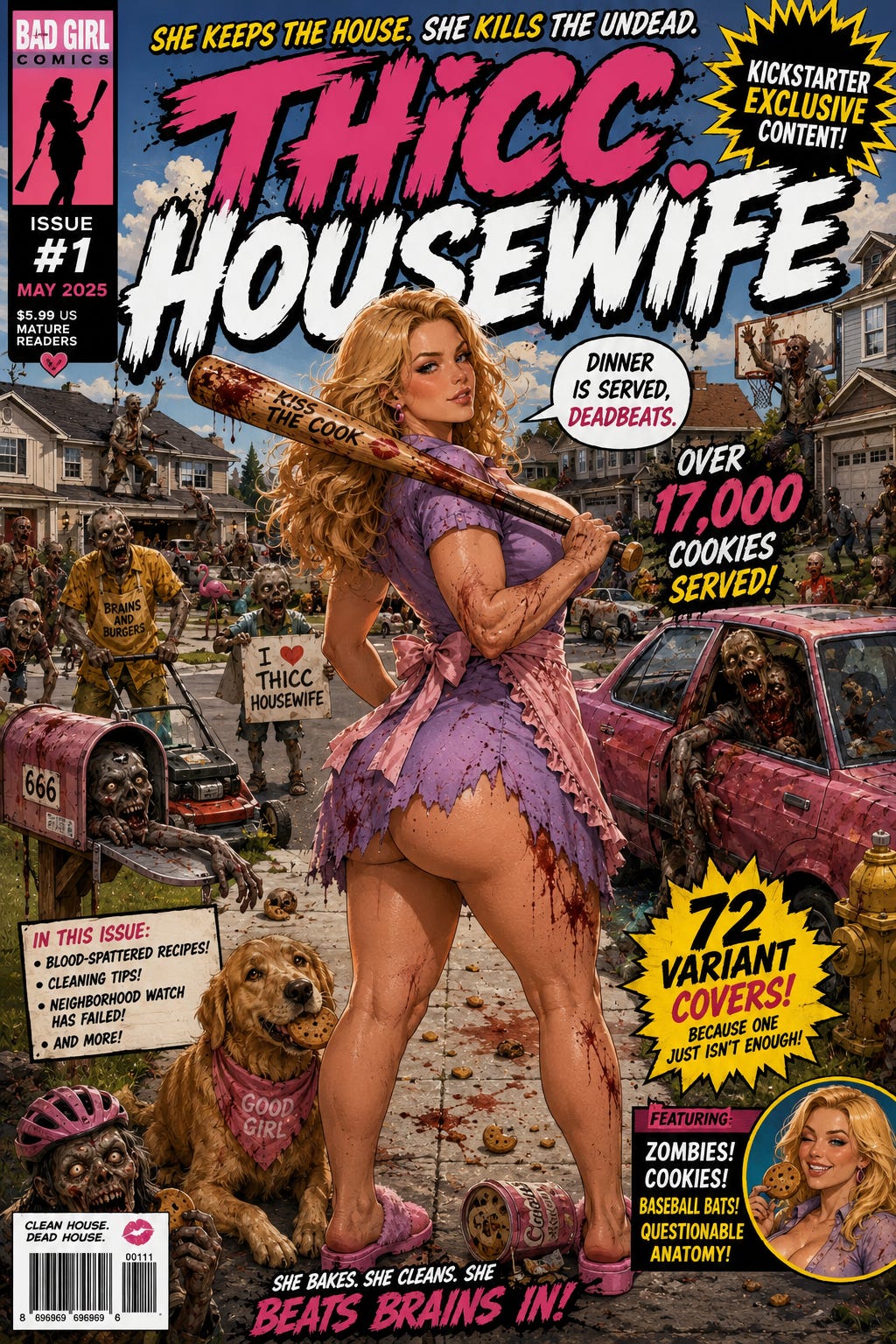
I apologize. I couldn’t help myself this shit is too funny like Mad Magazine.
Anyway…
Most people assume the creator just received a twenty-thousand-dollar check.
That’s not what happens.
Kickstarter and payment processing take their share. That’s roughly $1,500 to $2,000. Then come the inevitable failed pledges. Credit cards expire, payments are declined, banks flag transactions, and a handful of backers never complete payment. Shit happens, and that’s understandable. Using a typical failure rate, that’s another $700 or so.
Suddenly that $20,000 campaign has become roughly $17,300.
Now THICC HOUSEWIFE #1 actually has to be produced (by Humans).
Every project is different. One artist may charge more than another. A cover might cost a few hundred dollars or well over a thousand. Some creators commission one cover while others commission dozens (72?). Some letter their own books. Others hire a letterer. The numbers change, but the categories don’t: artwork, colors, covers, lettering, printing, packaging, postage, software, advertising, and the dozens of small production costs that quietly add up.
By this point, you’ve already spent somewhere between ten and twelve thousand dollars producing and fulfilling the project.
That leaves somewhere in the neighborhood of five to seven thousand dollars.
At first glance, that sounds like the creator’s paycheck.
Not so fast my friends!
Independent publishing isn’t a one-and-done business. If you want to keep making comics, that money doesn’t simply become income. Much of it gets rolled directly into the next campaign—commissioning covers, ordering supplies, building the next Kickstarter, and keeping production moving forward. Don’t forget to set some aside for Uncle Sam!
It also doesn’t include the boring shit like the cost of running a business. Utilities. Internet. Software subscriptions. Websites. Fuel. Vehicle maintenance. Office supplies. Equipment. None of those expenses appear on a Kickstarter page, but they’re just as real as paying an artist or printer.
Then there’s the most precious commodity of all — time.
Let’s say a campaign like this represents roughly 375 hours of work from the first script to the last package in your mailbox. At $15 an hour, that’s $5,625 worth of labor.
In other words, our hypothetical Kickstarter successfully raised $20,000, paid its bills, delivered the comic, and still didn’t generate enough to both compensate the creator at minimum wage and provide the working capital needed to begin the next project.
There are certainly ways to lower costs. Printing 500 or 1,000 copies overseas can dramatically reduce the cost per comic. The tradeoff is that you now have to pay for those books up front and find a place to store them while hoping they’ll eventually sell. Using Blue Geisha as an example there are currently 5 issues. even if I could move 400 of each I’m still sitting on 500 comics. Inventory can kill you.
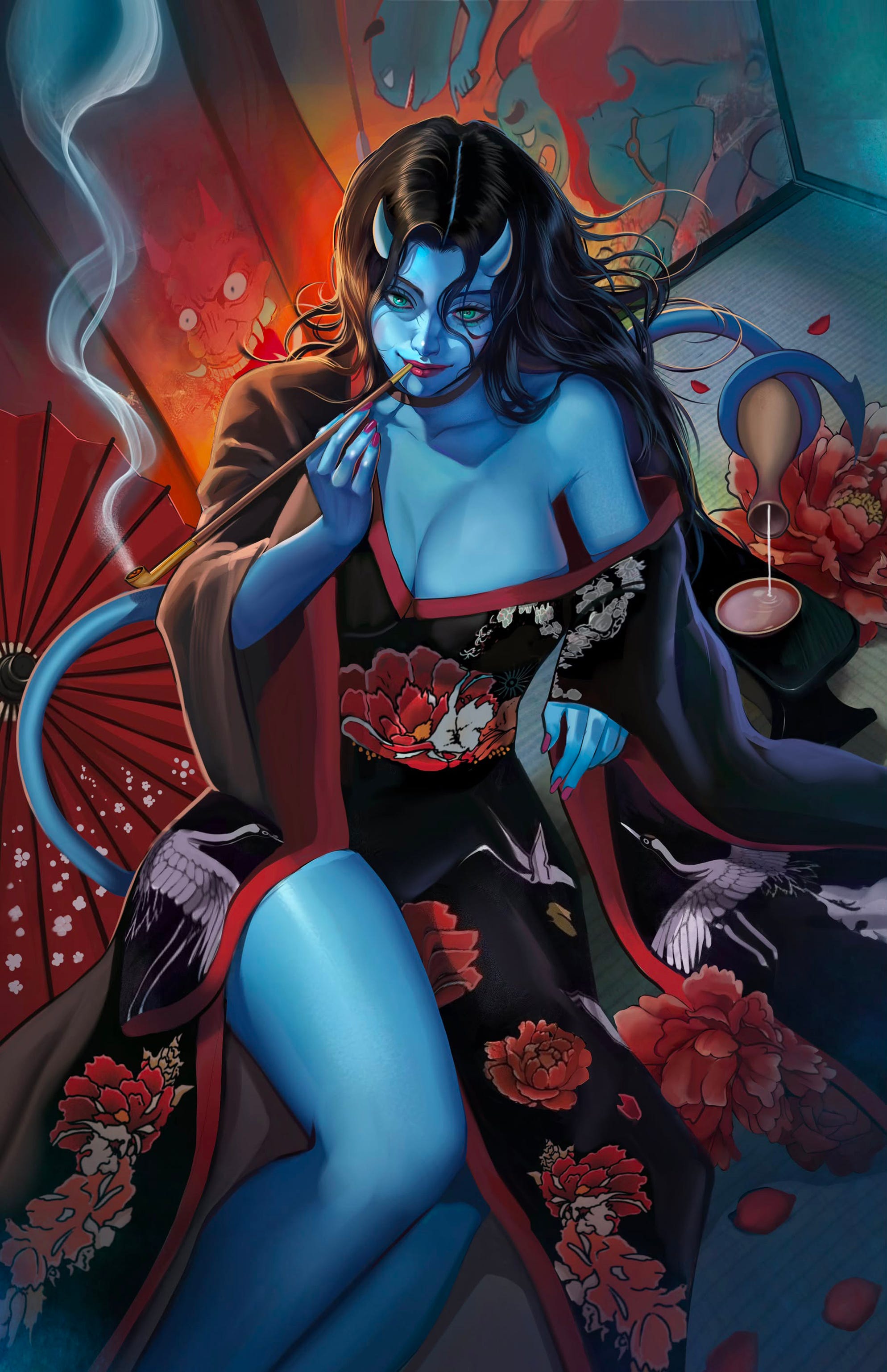
I play the long game.
I don’t do enough conventions or move enough units to justify filling my basement (or a warehouse) with inventory simply to lower my printing costs. My goal is to build a readership that comes back campaign after campaign and eventually expands to some buying directly from my website when the inevitable comes. That means smaller print runs, higher per-unit costs, and less financial risk.
A $20,000 campaign can keep the business alive.
A $40,000 campaign starts making it possible for the business to support the people running it.
That’s the difference between making comics and making a living making comics …with human hands like the lovely cover for Blue Geisha 6 I just showed you.

A quick reminder that I Eat Monsters is back on Kickstarter after an extended hiatus. Originally, this image featured a green monster over Annabelle’s shoulders and, after watching an interesting YouTube video about how Matt Groening purposely made the Simpsons yellow, I decided to test that theory.
-Justin
No posts
Comments
Nothing yet. Say the first thing.
Sign in to join the conversation.