
I want to walk through this paper the way I’d present it at a case conference, not the way a press release would spin it. Two patients, real numbers, and an honest look at what a case series can and cannot tell you.
The setup
Both patients were adolescent females, mean age 12, both classified Lenke 5C — a thoracolumbar/lumbar curve pattern, which matters clinically because these curves behave differently than thoracic curves in terms of both natural history and response to conservative loading. Neither had prior exposure to bracing or scoliosis-specific exercise. Both were flagged for rapid progression, which is the scenario where families are usually told to watch and wait until the curve crosses a surgical threshold, or to go straight to bracing with the standard expectation of halting progression rather than reversing it.
We ran both through a two-week, 20-session intensive protocol built around mechanical traction, Mirror Image positioning, proprioceptive neuromuscular training, whole-body vibration, and corrective exercise, then fit ScoliBrace during week two. That sequencing is deliberate. You’re not bracing a static curve; you’re bracing a curve you’ve already started to mechanically remodel, which changes what the brace is being asked to hold.
What we measured, and what we found
We didn’t just track Cobb angle. We pulled Functional Rating Index scores, height, chest expansion, angle of trunk rotation, Stork balance testing, and Modified Cox measurements at baseline, immediately post-intensive, and at 6 and 12 months. That’s the part I’d push back on if I were reviewing this blind: a lot of conservative scoliosis literature reports Cobb angle in isolation, which tells you about the radiograph but not about the patient in front of you.
Case 1: 35.7° pre-intensive to 21.7° immediately post-intensive, down to 10.4° at 12 months. That’s a 71% total reduction from baseline.
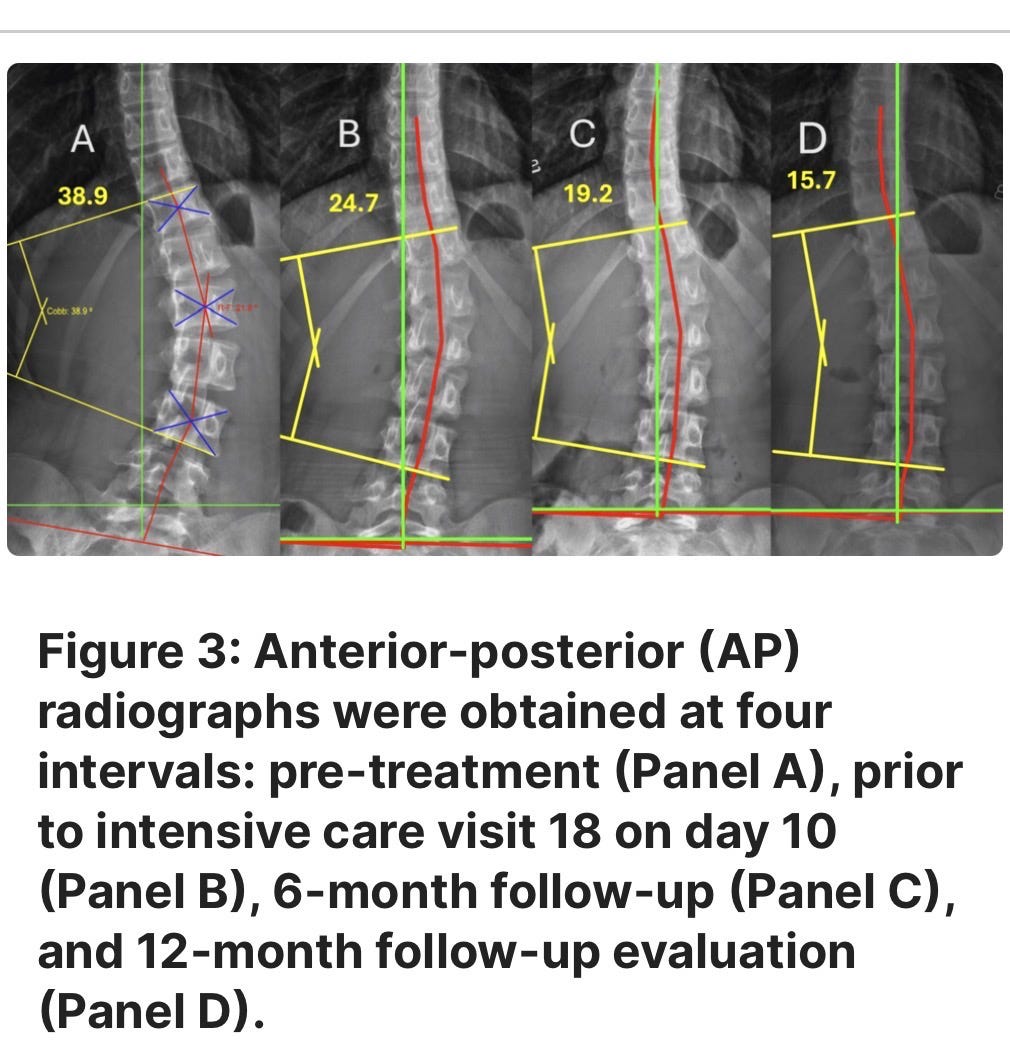
Case 2: 38.9° to 24.7° post-intensive, 15.7° at 12 months. A 60% total reduction.
Both showed corresponding improvement across the functional measures, not just the imaging. That correlation is what makes the radiographic change more credible to me clinically — a Cobb angle can move a few degrees on repeat films from positioning alone, but you don’t get parallel improvement in trunk rotation and balance testing from measurement noise.
Where I’d stress-test my own paper
This is a case series of two. N=2. That’s Level IV evidence at best, and I’d say that to a referring physician’s face before I’d let them read more into it than is there. Two things I want to be direct about:
There’s no control group and no blinding on the Cobb measurements. Progression risk in early adolescence is variable on its own, and I can’t rule out that some of what we saw reflects natural variability layered on top of the intervention. Case series generate hypotheses. They don’t confirm them.
Second, these were self-selected patients who completed an intensive, resource-heavy two-week program plus follow-through with bracing. That’s a specific population — motivated families with the capacity to do a short-duration, high-frequency intervention. It doesn’t tell you what happens with a patient who can only tolerate a lower-frequency outpatient schedule, and it doesn’t tell you what happens in curves that don’t share the 5C pattern.
Why I still think it’s worth publishing
The honest reason to put this in front of other clinicians isn’t to claim we’ve solved AIS management. It’s that the existing conservative literature is heavily weighted toward PSSE and bracing studied independently, and there’s a real gap in describing what a short, intensive, multimodal protocol does when it precedes bracing rather than substituting for it. If nothing else, this gives other CLEAR-trained and SOSORT-aligned clinicians two fully worked, transparently reported cases to compare against their own outcomes.
The paper closes by saying these results warrant investigation in larger prospective studies, and I mean that as more than a boilerplate limitations line. A two-patient case series is the floor of the evidence hierarchy, not the ceiling. If this protocol holds up, it needs a prospective cohort with pre-registered outcome measures and enough patients to say something about effect size with actual confidence intervals, not two data points and a percentage.
If you’re a clinician managing Lenke 5C curves, or a parent trying to understand what “non-surgical” options actually mean beyond bracing alone, I’m glad to talk through the specifics of what’s in the full paper. It’s open access through Cureus, linked above.
—
Dr. Justin M. Dick, DC, is a CLEAR Institute Fellow and Board of Directors member, dual-credentialed in imaging (CNMT, ARRT(N)(CT)), and treats scoliosis and spinal injury patients at Clear Life Scoliosis and Chiropractic Center in Charlotte, NC. This is part of an ongoing series reviewing his peer-reviewed publications as they’re indexed in PubMed.
No posts
Comments
Nothing yet. Say the first thing.
Sign in to join the conversation.