
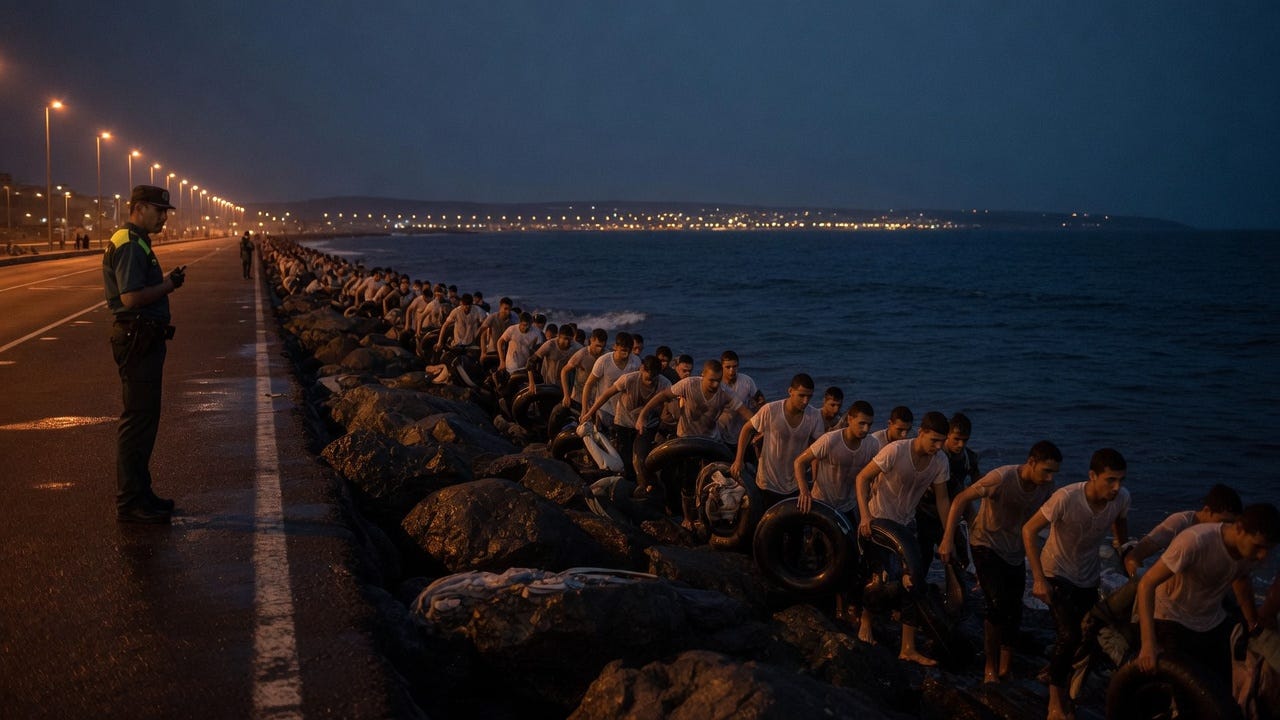
The breakwater at Tarajal is supposed to mark the edge of European sovereignty. Last Thursday, it looked like a breach. Between 2,000 and 3,000 people rounded the rocks or cleared the fence in a single day. They walked onto local roads in wet clothes and flotation rings. Some shouted victory slogans. Guardia Civil officers described themselves as overwhelmed and one step from total collapse.
This was not a sudden storm. Over the preceding week, 1,500 to 2,000 people arrived. Most were young Moroccan men, along with Algerians and others. Local facilities hit immediate saturation. The CETI hold facility, built for 512 people, packed in over 700 while hundreds slept on the pavement outside. Centers for unaccompanied minors operated at 1,600 to 2,400 percent of capacity. Ceuta President Juan Jesús Vivas declared a humanitarian emergency and asked Madrid to step in under a single command. Madrid said no.
The Interior Ministry claimed mass influxes do not meet the legal threshold for a civil-protection emergency. They sent a few platoons, some divers, and a boat. Why refuse a formal emergency declaration when local services collapse? Because acknowledging an emergency requires acknowledging who controls the border.

AZ Intel@AZ_Intel_
WATCH: Migrants continue flooding into Spain’s Ceuta as others attempt to enter Melilla; Spain closes Melilla border with Morocco.
9:47 PM · Jul 30, 2026 · 10.8K Views
4 Replies · 23 Reposts · 83 Likes
The immediate trigger was not economic pressure. It was a court ruling. Three weeks earlier, Spain’s Supreme Court settled a doctrine in Sentencia 814/2026. The court held that the summary “hot return” regime applies strictly to physical land fences. Swimming around a breakwater or arriving by sea does not qualify. Those intercepted in the water must receive ordinary return procedures with full legal guarantees.
The legal distinction was technical, but its effect on the ground was immediate. Smuggling networks in Castillejos and nearby towns advertised the news instantly. Young men launched themselves into the sea knowing summary expulsion was off the table once they hit the water. The court did not abolish returns. It simply shut down the fast path for the maritime route.
Smugglers read the doctrine faster than the political system could react. The ruling created an immediate incentive to pivot from the fence to the waves. The court designed a rule for individual rights. The street responded with massive volume.
Official statements from Madrid and Rabat offered a smooth narrative. Both sides blamed criminal networks and praised bilateral cooperation. That narrative conceals how the border actually functions. Morocco controls the land approaches. Spain depends entirely on Moroccan cooperation for daily management. When that cooperation tightens or loosens, the numbers move immediately.
The timing raises obvious questions. Prime Minister Pedro Sánchez visited Algiers on July 20 to repair relations frozen since Spain backed Morocco’s Western Sahara autonomy plan. Commercial and energy deals followed. In May 2021, over 8,000 people crossed in days during a diplomatic rift with Rabat. The current surge is smaller, but the mechanism is identical.
Official denials do not erase structural facts. Morocco turns the enforcement tap on and off to match its strategic needs. Madrid accepts the narrative to avoid confronting Rabat. Local residents organize to protect businesses while bodies wash ashore. Recent reports put the death toll in the water at 25 to 30 people.

WarMonitor🇺🇦🇬🇧@WarMonitor3
Insane video of Thousands of Morrocan migrants breaching across the border into Ceuta Spain.
12:12 PM · Jul 30, 2026 · 3.14M Views
1.25K Replies · 2.62K Reposts · 16.4K Likes
Unaccompanied minors represent a specific legal trap. Under Spanish law, they fall under the jurisdiction of the autonomous city, not the central state. Ceuta, a city of 84,000 people, absorbed hundreds of minors in days. Adults waited outside holding facilities under blankets. Small transfers to the mainland began, but the math remains impossible.
Madrid’s refusal to declare a formal emergency preserved legal forms while operational control vanished. The central government relies on rapid return agreements negotiated after the fact. Executing those returns under standard court-mandated procedures takes time and administrative capacity that local authorities do not possess.
The central state protects its diplomatic arrangements and legal definitions. The local enclave absorbs the physical and financial damage. The result is designed exposure.
3 Weeks Prior: Spain’s Supreme Court settles Sentencia 814/2026, ruling that summary border returns apply exclusively to physical land fence breaches.
July 20: Prime Minister Pedro Sánchez visits Algiers to re-establish energy and commercial ties, creating diplomatic tension with Rabat.
Preceding 7–10 Days: 1,500 to 2,000 arrivals land in Ceuta. Hold facilities saturate. Youth centers reach extreme capacity overloads.
Thursday: Single-day influx hits 2,000 to 3,000 arrivals around the Tarajal breakwater. Guardia Civil reports near-operational collapse.
Post-Breach: Ceuta leadership requests a national emergency declaration. Madrid officially rejects the request, offering minor troop support instead.
Ceuta is not suffering from an administrative error. It is suffering from designed exposure. A judicial ruling prioritizing procedural rights met a neighbor accustomed to using human movement as leverage. Madrid chose to absorb local damage rather than challenge the court or confront Rabat. When a government claims a massive border breach does not meet the legal definition of an emergency, it is not enforcing the law. It is hiding behind it.
Amend national migration laws to classify breakwater bypasses as physical border breaches.
Transfer custody and financial care of unaccompanied minors from local enclaves directly to the central state.
Trigger national security operational command immediately during multi-day influxes over capacity thresholds.
Link economic and diplomatic support for border partners directly to continuous, verifiable land enforcement.
Establish offshore state processing facilities to handle standard return claims without overloading local infrastructure.
Source Material Notice: This report is based on documented events surrounding the Tarajal border crisis in Ceuta, including data from Spanish state television, statements from the municipal government of Ceuta, reports from the Guardia Civil, and legal precedent established under Spanish Supreme Court Judgment (Sentencia) 814/2026.
Comments
Nothing yet. Say the first thing.
Sign in to join the conversation.