
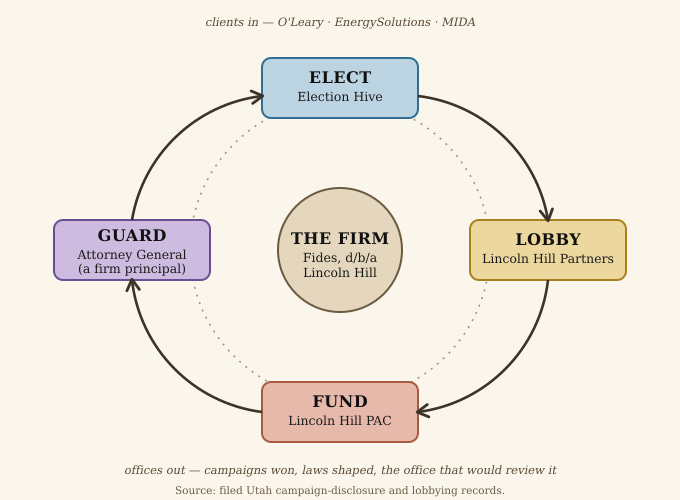
At the center sits one lobbying firm — Fides LLC, doing business as Lincoln Hill Partners. Around it are four roles the same firm plays in Utah politics. Elect: through a sister company, Election Hive, it runs the campaigns that put legislators in office. Lobby: it is then hired by private clients to lobby those same legislators. Fund: through its own political action committee, it gives money to their campaigns. Guard: one of the firm’s own principals, Derek Brown, now holds the office of Attorney General — the office that would review conduct like this. Money and clients enter from outside; won campaigns, shaped laws, and public offices come out. The arrows run in a circle because the money and influence return to where they began. Every link is drawn from public records, and every one is lawful — which is the point of the story, not the exception to it. (Being listed as a principal or director is what the records show; it is not proof of day-to-day control, and none is claimed here.)
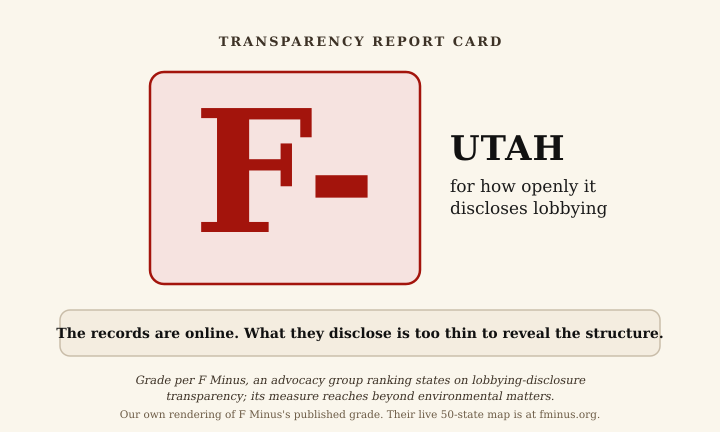
Begin with a number, because a number cannot be accused of a grudge. When an independent, nonpartisan outfit sat down to grade the fifty states on how honestly their governments disclose who is buying influence, Utah came home with an F-. Not a gentleman’s C, not a disappointing D. An F-, the grade you earn when the teacher has run clean out of worse letters.
The reflex in a place as proud as Utah is to wave it off — some yuppie coastal scolding with a jiggered spreadsheet. Hold that thought for a moment, because the rest of this piece is built entirely from documents the State of Utah publishes about itself, filed by the very people it concerns, available to anyone with a library card and a free afternoon. If Utah is transparent, it is transparent the way a lake is transparent: you can see all the way to the bottom, provided you are willing to dive, and provided you already know what you are looking for. Most voters have neither the wetsuit nor the time. This is the story of what is down there.
The picture is easier to hold if you stop thinking of the players as separate and start thinking of them as one. At the center of a great deal of Utah politics sits a single lobbying firm. On paper it wears a modest name, Lincoln Hill Partners, and behind that name sits an even quieter one: a limited liability company called Fides — Latin, agreeably, for “faith” — that a 2024 city contract reveals is simply the firm itself, doing business under a friendlier coat.
Now watch the hats this one firm wears, one at a time.
The first hat elects them. The firm runs a campaign shop, Election Hive, that manages the elections of the very legislators the firm will later lobby. It does not whisper this; it advertises it, boasting on its own website that close to half of Utah’s sitting lawmakers have hired it to win their seats. Roughly forty-three legislators, the Governor, the Attorney General — and, listed right alongside the humans, three of the political money-committees themselves, as if a PAC were just another satisfied customer. Which, here, it is.
The second hat lobbies them. Having helped seat the Legislature, the firm turns around and lobbies them — for paying clients. When television investor Kevin O’Leary wanted a colossal data center blessed in Box Elder County, he did not hire a stranger. He hired this firm. Lincoln Hill’s client book runs to data centers, power agencies, a mining-adjacent private-equity house, and a county or two. One of its partners also represents MIDA, the public authority whose approvals the data center happened to need. The firm, in other words, was retained by the man asking for the favor and by the body positioned to grant it. Efficient enough?
The third hat funds them. The firm also runs a political action committee, and here the numbers start to talk. Lincoln Hill PAC took in $627,000 over five years and paid most of it back out to candidates. The arresting part is not the size but the source: roughly sixty percent of the money it “raised” came from the firm’s own partners — two Shurtz-owned companies feeding some $375,000 into a PAC run by the same people. It is less a fundraising operation than a firm quietly writing checks to a committee that bears a different name, then handing those checks to officials under the committee’s letterhead. The money fanned out across the whole roster: $80,000 to the Governor (one of those checks a tidy $50,000, written in a single stroke), $50,000 to the Speaker’s leadership PAC, $22,000 to the Senate President’s committees, and smaller courtesies to dozens of legislators of both parties, the way a good host makes sure no one at the table is left without a drink.
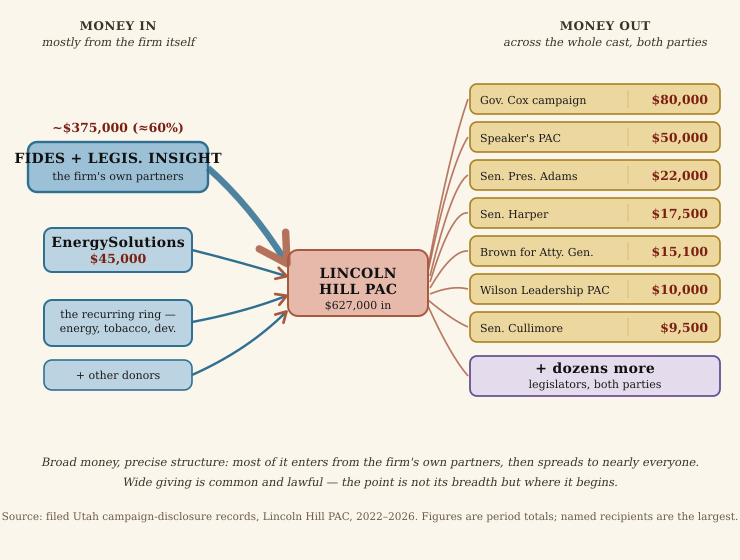
On the left is where the PAC’s money comes from; on the right is where it goes. The striking part is the left. Most of what Lincoln Hill PAC “raised” — roughly $375,000, about sixty percent — came from the firm’s own partner companies, Fides and Legislative Insight, both traced to the same man who runs the firm. EnergySolutions and a recurring ring of energy, tobacco, and development donors supplied much of the rest. From that pool, the money fanned out across the whole cast: the Governor’s campaign, the Speaker’s PAC, the Senate President, and on down through dozens of legislators of both parties. The seven names shown are simply the largest; the giving reached far more. Wide political giving is ordinary and entirely lawful — access-donors spread money broadly as a matter of course. That is not the point here. The point is where the money begins: not with a hundred independent supporters, but largely with the firm itself, then distributed outward under a committee’s name. Broad money, precise structure. Every figure is a period total drawn from the PAC’s own filed reports, 2022–2026.
Broad giving, by itself, is the oldest and dullest fact in politics; access-buyers spread money the way farmers spread fertilizer, on everything, hoping something grows. What lifts this out of the ordinary is not how wide the money goes but how neatly it comes back.
Follow one thread. Lincoln Hill PAC gives $50,000 to the House Speaker’s leadership PAC. The Speaker’s PAC, flush, then pays a bill — to Election Hive, the firm’s own campaign shop. The money leaves the firm through one door marked “PAC” and returns through another marked “campaign services,” and to keep the trip tidy, the same accountant — one Mike McCauley — keeps the books on both ends. A dollar can leave home, tour the Utah Capitol, and be back in time for supper, and the same bookkeeper signs it out and signs it in.
This is the closed circuit, and it is worth saying slowly, because everything else is decoration on it: the firm elects the officials, lobbies the officials, funds the officials, and — through a committee it capitalizes and a shop it owns — is paid by the officials it funded. The wheel turns money into access into offices and back into money, and it never has to touch a stranger to complete a revolution.
[IMAGE ANCHOR 2 — THE DOLLAR LOOP. Placed here. This is our one animation candidate: a single dot tracing Lincoln Hill PAC → Speaker PAC → Election Hive, once, then resting on the closed loop. Must pass the bench tests before it ships; static frame must read complete.]
Follow the money clockwise: The firm’s own committee — Lincoln Hill PAC — gives $50,000 to the House Speaker’s Leadership PAC. The Speaker’s PAC, in turn, pays $2,601.85 to Election Hive, which is the firm’s own campaign shop. The money leaves the firm through one door and returns through another, and the same bookkeeper — Mike McCauley — keeps the books at both ends.
A note on the two numbers: these are not the same dollars making a round trip, and the smaller return figure does not mean money went missing. They are two separate, documented flows that both run through the firm — one gift out to the Speaker’s PAC, one payment back to the firm’s campaign shop. What matters is not that the amounts match (they do not) but that the circuit closes: money and business begin at the firm and come back to it. Both figures are drawn from the committees’ own filed reports, and every transaction is lawful and disclosed.
Every account of this kind owes the reader its weakest moment stated plainly, so here is ours, up front, before the sharpest fact lands: no dollar of Kevin O’Leary’s money appears in this PAC. We looked, line by line. The developer hired the firm; the firm’s fee is nobody’s public business; and there is no wire we can trace from the Shark Tank checkbook into a legislator’s pocket. Anyone who tells you otherwise is selling. What follows is not a pipeline. It is something quieter and, in its way, harder to answer.
Because there is a fourth hat, and it is the one that turns an interesting arrangement into a civic problem.
One of the firm’s four named principals — named, in a 2024 city contract, as a man who would “personally” do the work — is Derek Brown. The same Derek Brown is listed, every single year from 2022 through 2026, as a Director of the firm’s PAC; the filing has never been amended to remove him. And the same Derek Brown is now the Attorney General of Utah — the officer to whom a citizen would bring a complaint about, say, a lobbying firm that elects, lobbies, and funds the government all at once.
We are careful here, and the care is not timidity. A name on an unamended form is not proof a man ran the firm day to day; being listed is the record’s claim, not a confession, and we assert no more than the paper does. But the paper says a good deal. It says the PAC that Brown is listed as directing wrote $15,100 to “Derek Brown for Attorney General” — a hundred dollars to break the seal, then five thousand, then ten. It says the office that would investigate this wheel is held, in part, by one of the wheel’s own builders. In every sandlot ballgame ever played, there is one arrangement the children will not abide, because even a child can see it is hopeless: the other team’s player cannot also be the umpire. Utah has arrived, by entirely legal steps, at the sandlot’s forbidden thing — and kept a straight face.
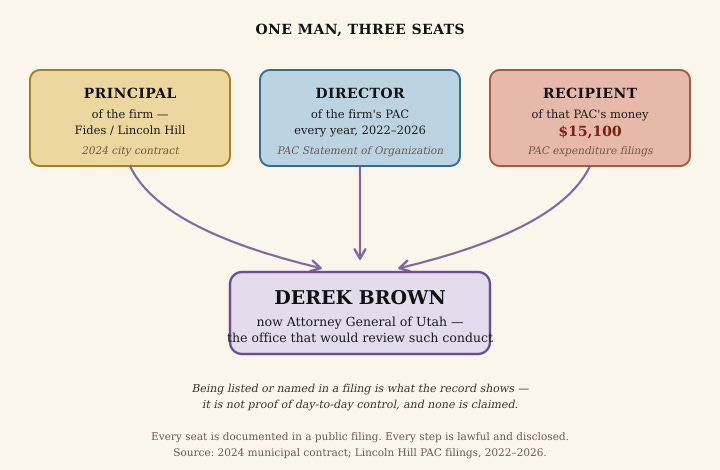
HOW TO READ THE THREE SEATS One man occupies three positions in this story at once, and each is documented in a public filing. He is a principal of the firm — named in a 2024 city contract as one of four who would “personally” perform its work. He is a director of the firm’s political action committee — listed on its Statement of Organization every year from 2022 through 2026, a listing never amended to remove him. And he is a recipient of that same PAC’s money — his Attorney General campaign received $15,100 from it. That man is Derek Brown, now the Attorney General of Utah — the officer to whom a citizen would ordinarily bring a complaint about conduct like the arrangement described here. Two things must be said plainly. First, being listed or named in a filing is what the record shows; it is not proof that a man managed the firm day to day, and no such claim is made here. Second, every one of these steps is lawful and was publicly disclosed. The concern is not that any single seat is improper — it is that the same person holds all three, and now holds the office that would judge them.
Here is the part that should trouble a reasonable Utahn more than any accusation could. Nothing in this account is, on its face, against the law. The firm may lawfully run a campaign shop and a lobbying practice and a PAC. Partners may lawfully fund their own committee. A committee may lawfully pay a vendor that happens to be its own sibling. A man may lawfully help build a firm, be listed on its PAC, and later win statewide office. Each step is legal, disclosed, and, taken alone, unremarkable. It is only when you step back and see the whole wheel that the trouble announces itself — and by then no law has been broken.
Which returns us, at last, to that F-. Utah’s failing grade for transparency was not handed down by a scolding adversary; it was earned in the categories that matter most to this very story — political financing, lobbying disclosure, and the enforcement of ethics. The same nonpartisan assessment noted that Utah is among the states with no independent body to police legislative ethics, folding that watchman’s job into the offices being watched. (Two honest caveats: those grades date to 2012 and 2015, and the group that issued them has since closed, so treat them as a benchmark, not a fresh audit; and they grade laws, not men. Note, too, without further comment, that the 2015 survey was taken while the office administering Utah’s disclosure system was held by a Lieutenant Governor named Spencer Cox.) A state that graded well on these measures would, almost by definition, possess the laws and the referees to notice a closed circuit before it closed. Utah, by its own filings, does not.
We do not allege a crime, because the record does not show one, and we will not manufacture what the documents decline to supply. We asked instead the only question the record actually raises, the question the Supreme Court itself made respectable in Caperton — not whether a bargain was proven, but whether the probability of bias has grown so plain that a fair-minded citizen can no longer be asked to simply trust it: When one firm helps elect the officials, lobbies them for pay, funds their campaigns, and counts the state’s chief law-enforcement officer among its own principals — what is left of the promise that the law applies equally, and that no one sits in judgment of his own house?
We do not answer it. We have laid the record; the reader may weigh it. But we hold that laying a wrong bare and walking away is only half an honest man’s work — the other half is pointing toward the fix. Utah’s F- is not a life sentence; it is a report card, and report cards can change. The reforms that would turn this state away from the failing grade — an independent ethics commission built so it cannot be stacked, real disclosure of who is behind the money, and a plain rule that a man cannot referee his own game — are laid out in a companion piece, What Would Fix It, kept deliberately apart from this record so the reporting stays cold and the remedy stays honest.
Nothing here may be illegal. That is not the reassurance it sounds like. It is the alarm.
This is where the report began: Utah earns an F- for transparency. The grade comes from F Minus, an advocacy group that graded all fifty states on how openly they disclose lobbying — who is paid, by whom, and to influence what. The point is not the number behind the grade but what the grade means on the ground. Utah’s records are online and easy enough to reach; the failure is that what they disclose is too thin to show what is actually happening. The documents exist. The structure they conceal does not surface in them — which is precisely the difficulty this report set out to overcome, by hand. Two notes on the source. F Minus is an advocacy organization whose focus is fossil-fuel lobbying, but the measure it applies here is disclosure transparency itself, which reaches well beyond any single industry. And the graphic above is our own rendering of F Minus’s published grade — not a copy of their material; their live, interactive fifty-state map is at fminus.org.
Every figure in this report is drawn from public filings any citizen may pull; the sources and the step-by-step paths to confirm them are set out in the companion evidence memo HERE, “The Closed Circuit — The Record.” Reforms are proposed separately in “What Would Fix It” HERE. This piece asserts no crime and imputes no motive; where a person is listed in a filing, that listing is the state of the record and not proof of active management.
═════════════════════════════════════════════
© 2026 Wayne L. Wickizer. All rights reserved.
Prepared with AI research and drafting assistance (Claude, Anthropic).
Wayne L. Wickizer — 89-year-old great-grandfather.
Former FBI Special Agent; graduate, FBI Command School of Advanced Criminology; uniquely commended by both Director J. Edgar Hoover and investigative journalist Jack Anderson — a distinction never repeated.
Former Special Agent, Utah Attorney General’s Office — investigated and prepared for prosecution two landmark major criminal cases.
Retired Major, U.S. Army Special Forces (Green Beret), Special Operations intelligence officer.
U.S. Air Force veteran, 5,000+ flight hours — weather-reconnaissance and nuclear-sampling missions; listed on the federal Ionizing Radiation Registry for Soviet fallout exposure. 100% service-disabled veteran.
Retired Utah secondary educator. Credentialed investigative journalist, Society of Professional Journalists. B.S. English (Journalism minor); M.S. Administration of Justice.
Publisher — Justice4All (justice4all.blog) and Justice4Eternity (justice4eternity.substack.com).
No posts
Comments
Nothing yet. Say the first thing.
Sign in to join the conversation.