
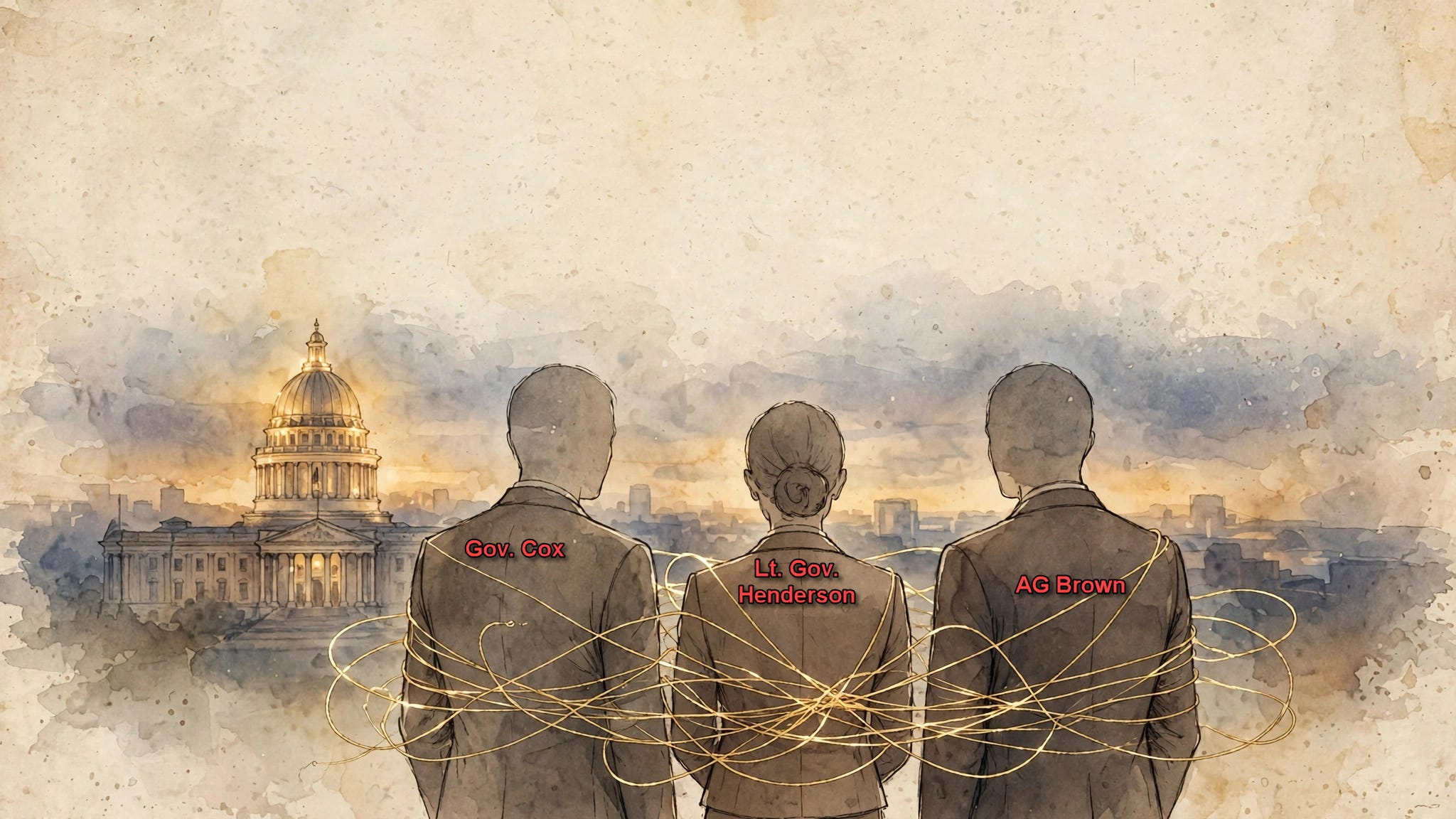
Built entirely from the public record. Every fact is verifiable; the map to each is at the end.
This report examines lawful, publicly disclosed political activity and official disclosure forms. It does not allege a bribe, a secret agreement, a crime, or a reporting violation. Its narrower question is whether the documented relationships and contributions create an appearance that a reasonable citizen would want independently examined.
The conduct unwrapped here does not arrive in a briefcase. It arrives as ordinary politics — a lawful check, a blank line on a form, a friend backing a friend’s campaign — all of it filed in daylight on a public website for anyone to read. That is its genius. It is camouflaged the way a praying mantis is — shaped so exactly like the leaf or twig around it that the eye slides past. A citizen hunting for a villain never finds one, because there is no villain in the picture — only three offices, a stack of perfectly legal contributions, and a form nobody filled in.
What follows is not an accusation. Every fact is drawn from filed campaign-finance records, official conflict-of-interest forms, and public enforcement actions — and at the end we hand you the map to every one, so you can confirm us, or correct us, yourself. We allege no bribe. We prove no secret bargain.
We are doing only what the law itself says is worth doing. In Caperton v. A.T. Massey Coal (2009), the United States Supreme Court held that when the circumstances around a decision-maker create a serious probability of bias, that probability alone offends due process — no proven bargain required, no smoking gun needed. The Court was speaking of a judge who should have stepped aside; but the principle it named is older and wider than any one courtroom. When money and power braid and wind this tightly around the officials who are meant to check one another, the appearance is not a technicality. It is the injury. We lay a structure in front of you, in the open, and let you weigh it for yourselves.
Three offices, one circle
Start with three of the most powerful officials in Utah and follow the money and the roles between them.
Governor Cox’s committee gave Attorney General Brown $52,500 — fifty thousand of it in a single day. The Governor’s committee also gave Lieutenant Governor Henderson $10,000. The Lieutenant Governor, by the duties of her office, runs Utah’s campaign-disclosure system — the very machinery on which all this money is reported and supposedly monitored. And that same Lieutenant Governor was named, in the campaign’s own December 2023 announcement, as one of three chairs of the Attorney General’s finance committee. The Attorney General, for his part, is the state’s chief law-enforcement officer — the office that should investigate and prosecute, and the office to which any matter touching even his own donors, or the Governor whose committee helped fund him, would be subject to the AG’s powers and responsibilities.
Pull any single one of those threads and the thread snaps under the lightest defense. Giving to a same-party candidate is ordinary. Serving on a friend’s finance committee is common. Running the office you were elected to run is the job. Each is innocent alone — a single dry twig, easy to break between two fingers.
Pull any single thread and it snaps. Braided together, they hold — the way a bundle of sticks will not break across the knee that snapped each one alone.
Braided, they describe a closed circle: the Governor funds the Attorney General who would investigate any matter touching the Governor; the officer who runs the disclosure system sits on the Attorney General’s finance committee while holding the Governor’s check. No law is broken anywhere in that sentence. That is exactly what makes it worth looking at. And it was not unremarked at the time: during the 2024 race, two candidates for attorney general publicly called the arrangement inappropriate.
disclosures.utah.gov → Public Search → Candidates & Office Holders → “Brown, Derek” and “Henderson, Deidre” → itemized Received Contributions, by year. The finance-committee role is in the campaign’s own announcement of December 18, 2023 (search UtahPolicy for the release naming the three chairs); the committee’s statement of organization is on file at disclosures.utah.gov.
The line nobody filled in
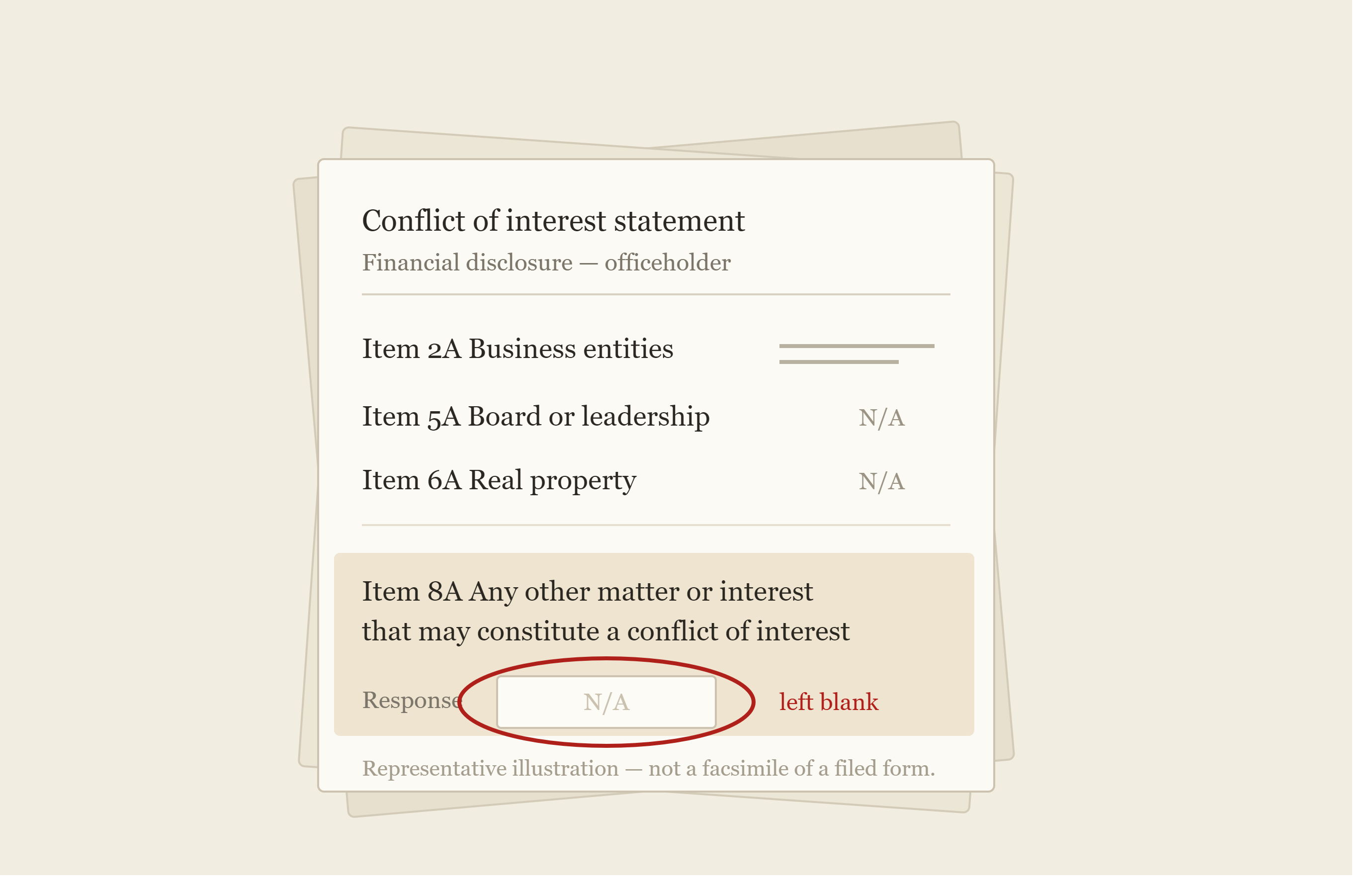
Utah gives every officeholder a form to catch precisely this kind of thing. Among its questions is a plain catch-all question: does the official have any other matter or interest that might constitute a conflict? It is the box built to name the unnamed.
Across all three officials, year after year, that box is blank — entered “not applicable,” or left empty. It sits there in every file as quiet as a diary nobody kept. None of the three used it to note the relationships binding them to one another.
The money is disclosed. The appearance of conflict it creates is noted nowhere.
Here we must be fair, and loudly so: that catch-all is optional and self-judged, so leaving it blank breaks no rule, and we allege no reporting violation. The contributions themselves were disclosed — on a different state form, in full. We do not claim the money was hidden. It was not. The narrower point is only this: the mechanism to note the appearance existed, sat right there on the page like an unrung bell, and went untouched by all three.
So much for the architecture. Now meet the company AG Brown keeps — because the circle is only the room, and every room is known by who it lets in the door. Read the guest list and notice who these people are.
First through the door is Enova International, a high-cost lender the federal Consumer Financial Protection Bureau did not merely fine but formally branded a repeat offender in 2023 — the regulatory version of “you again” — with a $15 million penalty for helping itself to money from more than a hundred thousand customer accounts without bothering to ask. It gave the attorney general’s committee $20,000.
Behind it, OppFi, whose loans have carried rates reported as high as 160 percent — the sort of number that makes a pawnbroker look like a philanthropist — run through a Utah-chartered bank for the simple reason that Utah sets no ceiling at all. That door contribution: $10,000. Would the AG be conflicted to investigate and prosecute OppFi were it necessary to do so?
Then the smoke drifts in. R.J. Reynolds — the maker of Camel and Newport, wearing the gray flannel alias “RAI Services” on the disclosure line — is the attorney general’s single largest corporate donor, at $25,000. Reynolds is, as we speak, at war with the Food and Drug Administration over the denial of its flavored Vuse e-cigarettes, a fight it hauled clear to the United States Supreme Court.
And at its elbow stands Altria — the company that in 2003 traded its name “Philip Morris” for the name Altria that is something Latinate and odorless, all so its money would stop reading and smelling like a bar room ashtray or spittoon. The maker of Marlboro, in the file too. Both of America’s tobacco giants, arriving at the door of an attorney general in a state whose faith is famous the world over for saying no to the very product. Utah’s own newspapers noted that irony decades ago; we only point at it and let it sit.
And what of the wager? Las Vegas Sands — the largest casino operator in the country — wrote $50,000 to the top lawman of the one state in the union where you cannot legally place a two-dollar bet. Why that house of Sands’ card players and gamblers should take so forgiving an interest in the sheriff of the town (Utah) that outlawed its game is a question that rather asks itself.
It is not a new question here. Forty-five years ago, in “Don’t Touch the Dice” (Utah Holiday, September 1980), reporters Bob Gottlieb and Peter Wiley documented how an Ogden-born banker financed the Las Vegas Strip when no other bank would touch the gamblers’ money — and how prominent Latter-day Saints came to sit on the very boards that regulated Nevada gaming, all-the-while their faith preached against the wager. Yesterday’s men are not today’s; the point is narrower and older — the entanglement of Utah money and officialdom with the gambling industry is not a fresh stain but a deep one, set decades ago and never quite scrubbed out.
And then the strangest guest of all — the one who will not give a name. The single largest individual contribution in the file, $50,000, arrived from someone filed only as “Tracy Mayer,” and arrived like an unsigned envelope left on a stump — no hand, no face, just the money — handed to a sitting attorney general nearly a year into his term. The address of record is not a home and not an office. It is a rented mail-drop in Las Vegas — a box on a wall of identical boxes. We went knocking with that name at every public door that might answer: state business filings, federal contribution records, the mailbox itself. Every door opened onto the same empty room. The biggest single check in the file came, in effect, not from a person with a mailbox but from the mailbox itself.
The largest single check in the file arrives from behind a curtain no public record will lift.
Weighing it honestly
Set the grin or grimace down for a moment because this is where care matters most. We sort what we find by a simple, old standard. An anomaly is something unusual that asks for an explanation. A red flag is a specific cause for concern. A smoking gun is direct proof that needs no inference. We are careful about which is which, the way a good coroner is careful about the cause of death.
The closed circle of three offices is the record — every leg is read straight off the filings and the campaign’s own announcement. The blank conflict line is an anomaly that sharpens the rest. The donor wall — lenders under federal challenge, both tobacco giants, the casino, and the gift no one will claim — is a red flag: the point at which a reasonable person would want to know whether the office and office holders can stay even-handed toward the very industries queued at the door.
Add them, and you do not get a crime. You get a structure — lawful in every visible part, and troubling precisely because it is lawful. That is the whole lesson. The most effective conflict leaves no law to point at; it simply arranges the furniture so the outcome was never really in doubt, the way a Las Vegas card shark never has to cheat once the deck is already stacked in his favor.
Troubling precisely because it is lawful — the most effective conflict leaves no law to point at.
What this record does not show
An honest witness is known by the limits he admits, so hear these as clearly as anything above.
There is no evidence of a bargain. The record shows people tied to regulated industries giving to the officeholder who regulates them. It does not show that any gift was solicited, steered, or traded for any act. Each donor may have given for reasons entirely his own and entirely lawful. We cannot show otherwise, and we do not pretend to.
The enforcement runs against the companies, not the officials. The lender penalties and the tobacco litigation are the donors’ troubles, not the officeholders.’ And the tobacco company’s trip to the Supreme Court settled only a narrow, procedural question of who may sue — not the merits of anything. We say so plainly.
And the biggest individual donor we cannot name. We chased that $50,000 to the end of every public record and could not lift the curtain. So, we draw no conclusion about who is behind it. We only note — because an honest reader deserves to know — that the largest single gift in the file has no findable human face.
These are not weaknesses we are confessing; they are the fence posts of the truth, and a fence is only as honest as the posts that mark its edges. A record that polices its own claims is one you can trust on the claims it does make.
The questions that remain
We end where an honest inquiry must — with questions, not verdicts. Each is anchored to a documented fact above; none is an accusation.
Does an official who runs the state’s disclosure system, while serving as a named chair of the attorney general’s finance committee and holding the governor’s contribution, sit in an arrangement a reasonable citizen would want examined very closely?
When the donors at the attorney general’s door are drawn so heavily from the very industries his office may be called to investigate and prosecute, does that raise a fair question about the appearance of even-handedness?
Why does the nation’s largest casino operator take such an interest in the attorney general of the one state that bans its gaming?
And who, exactly, is the largest individual donor in the file — the one the public record cannot name?
We do not answer them. We hand them to you — and, with them, the means to pursue them yourself.
Check our work below and see the data, details, and links HERE.
We cannot hand you a permanent link to every filing — government databases move, and many records sit behind search forms rather than fixed addresses. So, we hand you the path instead. Walk it, and you do not have to trust us; you can confirm us or correct us.
A · The contributions & the committee role. At disclosures.utah.gov, Public Search → Candidates & Office Holders → search “Brown, Derek” and “Henderson, Deidre” → open itemized Received Contributions by year. For the finance-committee role, the campaign’s own announcement of December 18, 2023, named Henderson one of three chairs (search UtahPolicy for the release); the committee’s statement of organization is on file at disclosures.utah.gov.
B · The conflict forms. From the same site, open each officeholder’s Financial Disclosure / Conflict of Interest form by year and read the “any other conflict” line.
C · The tobacco pattern. At followthemoney.org, search the contributors “Altria” and “R.J. Reynolds / RAI Services,” filter to Utah — or search the recipient by name. Either route reaches the same official filings; confirm any figure back at disclosures.utah.gov.
D · Enova. At consumerfinance.gov → Enforcement → “Enova International” → the 2023 action, the $15 million penalty and repeat-offender findings.
E · Reynolds. At fda.gov, search “Vuse” for the flavored-product denial announcements; then read the Supreme Court’s opinion directly at supremecourt.gov, Food and Drug Administration v. R.J. Reynolds Vapor Company, No. 23-1187 (June 20, 2025) — a ruling on who may sue, not on the merits.
F · The mail-drop donor. At esos.nv.gov, run a business-entity and officer search on “5940 South Rainbow Boulevard, Suite 400”; at fec.gov, search individual contributions for “Tracy Mayer,” ZIP code 89118. The address resolves to a commercial mail-forwarding suite; the person does not resolve.
G · The 1980 backdrop. The original article is held in Special Collections at the University of Utah’s J. Willard Marriott Library — “Utah Holiday records,” Accession No. ACCN 1547, Box 15, the September 1980 issue. Finding aid at archiveswest.orbiscascade.org. The same history appears in Gottlieb & Wiley, Empires in the Sun (1982).
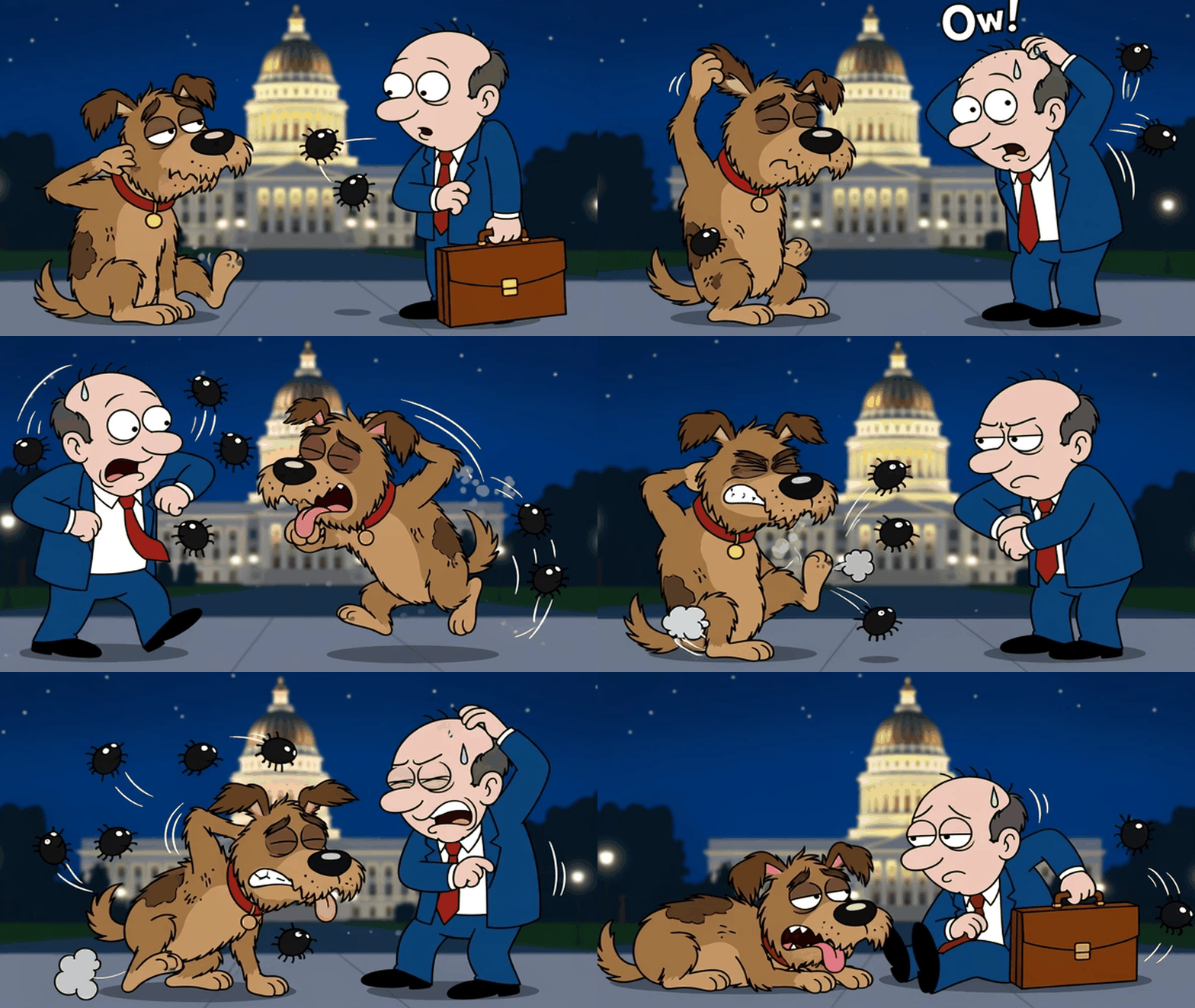
That is the whole of it. Three offices tangled into a circle. A form line left blank. And the company that lines up at the door — the lenders, the smoke, the house, and a name no record will give up — all of it lawful, all of it disclosed, all of it on the record. You have now watched the pattern assembled once, slowly, with every part named. The next time a public official’s troubles all wear the same lawful, well-filed face, you will feel the draft under the door — and, like the man in the cartoon, you will know exactly where the fleas came from.
Prepared with AI research and drafting assistance (Claude, Anthropic).
Wayne L. Wickizer — 89-year-old great-grandfather.
Former FBI Special Agent; graduate, FBI Command School of Advanced Criminology; uniquely commended by both Director J. Edgar Hoover and investigative journalist Jack Anderson — a distinction never repeated.
Former Special Agent, Utah Attorney General’s Office — investigated and prepared for prosecution two landmark major criminal cases.
Retired Major, U.S. Army Special Forces (Green Beret), Special Operations intelligence officer.
U.S. Air Force veteran, 5,000+ flight hours — weather-reconnaissance and nuclear-sampling missions; listed on the federal Ionizing Radiation Registry for Soviet fallout exposure. 100% service-disabled veteran.
Retired Utah secondary educator. Credentialed investigative journalist, Society of Professional Journalists. B.S. English (Journalism minor); M.S. Administration of Justice.
Publisher — Justice4All (justice4all.blog) and Justice4Eternity (justice4eternity.substack.com).
Contact: justice@utahwtp.com • 385-239-8326
No posts
Comments
Nothing yet. Say the first thing.
Sign in to join the conversation.