
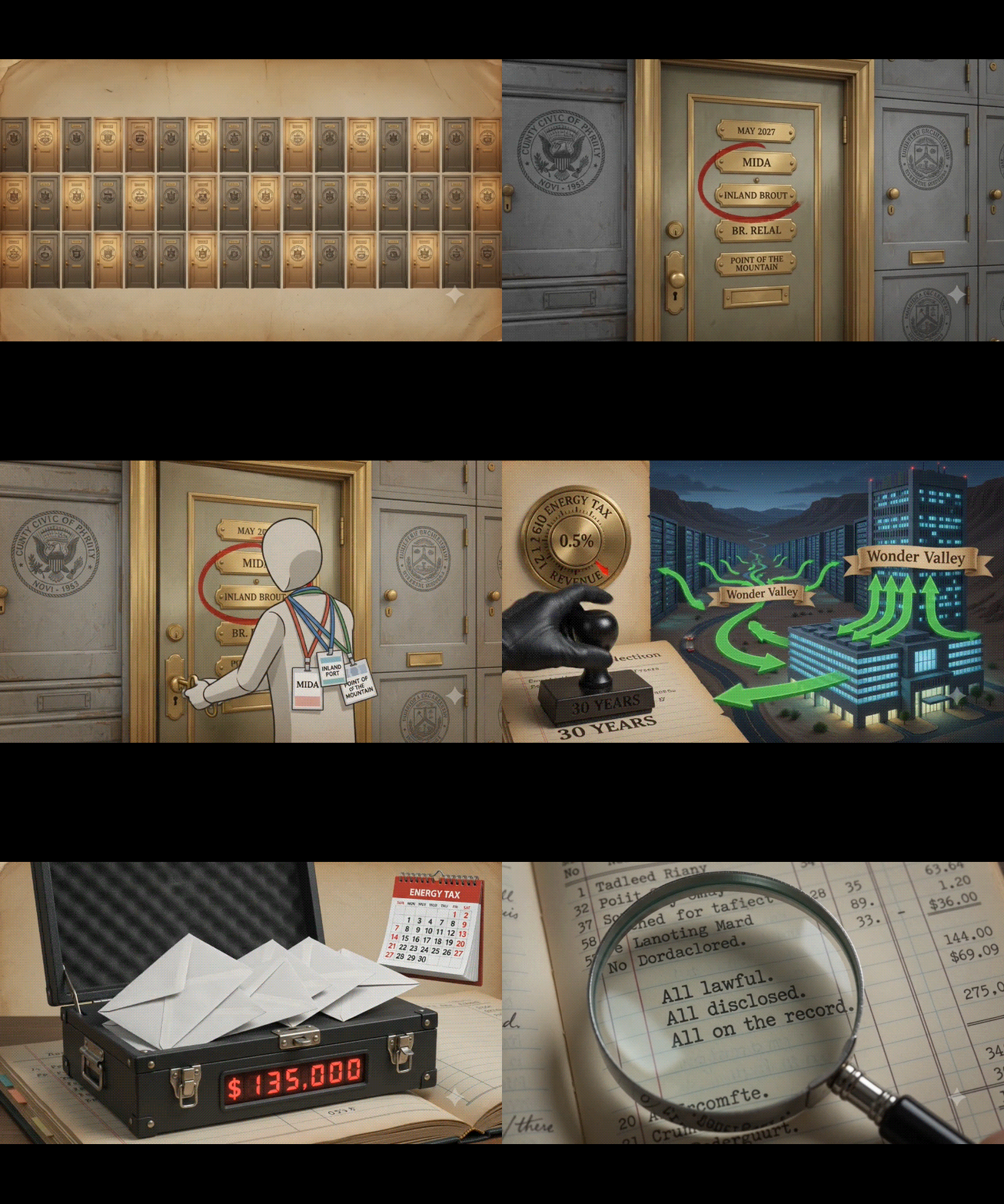
Utah quietly bricked up every ordinary path to the richest incentives in the state — then left one door standing, and seated its own man, Utah Senator Stevenson, on the boards that hold the key. Here is how the trick was done, in daylight, with a recorded vote and all the players at the ready.
Built entirely from the public record. Every fact is verifiable; the map to each is at the end.
It files paperwork. It does not slip you an envelope in a parking garage; it holds a committee hearing, takes a recorded vote, gets the Governor’s signature, and posts itself on a state website in a forty-section bill with a title so boring it functions as camouflage. You were meant to look away. The whole design depends on your looking away.
So let’s not.
Nothing here is an accusation, and nothing here needs to be. Every fact below comes from enacted law, sworn disclosures, official minutes, a recorded vote, and a signed contract — and at the end we hand you the map to all of it, so you can check us or correct us yourself. We allege no bribe. We don’t have to. The Supreme Court, in Caperton v. A.T. Massey Coal, settled that the law worries about the probability of bias — the arrangement that would make any reasonable person doubt the game was straight — and does not wait for a confession that never comes. Good. Because what Utah built here left no confession to find. It left something better: a paper trail a mile long, signed by the very men who benefit, and hiding in plain sight because they were confident you’d find it too dull to read.
There is smoke pouring through the floorboards of this law. We won’t cry fire. We’ll do something more useful — teach you the smell, so the next time a sleepy little omnibus closes an ordinary door and leaves one guarded door open, the hair on your neck stands up on its own.
Every capture of this kind is built the same way. Learn the three moves and you’ll spot the wiring behind almost any “economic development” press release in the state.
One: build a door only a few hands control — a special “authority,” floated up above the ordinary machinery of county and city, and answerable, conveniently, to almost no one.
Two: brick up every ordinary door, so anyone who wants the good stuff has no choice but to come knock on yours.
Three: let the people who walk through your door pay the doorman.
Not one of the three is, by itself, a crime. Each can be dressed in the Sunday suit of sound public policy — and each was. Watch them snap together, and watch the same handful of names keep showing up in every doorway.
The door already existed. It’s called the Military Installation Development Authority — MIDA — and though the name conjures runways and razor wire, its real muscle is over land and money. Inside any “project area” it paints on the map, MIDA shoves the county aside on how land may be used, scoops up the growth in property taxes that follows, and levies taxes of its own. It is, stripped of euphemism, a little government — with one refinement the Founders somehow overlooked: nobody who lives under it ever got to vote for its board.
Don’t take our word for it. Take the State’s. Utah’s own transparency portal calls MIDA a “quasi-municipal” government that runs its land and its taxes “independently and without any other governmental oversight.” The State Auditor doesn’t audit it — and doesn’t even control the contract for the private auditor MIDA hires to grade its own homework. Picture a casino allowed to bring its own dealer, own the pit boss, and certify its own payouts, and you have the civic spirit of the thing.
A government permitted to keep its own books, hire its own auditor, and check its own arithmetic. What could possibly go sideways?
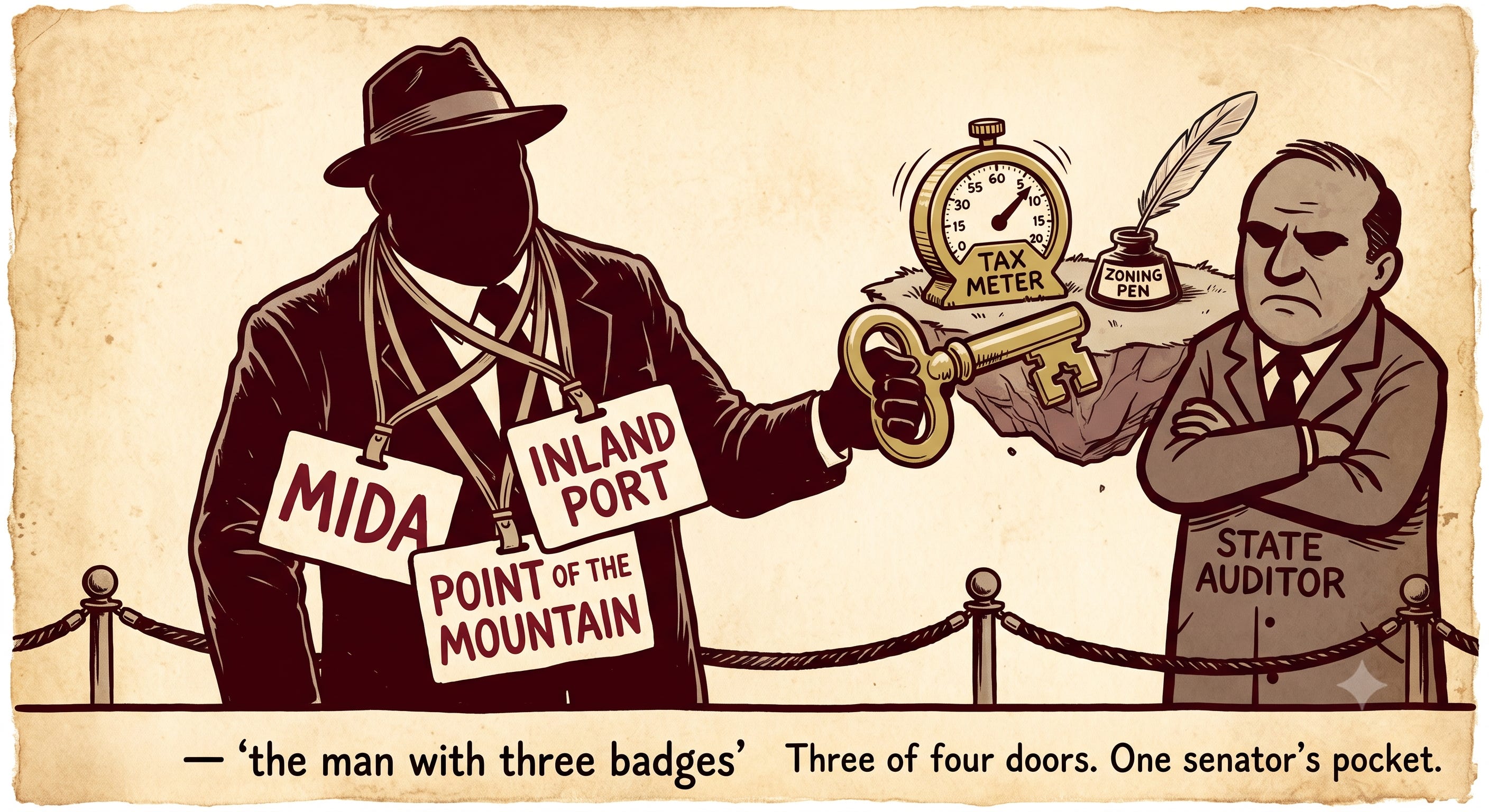
Now meet the man at the center of this story — not the chairman, we’ll get to him, but the quieter figure who turns out to be standing in every doorway we open. Senator Jerry W. Stevenson of Layton. By his own sworn hand, he sits on the boards of three of the four state authorities this whole scheme will shortly anoint: he is a voting member of MIDA, a voting member of the Utah Inland Port Authority, and the Senate President’s handpicked appointee to the Point of the Mountain State Land Authority. Three of the four golden tickets, in one senator’s pocket, disclosed in his own handwriting.
And in 2025 he was the chief sponsor of Senate Bill 316, which fattened MIDA’s powers — including the tidy new trick of letting money raised inside one MIDA zone be spent building things in another. He carried a bill to enlarge the authority he sits on. Then he took it to a Senate committee — on which he also sits — introduced it, argued for it, and, in a flourish of civic modesty, voted for it himself. The committee, gazing upon its own member’s bill, found it good, 5-to-0. This is not sausage-making. This is a man grading his own exam and being pleasantly surprised by the score.
Nor was it his first. Stevenson has been the Legislature’s go-to author of MIDA bills for a decade while sitting on the MIDA board — 2015, 2018, 2020, 2021, 2022, and again in 2025. When the authority needs a favor from the statute books, it apparently knows exactly which of its board members to call. His office is upstairs.
[CONFIRM IT YOURSELF] At le.utah.gov, 2025 session, SB316 names its chief sponsor on the face of the bill: Sen. Jerry W. Stevenson. The Authority’s own roster at midaut.org lists the same Jerry Stevenson as a board member — and its vice chair. One man, both hats. And here is the part he’d rather you glide past. For six straight years — 2019 through 2024 — the board-memberships line on his conflict-of-interest form HERE somehow had no room for MIDA, the Inland Port, or Point of the Mountain, though he’d sat on MIDA since 2008. Then, on January 15, 2025 — six days before the session gaveled in and he went to work on SB316 — room was miraculously found, and all three appeared at last as potential conflicts. We give him the credit the record earns: he disclosed before he acted, so we cry no cover-up. We simply note that a man can misplace three government board seats for six years and rediscover them the very week they’re about to matter, and that the timing has a certain… punctuality.
In the 2026 session came House Bill 507, forty sections under a title engineered to make the human eye slide off it: “State Coordination of Regional and Local Economic Development Projects Amendments.” Say it aloud and feel your attention leave your body. Somewhere in that fog sits one small, load-bearing lever.
Starting May 2027, an ordinary Utah county or city may no longer, on its own, hand tax incentives to a very large data center — the hundred-megawatt-and-up leviathans everyone’s suddenly courting. The only way to keep sweetening such a deal is to run it through one of exactly four state authorities named in the code. Four doors. No fifth. And — you’re ahead of us now — one of the four is MIDA, on whose board sits the very senator we just met.
Read the move slowly, because it’s elegant. The law doesn’t ban the goodies. It just repossesses them from the local officials you can actually fire at a ballot box, and hands them to four boards you can’t. The people’s doors get chained; the authority’s door stays oiled and open; and the men holding that key are, by remarkable coincidence, some of the same men who wrote and passed the chaining.
They didn’t outlaw the candy. They just moved the whole jar onto a shelf that only four unelected boards can reach — and stocked those boards with the friends of the house.
Two footnotes the authors surely hoped stayed footnotes. The data-center lever wasn’t in HB507 when it was introduced — it was slipped in later, by substitute, bolted onto a moving vehicle rather than presented as anyone’s headline. Who added it, and at whose request, the public record does not say — and we will not guess. And a further substitute shoved the shut-out’s start date back a full year, from 2026 to 2027 — keeping the ordinary door propped open exactly long enough for anyone already hustling through it. A coincidence, surely. The record shows the change; it declines to show the reason; and we’re not in the business of inventing motives when the facts are damning enough sober.
Now, credit where the ledger demands it — and it demands it loudly, because a report that only prosecutes isn’t evidence, it’s a pamphlet. The two lawmakers who actually carried HB507 — freshman Representative Cal Roberts and Senator Kirk Cullimore — took not a dime from the project’s beneficiary. We read their filings line by line. No money from O’Leary, from O’Leary Digital, from Stratos, from any of the four authorities; a fat slice of Roberts’s war chest is a loan he wrote to himself. The men who pulled the lever were not paid by the hand that gained from it. That matters, and we won’t bury it to keep the story tidy. It tells you the pressure in this tale runs somewhere other than through the sponsors — which leaves one impolite question hanging in the air: why hand a rookie a forty-section omnibus to carry, and whose shopping list was riding inside it?
[CONFIRM IT YOURSELF] le.utah.gov → 2026 session → “HB507”: every version, the substitute history, the sponsors, the votes. The operative fine print lives in Utah Code 63N-3a-101 (the four-authority list) and 54-26-101 (the 100-megawatt line).
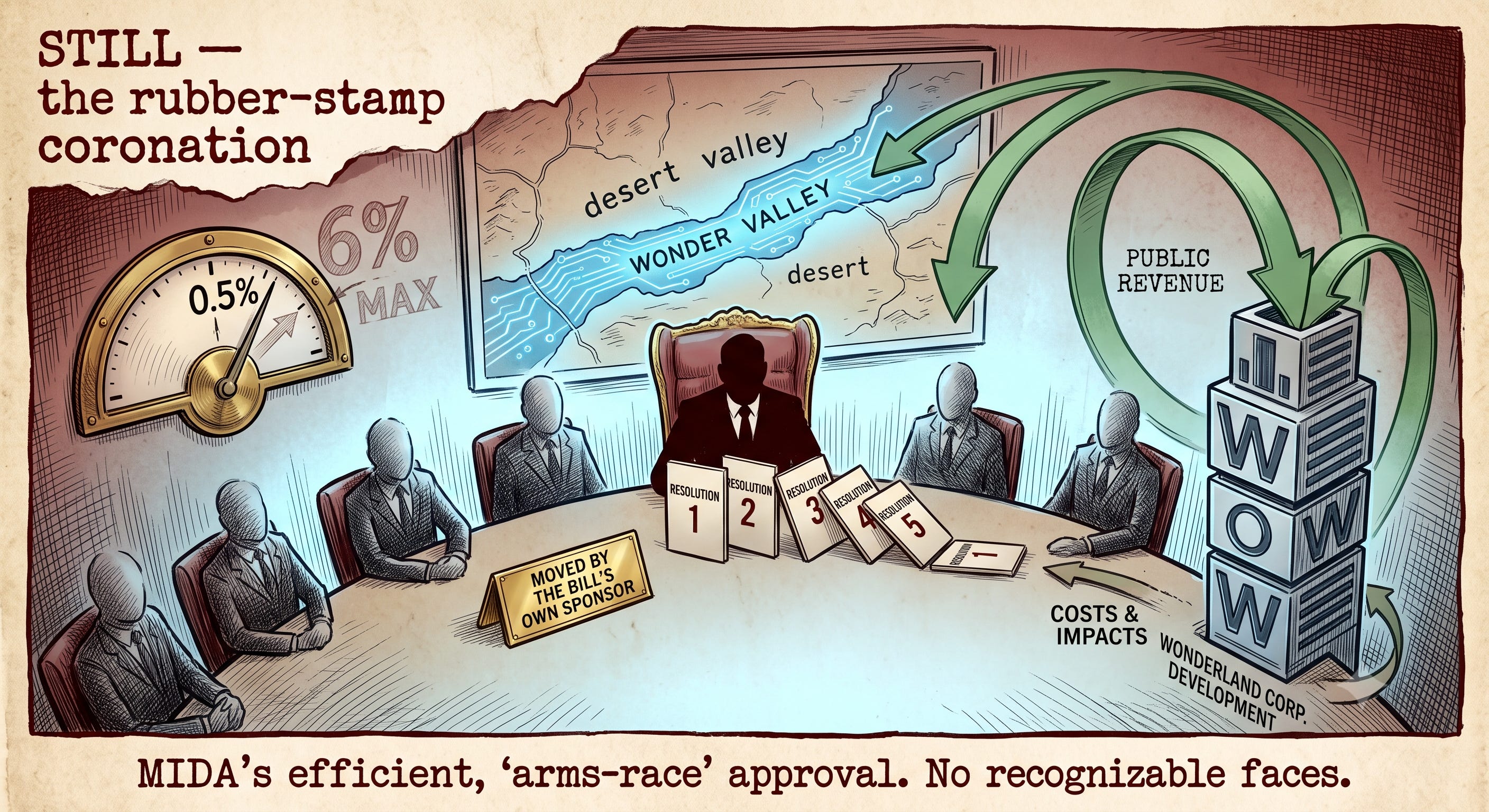
Friday, April 24, 2026. The shut-out is already law, its clock ticking. The MIDA board convenes, Senate President J. Stuart Adams in the chair, and in one brisk sitting — no dissent, barely a ripple — waves through the entire skeleton of a new empire on the map: a project called Stratos. Roughly forty thousand acres of private ground in unincorporated Box Elder County, out where the sagebrush meets the Test and Training Range.
Who moved the two motions that mattered — the development agreement, and the tax break? Not a hired hand. Senator Jerry W. Stevenson, MIDA vice chair, the same man who sponsored the bill, sat on the committee, and voted for himself. He moved to seat the developer. He moved to slash the tax. The circle doesn’t just close; it signs its own name at every station.
And the terms — oh, the terms. This isn’t our editorializing; it’s the executed contract, sitting in the board’s own packet for anyone with a library card. A thirty-year lock with vested rights. An energy tax the authority was fully entitled to set at six percent, dialed instead down to one-half of one percent — the fiscal equivalent of pricing beachfront property by the grain of sand. And a clause returning much of the project’s own tax revenue to the developer, so that, in the contract’s genuinely magnificent phrasing, the public works get “constructed by the Master Developer at no cost to Box Elder County.”
Sit with that sentence, because it’s a small masterpiece. “At no cost to Box Elder County” is engineered to make a taxpayer sigh with relief — right up until you read the line above it and grasp the mechanism: the county keeps the buildings, and the developer keeps the money the buildings throw off. It’s a gift you pay for and he unwraps.
The master developer, coyly unnamed in the meeting summary, is named without a blush in the agreement itself: O’Leary Digital Utah Development Company, dba the almost-too-perfect “Wonder Valley.” Kevin O’Leary turned up to speak for it. And the contract cheerfully confesses the sequence: the developer had already bought up the land and collected every landowner’s consent before MIDA drew the project area around it. The private deal came first. The “public” authority arrived afterward, like a valet, to park it and pay for it.
The county keeps the buildings. The developer keeps the money. And the public authority shows up last — not to decide anything, but to bless what was already done and hand over the tab.
[CONFIRM IT YOURSELF] utah.gov/pmn → “Military Installation Development Authority” → the April 24, 2026 meeting. Approved minutes show who chaired, who moved what, and how each measure carried; the board packet holds the executed agreement, whose opening line names O’Leary Digital Utah Development Company.
Now to the chairman’s ledger — the one belonging to Senate President Adams, who presided over all of it. A caveat first, and up front where it belongs, not whispered in a footnote: Adams has since lost his seat at the 2026 primary, so he is a lame duck, and he throws an annual spring fundraiser, so the date does part of the explaining. Note both facts, then notice they change nothing about what the ledger says. A lame duck still held the gavel that day. The checks still cleared.
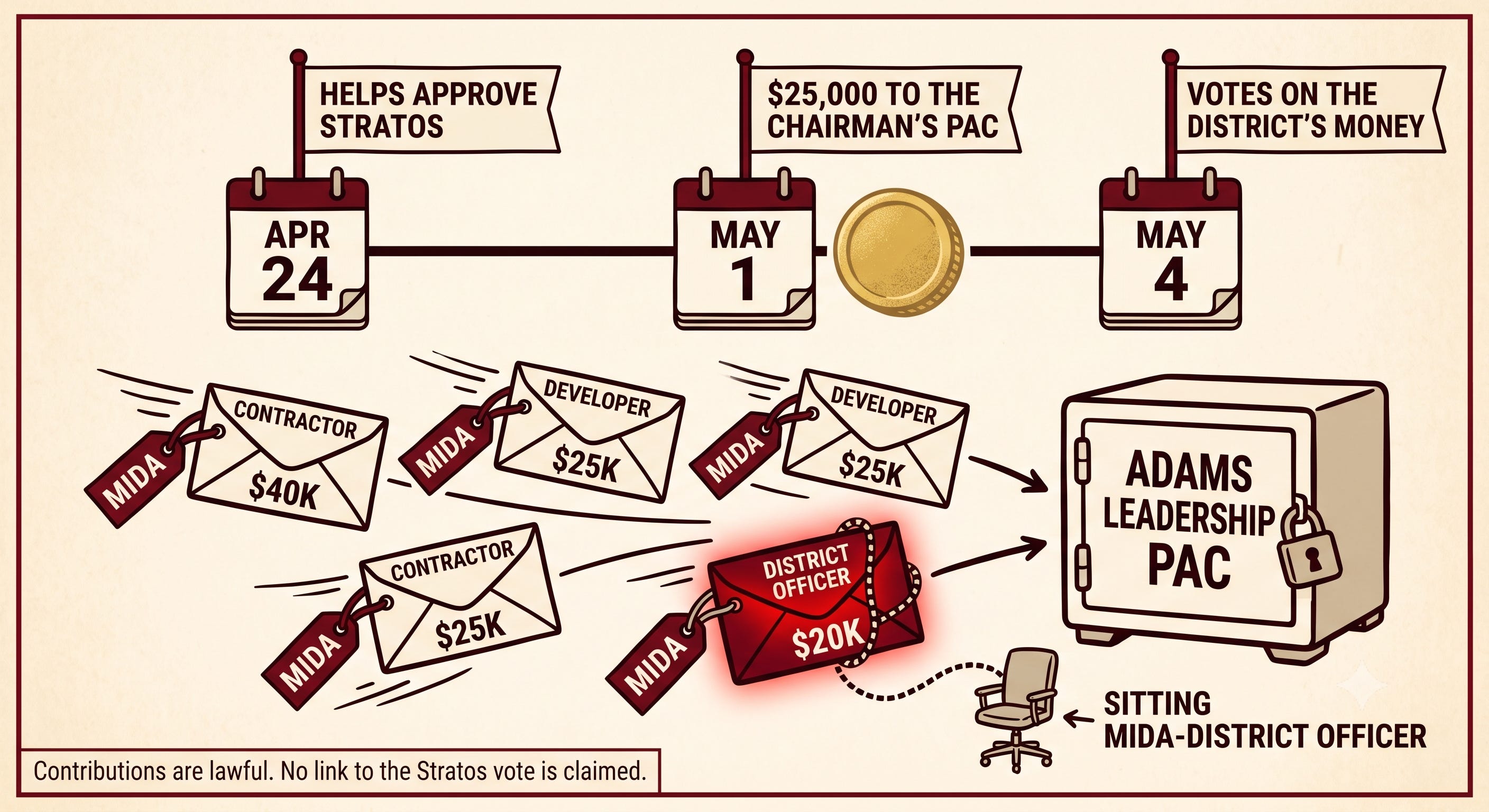
On May 1, 2026 — a single day, one week to the hour after Stratos sailed through — the Adams Leadership PAC booked $135,000 from five givers: $40,000 from Jacobsen Construction; $25,000 from Clawson General Contracting; $25,000 from Tyler and Jennifer Aldous; $25,000 from Gershon and Ayala Barnett of Extell; $20,000 from Copper Key Electrical. Toss in the same day’s other gifts and the tally clears roughly $167,500. Quite a spring party.
Forget the calendar entirely if you like; the pattern doesn’t lean on the seven days. It leans on who these five are. Not a bake sale’s worth of ordinary constituents — every last one is wired into MIDA’s world: a contractor on a MIDA build, the principal of a MIDA project-area developer, the managing director of a development parked inside a MIDA zone. Contractors to the authority and developers for the authority, all writing checks on one convenient day to the committee of the man who chairs the authority. The reporters who first spotted the cluster were careful to note these donors are tied to authority projects at Deer Valley and Jordanelle, not to Stratos, and that no direct line connects the cash to the data-center vote. We say it exactly as plainly as they did — and then we turn over the one card that needs no inference at all.
Skip the newspapers. Open a government document: the approved minutes of the MIDA Golf and Equestrian Center Public Infrastructure District for May 4, 2026. Under “Board Members Present,” there sits Tyler Aldous — not a bystander, but a working officer, moving to approve the minutes and holding forth on the district’s finances, a district whose budget, the same minutes note, leans on “pledged revenue from the SkyRidge development” — Aldous’s own project — “toward the bonds.”
Now lay the dates on the table, every one straight from the public record. May 1 he gives $25,000 to the chairman's PAC. May 4 he votes on the authority's money as a voting officer of a MIDA-created PID. As with the rest of that day’s gifts, these contributions are lawful, and no evidence ties them to the Stratos vote; the donors’ known ties run to MIDA’s Deer Valley and Jordanelle projects, not Stratos. May 4: Aldous takes his seat as a voting officer of a MIDA district and helps steer its money. Three days, three rooms, one man.
Strip away every last adjective and this is what stands, certified not by a reporter but by the authority’s own minutes: a voting officer of a MIDA-created public infrastructure district contributed to the Adams Leadership PAC, which the MIDA chairman leads. The record hands us the office and the dates. It does not hand us the motive — and unlike the men in this story, we don’t fill blank spaces with whatever’s convenient. We set the fact on the table and let it do its own quiet, damning work.
April 24 he helps approve it. May 1 he gives $25,000 to the chairman's PAC. May 4 he votes. The minutes give us the office and the dates. We’ll let you supply the adjective.
[CONFIRM IT YOURSELF] utah.gov/pmn → “MIDA Golf and Equestrian Center Public Infrastructure District” → the May 4, 2026 minutes name Tyler Aldous under “Board Members Present.” The May 1 money is at disclosures.utah.gov → committee “Adams Leadership PAC,” filtered to 2026.
One more quiet place worth a flashlight: the conflict-of-interest forms. Give Chairman Adams his due — as opposed to Stevenson — he disclosed his MIDA seat every year, 2020 through 2026, right out in the open. No hiding the chair. His forms even own up to a sprawling real-estate and development business. And then, year after obedient year, the very field that asks him to name the property that “may constitute a conflict of interest” gets a shrug of boilerplate, and the box for the specifics HERE is left blank. Everything required is filed; the one spot where a citizen might learn something useful is, reliably, empty. The form dutifully discloses that there is something to disclose — and then declines to.
We grade by an old, unglamorous rule. An anomaly is something odd that begs an explanation. A red flag is a specific reason to worry. A smoking gun is proof that needs no inference. We are stingy about which word we use, because the discipline is the whole point.
The man at the center — Stevenson — a senator seated on three of the four favored authorities, who wrote the bill enlarging one of them, voted it out of his own committee, and personally moved the motions that seated the developer and gutted the tax — is a red flag of the first order, and the sturdiest thing in this record, because every plank of it is a primary document and not one plank depends on characterizing a dollar. It is exactly the arrangement Caperton says should trouble a reasonable person about the fairness of the game.
The carve-out itself — ordinary door chained, exception reserved to four hand-picked boards, slipped in by substitute, its clock nudged back a year — is a red flag, fully documented; what it can’t show by itself is intent.
The April 24 giveaway — thirty years, a tax dialed to a rounding error, revenue piped back to the developer, the Senate President in the chair — isn’t inference at all. It’s record, in an executed contract.
The $135,000 one-day cloudburst from the authority’s own contractors and developers into the chairman’s committee, a voting officer of a MIDA-created district among them (same precision fix as everywhere else — he sits on the PID, not the MIDA board) — set beside that chairmanship and that approval — is a red flag climbing to the very lip of the Caperton line. It is not a smoking gun, and we refuse to costume it as one.
Add it up and you don’t get a felony. You get something craftier: a structure lawful in every visible joint, and disturbing precisely because it’s lawful. That’s the lesson worth carrying out of here. The finest capture leaves no broken statute to wave at a jury. It just rearranges the furniture until the outcome was never in doubt, then dares you to call rearranged furniture a crime.
Disturbing precisely because it’s lawful. The best capture breaks no law — it just builds the room so the answer is decided before anyone walks in.
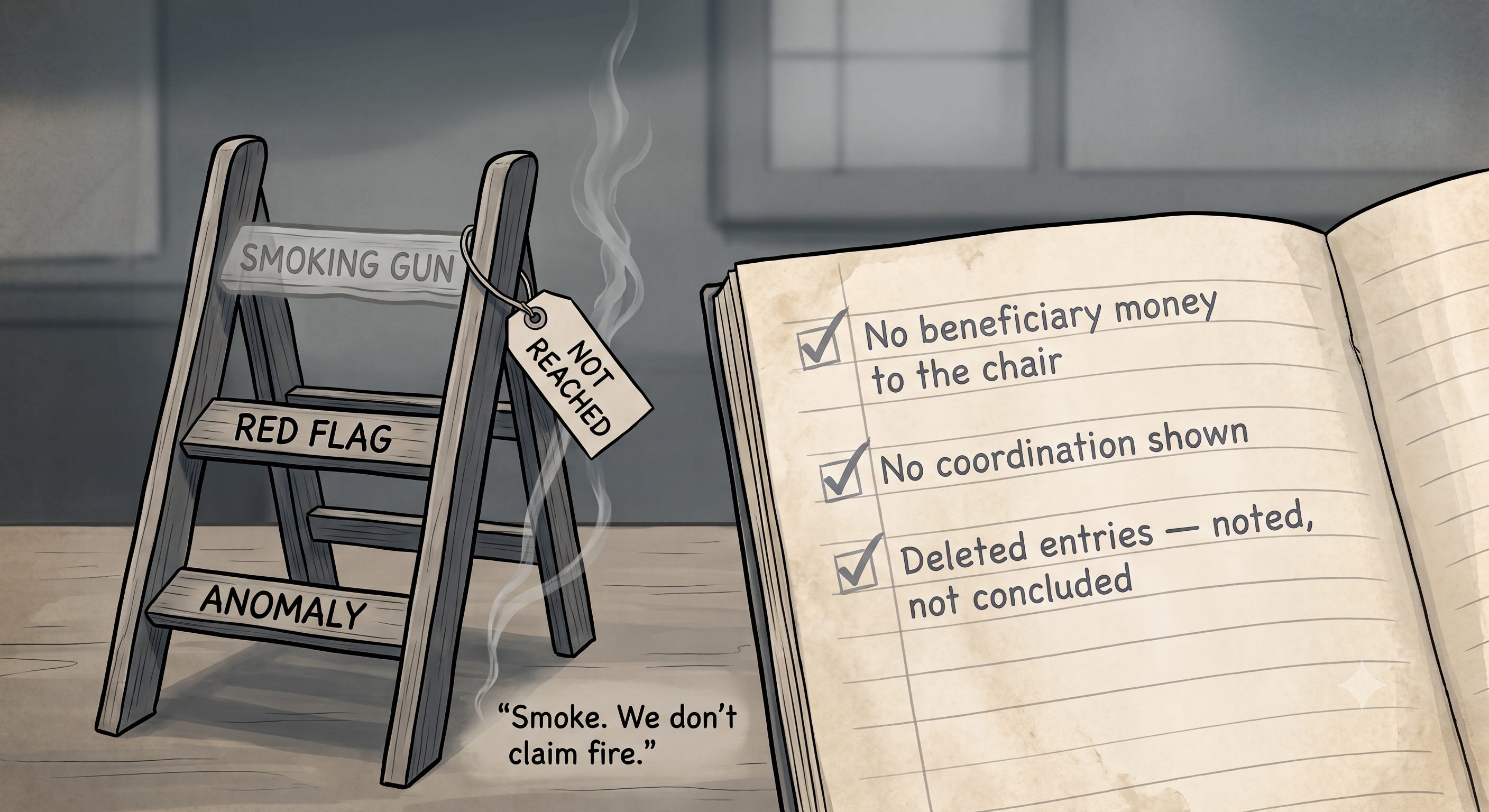
An honest witness is known by the limits he volunteers, so hear these as clearly as the rest — they’re not confessions, they’re the fence posts that make everything inside them trustworthy.
The beneficiary did not pay the chairman. We read the Adams Leadership PAC’s entire 2026 file, line by line. Not one dollar from O’Leary, O’Leary Digital, or “Wonder Valley.” The company that won Stratos gave the chairman’s committee exactly nothing on this record. If you came for the developer stuffing cash into the pocket of the man who chaired his approval, it isn’t here.
No money reached Stevenson, either. His own committee filings are clean of the developer and clean of the chairman’s PAC. The case against his conduct rests on his seats and his votes — on what he did in office, not on anything anyone paid him. We’d rather tell you that than let you imagine a bribe the record doesn’t hold.
No proof of coordination. The record shows authority insiders paying the chairman. It does not show any check was solicited, steered, or swapped for a vote. Every one of those donors may have given for reasons entirely his own and entirely legal, and we can’t show otherwise.
One question we won't pretend away. The 2026 filing carries a block of entries stamped 'deleted' — no amount, no donor name left in the public export. In Utah's disclosure system, a 'deleted' entry ordinarily marks an item that was reported and then amended — often wholly innocent, a duplicate or a correction. We draw no conclusion from it. We note it only because an honest record shows its own blanks.
We end where honest work ends — with questions, not verdicts. Each is nailed to a documented fact above; none is an accusation. We just decline to let them go quietly.
Should a senator who sits on three of the four authorities a law anoints be the one to write the bill enlarging one of them — and then vote it out of his own committee?
Was the door narrowed so the one project already strolling through gets grandfathered while every future rival must come begging to the boards — or is that just how the dice happened to land?
Why hand a freshman a forty-section omnibus to carry, and whose wish list rode inside it?
Why did five authority-tied givers drop $135,000 on the chairman’s committee on a single day?
And what, exactly, is behind those deleted lines?
We don’t answer them. We hand them to you — and the map to chase them down yourself.
The primary documents behind this report:
Stevenson’s conflict-of-interest forms (the 2019–2024 filings and the January 15, 2025 filing)
The SB316 committee vote: le.utah.gov/mtgvotes.jsp?voteid=36529
Enrolled HB507
The April 24, 2026 MIDA minutes and board packet
transparent.utah.gov/mida (the “quasi-municipal… no oversight” page)
The Adams Leadership PAC 2026 filing
Databases move and records hide behind search forms, so we give you the path, not a link that’ll rot. Walk it, and you don’t have to trust a word we said — you can confirm us, or correct us.
A · The senator’s disclosures. disclosures.utah.gov → search “Jerry Stevenson” → conflict-of-interest forms. The three authority seats — MIDA, Inland Port, Point of the Mountain — appear in the form filed January 15, 2025 and again in 2026, and are absent from 2019–2024. His candidate-committee reports sit on the same system (and show no developer or chairman-PAC money).
B · His bill and his own vote. le.utah.gov → 2025 session → “SB316.” Chief sponsor on the face of the bill: Sen. Jerry W. Stevenson. Heard in the Senate Economic Development and Workforce Services Committee, of which he is a member; the recorded favorable committee vote (Feb 26, 2025) is preserved at le.utah.gov/mtgvotes.jsp?voteid=36529.
C · The board seat. The Authority’s own roster at midaut.org lists Jerry Stevenson as a board member and vice chair — the same man named on the bill.
D · The statute that chained the doors. le.utah.gov → 2026 session → “HB507”: every version, the substitute history, sponsors, votes, fiscal note. Definitions at Utah Code 63N-3a-101 (the four-authority list) and 54-26-101 (the 100-megawatt line).
E · The approval & the developer. utah.gov/pmn → “Military Installation Development Authority” → April 24, 2026. Approved minutes record the chair and every motion (including who moved them); the board packet holds the executed agreement, whose opening names O’Leary Digital Utah Development Company.
F · The district officer who gave to the chairman’s PAC. Same site → “MIDA Golf and Equestrian Center Public Infrastructure District” → May 4, 2026 minutes name Tyler Aldous under “Board Members Present.”
G · The money. disclosures.utah.gov → committee “Adams Leadership PAC” → contributions → filter 2026. The May 1 entries list each contributor and amount. This is the source of record; treat any aggregator as a lead and confirm it here.
H · What MIDA is, and who audits it. transparent.utah.gov/mida compiles MIDA’s financials, legislation, and meeting materials, and states the auditing arrangement described above.
That’s the whole of it. A door built above the county. The ordinary doors chained. The doorman’s committee funded by those who stroll through — and standing in the middle of every frame, one sitting senator on the boards the law favors, who wrote the bill, voted it from his own committee, and moved the motions that sealed the deal. All lawful. All disclosed. All on the record. You’ve now watched the trick performed once, slowly, with the sleeves rolled up. You won’t need it shown so slowly again. Next time a dull, forty-section bill chains an ordinary door and leaves one gilded door open, you’ll feel the draft — and you’ll know exactly whose office is upstairs.
══════════════════════════════════════════════════════© 2026 Wayne L. Wickizer. All rights reserved.
Prepared with AI research and drafting assistance (Claude, Anthropic).
Wayne L. Wickizer — 89-year-old great-grandfather.
Former FBI Special Agent; graduate, FBI Command School of Advanced Criminology; uniquely commended by both Director J. Edgar Hoover and investigative journalist Jack Anderson — a distinction never repeated.
Former Special Agent, Utah Attorney General’s Office — investigated and prepared for prosecution two landmark major criminal cases.
Retired Major, U.S. Army Special Forces (Green Beret), Special Operations intelligence officer.
U.S. Air Force veteran, 5,000+ flight hours — weather-reconnaissance and nuclear-sampling missions; listed on the federal Ionizing Radiation Registry for Soviet fallout exposure. 100% service-disabled veteran.
Retired Utah secondary educator. Credentialed investigative journalist, Society of Professional Journalists. B.S. English (Journalism minor); M.S. Administration of Justice.
Publisher — Justice4All (justice4all.blog) and Justice4Eternity (justice4eternity.substack.com). Active pro se litigant, Wickizer v. Cox and related actions.
Contact: justice@utahwtp.com • 385-239-8326
═══════════════════════════════════════════════════
No posts
Comments
Nothing yet. Say the first thing.
Sign in to join the conversation.