
By Dean Rovang
Staying Curious · justdean.substack.com · ORCID 0009-0006-1351-5320
My great-grandfather was born in 1850. That is a hundred and seventy-five years ago. At about twenty-nine years to a generation it is six of them — him, my grandfather, my father, me, and two more I will not meet.
Run the same distance the other way and you land on 2200.
What he was born into
The air he was born into held about 284 parts per million of carbon dioxide, and the global temperature sat within a few hundredths of a degree of where it had been for the whole of the Holocene — the eleven thousand years in which agriculture, cities and everything we call history happened.
He had no way of knowing either number. Neither measurement existed. Over his lifetime the concentration rose by about twenty parts per million, which is a change too small to notice and too small to matter.
What we are leaving
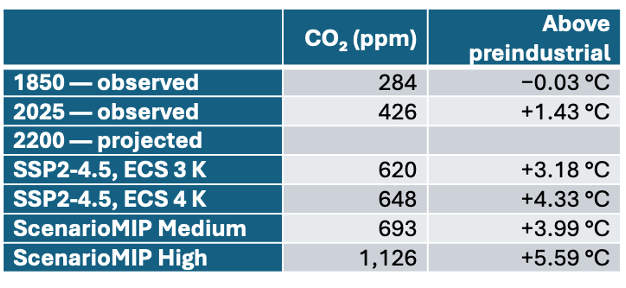
Observed values from the instrumental record; projections at 2200 from four published runs. Note that these are not four scenarios: the first two are one model at two climate sensitivities, the second two are a different modelling framework at two emission levels.
Between 1850 and now, carbon dioxide has risen 141 parts per million and global temperature has risen 1.46 °C. That is the entire industrial era. Six generations, every measurement in the record, every argument anyone has had about whether it is happening.
The same span forward — the same six generations — adds more than that. On the mildest of the four, another 194 parts per million and 1.75 °C. On the pathway current policies actually deliver, another 267 and 2.56. On the highest, another 701 and 4.16.
Every one of them is larger than everything that has happened since my great-grandfather was born.
Where the accumulation stops
2200 is not only six generations out. It is roughly where the carbon peaks. On the middle pathway atmospheric carbon dioxide tops out at 693 parts per million in 2197, and by 2200 the warming has reached about ninety-five per cent of its eventual maximum. The other runs peak within a few decades of the same date.
So the sixth generation forward arrives as the accumulation finishes. What comes after them is not more warming. It is the same warming, continuing.
How long it continues
Here the arithmetic stops being easy to hold, so I will keep it in the same unit.
Six generations took us from my great-grandfather’s world to this one. On the middle pathway it is about three hundred and thirty before the planet is as cool as it is today. On the high one, about six hundred and fifty.
Those two figures come from a simple carbon-cycle and energy-balance model I built and have written about elsewhere, including where it is weakest. Its most likely error is that it returns too fast — the published work on multi-millennial recovery suggests a slower one. So three hundred and thirty is a floor, not an estimate.
Which is why the version I would actually defend is rounder, and survives being wrong by a factor of two. Six generations to get here. Hundreds to get back.
The only difference
I do not know what my great-great-great-great-grandchildren will be called, or where they will live, or what they will think of us. Nobody does. But they are not an abstraction. They are six links along a chain I am already standing in, exactly as far from me as the man who was born before anyone had measured carbon dioxide at all.
He could not have known. That is the only real difference between his position and mine.
Comments
Nothing yet. Say the first thing.
Sign in to join the conversation.