
As part of my research for this project, I was at one point going year by year through a list of Harvard Divinity School grads from the early 1800s, trying to get a sense of what they were interested in, and what they were writing about after graduating.
I was trying to pin down the transition point where we shifted from morally panicking about supernatural religion, to morally panicking about grand secular/political atrocities like racism and climate.
Most of these Harvard Divinity grads are obscure and forgotten now, but one who stood out to me was Theodore Parker (1810-1860), a Unitarian pastor.
You may know Parker as the source for the quote “The arc of the moral universe is long, but it bends toward justice.” Martin Luther King popularized it, but the original was Parker:
I do not pretend to understand the moral universe. The arc is a long one. My eye reaches but little ways. I cannot calculate the curve and complete the figure by experience of sight. I can divine it by conscience. And from what I see I am sure it bends toward justice. (1853 sermon on slavery)
As I delved deeper into Parker, he was so fascinating to me, and so in line with my theory of modernity, that I ended up going through all of his writing I could find.
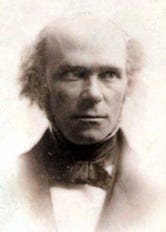
It felt like central casting had sent me a figure designed to perfectly epitomize this new type of moral panic—this new secular Puritanism that bursts out after Locke. Practically everything about Parker is archetypal for these new panics:
Harvard was an intellectual epicenter of the transition, and Parker was double Harvard.
Unitarians were on the leading edge of the transition, and Parker was a Unitarian’s Unitarian: he got so edgy even the Unitarians eventually kicked him out.
The transition to secular panics was driven by a rejection of the supernatural, and Parker was a leader in this disenchantment process. His 1841 denial of biblical miracles (“The Transient and Permanent in Christianity”) shook the faith of many.
Abolition of slavery was the first clearly recognizable panic of the new type, and Parker was a top abolitionist.
A characteristic of this new type of panic is that activists tend to collect a portfolio of them: racism, sexism, climate, school shootings etc. Stopping one atrocity is not enough! Parker had his own portfolio as well: slavery, alcohol (the “Temperance” movement), penal reform, war in general (he attended an anti-war conference), etc.
The term “progressive” is used for many panics of the new secular type, and Parker is the first I’ve found to use the term in its modern sense.
The secularity of these new panics tends to replace Heaven with a vision of endless progress toward greater and greater justice and decency here on earth. And again it’s Parker who gave what is still our best language for this: the arc of the moral universe bending toward justice.
The new type of panic implies a certain argumentative personality, and Parker had this in spades: irascible, caustic, constantly setting up unfair straw men to argue against. It was remarked on by his contemporaries, even those who admired him.
I’ll give you a bunch of examples from his writing now. I think you’ll be amazed by how modern Parker sounds, and by how ancient some of these memes are. When someone complains “X percent of the wealth is owned by only Y percent of the population”, well, Parker was complaining about exactly that 175 years ago:
I do not believe it is just and right that less than one-twentieth of the people in the nation should own more than ten-twentieths of the property of the nation. (A Sermon on the Moral Condition of Boston, 1849)
It's not that Parker anticipates one or two aspects of modern progressivism. It’s that he seems to anticipate almost all of it: feminism including equal pay and a male and female God; “root causes” of crime; Anglo-Saxon genocide of native peoples… It was mind-blowing.
I suspect Parker feels so modern to us, because Locke’s system creates a very particular kind of mental box for moral panics—a very constrained box—and we have been trapped in this very specific box for the last 200 years. Briefly here, I think the box is limited to issues with these particular qualities:
Secular atrocities that can be solved by democratic government action, but the action is politically blocked by villains blinded by secular sin (hate, misogyny, science denial, etc). Hence we must engage in a vast campaign to shift public opinion on the issue, to overcome the villains’ resistance.
And what luck! Pastors put out of work by Locke’s privatization of the supernatural could simply shift their preaching to these vast political campaigns. Exhorting and shaming are what they do, and they get to keep doing that.
And they get to keep doing it at the highest level. If you were preaching on purely supernatural ideas like the Trinity or baptism in 1800, ordinary people outside your denomination could disagree and even roll their eyes at how ridiculous your ideas are. But if you preached on secular atrocities like Slavery, you had the moral high ground to rail down at everyone. You could call for force and even war. You remain major league. Your religion doesn’t get privatized down to minor league status.
Whether consciously or unconsciously, Parker grasped these fundamentals. He was essentially a scolding Puritan who refused to privatize. He insisted on remaining up top, and he worked out the pivot to politics that made this possible.
I’ll let Parker speak for himself now.
The term “genocide” hadn’t been coined yet, but Parker surely would have used it:
We are the most aggressive, invasive, and exclusive people on the earth. The history of the Anglo-Saxon, for the last three hundred years, has been one of continual aggression, invasion, and extermination. …
The same disposition to invade and exterminate [shown by English to Irish] showed itself on this side of the ocean [toward Indians]. …
If the problem is to destroy a race of men with the least expenditure of destructive force on one side, and the least suffering on the other, the Anglo-Saxon, Briton, or American, is the fittest instrument to be found on the whole globe. (Some Thoughts on the Progress of America, 1854)
His weaponized “we” also stands out to me as very modern—as in “we” whites must stop being so fragile, “we” Westerners must drop our colonialist attitudes, and so on.
On suffrage and women’s equality:
To make one half of the human race consume all their energies in the functions of housekeeper, wife and mother, is a monstrous waste of the most precious material that God ever made.
Looking at it as a matter of pure Right and pure science, I know no reason why woman should not be a voter, or hold office, or make and administer laws. I do not see how I can shut myself into political privileges and shut woman out, and do both in the name of unalienable right. (Of the Ideal Public Function of Woman, 1853)
On equal pay:
But I confess I mourn that where her work is as profitable as man's, her pay is not half so much. A woman who should teach a public school well, would be paid four or six dollars a week; while a man who should teach no better, would be paid two, three, four or six times that sum. (same)
Women in government would be less war-like:
If the Affairs of the Nation had been under woman's joint control, I doubt that we should have butchered the Indians with such exterminating savagery, that, in fifty years, we should have spent seven hundred of millions of dollars for war, and now, in time of peace, send twenty annual millions more to the same waste. (same)
Male and female God:
God is...Father and Mother of all men .... the Infinite Mother of us all (Some Account of My Ministry, 1852)
Why not a Secretary of Peace instead of a Secretary of War?
Why, there is not a Christian nation in the world that has not a secretary of war, armies, soldiers, and the terrible apparatus of destruction. But there is not one that has a secretary of peace, not one that takes half the pains to improve its own criminals which it takes to build forts and fleets! (The Dangerous Classes in Society, 1847)
Denormalizing the death penalty as self-evidently repulsive:
It is not long since the gallows was a public spectacle here in the midst of us, and a hanging made a holiday for the rabble of this city and the neighbouring towns; even women came to see the death-struggle of a fellow-creature, and formed the larger part of the mob. ... I remember a public execution some fourteen or fifteen years ago, and some of the students of theology at Cambridge, of undoubted soundness in the Unitarian faith, came here to see men kill a fellow-man! (same)
Anti-nationalist universalism:
Now, the minister is to represent, not America, not England, not France alone, but the human nature of all mankind; and see that his nation harms no other nation; that the majority hinders no minority, however small; that it brings the weight of its foot upon no single man, never so little. (On the Position and Duty of a Minister, 1852)
Also very modern-sounding is his idea that “the majority hinders no minority, however small”. “LGBTQIAA” is almost literally a series of ever smaller minorities, each letter creating (per Parker’s logic) a sort of moral absolute for majority effort and protection.
Criminals are blameless products of their social conditions:
What keeps you from a course of crime? Your morality, your religion? Is it? Take away your property, your home, your friends, the respect of respectable men; take away what you have received from education, intellectual, moral, and religious; and how much better would the best of us be than the men who will to-morrow be huddled off to gaol, for crimes committed in a dram-shop to-day? The circumstances which have kept you temperate, industrious, respectable, would have made nine-tenths of the men in gaol as good men as you are. …
Much can be done for juvenile offenders, much for discharged convicts, even now. We can pull down the gallows, and with it that loathsome theological idea on which it rests—the idea of a vindictive God. A remorseless court, and careful police, can do much to hinder crime; but they cannot remove the causes thereof. …
[T]his is plain, that now public charity is more extended, more complete, works in a wiser mode, and with far more beneficial effect; and that pains are now taken to uproot the causes of poverty—pains which our fathers never thought of. …
A beginning has already been made in the right direction, by establishing the State Reform School for Boys. It will be easy to improve on this experiment, and conduct prisons for men on the same scheme of correction and cure, not merely of punishment, in the name of vengeance. But, after all, so long as poverty, misery, intemperance, and ignorance continue, no civil police, no moral police, can keep such causes from creating crime. (The Moral Condition of Boston, 1849)
After slavery, Parker’s biggest hot button was probably Temperance. He rails at what we would today call “Big Alcohol”. Before reading Parker, I imagined the early Temperance crusaders were Puritans shaming down at individual alcoholics for their lack of purity or willpower. But Parker framed the issue as much more of a secular “public health” problem caused by Big Alcohol.
This is a very modern/progressive way of seeing Temperance, which blames large forces at the top of the power hierarchy, as opposed to demanding more individual willpower at the bottom:
Then I have preached against intemperance, against making rum, selling rum, and drinking rum. The evil of intemperance has been under my eyes every Sunday. There is not a man before me, not a woman before me, not a girl or boy before me, but has lost some dear and valued relative, within not many years, slain by this monstrous vampire, which sucks and poisons the body of America. The poor men that I feed have been made paupers by rum; of the funerals that I attend, rum, with its harsh hammer, has often nailed down the coffin-lid; and of the marriages that I have helped to solemnize, how often has the wife been left worse than a widow! Since intemperance has become so popular in Boston; since it has got the mayor and aldermen on its side, and while every thirty-fifth voter in Boston is a licensed seller of rum; when it is invested with such strength, and gets possession of the House of Representatives, — I have preached against it all the more. I know, from the little town where I was born, as well as this large one, what a curse and blight drunkenness is. (Some Account of My Ministry, 1852)
Note the cosmically intense language of good and evil as applied to a secular political issue: a “monstrous vampire”, an “evil”, a “curse”.
Modern progressives use the term “progressive” with both political and moral connotations, and Parker is the first I’ve found who used the term with both senses simultaneously.
It’s interesting that at the very beginning of this modern usage, Parker was literally opposing the word “progressive” to the word “Satanic”. And his “progressive” was not merely democratic: it was “celestial-democratic”.
The theological roots are so evident, it feels like finding the fossil of a missing link: a pastor who still employs cosmic Christian terms of Good vs Evil, but can only apply them to secular politics. I picture something like a monkfish using its fins to walk on dry land. The supernatural ocean is losing its nutrients as belief in the supernatural becomes increasingly suspect, so the monkfish adapts its existing fins (shaming people as “Satanic”) to walk on dry land (secular politics). Here is Parker, walking on dry land:
Now the progressive power of America is lodged chiefly in the North, where it is diffused almost universally amongst the people, but most conspicuously comes to light in the men of genius. Accordingly, every man of poetic or scientific genius in the North is an anti-Slavery man; every preacher with any spark of Christian genius in him is a progressive man and hostile to Slavery. …
The regressive power is lodged chiefly at the South, where it is considerably diffused among the people. That wide diffusion comes partly from the ethnologic sluggishness of the African element mixed in with the population, but still more from the degradation incident to a people who have long sat under tyrannical masters. It is this which has debased the Caucasian of Virginia, Tennessee, North and South Carolina. …
If we once put an anti-Slavery man, never so moderate, into the presidency, then see what follows immediately or at length: ... All the great offices, executive, judicial, diplomatic, commercial, will be controlled by the progressive force; the Administration will be celestial-democratic, not Satanic merely, and seek by natural justice to organize things and persons so that all may have a share in labour and government. (The Present Crisis in American Affairs, 1856)
Isn’t that the perpetual goal of progressivism still: to control “all the great offices” and impose “celestial-democratic” rule?
Progressives would later progress beyond being this openly self-congratulatory, but it’s interesting and almost endearing to see how artless the early progressives were, in praising themselves for their progressivism.
Parker praised his own Puritan-descended tribe for being the “the most progressive portion of the most progressive people, of the most progressive stock, in all Christendom.”
As Parker tells it, his progressive tribe had reached the pinnacle of humanity up to that date—and rather than being content with that, they were pushing ever higher:
These Northern Saxons, moreover, are mainly descended from men who fled from Europe because they had ideas, at least sentiments, of Christianity and democracy which could not be carried out at home. They are born of Puritan pilgrims, who were the most progressive portion of the most progressive people, of the most progressive stock, in all Christendom. They came to America, not for ease, honour, money, or love of adventure, but for conscience’ sake, for the sake of their Christianity and their democracy. Such men founded the chief Northern colonies and institutions, and have controlled the doctrines and the development thereof to a great degree. We see the result of such parentage: more than all other nations of the earth, the North has cut loose from the evil of the past, and set its face towards the future. ... No people on earth has such material comfort, such enjoyment of natural rights of body and spirit already possessed, such general development of the human faculties. But the attainment does not satisfy us; for we share this instinct of progress to such a degree, that no achievement will content us. (The Present Crisis in American Affairs, 1856)
As Parker sees it, the real headline from a “sweep of human history” perspective is the progressives themselves, who were leading humanity to new heights in every possible dimension: political, economic, moral. Slavery is the detail, the Progressives themselves are the main plot thread. Abolition was just one of many projects in their portfolio.
In a similar vein, Boston is awesome:
After all, it is a good town, this dear old Puritanic Boston. We wish we may be mistaken, but yet we think it the best city in the world—the most moral, intelligent, charitable, and progressive—the most hospitable to a great, new truth of philosophy, morals, philanthropy, or religion. We hope there are better towns, but know not where to find them. (The Material Condition of the People of Massachusetts, 1860)
“The most moral, intelligent, charitable, and progressive”…is that far from Harvard’s self-image today?
In 1839, Parker attended Boston's Berry Street Conference, an annual meeting of Unitarians. Parker was “horrified” by talk of excommunicating members who denied biblical miracles. Shocked, he wrote in his journal:
This is the 19th century! This is Boston! This among the Unitarians!
In other words, how could the most progressive and enlightened people on earth still believe in bullshit miracles? It’s 1839!
(Story from Gary Dorrien’s 2001 book “The Making of American Liberal Theology: Imagining Progressive Religion 1805-1900”)
Though Parker was a pastor, his only moral absolutes seem to have been his political positions. When it came to supernatural theology, he thought people should be free to believe pretty much anything—and he praised the Unitarians for having this tolerant permissiveness:
The Unitarians have no recognized and public creed. It used to be their glory. At the Theological School in Cambridge, I subscribed no symbolical books; at my ordination I assented to no form of doctrines—neither church nor council requesting it. When I became a member of your learned body, no one asked me of my opinion, whether orthodox or heterodox. No one even demanded a promise that I should never change an opinion, or discover a new truth! (Letter to Boston Association of Congregational Ministers, 1845)
When some Unitarians eventually attempted to prosecute Parker for his own apostate theology, he taunted them with their own permissiveness and lack of boundaries:
But still, I do not know that I have transgressed the limits of Unitarianism, for I do not know what those limits are. It is a great glory to a liberal association to have no symbolical books, but a great inconvenience that a sect becoming exclusive should not declare its creed. I cannot utter the Shibboleth of a party till I first hear it pronounced in the orthodox way. I shall presently proceed to beg you to point out the limits of scientific freedom, and tell the maximum of theological belief which distinguishes you from the "orthodox" on the one side, and the minimum thereof, which distinguishes you from the "infidels" on the other side. (same)
Parker had simply internalized the argument for religious toleration given by John Locke, that supernatural religious ideas are mere “speculative opinions” that harm no one. Here is Locke:
[T]he magistrate ought not to forbid the preaching or professing of any speculative opinions in any Church because they have no manner of relation to the civil rights of the subjects. If a Roman Catholic believe that to be really the body of Christ which another man calls bread, he does no injury thereby to his neighbour. If a Jew do not believe the New Testament to be the Word of God, he does not thereby alter anything in men’s civil rights. If a heathen doubt of both Testaments, he is not therefore to be punished as a pernicious citizen. The power of the magistrate and the estates of the people may be equally secure whether any man believe these things or no. (Locke, A Letter Concerning Toleration, 1689)
Between the lines, this is a very patronizing argument that essentially says supernatural ideas aren’t real enough to harm others, so you can’t use force over them.
Rather than be patronized by Locke, Parker simply shifted his preaching to things that are real, like slavery. More than that, Parker figured out the broad range of secular political issues one could apply this to: women’s rights, criminal rights, minority rights, corporate public health issues, anti-war activism, etc.
Again, I think Parker feels so weirdly modern to us because we are still trapped in the same panic box with him. Locke’s epistemic assumptions are still controlling, and under those assumptions, this is still the only formula we have for creating moral panic. We are basically all trapped in this box today, at least if you’re a mainstream Brit or American.
You might think pro-life conservatives are the opposite of Jurassic Parker progressives, but they are trapped in the very same, very secular box. Evangelicals will picket an abortion clinic because 700,000 babies are being killed each year. That is a real secular harm that needs to be corrected with democratic government action, so we need a vast campaign to shift public opinion. It follows Parker’s Panic Box formula.
Evangelicals will not picket atheist group offices, nor will they picket churches that practice the wrong kind of baptism. This is because those are purely supernatural ideas that don’t harm others in the Lockean sense, and they are not a proper object of Lockean legislation.
It’s not just that Christians refrain from seeking legislation on their supernatural ideas. These ideas are downgraded so much they won’t even criticize someone as being a bad person over them. If you’re a Christian, you may disinvite someone from your block party for using the N word or denying the Holocaust, but you certainly won’t exclude someone for being Hindu or Muslim or atheist. They are still good people! Perfectly nice!
I’m not saying this toleration is necessarily bad. I am saying it’s a huge break with the past—and very Lockean.
This religious toleration seems good to us, and like progress. We need to look up to modernity’s very intolerant Panic Box, to start to see some of the downsides of Locke’s program.
Locke privatized supernatural religion, downgrading it to minor league morality. The vacuum gets filled by secular political panics, which become our new litmus tests of human decency. Are you a Slavery Man, or an Anti-Slavery Man? (Parker literally asks this somewhere). It is secular political tests like these that now decide whether we disinvite someone from a block party.
Collectively, these secular panics create our new major league quasi-religion.
The problem is, something essential was lost in the privatization.
You could say Christianity had a hard rind of judgment (“atheists are evil”), and a gooey center of peace, awe, mercy, and forgiveness.
As we transitioned to the new secular moral panics, we retained the hard rind of judgment (“racists are evil”), but we lost the gooey center of joy and peace. It makes no sense to preemptively forgive racists while they are still harming people. We need to stay angry and committed until the harm stops. See Greta Thurnberg’s usually angry face.
It made no sense for Theodore Parker to have a sweet and lovely temperament like St. Francis of Assisi—not as long as these secular atrocities were still raging. Having a beautiful soul is eternally important only if the supernatural is real.
I will end on a description of Parker by one of his admirers, the Unitarian Joseph Henry Allen (1820-1898):
Out of a certain defect in his mind which I have tried to indicate, he would often seem not in the least to understand or do justice to the minds of others. And so there was a vein of misunderstanding and injustice, on both sides, which made bitter and false a large part of his controversy with the popular theology. I do not remember a single statement he ever made of the doctrine of his opponents which they would be willing to accept, while he did make many statements of their doctrine which they considered wilfully offensive misrepresentations and caricatures. …
Considering how much of a controversialist he was, how familiar with the history and criticism of every form of belief, how generally known as assailing other men's opinions, it is remarkable how self-confident he always was in asserting his own. It is as if he had never known a doubt. It is as if there were no shading-off in his mind between absolute belief and absolute disbelief .... It did not occur to him that where he and other men differed, he might possibly be mistaken; that there might possibly be some truth of experience, if not of fact or philosophy in the doctrine he attacked. (Our Liberal Movement in Theology, 1882)
Do you feel the style and tone of our modern political panics in this description? We are forced to maximally spin and demonize, because our Panic Box formula requires a vast campaign to flip public opinion on the issue. Only that (we imagine) can end these horrific secular atrocities.
Curiously, though, the secular atrocities never end, no matter which “celestial-democratic” candidates won the all-important last election. There are always four or five simmering at any given moment. As Voltaire might have said to Locke, if secular atrocities didn’t exist, it would be necessary to invent them.
No posts
Comments
Nothing yet. Say the first thing.
Sign in to join the conversation.