
Last week I wrote about what helped me mindset-wise when playing a tournament.
In this post I’ll write about the first of two goals I had for the tournament and how it went.
I wrote these down an hour before Round 1 (and more specifics on the first one before Round 2):
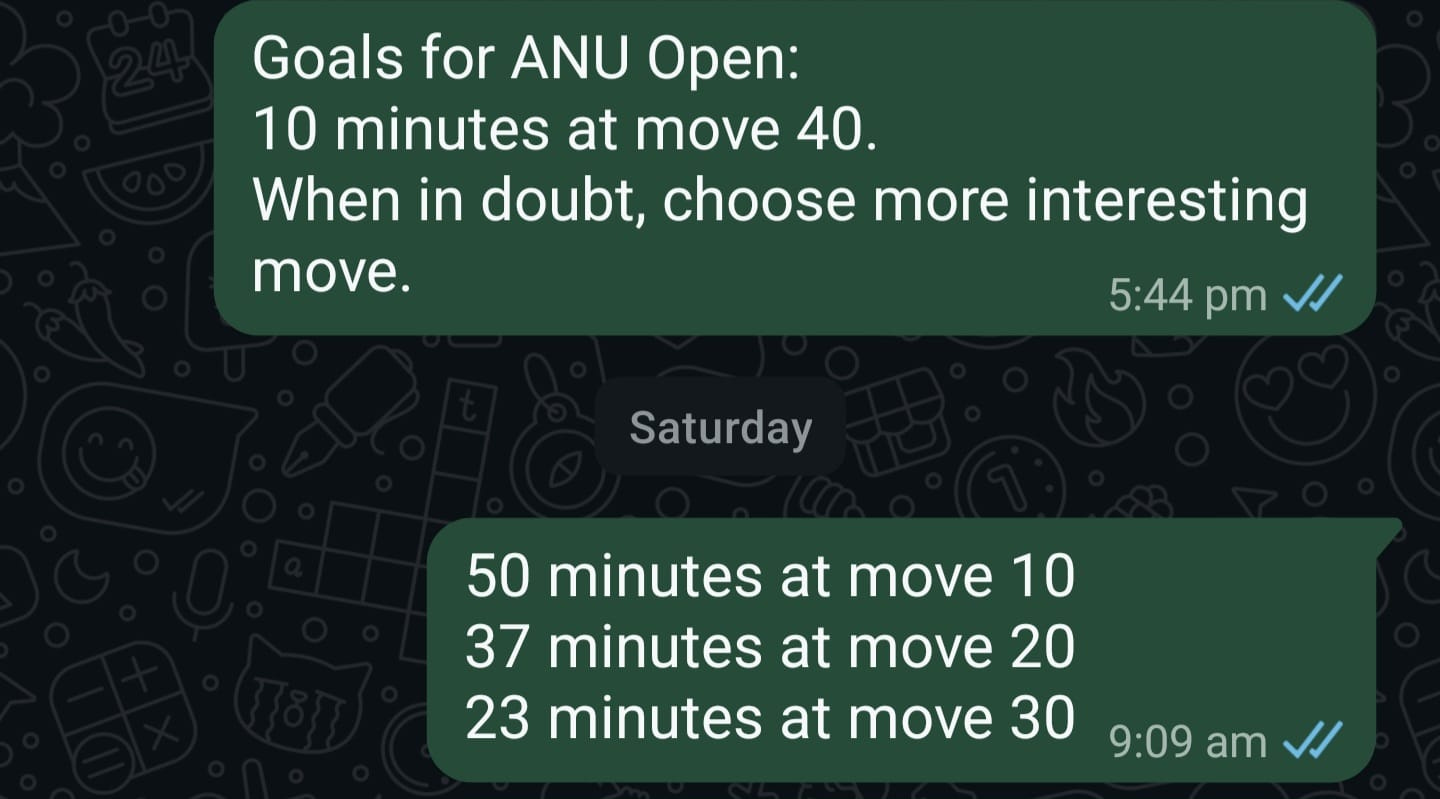
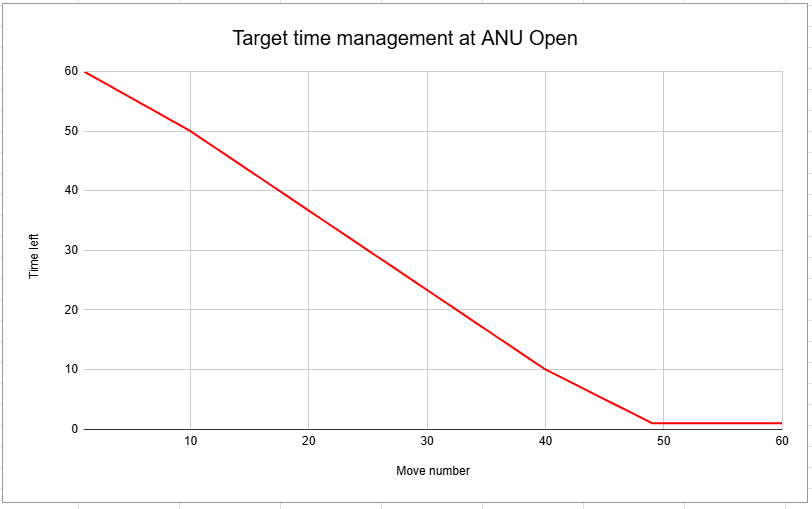
The goal was to have 10 minutes at move 40 so I still have time to think in the endgame. The first 10 moves should take the least, so starting with 60 minutes in this tournament (+30 seconds/move), the target time management would translate to having around 50 minutes at move 10, 37 at move 20 and 23 at move 30.
In a graph that looks like this, so I wanted to be above the red line:
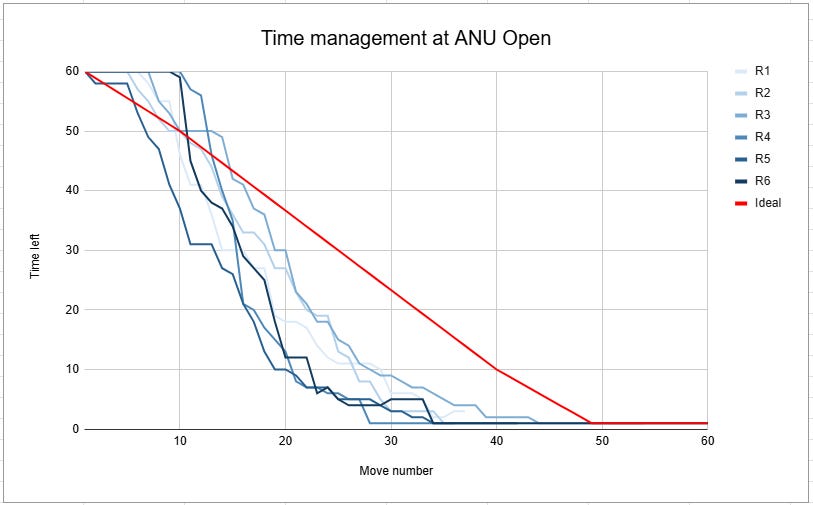
But I have to admit, I utterly failed with this goal. With 90+30 I’ve been noticeably improving things each year but here I struggled, and this is what my time management looked like in the 6 games:
Yep.
The point of tracking your time is to see which phase of the game you tend to think too much. And then inside that, which moves you thought too much and why.
A lot of players write their (and maybe opponent’s) time down but don’t do anything with it afterwards. If you’re not going to take a proper look at it later to see what you can improve, there isn’t much point writing them down.
So after move 10, things were fine in most games.
After move 15, when I want to have around 43 minutes, I had 30/36/42/35/26/34 minutes left. I was already an average of 9 minutes under where I want to be.
And at move 20, when I want to have 37: 18/27/30/13/10/12. Things have gone from bad to worse. I’m averaging 18 minutes under where I want to be (that’s nearly a third of the time control), and from move 21 to 28 is where I’m below target the most, by 20~21 minutes.
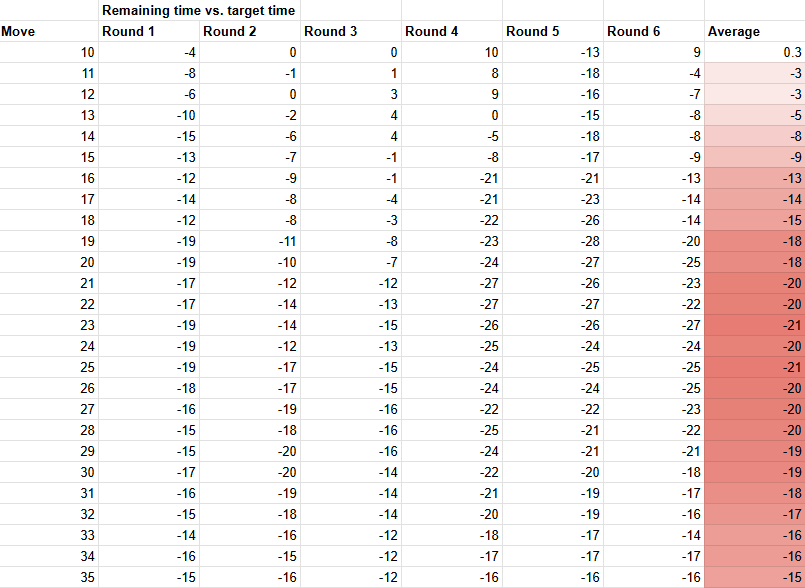
So especially from moves 15–25 or so, or you could say the early to middle? middlegame is where I’m spending too much time. And once I identify that, I can investigate that phase in each game where I took longer than I should have.
For example, Round 1. After 13.Bd2, I’m already much better as Black.
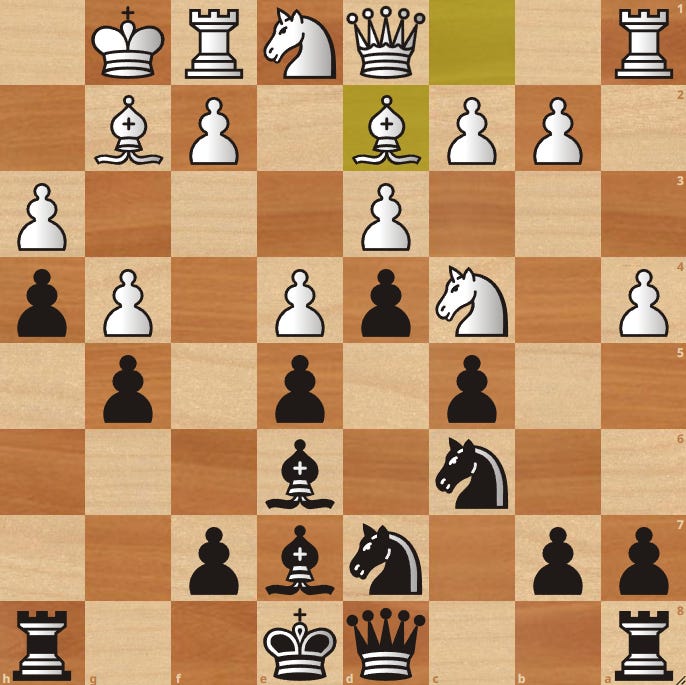
I’ve got more space, and most of White’s pieces are going to be suffering in a confined space for a long time, like extraverts in a nation-wide lockdown of unknown length.
While the kingside is locked up, Black has the long-term plan of playing …a6 and …b5, gaining more space on the queenside and eventually setting up a break there.
So 13…b6 makes a lot of sense before playing …a6 to avoid a4-a5 (I can answer with …b6-b5), but I spent 5 minutes here (41—>36 minutes). Not the end of the world, but in a 60+30 game and already with a semi-permanent advantage, that feels like too much.
Here’s the next position I want to highlight, after 19.Na3.
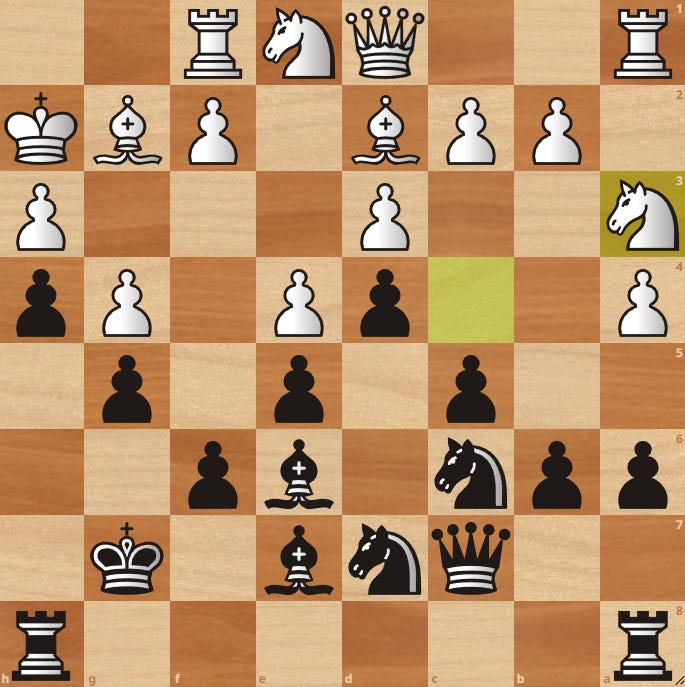
Things have gone smoothly in the last 6 moves, and I could say play …Rfb8 and set up …b5 already. But after 19.Na3, I realised White can play c2-c4 to stop b5. Then it’s very much locked up across the board and winning may become tricky. So when White plays c2-c4, I’ll take en passant and then I’ll have another target on d3 along with the …b5 break to go for.
So, thinking that there’s no rush to go for …b5 (maybe my h-rook will be better on d8 in the en passant scenario), I can improve another piece first - I thought it best to take one of my knights to the juicy f4 outpost, and I was comparing the plans of …Bf7—>Nd8—>Ne6—>Nf4 and …Nf8—>Ng6—>Nf4. When the game opens up later when I play …b5 or White plays c4 and I en passant, I figured the c6 knight would be more useful than the d7 knight (and not in the way of a rook on d8), so I chose the latter plan and played 19…Nf8.
The thinking was good, but I spent 8 minutes (27—>19) and again that was too much. Very comfortable position with an advantage, inevitably there will be more forcing lines to calculate later, so I should keep a good reserve. In this game, when I was already better out of the opening, I’d already spent more than two-thirds of the 60 minutes by move 19 so you can imagine how I struggled in the other games. As I look at the moves I spent too long on there, I can see which kinds of decisions I should work on. (Games here)
Note, you don’t need to look at your sands of time like this if you do well with the clock. I’ve written many posts on time management, but as you can see there’s still work to be done so that was one of my goals for this tournament.
What I want to emphasise is that when you take a whole tournament, you’re bound to see some patterns in your chess that tell you a lot about what you’re doing well and what you can still improve, whatever your demons or weak areas are.
So after a serious tournament, don’t rush to turn the engine on immediately, because then you’ll be fed answers without knowing what questions you should be asking. Take the time to write your thoughts down, explore anything you’re curious about and take stock of what you did well, what needs more work and what you learnt. And by having a goal separate from results, with each game or tournament you can focus on improving a part of your chess that would make a meaningful difference (you can learn how to set your own goals with The 10-Habit Improvement System).
In the next post, I’ll write about the other goal I had for this tournament.
Autopsychography
The poet is a feigner / Who's so good at his act
He even feigns the pain / Of pain he feels in fact.
And those who read his words / Will feel in his writing
Neither of the pains he has / But just the one they're missing.
And so around its track / This thing called the heart winds,
A little clockwork train / To entertain our minds.
1 April 1931
—Fernando Pessoa, A Little Larger Than The Entire Universe: Selected Poems
The 10-Habit Chess Improvement System
If you’re new here, this is the course I built for the problem I write about most: you play, you study, and you still don’t know what to work on next.
Ten connected habits across 12 chapters. They teach you how to take your own serious games and turn them into clear lessons, focused training, and better decisions next time you sit down. Built for ambitious improvers who don’t have spare hours and want the ones they have to count.
No posts
Comments
Nothing yet. Say the first thing.
Sign in to join the conversation.