
by Amy Fallon
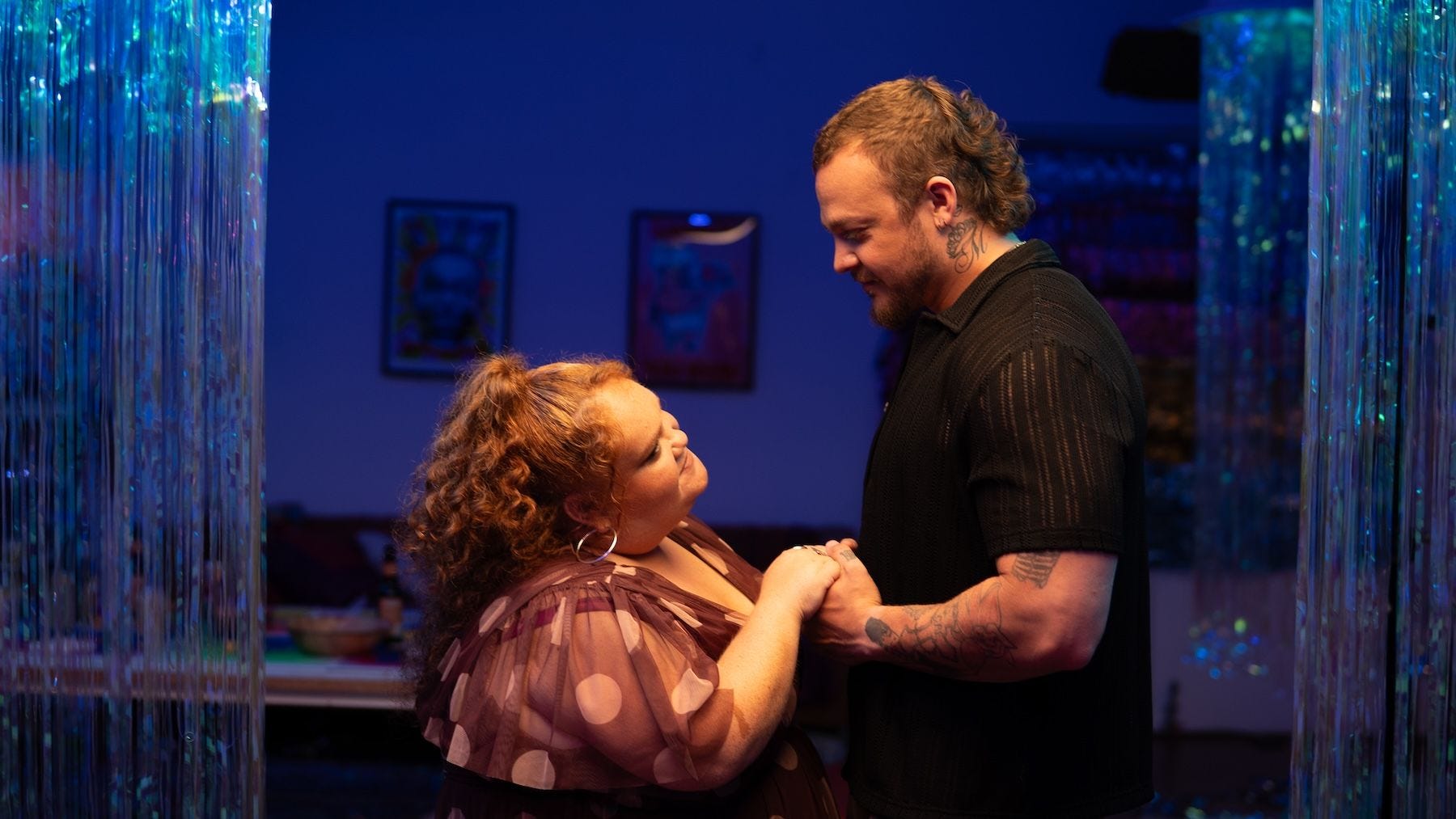
In the First Nations short Belly, which premiered at the Sydney Film Festival this year, there is a tender kiss between actors Megan Lilly Wilding and Dion Williams. It’s just one of a few emotionally charged scenes in the production, so intimacy coordinator Christie Yip was brought on board.
“I was working with the director Aaliyah Jade Bradbury about what cultural sensitivities to look out for during choreography, and she explained that in First Nations culture, avoidance of eye contact is customarily a gesture of respect,” says Yip. “With that consideration, we were able to produce really beautiful work.”
The Hong Kong-Australian, who became an “IC,” as it’s known in the industry, with collective Key Intimate Scenes (KIS), is one of a handful of emerging Australia-based intimacy coordinators helping minority communities tell their stories carefully and creatively.
The productions that KIS’s Australian-trained and internationally-accredited intimacy coordinators work on span a broad spectrum of lived experience, from queer and disabled communities to First Nations, refugee, Arabic, Latin American, and African contexts, plus mixed-identity relationships. Since 2019, KIS has provided support for Nine Perfect Strangers, While the Men Are Away, and Birdeater, among others.
Films started using ICs in about 2015-2016, with theatre adopting them a year later, and both industries employing them widely after #MeToo in 2018. They’re still divisive in some entertainment circles, though. More recently, they have been in the news after Chala Hunter, who worked on the raunchy multi-award-winning Heated Rivalry, was declared “absolutely the hero of this show” by its creator, writer and director, Jacob Tierney. Conversely, star Mikey Madison, who portrayed a sex worker in Anora, revealed she’d turned down the offer of an intimacy coordinator.
KIS founder and director Michela Carattini likens the relatively new role to that of a stunt coordinator. “It didn’t used to exist, but now it’s ubiquitous and a normal part of the industry,” she says.
However, Carattini, an Indigenous Panamanian and Anglo-Celtic Australian actor, writer, director, producer and intimacy coordinator, who has a background in criminology and previously worked with UN agencies and anti-trafficking NGOs, stresses that not every production needs an intimacy coordinator.
“We are absolutely needed, as much as and in a different way as a stunt coordinator, but not on every set and not for every person,” she says, adding that there were also some similarities to a crisis counsellor. “Certainly, I would love to see more cultural change so that there is less need for us.”
Yip worked as a content producer and video editor for the Sydney Opera House, among others, before she decided to add another string to her bow and train with KIS. Yearning for a creative role where she could help make a difference, she has now cut her teeth on Curls, described as an Australian Fleabag, and A Shot in the Dark, billed as a psychological horror.
As an intimacy coordinator, Yip now has a particular interest in working with what’s known as modesty garments — nipple tassels or stick-on G-strings — to cover an actor’s body while filming intimate scenes.
“There are a few companies that are making garments for this purpose, but a lot of times we have to get creative, cutting up nude underwear and taping it onto people’s bodies,” Yip explains.
While this might sound like fun, Yip stresses that at times the role is far from exciting or glamorous. “Often, a lot of the things that you’re working through are interpersonal, and your job is to mediate,” she says. “Sometimes it might get a little ugly.”
Being an IC is “not just all about sex”, explains Bayley Turner, who worked on one of Australia’s most iconic soap operas for two years.
The role can be of value in any scene with “depiction of the intimate body or a large difference in power,” which could include intercourse, intimate partner violence, simulated breastfeeding and scenes featuring a minor, representations of care for the elderly and disabled, and simulations of unconsciousness or death, including simulated cardiopulmonary resuscitation (CPR), she says.
“When I worked on Neighbours, I was part of scenes where there was a simulation of unconsciousness or death, because when someone has their eyes closed, they have to lie still; they’re entirely vulnerable to the actors around them,” she says.
The writer and performer had left the theatre and film industries, having “run into some of the challenges that #MeToo talked about”, and was completing a university thesis looking at preventing sexual violence in the workplace, when she heard about the work of world-renowned intimacy coordinator Ita O’Brien.
Turner’s CV today boasts roles as an IC on theatre productions The Lewis Trilogy, the UK stage adaptation of The Wolf of Wall Street, and Truth, which was about Julian Assange. For the past seven years, Turner has also been running sexual violence prevention education and initiatives through her consultancy Create Consent. In addition, she brings to any role her lived experience as a transgender woman.
In terms of soapies, Turner says having an intimacy coordinator is not just about the extremity of the content, but about the relationships between actors who have played the same character for years.
“Look at Jackie Woodburne and Alan Fletcher, who played Susan and Karl [on Neighbours] — those people had played husband and wife five days a week for decades,” she says.
Syria-born actor Adeeb Razzouk, who came to Australia as a refugee from Syria in 2019, was appearing in a theatre version of Hamlet two years later when he heard via Carattini that there was such a thing as an intimacy coordinator
“I saw that there is a need for a role like this, not just because of intimate scenes or like simulated sex scenes, but also because of how the Arabic body is represented in the media,” he says. “From my perspective as an artist and as a story maker, I believe that these images transition to stories in film, or in movies or in media produced later on to document these stories, to tell these stories.”
Besides working as an IC on the thriller The Method and romance The Duke & The Raja, Razzouk has developed the KIS training with Carattini and others. It’s since been adapted for use in Switzerland.
“To have developed a training curriculum that really specialises in mental health and cultural competency in Australia was really unique,” says Carattini. “Australia has incredible value to bring.”
Comments
Nothing yet. Say the first thing.
Sign in to join the conversation.