
Hello, friends. Here we are half-way through August. How did that happen? The trees are showing signs of early autumn brought about by drought distress. There are conkers on the horse chestnut tree, and pine cones and beech mast falling to the ground, along with brown, crispy leaves. Our little apple tree has produced and dropped its fruit early, ripe-ish but small and hard. This stately gunnera at the arboretum is doing well with its feet in the stream, but below are leaves from a Cornus kousa showing definite signs of distress. I long for rain.


The small birds are returning to the garden after their summer holidays out in the fields and woods. Early this week I heard the robin test out a few notes of his winter song, and by Friday it had replaced his summer one. It changes from that buoyant, mate-attracting, territory-defending, enthusiastic trill to the rather more circumspect, maybe a little wistful, ‘it’s-all-over-for-this-year’ notes. A sign of sorts, that even in the hottest of hot weather, this little creature knows that the wheel of the year is turning and he’ll be all over the greeting card industry any time now. I don’t know why, but I never think of a robin as ‘she’.
I’m not going to say anymore about the weather—pretty much all of you in England are in the middle of it—but I am going to mention the wild fire that happened over the last week near the town where I grew up, and close to where my sister still lives. People and fire fighters hurt, and nineteen homes completely destroyed, it was shocking to see the streets that I am still so familiar with going up, literally, in flames. It’s hard to imagine how those local fire-fighters managed such gruelling work at the zenith of the latest heatwave and in the face of additional burning, fiery heat in their heavy protective clothing and hauling equipment about. Their selflessness and bravery are heroic. We really do not pay them enough. We seem to have a very skewed view in the UK of which professions/jobs/roles are the most valuable in terms of what they contribute (or don’t) to the greater good of the community. Did you know there is a UK FireFighter’s Charity that supports current and ex-fire-fighters wth all kinds of things from mental health to financial difficulties? I didn’t until now, and I shall be making a donation to it this weekend. I plan to write to my MP asking him to oppose any political moves to cut funding for such vital services and to ask what he is doing to draw attention to climate change and the need to strategically plan for mitigation at the most local levels as well as nationally. And I shall try to be a better activist, and not just wait until something feels personal before I do something. And the alarm telling me not to buy a disposable barbecue (As if. What kind of person buys, and USES, a disposable barbecue in these conditions?) or light any fires almost scared the wits out of me, but at least it was action following the COBRA meeting, so I guess they did more than wring their hands and talk about costs, which has to be an improvement.
This week’s reading has been two very different novels. Note: if you haven’t read this novel you may consider what follows to contain bit of spoiling.
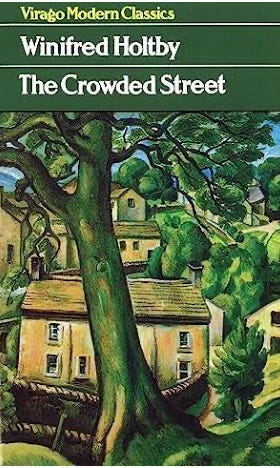
I finished Winifred Holtby’s The Crowded Street, the story of Muriel Hammond, a young woman growing up within the stifling confines of middle-class, Edwardian provincial society in a village in Yorkshire. The expectation of Muriel is to marry well, keep a well-ordered house, and support her husband, but shy, awkward Muriel expects to fail as she wallflowers at dances, exists in the shadows cast by beautiful, charming and vivacious friends, or envies the young women she knows who are clever and college educated and have jobs in London. She seems rather pathetic to a modern eye, but it is hard for us to imagine how suffocating these proscribed lives were for young women and how, without real confidence and determination (which Muriel lacks), escaping was almost impossible. In the bell jar of local society, other young women marry, fall in love, have families and live, while Muriel is left behind, growing increasingly introspective and bitter. The titular ‘crowded street’ (taken from lines of a poem by Holtby’s friend, Vera Brittain) is an apt metaphor: everyone she knows is making their way through life with scarcely a look in her direction, while she stands isolated at the window, watching it all pass by.
What I found interesting is that Holtby doesn’t allow Muriel to become heroic: there is no Damascene moment of liberation, or a rewarding career, and there is certainly no redeeming romantic ending. Instead, Muriel slowly realises what she has missed by lurking under the blanket of respectable middle-class life, expecting to be fulfilled by the attention and social position of a Man—something that eludes her, along with a sense of gratitude for the small societal roles offered to unmarried women, like the Committee work (but nothing ‘unsavoury’), entertaining neighbours, good works among the less fortunate, and always the chased coat-tails of minor aristocracy.
The first World War intervenes, although it has little impact on life in the Yorkshire village other than to provide more good works to attend to, more socks to knit. There is a sub-plot about Muriel’s younger sister, Connie—wilful, angry Connie who does escape, but whose furious liberation-at-any-cost leads her into an even greater trap and a tragic future. (This section laboured the point a little for me, I found it rather melodramatic and I’m not sure what it added to Muriel’s story, although it was another example of how a whole generation of intelligent women were not allowed to find a useful place in society and how the seeking for it played out for individuals).
There could have been a trite ending for Muriel, but instead Holtby shows us a woman finally understanding that putting off life to meet other’s expectations can mean that delay becomes too late; and that self-realisation is a more interesting prize. It’s not all doom and gloom, Holtby leavens things with the humour to be found in petty social rivalries, but it is a cautionary tale of the times and the issues that became even more acute as women like Muriel found themselves as ‘excess’ after the loss of so many young men in the war and fitted for not very much at all.
Half-way through I thought I didn’t like it, and Muriel was irritating me terribly with her defeatism, but by the end I found myself reflecting on it at some length. The Crowded Street is a novel examining the stultifying lives of ‘ordinary’ middle-class young women in the first twenty years of the 20th century and how they were caught on the edge of a chasm of change between their life and the life that came after the Great War. It’s a thought-provoking read.
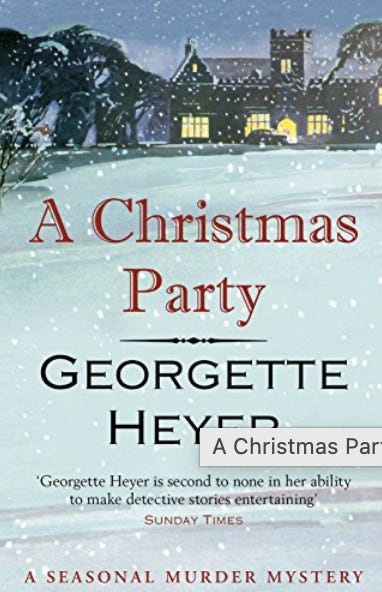
Now, how many of you knew that Georgette Heyer, the doyenne of the historical romance, also wrote crime stories? Lots of you? Well, I didn’t until I happened to pick one up in the charity shop last week. A Christmas Party is a country house-family gathering-locked room-murder mystery and is executed (if you’ll pardon the pun) rather well. Published in 1941 under the title Envious Casca (presumably they changed it because they didn’t think Ms Heyer’s reading public would make the connection with Shakespeare’s Julius Caesar and Mark Anthony’s reference to Publius Casca, the first of the emperor’s stabbers), it gives us the usual suspects of a fatuous brother and his wife who live with Nathaniel Harriad in said country house, a dodgy business partner, a trio of very different ‘modern’ young women, a rather feeble aspiring playwright and, a staple of Heyer’s stories, a handsomely saturnine young man, who is grumpy and suspicious AND likely heir to Uncle Nat, all gathered for an unwelcome Christmas party. Even more grumpy and irritable is Uncle Nathaniel himself who is found dead from a stab wound in his locked bedroom on Christmas Eve. Naturally, there has been much bickering and angry words exchanged previously. Scotland Yard arrives and the detectiving begins. It romps along nicely, with good Golden Age vibes. I did guess the murderer in the first chapter, but refrained from checking the end of the book, so was still able to engage with the coming and goings and moving in and out of suspicion of the members of the household. There is a neat little literary clue threaded in, and all in all, I thought it equal to anything I have read from the British Library Classic Crime series. Indeed, better than some. Put aside any prejudices you may have and give Heyer’s Golden Age crime novels a try. There are a dozen of them, written between 1932 and 1953. On the strength of this one, I shall be reading more.
One more thing.
Friends, I spent the last 16 years of my working life as an academic, in a senior position in a university. Most of the time it was a gloriously enriching experience of interesting, intelligent people sharing their expertise and their thinking, their friendship and collegiality. I loved it. But some of the time it could also be a den of petty tyrannies, of condescension, and clever put-downs. If, like me, you hadn’t followed a ‘traditional’ academic career, a very thick skin, good support, and an unassailable sense of self-worth could be vital. There will be a lot of individuals with questions to answer in the coming weeks, both in academia and in journalism (I use that term loosely). I hope they are already reflecting on their power, and the ways in which they use it. In my view, recognising vulnerability was not difficult to do. Enough.
That’s all for this week. Take care, and I will write again soon. x

Comments
Nothing yet. Say the first thing.
Sign in to join the conversation.