
Hello, hello! First up—A is feeling much better, so there is joy unconfined here. Having his medication slashed seems to have had the desired effect. He’s not quite like a spring chicken (he is 71 after all), but my goodness there’s a positive difference. Hurrah.
Weather-wise, it’s still boiling here, but slightly less boiling than previously. We’ve ranged between 26 and 28 degrees C and there is hope for a fall to 22 to 24 at the weekend. We may also see a splash of rain, but we also may not. Heigh ho. I’ve given up trying to save the garden. I’m now watering only pots and am reconciled to starting new planting in the autumn and next spring. The bulb catalogues have arrived so there is excitement in the air for ordering. I have to try to remember that every bulb I buy has to be planted and that while the idea of masses of spring flowers is lovely, the idea of masses of autumn hands and knees planting is not. We are still seeing lots of butterflies in the garden thanks to surviving nepeta and thriving verbena bonariensis. It has been a very good year for Painted Ladies, I should say. I bought a trail camera last week to try and see what might visit the garden during the twilight hours, but I haven’t managed to set it up yet. It looks a bit complicated and the instructions are the kind that say things like ‘beware small part drop’. And it takes EIGHT AA batteries so I have to restock them first. I hope it’s worth the effort. If I only see a couple of creeping cats and a rodent I’ll be well disapointed.
The town and the beach is getting busier and busier as the first of the summer holiday visitors arrive. At the supermarket it’s easy to spot the holiday cottage people as they are pushing trollies laden to overflowing with stuff they need for a week. This morning I saw one woman whose big trolley was piled high with bread, rolls, sausages, fruit and salad and whose daughter was trailing with a second big trolley just full of cartons of Diet Coke and loo roll. I shouldn’t talk though because our little trolley just had Peroni, strawberries and Calippos.


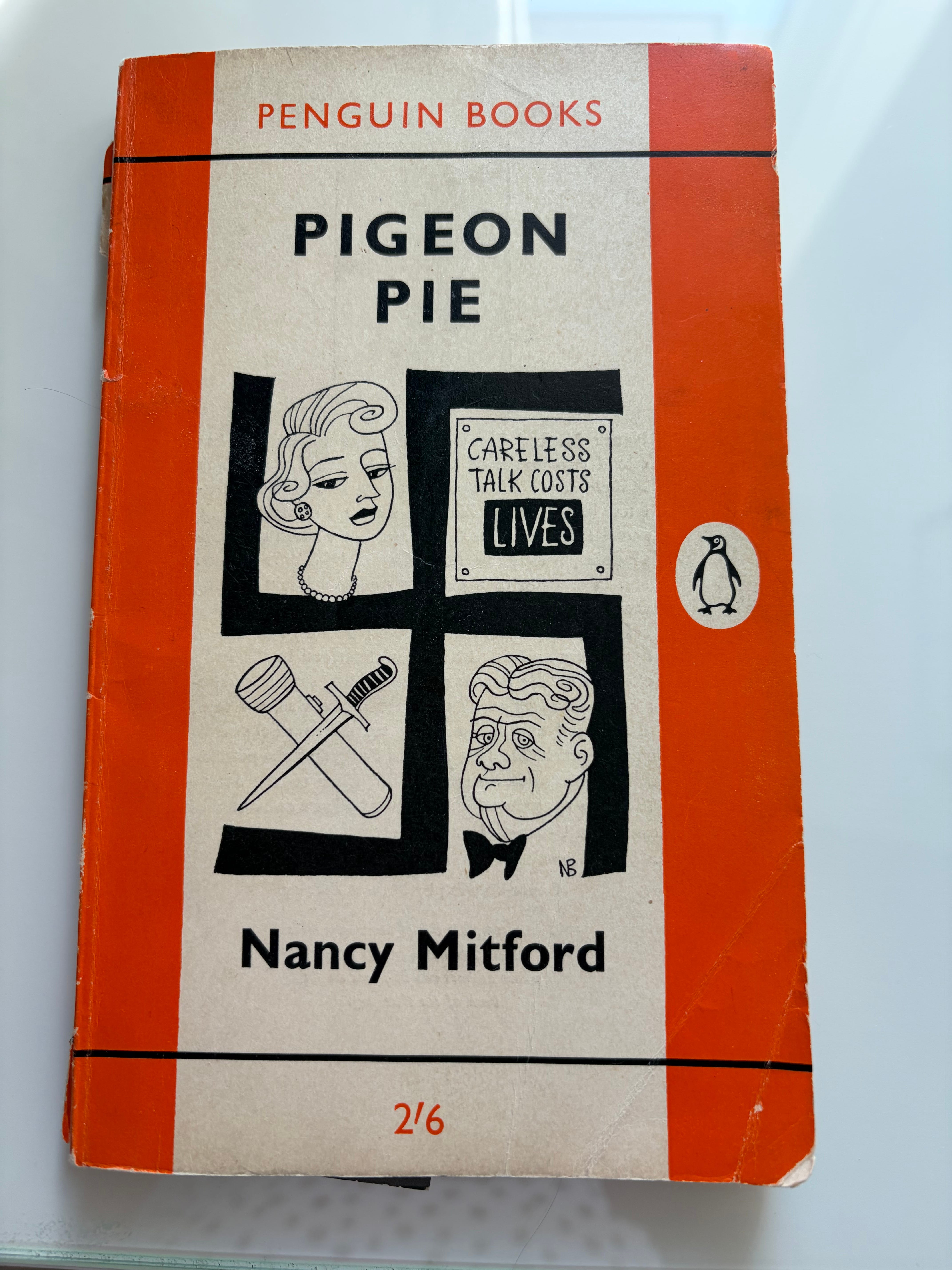
I had a very good find from the bookshelves in the Oxfam shop last week. This early Penguin paperback edition of Nancy Mitford’s Pigeon Pie. It’s quite short so I finished it in a couple of evenings and completely loved it (of course). I’ve read it before, many years ago, but have never had a shelf copy, so I was pleased to re-acquaint myself with Lady Sophia and her tedious husband Luke, and Britain’s ‘phoney war’ between 1939 and 1940. It’s certainly not one of Nancy’s best, and it suffered from being published in 1940 just when the war was becoming very real indeed and jokes about its early unreality were not appreciated, as Nancy herself remarks in a note at the beginning:
"I hope that anybody who is kind enough to read it in a second edition will remember that it was written before Christmas 1939. Published on 6 May 1940 it was an early and unimportant casualty of the real war which was then beginning."
Anyway, Lady Sophia and Luke are no longer in love (were they ever?) and by mutual agreement stay together but have lovers: Rudolph and Florence respectively. Feeling she must contribute to the war effort, Sophia volunteers at a First Aid post (as indeed Nancy did), continues to have fun with her jolly, upper-class friends (oysters, pink champagne and all that) before she finds herself embroiled in a real spy drama, and needs to SAVE THE COUNTRY, which of course she LOVES. It has all the early signs of Nancy’s later brilliant writing—merciless teases of her own class; good characterisation; ridiculous situations, and ditsy, though beautiful, women being cool and funny. I do love Nancy, especially when I haven’t read her for a while; she is so clever and amusing. Aside: my husband made me take it from the bedside table and hide it when the decorator came to quote, in case he saw it and thought we were Nazis. 🙄
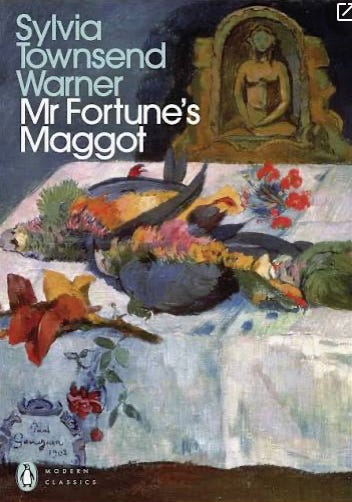
This week’s more serious reading has been the short (160 pages) novel Mr Fortune’s Maggot by Sylvia Townsend Warner. I’ve read two other novels of hers—the delightful Lolly Willowes and the more expansive The Corner That Held Them— and loved them both, so was keen to explore more of her fiction. I confess to being ignorant of any meaning of ‘maggot’ other than a blowfly larva (yuk) and couldn’t imagine how that might be woven into a novel, but I didn’t have to worry. There is a note right at the start that gives an older meaning: a maggot is a whimsical or eccentric idea. Timothy Fortune, the novel’s protagonist, gives up his job as a bank clerk, trains as a Deacon and has spent 10 years being a missionary in the South Seas. His ‘maggot’ is a burning vocation to take the Gospel to the tiny island of Fanua, where no missionary has ever ventured.
He arrives, filled with evangelistic zeal and good intentions, only to find that although the people of Fanua are warm, gentle, kind and generous, they’re not remotely interested in becoming Christians. They don’t oppose or mock him, they just go about their daily lives, accepting Mr Fortune as a friend to the village and, after a year, he has succeeded only with one convert; a young man called Lueli, and even that is not as straightforward as Mr Fortune thinks.
Though short, the novel manages to cover a host of concepts: the nature of friendship, loyalty and love; questions about empire and colonialism; the challenging of pre-conceived ideas; faith, doubt, self-knowledge and fatalism. Published in 1927, it feels very modern, and considerably more subtle than many contemporary novels that try to handle these questions. Warner never preaches. Mr Fortune is kind and has integrity, he isn’t pompous or arrogant, simply a product of his culture and his time. The islanders aren’t noble innocents, they are also products of their culture—Warner treats them all with great affection, never reducing them to obvious symbols.
I think that’s why I found the novel so touching. There are no great speeches or proselytising. No raised voices. Events unfold, usually quietly, occasionally cataclysmically, until Mr Fortune can begin to accept that perhaps he hasn’t improved anyone’s life, after all, but he may have just changed his own. The ending is quite lovely. Slightly melancholy, but full of care and compassion, and love.
If you haven’t read any Sylvia Townsend Warner I suggest you start with Lolly Willowes (which is just fabulous and which I’ve written about before in a post on here, but I can’t find it to link. Is there any way of searching the text of posts, does anyone know? My titles are so random that searching them is hopeless. Update, I found it here, thanks to instructions from Melissa Harrison, who also provided useful advice on the Trailcam), but don’t leave it too long to get to Mr Fortune’s Maggot. It’s a delight.
I had the misfortune this week to watch the Branagh film of Agatha Christie’s Death On The Nile. I know it came out ages ago but it’s only just arrived at free to view. If you haven’t seen it yet, I would advise caution, especially if you are a fan of Agatha Christie and/or either Suchet or Ustinov previous adaptations. My brief thoughts were:
the backstory of ‘how I got my moustache’ and ‘I have indeed known love’ was unnecessary and unwelcome, also if you don’t have subtitles on and you don’t speak pretty fluent French you won’t understand the first ten minutes
apparently Poirot really wanted to be a farmer. Yeah, right
the casting is all over the place, plus it manages to get Armie Hammer and Russell Brand into the same film
French and Saunders? Why??
it’s practically a musical
Egypt in CGI
vomit-inducing dirty dancing
Just don’t go there. It made me thank the heavens for Bette Davis and Maggie Smith.
There’s been a lot of to-ing and fro-ing on Substack about it’s partnering with Pangram. I’m struggling to see it as a good thing but am trying to keep an open mind. I know that some writers have helped to make changes to it (thank you, Katie Clapham and others). To be honest, if you’ve been reading my posts for most of the time I’ve been on Substack then I assume you are not suspicious of my writing not being my writing and I thank you.
And that, my dears, concludes my writing for this week. Take care of yourselves, and I’ll write again soon.
Comments
Nothing yet. Say the first thing.
Sign in to join the conversation.