
First I must apologise for being a little late with this post. A has been unwell this last week and I’ve been busy doing stuff and chasing appointments and getting annoyed with the NHS etc etc. Having time to sit down and think enough to write something coherent has been difficult. He is okay, but needing quite a lot of emotional support. It’s all very normal given what he’s been through this year. My sister is coming for a few days and it will be good to have some distraction and a bit of company. We won’t do much because it’s going to be scorchio again and we will likely be living on lollies and cold cocktail sausages.
Butterflies seem to be out in force in tis warm weather and as the buddleia is in flower we are seeing quite a few—lots of Painted Ladies, Peacock, Holly Blue, Comma, Gatekeeper, even a Small Tortoiseshell, the first I’ve seen for a while. I put out a little fruit on a plate and a bit of water in case they need revival in the heat, but they do seem to be doing just fine.
I think the best I can do this week is to tell you about this week’s book—I haven’t been able to get out much but I have been reading. I managed to finish Angela Thirkell’s The Brandons which was, as all Thirkell’s novels, a delight. There are some Angela Thirkell novels that sparkle from the first page—High Rising, for example—and others that sneak up quietly so that you don’t realise how much you’re enjoying yourself until you’re halfway through. The Brandons belongs in the second category. I finished it with that familiar Thirkell feeling of wishing Barsetshire was a real place so I could pop in for tea and a catch up.
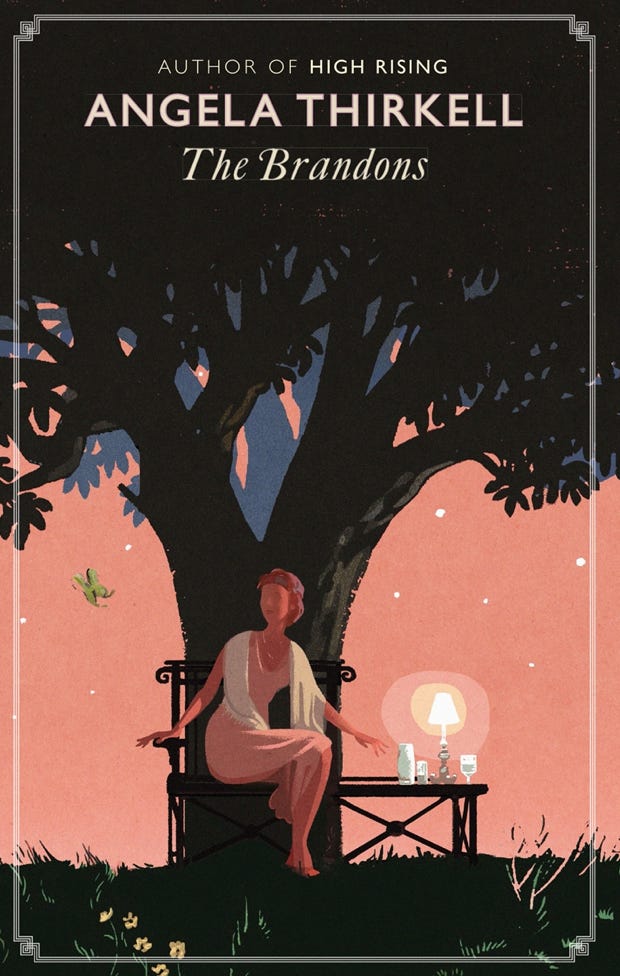
The premise has a hint of Victorian melodrama. Old Miss Brandon is rich, elderly and installed at gloomy Brandon Abbey. She enjoys hinting that she may leave her house and fortune to one relation or another, depending on who has pleased her most recently. It could have been a predictable novel of greedy nephews, hastily re-written wills and family skulduggery but, because this is Angela Thirkell, everyone behaves with disarming decency. Old Miss Brandon is cantankerous, manipulative and perfectly aware that dangling the prospect of an inheritance is an excellent way of ensuring regular visitors. She runs her companion/housekeeper, Miss Morris, ragged. The real lynchpin of the novel, though, is Lavinia Brandon. At first she seems to be almost too vague to function; she dislikes effort in any form, has perfected the art of drifting gracefully through life, and leaves practical matters to whichever of her children happens to be nearest. She could be unbearable…instead, she’s delightful. And every man in her orbit falls under her spell.
I think Thirkell is very good at encouraging us to revise our first opinion of people. Lavinia isn’t secretly brilliant or hiding unsuspected depths. She remains absent-minded, idle and gloriously impractical to the end, but she is kind. She has perfect manners without ever seeming too artificial, and she possesses the rare ability to make everyone around her feel at ease. Lavinia’s children are surprisingly capable adults—probably because somebody had to remember appointments and organise the household throughout their lives. Her son Francis spends much of the novel being amusing and rescuing situations before they become disasters, while daughter Delia is no usual heroine: she is fascinated by catastrophe, and positively lights up at the prospect of medical emergencies. When poor Jimmy Thatcher collapses with appendicitis at the village fête, Delia is probably the only person present having a thoroughly good time.
Hilary Grant arrives as a possible heir and, like so many pleasant young men in novels, has the misfortune to possess an overpowering mother. Mrs Grant is gloriously irritating. Hilary is studying with the vicar, Mr Miller and both of them fall hopelessly under Lavinia’s spell, despite the awkward fact that she has zero interest in the subjects they most want to intensely discuss. Their solemn attempts to impress her with their writing are among the funniest scenes in the book—mostly because Lavinia is so perfectly polite while understanding almost nothing, daydreaming about her diary, her clothes or dinner, and ignoring their bessottedness. She manages to gently deflect Hilary Grant, and to be kind to Mr Miller before steering them both towards much more suitable matches. Later on, Noel Merton arrives; the young London barrister who is already familiar from earlier Barsetshire novels. He comes down to the county as a friend of the Keith family, and at the end of The Brandons he and Lavinia are engaging in a deliciously ambiguous bout of mutual flirting. I loved this ending—because Thirkell refuses to tell us exactly how seriously to take it. Noel and Lavinia are both accomplished flirts and it’s a wonderfully sparkly ending. Much better than a straightforward engagement.
As so often with Thirkell, almost nothing dramatic actually happens. People pay calls, arrange fêtes, discuss servants, drink quantities of tea and gently fall in and out of love. And for me, that gentle rhythm never palls. I think High Rising is the perfect introduction to Barsetshire, and Summer Half is also a favourite. But The Brandons reminds me why I keep returning to Thirkell. She writes as though people are fundamentally ridiculous, occasionally exasperating and, despite everything, well worth spending time with. That’s a pleasing combination, and nearly ninety years later it still feels like being in very good company. I’m glad she wrote so many!!
Take care of yourselves and I’ll write again soon. x
Comments
Nothing yet. Say the first thing.
Sign in to join the conversation.