
The hardest problem in patient monitoring isn’t measuring a vital sign — it’s measuring it continuously, accurately, and without adding one more device to charge, one more alarm to ignore, or one more dashboard to check. In this episode of Signal & Symptoms, Dr. Junaid Kalia hosts — with co-hosts Dr. Harvey Castro and Ed Marx — a conversation with Nayan Patel, a career hospital CIO who spent decades buying health technology before crossing to the vendor side as SVP of Transformation & Digital Health at Neteera.
Neteera’s thesis is subtraction. Its FDA-cleared, deck-of-cards-sized high-frequency radar sensor reads heart rate, respiratory rate and movement by tracking micro-movements on the skin — through clothing and bedding, with nothing worn, nothing charged, and nothing to clean [3][8]. In a retrospective study across skilled-nursing facilities, the platform’s trend data flagged an impending hospitalization roughly five days in advance, most of the time [2]. This briefing maps the market pulling monitoring toward passive and continuous, the adoption traps that kill promising tools, and what a buyer-turned-builder says health-system leaders should demand before any AI monitoring tool goes near a patient.
Remote and continuous patient monitoring is now a large, fast-growing market. Estimates vary by scope, but a representative device-market view puts it at roughly $26B in 2025, projected to about $110.7B by 2034 at a ~20% CAGR [1]. Two structural forces are pushing demand: a global nursing shortage the WHO still projects in the millions of nurses by 2030, and a population aged 60+ rising from 1 billion in 2020 toward 1.4 billion by 2030 [7]. More patients, fewer hands — the exact gap that passive, always-on monitoring is meant to close.
The frontier of that market is moving from worn to ambient: sensors that require no patient compliance at all. That’s where contactless radar sits — and where Neteera reports it already has scale, with the guest describing tens of thousands of devices deployed across long-term-care and skilled-nursing settings (an on-air figure from the guest) [8].
Consumer wearables (Apple Watch, Oura, Google/Fitbit). Ubiquitous and improving, but the panel drew a hard line: these are consumer grade, not clinical grade, and — critically — many patients simply won’t or can’t wear them (Junaid: “I cannot sleep with an Apple Watch”).
Contact sensors (bed pads / mattress sensors). No wearable, but they move around, must be cleaned, and — per the guest — trail on accuracy.
Camera / phone-based “vitals.” The clinician on the panel was blunt from direct testing: phone cameras help with motion but cannot reliably read real vitals or temperature today.
Contactless radar (Neteera). A fixed, wall- or tripod-mounted sensor, wired-on, nothing to wear or clean — positioned as the ambient layer that supplements rather than replaces existing tools.
Labor leverage: Continuous ambient vitals reduce manual vitals rounds — including waking patients every four hours overnight — freeing scarce nursing time against a structural shortage [7].
Consolidation: Ed Marx’s point — one continuously expanding platform can absorb several point solutions, lowering total cost.
Upstream savings: Catching deterioration early (the study’s ~5-day signal) is the kind of intervention that avoids far costlier downstream events — ICU escalations, avoidable admissions, adverse outcomes [2].
Deployment simplicity: USB-C power plus Wi-Fi (or a hotspot for home use); pre-programmed, no per-patient configuration — a low-friction install, which is itself an ROI lever in facilities.
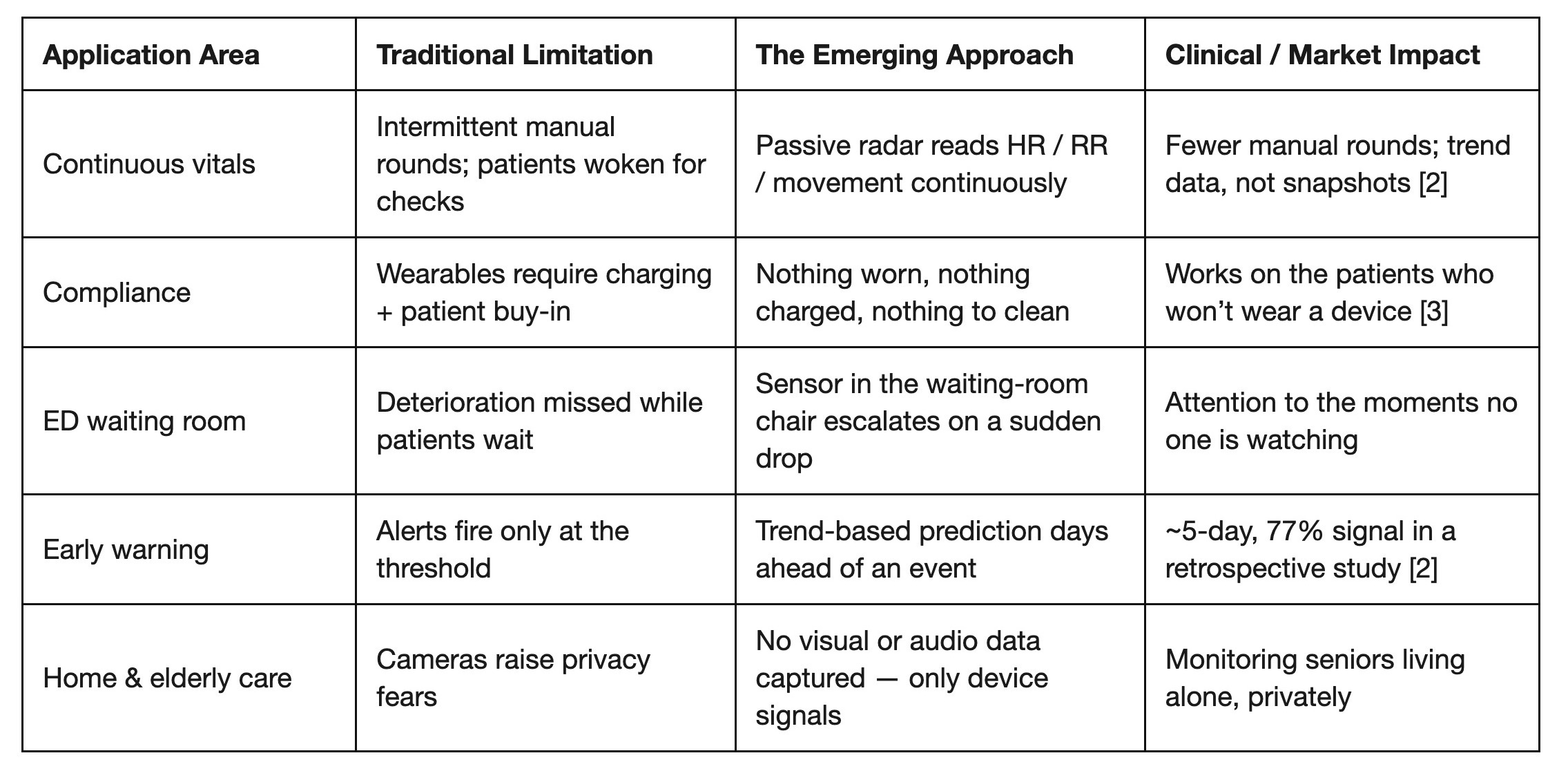
Alarm fatigue is the adoption killer. The literature is stark: an estimated 72–99% of clinical alarms are false or non-actionable, nurses can face ~1,000 alarms per shift, and a large share of clinicians link alarm fatigue to adverse events [6]. Any new monitor that adds noise fails. Neteera’s answer: clinician-defined, trend-based thresholds, not raw streams.
“Don’t make me another dashboard.” The guest — speaking as a former CIO — insists the setup dashboard is for configuration only; alerts must flow into the systems already in use (nurse-call, Vocera/Spectralink/Zebra), via existing HL7 feeds, with FHIR integration in progress.
Accuracy vs. trend. Point accuracy is ~95% and improves with trending; the clinical value the panel emphasized is the trend, not any single absolute number.
Scope discipline. Neteera is cleared for contactless vital-signs monitoring; blood pressure and arrhythmia/AFib detection are explicitly not yet cleared and were framed on-air as capabilities in progress. Conflating “coming” with “cleared” is exactly where trust breaks.
The crisis is a widening gap: more, older, sicker patients and fewer nurses to watch them [7] — while the monitoring layer meant to help is drowning clinicians in false alarms [6]. Adding another beeping box makes it worse.
The path the episode points to pairs passive, compliance-free sensing (nothing to wear, nothing to charge) with intelligent, trend-based alerting that routes only clinically meaningful signals into the workflow a hospital already runs. The design principle is subtraction: remove the device, remove the noise, remove the friction — and keep the clinician firmly in the loop as the decision-maker. The technology alerts and predicts; it does not diagnose. That combination is what turns a “cool demo” into a tool that survives the pilot.
Executives / health systems: Evaluate monitoring on workflow fit and alarm burden, not spec sheets. Demand integration into existing nurse-call and EHR pathways before you pilot — the tool that adds a dashboard won’t last.
Investors: In ambient monitoring, the moat is accuracy + clinical validation + frictionless deployment, not novelty. Regulatory scope (what’s actually cleared) is the diligence question.
Clinicians: Treat these signals as trend-based decision support, not diagnosis. Define the thresholds that matter to you so the system earns its alerts.
Policymakers: Continuous ambient data raises real consent and governance questions (who is being monitored, who owns the data) — the episode’s unresolved “who owns the record” debate applies directly.
The likeliest future isn’t one sensor winning — it’s monitoring becoming invisible. Vitals read from across the room, at home, in the waiting-room chair, overnight without waking anyone; trends surfaced days before a crisis; alerts arriving only when they matter, inside the tools clinicians already use. The credential that will separate what sticks from what stalls is the one this guest carries: built by someone who spent years as the buyer, who knows that the demo is not the deployment — and who designs for the three-year operational reality, not the boardroom applause. As the panel closed: it always comes back to the patient, and to preventing things before they happen.
[1] Grand View Research — Remote Patient Monitoring Devices Market (size & CAGR) —https://www.grandviewresearch.com/industry-analysis/remote-patient-monitoring-devices-market
[2] PR Newswire — Study: Neteera patient-monitoring system alerted for 77% of hospitalizations (~5-day lead), 612 residents / 96 events — https://www.prnewswire.com/news-releases/study-results-show-neteera-patient-monitoring-system-successfully-alerted-for-77-of-hospitalizations-aiding-timely-intervention-302567520.html
[3] Neteera — FDA clearance for contactless monitoring (2022) — https://www.neteera.com/is-healthcare-going-wireless-fda-clears/
[4] Neteera — CE MDR Class IIa certification (Mar 2025) — https://neteera.com/neteera-secures-ce-mdr-certification-for-its-groundbreaking-contactless-monitoring-platform/
[5] PRWeb — GlobalMed named exclusive reseller of Neteera contactless ambient sensing into U.S. federal healthcare (2026) — https://www.prweb.com/releases/globalmed-announces-strategic-partnership-with-smart-meter-and-neteera-to-bring-contactless-ambient-sensing-technology-to-federal-healthcare-market-302788922.html
[6] Nurse.org — Alarm Fatigue Statistics & Patient Safety (false-alarm rate, alarms per shift, adverse-event link) — https://nurse.org/articles/alarm-fatigue-statistics-patient-safety/
[7] World Health Organization — Nursing and midwifery fact sheet (projected nurse shortage; aging-population demand) — https://www.who.int/news-room/fact-sheets/detail/nursing-and-midwifery
[8] Neteera — homepage & platform overview — https://www.neteera.com/
Comments
Nothing yet. Say the first thing.
Sign in to join the conversation.