
The healthcare-AI debate is usually fought at altitude — boardrooms, EHR contracts, model benchmarks. But the decisive test happens in the exam room, where a pediatrician now meets parents who have already consulted TikTok and ChatGPT before the appointment begins. In this episode of Signal & Symptoms, board-certified pediatrician and InTuneMD founder Dr. Isha Mannering joins Dr. Junaid Kalia, Dr. Harvey Castro, and Ed Marx to reframe the question every health system is asking. The issue isn’t whether AI is powerful enough to replace clinicians — it’s whether it can be deployed in a way that rebuilds the one asset medicine cannot function without: trust.
Mannering’s thesis is that AI is a tool, not a takeover. Used well, it hands clinicians back the time the EHR has taken from them, sharpens early-warning “signals” in patients who can’t speak for themselves, and extends care into the home. Used poorly — or opaquely — it accelerates the same trust erosion that already has parents trusting an algorithm over their physician. This briefing maps the market forces behind that shift, the ROI case for the technology that’s actually working, and the practical implications for leaders deploying AI at the point of care.
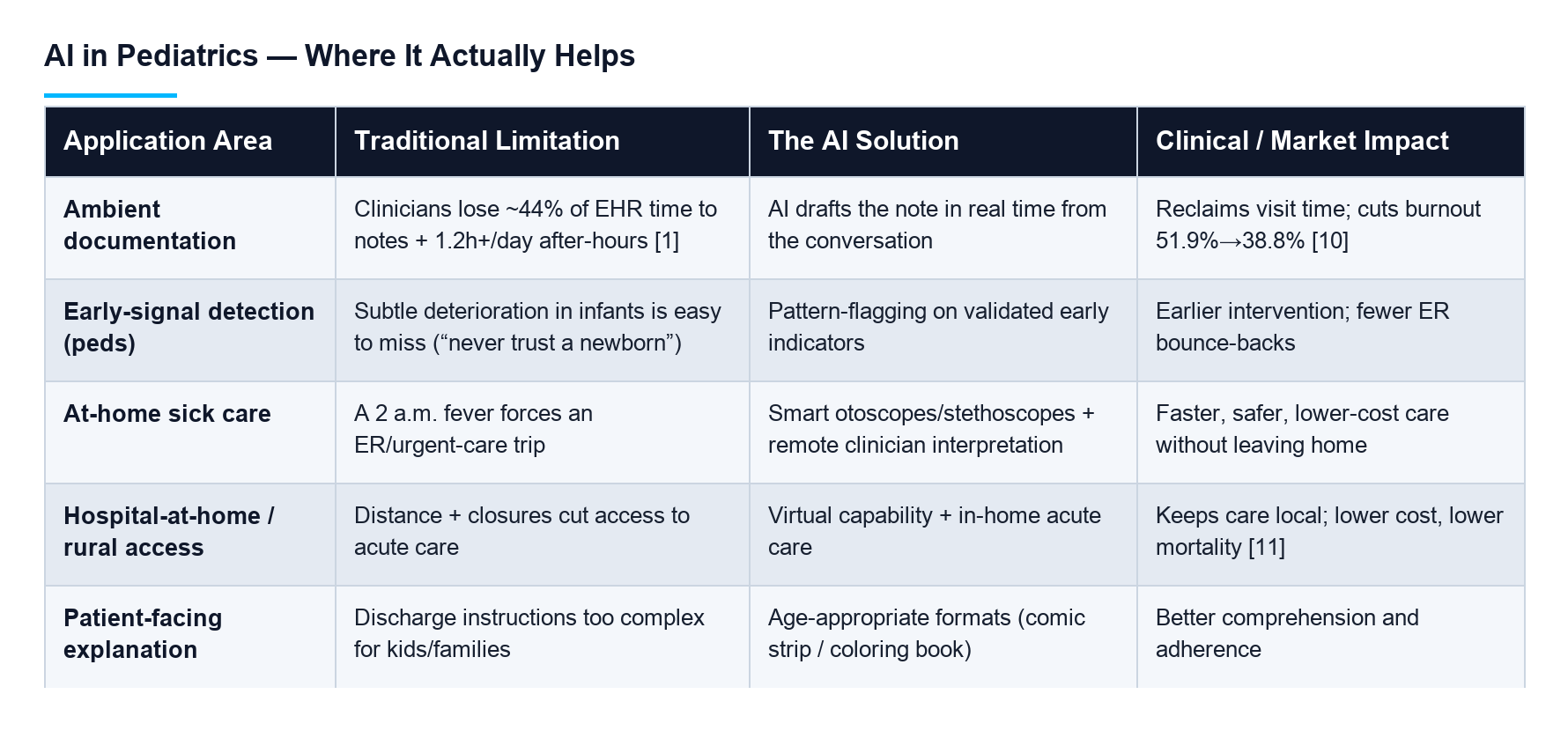
The documentation burden is the structural problem AI is rushing to solve. Physicians spend roughly nine minutes charting for every fifteen minutes with a patient, and clerical/documentation work accounts for about 44% of total EHR time [1]. That overflow becomes “pajama time” — the 1.2–1.3 hours of after-hours charting that follows clinicians home — and it is directly linked to burnout: among family-medicine residents, 33.6% report more than three hours of after-hours EHR work per night, with the heaviest users significantly more likely to burn out [1][2].
That pain has produced healthcare AI’s first breakout category. Ambient AI scribes generated roughly $600 million in 2025 — a 2.4× year-over-year jump and more revenue than any other clinical AI application [3] — with the documentation-scribe market projected to reach the tens of billions over the next decade [4].
Meanwhile, the trust problem is widening on the demand side. About 79% of parents see children’s-health information on social media at least occasionally, and the majority use it as a health-information source — yet only 15% say there is a particular influencer they trust, and 38% struggle to tell whether what they’re seeing is trustworthy at all [5]. The content itself is a known hazard: studies place misleading or false information in roughly 40–61% of TikTok health videos, and 61% of “natural parenting”-style videos directly contradicted established pediatric guidelines [6][7]. The pediatrician is no longer the first opinion — they are the correction.
The infrastructure of trust-at-the-point-of-care is being built by four distinct actors:
The documentation layer (ambient AI scribes). The breakout category — ambient documentation vendors (e.g., Abridge, Microsoft/Nuance DAX, Suki) — sits closest to Mannering’s “put the laptop down” thesis: drafting the note so the clinician can look at the patient instead of the screen [3].
Hospital-at-home operators. Acute care delivered in the home is now an approved model at 366 programs across 139 health systems in 37 states, with the CMS waiver extended through 2030 [11][12]. This is the infrastructure behind the episode’s “2 a.m. fever” and rural-access arguments.
The social platforms. TikTok and its peers function as the de-facto first consult for modern parents — high-reach, low-accountability, and the source of the misinformation clinicians now spend visit time unwinding [6][7].
The independent clinician. Practitioners like Mannering, who left a group to build InTuneMD, are the last mile of every digital-health strategy — and increasingly the entrepreneurs health systems are warned not to lose.
Hard ROI (time). In a study of ~1,800 clinicians across five academic medical centers (2023–2025), ambient AI scribe users saved about 16 minutes of documentation time and spent 13 fewer minutes in the record per eight hours of care; matched-control analyses show ~8.5% less total EHR time and a >15% drop in note-composition time [8][9].
Hard ROI (cost of care). Hospital-at-home programs have demonstrated lower mortality and fewer complications than comparable inpatient care, with cost reductions reported up to ~30% [11].
Soft ROI (retention + trust). A quality-improvement study of 263 clinicians across six systems found ambulatory burnout fell from 51.9% to 38.8% after 30 days on an ambient scribe [10] — a direct lever on the workforce-retention costs that dominate health-system P&Ls. Mannering’s reframe extends this: time returned to the visit is trust returned to the patient.
Cost of inaction. Leave clinicians buried in documentation and families unattended, and the trust vacuum is filled by the algorithm — at a measurable cost in deferred care, ER bounce-backs, and misinformation-driven anxiety.
The transparency requirement. AI used invisibly erodes trust; Mannering argues clinics must be explicit with families about where and how AI is used.
The misinformation headwind. With 40–61% of TikTok health content misleading [7], clinicians are competing with an algorithm optimized for engagement, not accuracy.
The tools aren’t plug-and-play. The largest scribe study to date found time savings that were real but modest and inconsistent — clinicians need workflow guidance to realize the benefit [8].
The last-mile burden. Solo and independent practitioners are their own IT, compliance, and AI-implementation team; cost and integration are real barriers.
The pediatric double-bind. Every pediatric encounter involves two trust relationships — the child and the parents — and AI has to strengthen both.
The current trajectory in pediatric care is unsustainable for the one thing medicine cannot operate without: trust. Clinicians lose nearly half their EHR time to documentation while families increasingly arrive with a diagnosis pre-formed by TikTok or ChatGPT — and in rural and frontier communities, the clinic itself is disappearing. Left unchecked, the trust vacuum is filled by whatever the algorithm served up at 2 a.m.
The solution is not more technology for its own sake, but AI deployed deliberately against time and trust. Ambient documentation hands the visit back — eyes on the patient, not the screen. Validated early-signal tools let clinicians catch deterioration sooner. Virtual and home-based care extend the clinician’s reach to the communities losing access. The unifying architecture is human + AI: the model absorbs the scut work and surfaces the signal; the clinician keeps the relationship, the judgment, and the transparency that earns a family’s confidence. Deployed this way, AI doesn’t compete with the physician for trust — it buys back the time to win it.
Executives / health systems: Treat ambient documentation as a retention play, not a novelty — burnout is a balance-sheet item. And heed the episode’s blunt warning: enable entrepreneurship within your walls, or watch clinicians leave and disintermediate you.
Investors: Ambient scribes are the breakout category ($600M, +2.4× [3]) — but diligence the time-savings claims, which the evidence shows are real yet inconsistent [8].
Policymakers: Rural and frontier access is in active collapse — 18 rural hospitals closed or dropped inpatient care in the past year, and 432 are vulnerable [13][14]. Durable reimbursement for virtual and home-based acute care (the CMS waiver now runs through 2030 [12]) is the most direct lever.
Clinicians: Treat AI as a tool, be transparent with families, use the reclaimed time to deepen the visit, and meet parents where their information actually comes from.
The exam room of 2030 looks less like science fiction and more like a return to form: a clinician who isn’t tethered to a keyboard, an AI quietly surfacing the early signals that matter, and acute care that increasingly reaches the patient at home instead of pulling them into a closing rural hospital. The technology is not the point. The point is that AI, deployed with transparency and aimed at time and trust rather than replacement, lets medicine do the one thing the algorithm cannot: earn a family’s confidence, in person, when it counts. AI as a tool — not a takeover.
[1] American Medical Association — Burnout on the way down, but “pajama time” stands still — https://www.ama-assn.org/practice-management/physician-health/burnout-way-down-pajama-time-stands-still
[2] Pajama Time: Working After Work in the Electronic Health Record (PMC) — https://pmc.ncbi.nlm.nih.gov/articles/PMC6712097/
[3] Menlo Ventures — 2025: The State of AI in Healthcare — https://menlovc.com/perspective/2025-the-state-of-ai-in-healthcare/
[4] AI Ambient Clinical Documentation Scribe Market Research Report — https://marketintelo.com/report/ai-ambient-clinical-documentation-scribe-market
[5] KFF / The Washington Post — Survey of Parents: Exposure to and Trust in Children’s Health-Related Information Online — https://www.kff.org/public-opinion/kff-the-washington-post-survey-of-parents-exposure-to-and-trust-in-childrens-health-related-information-online/
[6] American Academy of Pediatrics — Majority of “Eco-Influencer” TikToks Contain Contradictory Medical Information — https://www.aap.org/en/news-room/news-releases-from-aap-conferences/majority-of-eco-influencer-tiktoks-contain-contradictory-medical-information/
[7] HealthDay — TikTok Riddled With Misleading Info on Health: Study — https://www.healthday.com/health-news/general-health/tiktok-riddled-with-misleading-info-on-health-study
[8] STAT — Large AI scribe study finds modest time savings, inconsistent use — https://www.statnews.com/2026/04/01/ai-ambient-scribes-modest-time-savings-clinical-documentation/
[9] UChicago Medicine — Studies suggest ambient AI saves time, reduces burnout and fosters patient connection — https://www.uchicagomedicine.org/forefront/research-and-discoveries-articles/ambient-ai-saves-time-reduces-burnout-fosters-patient-connection
[10] Use of Ambient AI Scribes to Reduce Administrative Burden and Professional Burnout (PMC) — https://pmc.ncbi.nlm.nih.gov/articles/PMC12492056/
[11] CMS — Acute Hospital Care at Home Data Release Fact Sheet — https://www.cms.gov/newsroom/fact-sheets/acute-hospital-care-home-data-release-fact-sheet
[12] American Medical Association — Lawmakers extend CMS hospital-at-home waiver for five years — https://www.ama-assn.org/public-health/population-health/lawmakers-extend-cms-hospital-home-waiver-five-years
[13] Chartis — 2025 Rural Health State of the State — https://www.chartis.com/insights/2025-rural-health-state-state
[14] National Rural Health Association — 2025 State of Rural Health — https://www.ruralhealth.us/nationalruralhealth/media/documents/advocacy/2025/2025-state-rural-health-graphics.pdf
Comments
Nothing yet. Say the first thing.
Sign in to join the conversation.