
Digital twins are crossing from the factory floor to the hospital ward — and the crossing exposes medicine’s real bottleneck, which is not capability but trust. The healthcare digital-twin market is compounding fast, in-silico simulation is gaining regulatory footing, and yet opaque “black-box” AI still stalls clinician adoption. In this episode of Signal & Symptoms, Dr. Junaid Kalia hosts — with Ed Marx and Dr. Harvey Castro — the two people who embody the tension: Dr.-Ing. Amir A. Hashmi, an industrial engineer who built the GENEXIX digital-twin engine (it runs a 400 MW power plant in one configuration and models a patient in another), and Dr. Dania Amir, the physician deciding whether that industrial-grade tool belongs near a clinical decision.
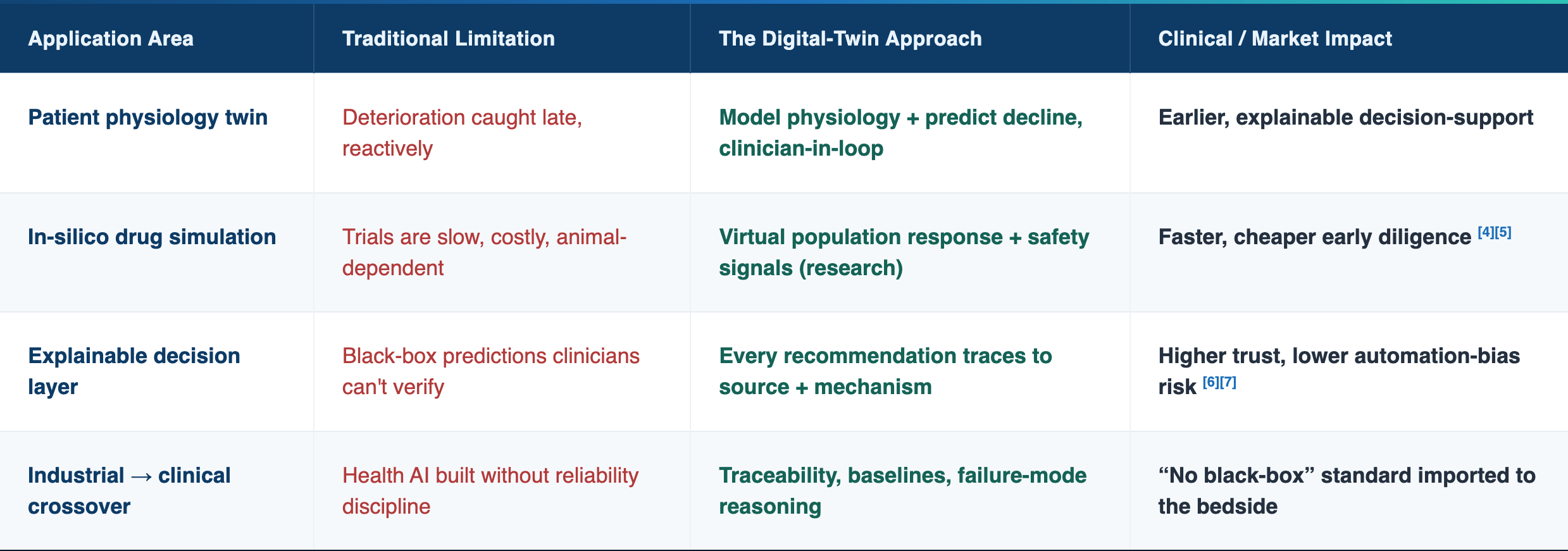
The thesis is provocative: the discipline of heavy industry — traceability, baselines, failure-mode reasoning, “no black-box AI” — may be exactly what medicine’s opaque models have been missing. This briefing maps the digital-twin market, the in-silico regulatory shift, the explainability-trust data, and what a health system should demand before a twin informs care.
Healthcare digital twins are early but accelerating: the market is estimated at roughly $1.1B in 2025, projected to ~$9B by 2034 (≈26% CAGR) [1], with near-term forecasts of ~$3.55B by 2030 [2]. The adjacent in-silico clinical-trials market runs about $3.5B (2024) → $7.25B (2032) [5].
Regulators are moving the same direction. The FDA actively promotes Computational Modeling & Simulation (CM&S) and “virtual patient” cohorts, and in 2025 signaled a shift toward human-relevant computational methods over animal testing [3][4]. The rails for simulation-as-evidence are being laid.
But the ceiling is trust, not tooling. Studies find opaque AI drives 20–30% clinician distrust, while transparency can lift adoption by ~40% and reduce error rates [7]. The market can grow all it wants; a recommendation a clinician can’t interrogate doesn’t change care.
The industrial-crossover builders. Xcelenz’s GENEXIX is the archetype here: one explainable engine pointed at a power plant (iDT) and a patient (cDT), carrying reliability-engineering DNA into medicine.
Med-device & pharma digital-twin players. Established simulation and modeling vendors serve device design and virtual trials; the field is consolidating around explainability.
The regulators. The FDA’s CM&S / in-silico programs are turning simulation into admissible evidence [3].
The physician-validators. The decisive actor is the clinician (Dr. Dania Amir’s role) who stress-tests whether a twin is trustworthy enough to change what a doctor does.
Clinical ROI. A clinical twin that models physiology and flags deterioration earlier is decision-support that can move outcomes upstream — with a clinician in the loop.
Pharma/research ROI. In-silico simulation compresses the cost and time of early drug-development diligence — running virtual population responses and safety signals as research before a real trial [4][5].
Explainability ROI. Transparency isn’t compliance overhead — it’s the adoption lever: +~40% adoption and fewer errors when clinicians can see the reasoning [7].
Cost of the black box. Opaque models sit unused (20–30% distrust) no matter how accurate [7].
Automation bias. The core risk: clinicians over-relying on AI output without interrogating it — dangerous exactly when the model is wrong [6][7].
The reassuring-but-uninformative explanation. An explanation that builds confidence without actually informing is worse than none; explanation quality matters more than its presence [6].
Validation burden. Someone has to prove clinical validity (the physician’s job) — industrial provenance doesn’t transfer trust automatically.
Regulatory boundary. Clinical twins here are decision-support / research with a human in the loop — not autonomous or cleared diagnostic devices, and in-silico results are research, not real-world outcomes.
The crisis is familiar: health-AI adoption keeps stalling on distrust of models no one can interrogate, and digital twins could inherit the same fate if they arrive as prettier black boxes. Accuracy alone has never been enough.
The solution the episode surfaces is a discipline transplant. Heavy industry never tolerated the black box — in a power plant, an unexplained failure is a catastrophe, so every recommendation traces to a cause, a baseline, and a mechanism. Bring that standard to the clinical twin — explainable, traceable, failure-mode-aware — pair it with mandatory human-in-the-loop judgment and independent clinical validation, and frame simulation honestly as research rather than proof. That is how a prediction earns the right to change care.
Executives / CIOs & CMIOs: Before deploying any twin, demand traceability and explanation quality — not just accuracy metrics. Ask where the industrial-born tool has been clinically validated.
Investors: In clinical AI, the durable moat is explainability + validation, not model performance in isolation — that’s what converts a pilot into adoption [7].
Regulators/policymakers: The CM&S / in-silico framework is maturing [3] — keep building the evidentiary standards that let simulation support (not replace) clinical judgment.
Clinicians: Treat the twin as decision-support, guard actively against automation bias, and refuse to act on a prediction you can’t trace.
The bedside worth building toward isn’t one where AI decides — it’s one where every recommendation can be argued with. A clinical digital twin flags a patient’s decline and shows its work: the baseline, the mechanism, the source. A drug is stress-tested in silico before a single real patient is enrolled. And the reliability discipline that keeps turbines from failing catastrophically becomes the same discipline that earns a physician’s trust. The lesson traveling from the power plant to the patient isn’t the algorithm — it’s the refusal to accept a black box. That’s what makes a digital twin belong in medicine.
[1] Precedence Research — Healthcare Digital Twins Market ($1.14B in 2025 → $9.05B by 2034, 25.92% CAGR) — https://www.precedenceresearch.com/healthcare-digital-twins-market
[2] Grand View Research — Healthcare Digital Twins Market Report, 2025–2030 — https://www.grandviewresearch.com/industry-analysis/healthcare-digital-twins-market-report
[3] FDA — Credibility of Computational Models Program (CM&S / in-silico) — https://www.fda.gov/medical-devices/medical-device-regulatory-science-research-programs-conducted-osel/credibility-computational-models-program-research-computational-models-and-simulation-associated
[4] ZS — In Silico Clinical Trials: A Blueprint for the Future — https://www.zs.com/insights/in-silico-trials-clinical-research
[5] GlobeNewswire — In Silico Clinical Trials Market, Global Forecast 2025–2032 ($3.5B → $7.25B) — https://www.globenewswire.com/news-release/2025/12/18/3207582/0/en/In-Silico-Clinical-Trials-Market-Global-Forecast-2025-2032.html
[6] JMIR AI — How Explainable AI Can Increase or Decrease Clinicians’ Trust: A Systematic Review — https://ai.jmir.org/2024/1/e53207
[7] Censinet — Beyond the Black Box: Transparency Strategies for Healthcare AI (20–30% distrust; ~40% adoption lift) — https://censinet.com/perspectives/beyond-black-box-transparency-strategies-healthcare-ai
Comments
Nothing yet. Say the first thing.
Sign in to join the conversation.