
Today’s post is part of my “Writing Resources and Tips” section. Friendly reminder that if you are not interested in writing topics, you can adjust your subscription preferences by visiting this link and unselecting any sections that don’t interest you.
I spent a lot of time reading picture books to my kids when they were little, and I always appreciated engaging books.
I know that good picture books can be tricky to write, and a lot of writers (myself included) are interested in writing them. So I asked three writers — Pooja Makhijani, Melissa Taylor, and Heidi Fiedler — to share their advice on this form.
First, Pooja and Melissa share how their books came to be and offer advice for writers interested in writing picture books. Then, Heidi, who is a children’s book writer and editor, shares tips on reading like a writer and adding humor to these books.
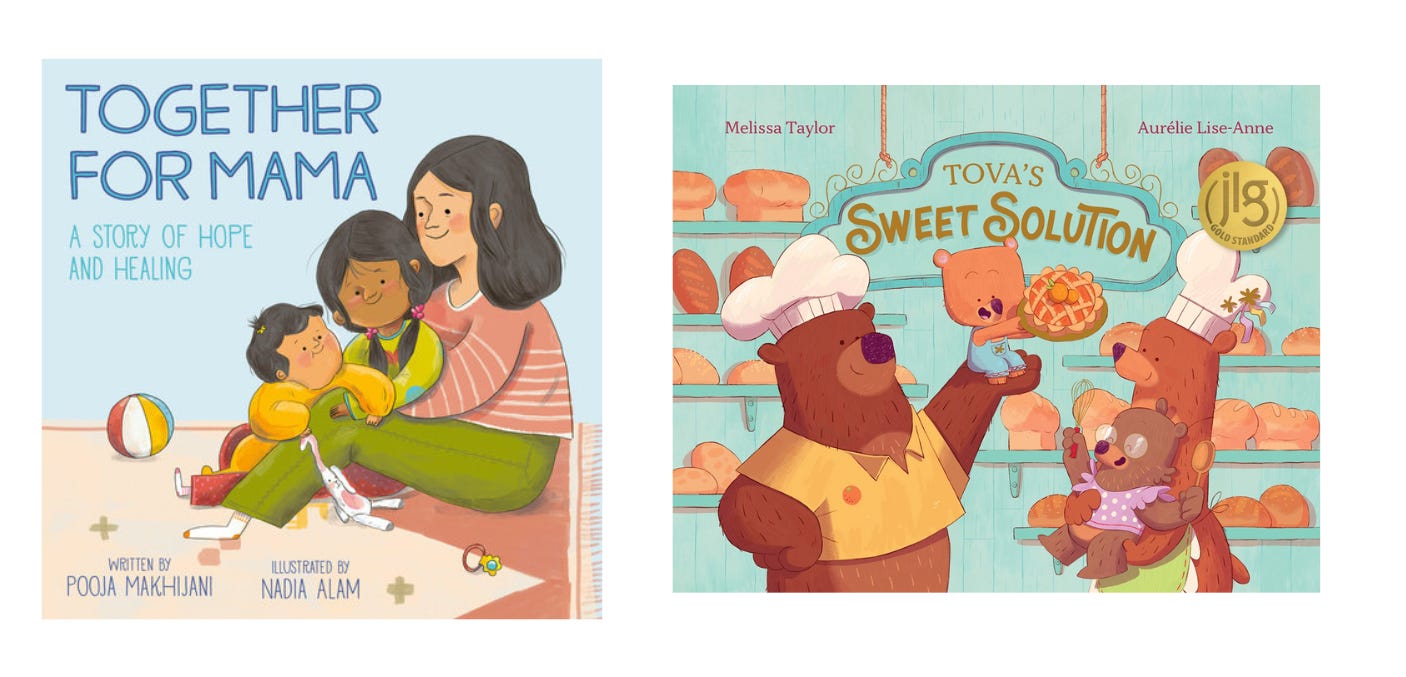
Pooja’s book Together for Mama comes out in June, and Melissa’s book Tova’s Sweet Solution came out in April.
Pooja: I wrote the first draft of Together For Mama: A Story of Hope and Healing (Rocky Pond/PRH, June 23, 2026) in a fever dream of a writing session. It took 45 minutes to put down the beginning, middle, and end.
This child-centered story was, quite literally, inspired by my own experiences — including a personal essay published in The Washington Post in 2015 — as well as my extensive reporting on parenting/maternal mental health/the “fourth trimester” for The New York Times, Bon Appetit, Buzzfeed, Pacific Standard, and elsewhere.
I didn’t have to do research in the traditional sense; I tapped into lived lessons and experiences as I wrote. Editing took a few more months and included some sensitivity reads by expert friends (a psychotherapist, an OB/GYN, etc.).
Melissa: This is one of the first fiction stories I ever wrote. I started with the topic of food allergies because both my daughter and I have many. (Write what you know.) Then, I brainstormed a plot. My first plot was about a girl like my daughter who got left out of a classroom birthday party. It was depressing and, quite frankly, terrible.
After that, I realized that I wanted this book to be positive, playful, and general, so I started over with a different plot. This time, I made the main character a fantasy creature, a troll (it changed to a bear eventually), who lived in a bakery because what would be worse than being allergic to your family’s bakery goods?
Next, I decided to play with the food words. I created a spreadsheet of foods and flavors, combined them together, and used them in my story. Chocomint, pericot, and cinnalove, for example. Some of my made-up words got edited out when I sold the book, but most stayed in. When I was asked to change the troll to a bear, I revised the original allergen from fluteny flour to honeygrain.
Pooja: I knew I had written a very good manuscript, but I was skeptical it would sell. I had no solid comp titles: there are still no other traditionally-published picture books about postpartum depression (PPD) on the market. (There are traditionally published picture books about tangential topics, such as pregnancy loss [Dear Star Baby; Always Sisters; Ours] and parental depression more generally [In The Blue]. And I know of one self-published picture book about PPD.)
But but but, to my utter surprise and joy, we received interest on my manuscript within 48 hours of being on submission. Lauri Hornik is president and publisher of Rocky Pond Books, which publishes books, both fiction and nonfiction, with a primary focus on mental health and social-emotional learning. “It’s a beautiful and necessary book,” she wrote in our initial email correspondence.
I need to assure your readers: this book’s relatively swift timeline (a day to draft, a few months to polish, five weeks from submission to sale) isn’t indicative of anything! I’ve been writing picture books for over 20 years. I made my first sale in 2004 (Mama’s Saris) when I was twentysomething, and sort of lost myself as an artist in the industry shortly after the book was published in 2007.
It was the pandemic that prompted me to take an inventory of my creative ambitions, and when I decided to recommit to writing picture books. So, I had a 19-year gap between the publications of my first book and second! I also recently had a well-received manuscript die on submission. The commerce of art is something we all really have no control of.
Melissa: My first agent didn’t want to sub this manuscript, so it was sitting dormant for a while. After I left that agent, a friend introduced me to the editor of Red Comet Press. I pitched him the story, and he made a two-book offer, which I used to find a new agent to negotiate the deal. She got me three times more money, so it was very worth it to have her representation.
The contract took months to finalize, as it was the beginning of contracts having anti-AI language. I think my agency was still newly working with lawyers to make sure everything was anti-AI, so it took time.
I loved the illustrator that the editor chose, Aurélie Lise-Anne. She created such a cozy ambience, exactly like I imagined, but better. Many people don’t realize that in traditional publishing, authors do not get to pick the illustrator. Art directors and editors make those decisions.
The publisher also set the dates for the cover reveal and final pub date. The publish date was about three years from the time of the signed contract, so it’s a long process.
Pooja: 1. Read, read, read—especially books that have been published in the past three years. (And, hey, you can read at least two dozen picture books in a single sitting!) Newcomers to the genre are often nostalgic for the picture books they read as a child and/or read to the children in their care, and aren’t always up to date on market trends.
2. Understand and appreciate the container and its limitations, whether you write or illustrate or both. Picture books are a unique form: a unified artistic whole in which text and pictures, covers and endpages, and details of design work together.
3. Remember that picture books are meant to be performed (read aloud) and often read hundreds of times.
4. Suss out free and paid professional resources. I like 12 x12 Challenge ($$), workshops at BoydsMills ($$$), KidLit411, Kid Lit in Color, We Need Diverse Books Mentorship Program, and podcasts like Kidlit Love, The Children’s Book Podcast, Book Friends Forever, and KidLit Happy Hour. (I listen to way too many podcasts!) FYI, it’s a fairly soft market—what isn’t these days?—but that shouldn’t deter you. Picture books are a timeless genre, and publishing is very cyclical.
Melissa: Read a lot. As a book reviewer for Imagination Soup for the last 16 years, I was reading hundreds of picture books a month and very aware of good writing, storytelling structure, what was already in the market, and holes in the market. (Food allergy books, for example.)
In addition, I recommend finding the right critique group. Specifically, be in a group with people who are better writers than you are. It took me some trial and error, but I found a group of writers who were all already published. We are still together and the best of friends.
The Society of Children’s Book Writers and Illustrators (SCBWI) is a good way to connect to classes and community. But there are a lot of inexpensive classes available elsewhere. Take advantage of all of those opportunities.
Finally, write a lot. Don’t worry about all your manuscripts being amazing. They won’t be. Keep finding ideas and practicing your art. I often see new writers honing the same manuscript for years. That’s a mistake. Put it aside and write something new every month or two. Not that you shouldn’t revise a million times, but you should not get stuck on one manuscript.
When you do pitch an agent, you need at least three polished pieces, and sometimes what’s selling isn’t going to be your favorite draft. Trends come and go, and you need to have a range of possibilities to pitch agents and editors.
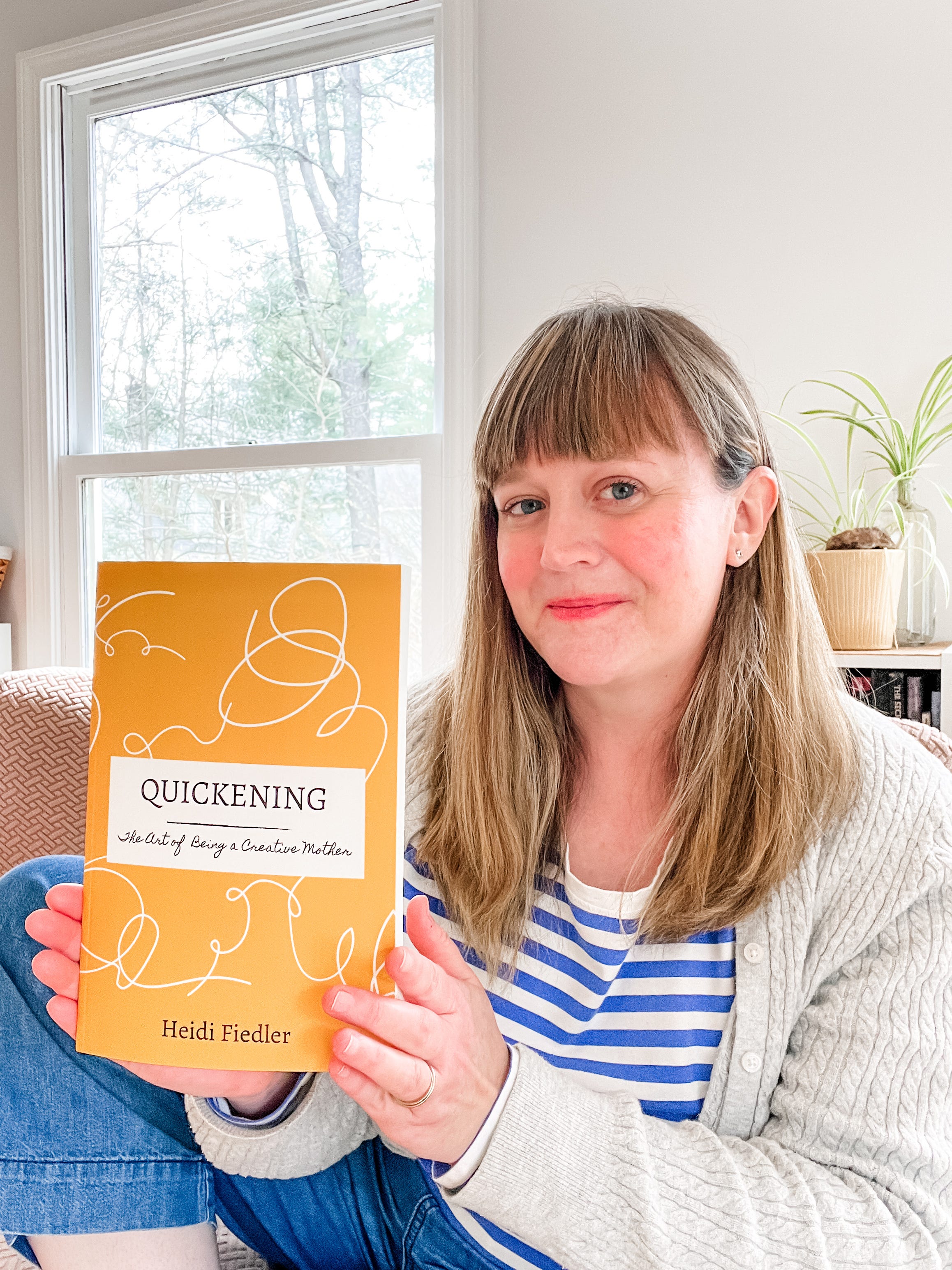
I also asked Heidi Fiedler a few questions about her experience and advice.
I’m a children’s book writer and editor. I worked in-house for a long time, and then I went freelance about 10 years ago. At this point, I’ve worked with hundreds of authors on all kinds of books, and I specialize in picture books, chapter books, and nonfiction for kids.
I recommend reading LOTS of picture books. Like hundreds! Reading like a writer is a valuable skill for any writer, and with picture books, it’s possible to read a LOT of books quickly, so you can learn more about the craft and your personal aesthetic more quickly.
How do you read like a writer? Read each book multiple times. Read several books by the same author, all in a row. Grab a stack of picture books and just compare the beginnings. Keep an eye out for the themes you’re drawn to. Notice when you want to skim past something or start to zone out. Try to figure out why that’s happening. If you laugh or feel yourself getting emotional, slow down and read that passage again. See if you can figure out how the author evoked that response in you. What would happen if you changed one element?
Along the way, you’ll find that picture books are their own unique art form. You’ll also get to see what’s selling right now, not because you want to jump onto a trend, but because the market is always changing, and it’s good to know what editors are currently buying.
As you read, you’ll start to get an intuitive feel for the format and discover what you like and don’t like. And you’ll walk away inspired! Whenever I’m not sure how to tackle a problem in my manuscript, I get ideas by reading other books.
Humor is so important in picture books! Most picture books are read aloud, and these are the books that families want to read again and again. Humor can also help writers talk about heavier topics in a way that doesn’t feel too intense.
There are lots of ways to add humor. Exaggerate, include fantasy elements, combine two familiar things in a new way, play with language, surprise your reader, give the adult who’s reading the story aloud a silly job to do, make your characters foolish — these are all ways to make your reader laugh.
But mostly I want to encourage you to bring an open, playful spirit to the writing process. Mix it up. Write down your worst ideas. Laugh at your own weirdness. Let it be fun! Because when you’re having fun, that comes through to your reader.
Thanks to Pooja, Melissa, and Heidi for sharing so much great advice. Learn more about these writers here:
Pooja Makhijani is the author of Mama’s Saris, Bread Is Love, Together For Mama, and Aunties.
Her bylines have appeared in The New York Times, The Washington Post, NPR, Real Simple, The Atlantic, WSJ.com, The Cut, Teen Vogue, Publishers Weekly, ELLE, and Bon Appétit among others.
Pooja is a 2026 New Jersey State Council on the Arts Individual Artist Fellow in prose.
Melissa Taylor, MA., is a writer, author, children’s book reviewer, marketing consultant, and former teacher. She founded the popular children’s book review blog, Imagination Soup, for parents, teachers, and librarians, and is currently offering publicity and marketing services through Imagination Soup Consulting.
Her first children’s picture book, Tova’s Sweet Solution, was published on April 21, 2026. She freelance writes about topics in education for publications such as Brightly, Adobe Education, and Parenting. She’s an active volunteer at The Right Step, Inc., an adaptive riding barn that serves disabled children and adults. For more information about Melissa, please visit her websites, melissataylor.net or imaginationsoup.net.
Heidi Fiedler is a writer, editor, and creative coach. She writes books for kids and essays for grown-ups. She’s also the author of the book Quickening: The Art of Being a Creative Mother. You can find her at helloheidifiedler.com or on Instagram and on Substack @heidifiedler.
Thanks for reading Humor Me, a newsletter featuring funny stuff and writing tips. In case you’re new here, I’m a humor writer and freelancer whose work has appeared in New Yorker Shouts, McSweeney’s, Real Simple, and more. Find out more about me at julievick.com.
Any typos in this newsletter are a result of the text being written by a human and not AI.
If you’d like to help support Humor Me, you can:
No posts
Comments
Nothing yet. Say the first thing.
Sign in to join the conversation.