
WASHINGTON, June 29 —Parental alienation theory, as applied in family courts, functions as a mechanism for shifting judicial attention away from documented or credibly alleged abuse — that was the through-line of theAmerican Bar Association, (ABA) Commission on Domestic & Sexual Violence panel “Write and Tell Webinar: Challenging Parental Alienation,” with Jean Mercer and Margaret Drew, authors of Challenging Parental Alienation: New Directions for Professionals and Parents (Routledge).
The panel, part of the commission’s “Write & Tell Live” series, was moderated by Paul Griffin, legal director of Child Justice, Inc. Mercer holds a doctorate in psychology from Brandeis University and is professor emerita of psychology at Stockton University; Drew is an associate professor of law at UMass Law and a former chair and special advisor to the ABA commission that hosted the event.
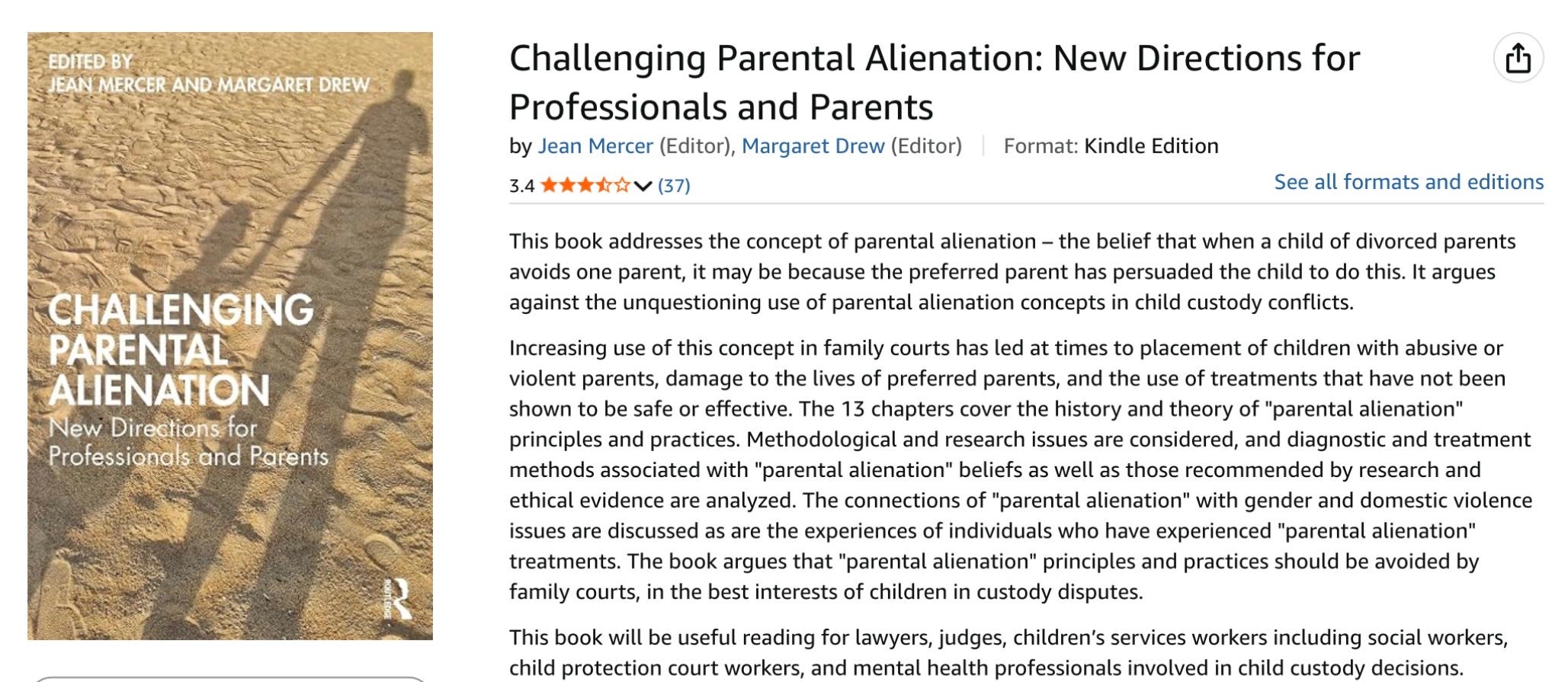
Mercer was the most direct of the panelists on this point, describing parental alienation as functioning as a signal to courts to move custody away from a non-abusive parent and toward an abusive one — specifically in cases where abuse is already part of the record. In those cases, she said, raising alienation operates to redirect the court’s focus away from the abuse itself and onto the alienation claim instead.
Drew, drawing on research by Deborah Epstein and Lisa Goodman on how mothers in domestic violence cases enter court with what she called discounted credibility, described parental alienation claims as reassigning who is treated as the abusive party — shifting the accusation from the parent accused of abuse onto the protective parent who raised the concern.
She called the pattern “deflection.”
Drew argued that courts don’t need a parental alienation finding to act on a parent’s harmful conduct — a judge can identify specific behavior as damaging to a child and rule on it without invoking the alienation framework at all. Her concern was less with a hypothetical judicial finding, however, than with what happens once the word “alienation” enters a case, she said:
“The label carries evidentiary and rhetorical weight beyond the underlying facts, and that weight tends to work against the parent raising abuse concerns.”
Both panelists returned repeatedly to a related pattern: PA analysis, as they described it, tends to treat a child’s own stated reasons for avoiding a parent as inherently suspect — dismissed as frivolous, weak, or irrational — rather than investigated. Drew and Mercer each raised cases in which children reported specific conduct (privacy violations, physically or sexually inappropriate behavior) that would independently justify avoidance, but where that conduct was not pursued once alienation was raised as an alternative explanation.
Drew described a specific evaluative tactic in which a mother and child’s matching account of abuse is characterized by an evaluator as a “shared delusional disorder” — used as grounds to separate the two, and, in a case she described directly, as grounds for a court to order the removal of both the mother’s and the child’s existing mental health providers. Drew framed this as a mechanism for displacing a credible abuse account rather than adjudicating it, noting the court in that instance ultimately rejected the delusion framing, distinguishing a parent’s good-faith factual belief from a clinical delusion.
Drew’s practical advice to attorneys was to treat unsupported parental alienation assertions as objectionable on evidentiary grounds from the outset — pressing opposing counsel on what evidence supports a manipulation claim, since in her experience there typically is none. She noted that PA claims are unusual in relying on one person’s behavior or emotional symptoms as proof of another person’s alleged conduct, a standard she said is not applied to other family law contexts — for example, a parent’s response to living with someone with an active substance use disorder is not treated as evidence of the addiction itself.
Mercer separately raised concerns about the credentialing of experts who testify in support of alienation claims, noting that some describe their qualifications as rooted in personal experience with alienation rather than recognized academic training, and that, to her knowledge, the University of Malta is the only institution that grants academic credit specifically for parental alienation coursework. She pointed attorneys to language in the Federal Judicial Center’s Reference Manual on Scientific Evidence — drawing an analogy to a case limiting how narrowly courts can define a “relevant scientific community” for expert-qualification purposes — and cautioned that peer review conducted within a small, self-referential group of proponents undercuts its value as a research safeguard.
Drew pointed to Kayden’s Law — a federal framework that some states, including Arizona and California —have adopted in some form — as a direct response to this dynamic. The law requires courts to treat child safety as a threshold, first-order factor in custody decisions. Drew noted that safety findings are frequently absent from custody rulings that shift custody away from a protective parent, and said the absence of an explicit safety finding can itself become grounds for appeal.
The panel closed its substantive discussion on court-ordered reunification therapy, which panelists distinguished from the reunification services used in foster-care reentry cases. As described, the family-court version typically pairs treatment with a no-contact order — commonly 90 days, sometimes repeated — cutting off a child’s access to the preferred parent regardless of whether that parent’s underlying abuse concerns were ever substantiated. Griffin said no rigorous outcome research exists on these programs; Mercer cited anecdotal interviews with young adults who went through them, some of whom reported a damaged or severed relationship with one or both parents afterward. Panelists characterized the programs as structured around producing a predetermined outcome — a child’s acceptance of the avoided parent — rather than as a neutral evaluation of the child’s stated concerns.
Griffin closed the session by thanking the panelists and noting the commission would post additional resources and responses to unanswered audience questions on the event page in the following days. The recording is available on the ABA Commission on Domestic & Sexual Violence’s website; the publisher has offered a discount code (26AEV1) for the book through Routledge. No CLE credit was offered for the session.
But the close of a webinar is not the close of this issue. As Mercer and Drew laid out, parental alienation theory has no basis in the DSM-5 or the ICD, no body of research capable of distinguishing an alienated child from an abused one, and a track record — by the panelists’ own account — of moving custody toward the abusive parent in exactly the cases where a court should be moving the opposite direction. That is not a gap in the science. It is the science saying no, being overruled by courtrooms anyway.
Family courts should stop treating “parental alienation” as an evidentiary shortcut around findings of abuse — full stop, effective now, not as a future best practice to be phased in gradually. Every court that permits an alienation claim to substitute for a Daubert hearing, every evaluator who testifies to alienation without the credentials or data to support it, and every JUDGE who orders a child into reunification “treatment” without a safety finding on the record is participating in a practice this book’s own editors say the evidence cannot support.
That reckoning cannot stop at future cases. Children and protective parents already separated by these orders — some of them years ago, some of them still inside court-ordered no-contact periods right now — are not owed a policy change going forward. They are owed a way back. Judicial immunity, tight appellate windows, and the absence of any federal mechanism tracking custody outcomes after abuse findings have combined to make these orders functionally permanent once entered, regardless of how thin the evidentiary basis turns out to have been. That is not an acceptable stopping point. Courts, licensing boards, law enforcement, and legislatures that have embraced parental alienation theory without requiring the evidence behind it bear responsibility for the outcomes it produced, and that responsibility does not expire when a case closes. Reopening and undoing wrongly decided custody orders, disciplining evaluators who testified past their qualifications, lawyers and judges who pushed this narrative and made these orders, and building the retroactive review mechanisms that do not currently exist should be treated as priority number one of the court’s unfinished business — not a hypothetical for some future legislative session, but an obligation owed now to the families already living with the consequences.
This article is investigative reporting intended for public-information and public-interest purposes only. It does not constitute legal advice, and nothing herein should be relied upon as a substitute for consultation with a licensed attorney or qualified legal professional. References to laws, court proceedings, or legal processes are presented for journalistic and informational purposes.
The time for action is now. Lawmakers, the media, and the public must act together to demand justice, accountability, and protection for families and children.
Are you committed to protecting America’s children and restoring integrity to our legal system?
Contact your legislative representatives. Speak out. Reach out to media outlets. And vote.
Find your state and federal legislative representatives HERE.
Find out what your legislators are doing on a weekly basis HERE.
Whistleblowers and victims of family court, CPS, probate court, IDEA/ADA or foster care corruption anywhere in the U.S.—please contact this reporter at juliea005@proton.me or rjh.investigative.reports@gmail.com.
Together, we can ignite a national movement and create lasting change.
Julie M. Anderson-Holburn is a California-based investigative journalist reporting on criminal and family court corruption, judicial abuse, domestic violence, child abuse and systemic failures. Her work is published on NewsBreak, Substack, and The Family Court Circus, and has been featured by the Center for Judicial Excellence and National Safe Parents. Julie believes that exposing the truth is the first step toward meaningful reform.
This article was made possible by the support of readers like you. Thank you.
Related coverage:
Update: Estranged Husband Charged in Nicole Winans’ Murder Remains in Custody Without Bail
California: People v. Shane Winans— A Domestic Violence Tragedy and the Murder of Nicole Winans
California: Mother Murdered in San Joaquin County, Tragedy Highlights Family Court Failures
From Orange County to Texas: Two Courtrooms, Two Outcomes in the Bill Hutchinson Cases
After Months of Hearings Into Family Court Failures, Arizona Enacts Alec and Lydia Act
UPDATE: Six Orange County Family Court Judges Respond to Recall Petitions
BREAKING: Six Orange County Family Court Judges Served With Recall Petitions
FOR IMMEDIATE RELEASE — Rally and Court Watchers Requested for Nov. 7 in Orange County, Calif.
FOR IMMEDIATE RELEASE—COURT WATCHERS REQUESTED FOR OCT. 20 GISELLE SMIEL CASE IN LOS ANGELES
Orange County DA’s Office: Jury Awards $3M Over Culture of Malice and Retaliation Against Women
Leanne fled the country to escape domestic abuse. Now she could face jail.
No posts
Comments
Nothing yet. Say the first thing.
Sign in to join the conversation.