
Recently I was listening to Matias de Stefano being interviewed by Emilio Ortiz. He was describing work he had been doing in Egypt — calibrations, chromosomes, DNA. A group had gone into the middle pyramid. And then, he said, the master became a trickster. He started to talk about Peter Pan.
He talked about time broken inside the crocodile. A pirate ship sailing through the skies in the wrong direction. Every child looking for its shadow.
And then he said something that stopped me.
The codes are written in children’s stories, because the only ones who have the infinite power to restore all the balance of everything are the ones who can still imagine with no limits. So everyone under the age of seven has to receive the codes — because we already know all the codes. The stories simply remind us.
I sat with that for a long time.
Because I have always been a reader. And there were certain books, as a child, that did not feel like stories. They felt like recognition. They felt like something in them already knew me, and was waiting for me to catch up.
One of them was a book I couldn’t remember the name of for eighteen years.
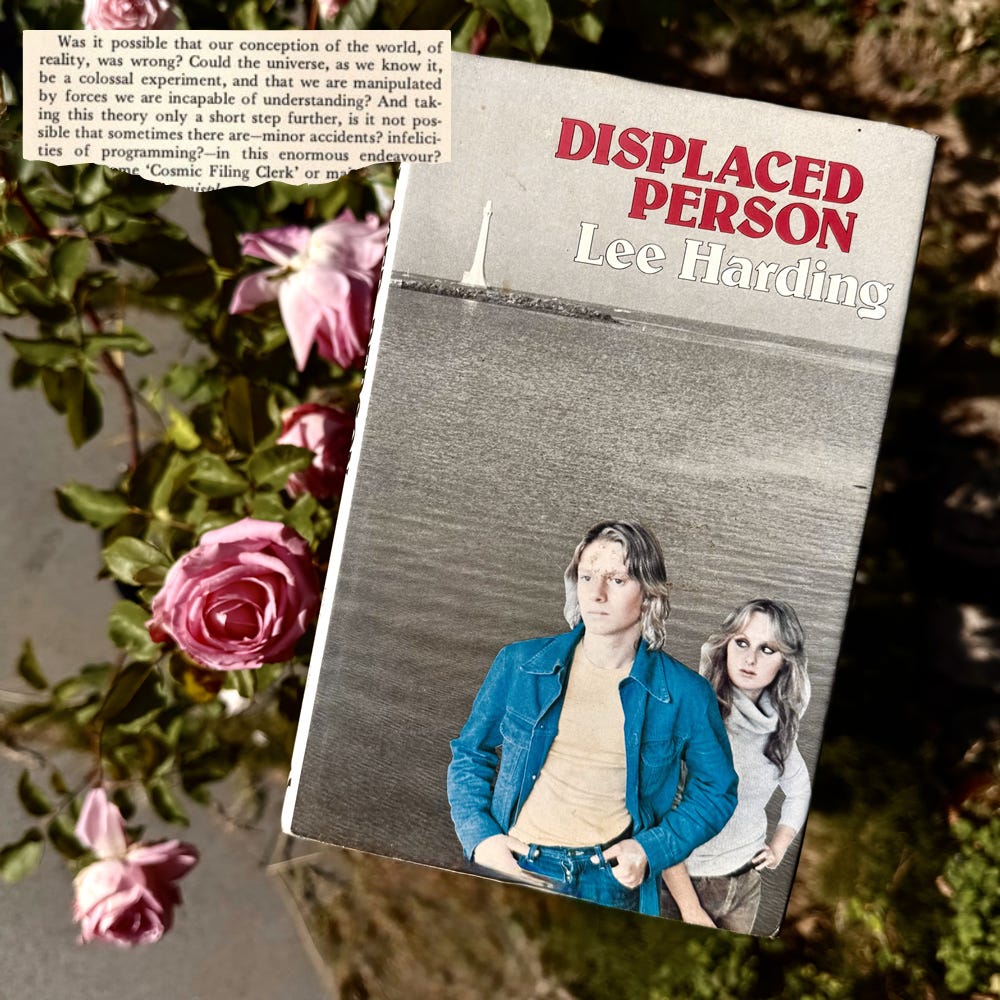
I was in Year 6 when my teacher read it aloud to us. I don’t remember her voice or the classroom, but I remember the cover. I remember the feeling of it — which was not dread, though the book has often been read that way. What I felt was recognition.
The story follows an ordinary teenager who begins to disappear from the world. At a fast food counter, no one serves him. His parents stop noticing him. His girlfriend looks through him. The colour drains from the world around him until he is standing alone in a grey, lifeless version of the town he has always known.
But as he wanders through the greyworld, he starts to notice something else. Small things that have kept their colour. Objects that have been displaced the way he has. And then, people. A girl named Marion. An older man named Jamie. They live together in a derelict house. They are not grey. They are not fading. They have found each other on the other side of the thinning, and they are alive there in a way that his old world had not permitted.
He falls in love with Marion — more truly than he had loved anyone in the life he left behind. The relationships in the greyworld are more vivid than the ones in the consensus world were.
They come to understand that the displacement is time-based. One by one they begin to move on, though to where they cannot say. Because he arrived last, he will be the last to go. He finds a tape recorder in a supermarket — also displaced — and begins to record everything he can, in case his memory is taken with him when his turn comes.
And then, in a passage I had forgotten but rediscovered this week when I opened the book again, he writes:
Was it possible that our conception of the world, of reality, was wrong? Could the universe, as we know it, be a colossal experiment?
I stopped when I read that line.
Because as a child — somewhere between the ages of eight and twelve — I had a vision that I described in The Smoke Shed. I was walking out to see our rabbits in the backyard of our home in Katoomba when it came. I saw the Earth held inside a conical flask, being observed by vast beings in white lab coats. I was inside the flask. I was participating in the experiment.
A colossal experiment.
My teacher read those words aloud to me in Year 6, only a year or two after I had seen the vision in the backyard. At the time, I could not have told you that the book was describing what I had already been shown. I simply knew the story was true.
At the end of the book, as the darkness closes in, the boy reaches into his jacket pocket and finds two things. A small, faded rose. And a scrap of paper with a signature in ballpoint — Marion — and two words.
Remember me.
In 2000, my daughter Kaleisha was born.
Somewhere in the first months of her life I decided to return to the books that had left the deepest marks on me as a child. I wanted to read them with the eyes I had now, to see what I had been reading before I had language. I found them all — The Silver Crown, The Dark is Rising, the others — except one. I could remember the cover. I could remember the feeling. I could not remember the title or the author.
I have a practice, when my memory won’t give me what I’m looking for. I set the intention — please bring this back — and then I release it. Without fail, within days, the answer arrives.
This one took eighteen years.
On the 4th of October 2018, I was scrolling through emails. The word displaced caught my eye in the subject line of something unrelated. And there it was, the way a name returns when it has been sitting quietly inside you for decades.
Displaced Persons. By Lee Harding.
I googled it immediately. It was out of print. The only copy I could find was around two hundred dollars and it wasn’t even the Australian cover I remembered — it was a later American edition. Something in me said not this one. I put it aside.
A few weeks later, I felt the nudge again. Look once more.
I almost didn’t. I had already searched. There was nothing more to find.
I picked up my iPad anyway and typed in the title. And there it was, on Fishpond, for eight dollars and thirty-eight cents. Shipping from New Zealand. Estimated delivery between the 10th and the 22nd of October.
I was so surprised that I walked straight to my computer and typed the same search on the same account. The listing didn’t exist. I refreshed. I tried the direct link from the iPad. The page returned nothing. The book was only findable through one doorway.
That was the moment I understood something was being shown to me. I didn’t know what, yet. But I knew to pay attention.
I bought it through a gift card, in case it was a scam. It arrived.
Astrology, for those curious about such things: on the day the book came back to me, the transiting Vertex — the fated point, the place where something the soul arranged in advance finally breaks into time — was at 28° Aries, within one degree of my natal Saturn at 27° Aries. Saturn is the apex of my Yod, the focal point of my chart’s central instruction. The Vertex doesn’t move fast, and it doesn’t touch that degree often.
At the same time, transiting Chiron at 29° Pisces — the wound at the final breath before completion — was sitting within one degree of my North Node at 0° Aries, the direction my soul is travelling in this life. The old wound arriving precisely at the threshold of the new.
The book did not come back to me on an ordinary day. It came back to me on a day the sky was marking something.
I read it again with adult eyes.
What the book had given me at eleven was not dread. It was validation. Someone else had seen it. Someone else had written down what it might feel like to slip between the agreed-upon layers of reality and find that there is another layer where things are still in colour, where the people you meet can feel more real to you.
The book had not come back to me as nostalgia. It had come back to me as confirmation — that the vision I had at Carnarvon Gorge at twenty-seven, the vision I had only recently written down and published for strangers to read, was part of the same question a book had planted in me when I was eleven.
Could the universe, as we know it, be a colossal experiment?
A rose. A scrap of paper. Remember me.
I think I have been remembering ever since.
Matias de Stefano said the codes are given to children because children can still imagine without limits. The stories don’t install something new. They remind us of what we already know.
I think the books that find us when we are small are not random. I think they are the first language the soul is permitted to speak in, before the world teaches it to be quiet. A child absorbs them the way soil absorbs rain — without resistance, without needing to understand what is happening.
And then, decades later, when you are finally ready to read them again, they are waiting. Through whatever strange doorway they need to come through. For eight dollars and thirty-eight cents. Shipped from New Zealand. Arriving precisely on a day the sky had written their return into its own calendar.
The next piece is about facing the dark — the dreams that arrive to teach us not to run.
The patterns I write about here can be read in your own chart too. If you'd like to explore your soul map, I offer galactic astrology readings at divinehealingx.com — including an Asteroid Deep Dive that explores the soul-level threads traditional astrology often misses.
If this writing resonates and you’d like to support it, you’re welcome to do so here.
No posts
Comments
Nothing yet. Say the first thing.
Sign in to join the conversation.