
Today begins a limited series, “We are the ancestors,” exploring themes of relationship, re-storying, and returning home to our kinship with the living world. I’ll also fit in a two-week chill-out summer break before continuing the series towards the end of the month.
Today: Part 1, Earth dreams us
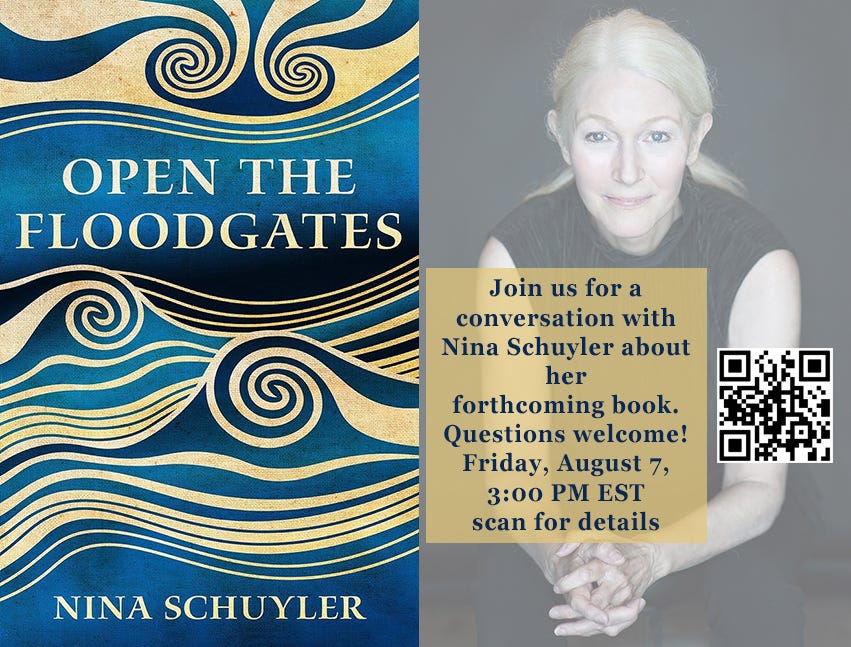
Tomorrow, 8/7: join my Live conversation with Nina Schuyler about her forthcoming book, Open the Floodgates, in which a river comes to court to claim personhood.
8/13 + 8/20: 2-week August break – amusements in the form of watercolors and humor
8/27: Part 2, Trusting our senses
9/3: Part 3, Nature is speaking, but not like that
9/10: Part 4, Nature is a marginalized voice
9/17: Part 5, How to tell a new story
What does it mean to be a good ancestor? Are we meant to project current chaotic reality into an uncertain future, or work towards a more hopeful vision? Many of us have heard of the Seventh Generation. Yes, the eco-household brand, and also the Haudenosaunee (Iroquois) understanding that today’s decisions ripple far into our descendants’ lives.1 For perspective, seven generations ago takes us back to about 1850, over a decade before the American Civil War.
After much trial and error, attempts and failures, side quests and surrender, I’ve come to understand that my contribution to future generations is to cultivate soil. I used to believe I was planting seeds, but before seeds can grow and thrive, they need fertile soil. My brief time here is to help prepare the ground by composting toxic stories so better stories can flourish.
What sort of stories about our relationship to nature do we tell ourselves now? One way to understand recent literature and film is in three broad themes. This is not meant as a criticism; the works on these lists are all brilliant in their ways.
Nature is a violent adversary not to be underestimated, in film:
“The Revenant,” 2015
“All is Lost,” 2013
“The Perfect Storm,” 2000
Nature is relentlessly exploited by extractive industry, in novels:
Imbolo Mbue, How Beautiful We Were, 2021 (oil drilling in West Africa)
Ash Davidson, Damnation Spring, 2021 (logging in the Pacific Northwest)
Ann Pancake, Strange as This Weather Has Been, 2007 (mountaintop removal coal mining in West Virginia)
Nature has lost to humans
Cormac McCarthy, The Road, 2006
Hugh Howey, Wool series, 2011+
Margaret Atwood, Maddadam trilogy, launched in 2003 with Oryx and Crake
“Mad Max,” 1979 film
These admittedly oversimplified themes have been, and continue to be, countered with stories of nature as provider, mentor and creative partner.2 Stories that dramatize a reciprocal relationship where humans learn to appreciate nature’s gifts. Stories that allow readers to experience such a world, to immerse in what it looks and feels like. And crucially, stories that hint at how we might get there.
The power of this summer’s blockbuster “The Odyssey” reminds us that stories create worlds. Anyone can step into a theater and be immersed in that world, not least because the ancient poem is embedded in our collective cultural psyche. The good news is that human culture’s millennia-long relationship with nature is also embedded in our psyche.
We are a storytelling species. Since our imaginations and collective beliefs create the world we inhabit, today and every day, this series will explore legacies and possible paths forward.
What will it take for a pathologically self-absorbed culture to recognize that there’s other life out there with which we’re meant to engage? What will inspire the first tentative, humble steps towards repairing our broken relationships with the living world?
The great theologian and ecological thinker Thomas Berry wrote that, far from being a cancer on the earth, humans are an intricate and beloved part of the complex, wondrous whole.3 My dear friend Lisa Bardack, who is a heart warrior for our renewed relationship with Earth and all her beings, knew Berry. She once emailed me her understanding of his teaching:
“The deep and extraordinary revelation for me when I read Thomas Berry’s The Dream of the Earth was his eloquent explanation of the human as intentionally born onto the Earth and into the universe to serve as a conscious mode of reflection. . . I felt it deeply as the Earth’s dream, that she would bring forth a being that could consciously take in and celebrate the beauty and wonder that is the living earth; a being that could feel moss below its feet, take in the smell of the lilac, the taste of a perfect strawberry, the loveliness of bird song, the magic of the forest, the awe of the stars. Then sing, dance, paint, write about it. Celebrate the splendor of the Earth!”4
What if the way beyond our lonely self-absorption is to embrace a purpose far beyond control and exploitation of nature as a limitless Big-Box store? What if our sacred purpose is a calling from the Earth herself to immerse and notice, to celebrate our entanglement, to participate in the wild community of life?
The myopic modern gaze sees, measures, and values only human beings and human-made systems. With such a narrow focus, we’re cornered into human-centric explanations for our problems and resentments. If I struggle to make ends meet, it’s either my own fault or someone must be stealing from me. If a fire blows toxic smoke over my city, someone else is failing in proper “forest management” and must be made to pay.
This means that any solutions to these human-sphere problems must come only from human systems, whether exceptional individuals who rise above long odds, or institutions or leaders bold enough to stand up and claim their heroic role. The absurd extreme of this is to follow anyone who promises, “I alone can fix it.”
A recent poll by Pew Research revealed that about 40% of American adults believe we’re living in the “end times.”5 Climate anxiety, pandemic, creeping fascism, war, and growing wealth disparity all contribute to a collective intuition that we’re all doomed and there’s no way out. This existential paralysis spawns dystopian narratives, even as it gives rise to more and more outlandish claims like the latest: AI can solve any problem.
The great scientist Albert Einstein understood that new thinking would be required for humankind to advance. What happens if we expand our understanding of the context of both our problems and their possible solutions? If we see ourselves not as the center of it all, but as one being in a vast web of life, what might be possible?
"You never change things by fighting the existing reality. To change something, build a new reality that makes the existing reality obsolete." ~ R. Buckminster Fuller
I love stories that immerse me in an unfamiliar world and open my eyes. Novels like The Underground Railroad, Americanah, James, and The Trees challenged and stretched my consciousness around race and racism, white privilege and the presence of the past. To see American culture through the eyes of an immigrant is a gift. To immerse in the lives of people with loves and hopes and ancestors who endured unspeakable horrors reminds us of the power of storytelling.
More recent writers make the case for stories that widen our perspective to include our non-human kin and to experiment with form. In The Great Derangement, Amitav Ghosh argues persuasively that literature must move out of its cultural role as mirror and become more of a lamp. At a time when collective solutions are critical, he writes that the novel, with its emphasis on the individual, is not up to the task of imagining possible ways forward for humanity.
Regarding the consciousness of our non-human kin, Ghosh speculates that they communicate through image, as well as sound. He suggests that to think about the Anthropocene would be to think in images. To his mind, TV, film and visual arts are better at this than literary fiction, whose logocentricism falls short in serving the cultural moment. He cites literary forms that embrace these ancient truths, from both past and present, including illuminated manuscripts, frontispieces, graphic novels, and the ubiquity of images on the internet.
In this era of climate collapse and environmental reckoning, storytelling can help us imagine more reciprocal, restorative relationships with the living world. Through narrative, image, and voice, we can recover forms of intimacy with the layered worlds we live within: brown bears and beetles, sidewalks and skylines, clouds and crabs, herons and high-rises, lemurs and larkspur, monarchs and murals, oaks and overpasses, storms and streets.
Here are some recommendations for you to explore new perspectives and renewed relationships:
Novels that expand beyond human POV:
Open the Floodgates, by Nina Schuyler (forthcoming; preorders available; see below for info on tomorrow’s Live with Nina)
Mink River, by Brian Doyle (many voices)
Open Throat, by Henry Hoke (mountain lion)
Pod, by Laline Paull (marine mammals, fish)
Stories of relationship:
The Word for World is Forest by Ursula K. Le Guin
The Bear, by Andrew Krivak
Matrix and The Vaster Wilds, by Lauren Groff
Drive Your Plow Over the Bones of the Dead, by Olga Tokarczuk
Prodigal Summer and Flight Behavior by Barbara Kingsolver
Short stories and collections that conjure wild POVs:
“Luna Moth: Seven Nights Flight,” by Ann Collins, here
My stories “Shapeshifting” (heron), here, and “Heartwood” (maple tree), here
In This Ravishing World, by Nina Schuyler (Gaia, in 1st person, comments at the end of each story)
What We Fed to the Manticore, collection by Tallia Laksmi Kolluri (animal narrators, eg, a wolf in “A Level of Tolerance” and vultures in “Someone Must Watch Over the Dead”)
Decentering humans, animism, and reciprocity:
Braiding Sweetgrass, by Robin Wall Kimmerer
Sand Talk and Right Story, Wrong Story, by Tyson Yunkaporta
Spell of the Sensuous and Becoming Animal, by David Abram
Join us Live tomorrow, Friday, 7 August, at 3:00pm EST, for a chat about Nina Schuyler’s forthcoming novel, Open the Floodgates. It’s written in what she calls a river-of-consciousness that swishes around into different points of view. I’m so inspired by her daring—and especially her respectful imagining of the River’s voice and so many more: pigeons, dogs, a cat, ducks, horses. . . Preorders are available now.
Each season, we donate 30% of paid subscriptions to a worthy environmental cause. This season, it’s Indigenous Climate Action. They envision a world with sovereign and thriving Indigenous Peoples and cultures leading climate justice for all. Track past and current recipients here.
What did you enjoy most about this essay? I’d love to hear from you. Or share it with others by restacking on Notes, via the Substack app. Thanks!
An early example of this is George R. Stewart’s 1949 novel, Earth Abides. A global pandemic thins the human population dramatically, and eventually people adapt. . . .A wild read during the COVID pandemic. My review of it is here.
Some of his books include The Dream of the Earth, The Great Work: Our Way into the Future, and The Sacred Universe: Earth, Spirituality, and Religion in the Twenty-First Century
Lisa leads and teaches Sacred Circle Dance. Find out more at her website, Evoke the Sacred.
Comments
Nothing yet. Say the first thing.
Sign in to join the conversation.