
0:00
-10:48
This week, Coinbase cut 700 jobs, which was 14% of the company. The CEO, Brian Armstrong, didn't fluff about with his words. Where most CEOs skirt around the real reasons for layoffs, Armstrong described what he's doing as a structural reset of how Coinbase will operate from now on.
Here’s how I read what they are actually doing. Coinbase is openly building what most boardrooms are privately calculating right now. I am having a lot of conversations with executives at mid to large tier organisations, and they are all saying the same thing: AI is changing the maths on what a team needs to look like, and the middle of the corporate ladder is getting hollowed out as a result.
The people running these companies have stopped pretending the old shape will hold. Coinbase is one example. There will be more, and it will happen faster than most people expect.
The structural details Armstrong shared in his memo show you exactly how the old system is being dismantled. Coinbase is flattening to no more than five management layers below the CEO. Pure managers are removed.
Gone too are the days when managers managed managers who managed managers. Amazon was famous for ridiculous layers of managers managing one person, who in turn managed one person below them. When I began my corporate career, there were over 12 layers between me and the top of the organisation. That’s how you knew where you were climbing to; you could count the layers above you.
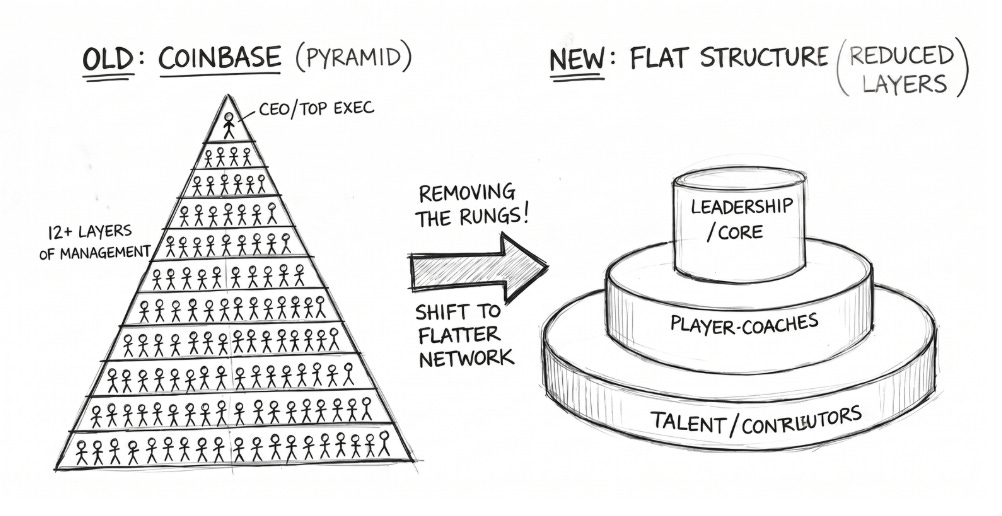
Now, Coinbase is removing those layers altogether. Leaders who stay are being reframed as ‘player-coaches’, each carrying 15 or more direct reports and expected to do the work themselves on top of managing teams. Some teams will collapse into one person doing what used to take three: engineering, design, and product. Then there’s how Armstrong described what they are actually building: ‘an intelligence, with humans around the edge.’ (not gonna lie, sounds a bit ominous).
Long-time readers will know I’ve been calling this the Hollywood model for the past year (here and here). The corporate model is giving way to a film-set structure where talent moves between productions, builds a reel, and owns their reputation. On a film set, the player-coach is the writer-director or the showrunner. They’re writing the scripts, sitting in the room with the cast, and leading the production at the same time.
What this changes is the shape of a working life. Your CV is replaced by a Career Reel, a portfolio overview of the work you actually produced and the outcomes you delivered. The single-company ladder climb gives way to a body of work assembled across multiple projects and clients. The job description has a Hollywood equivalent too: an offer that names what you deliver, who needs it, and what they get when they bring you in. Your reputation belongs to you, and it travels with you to the next production.
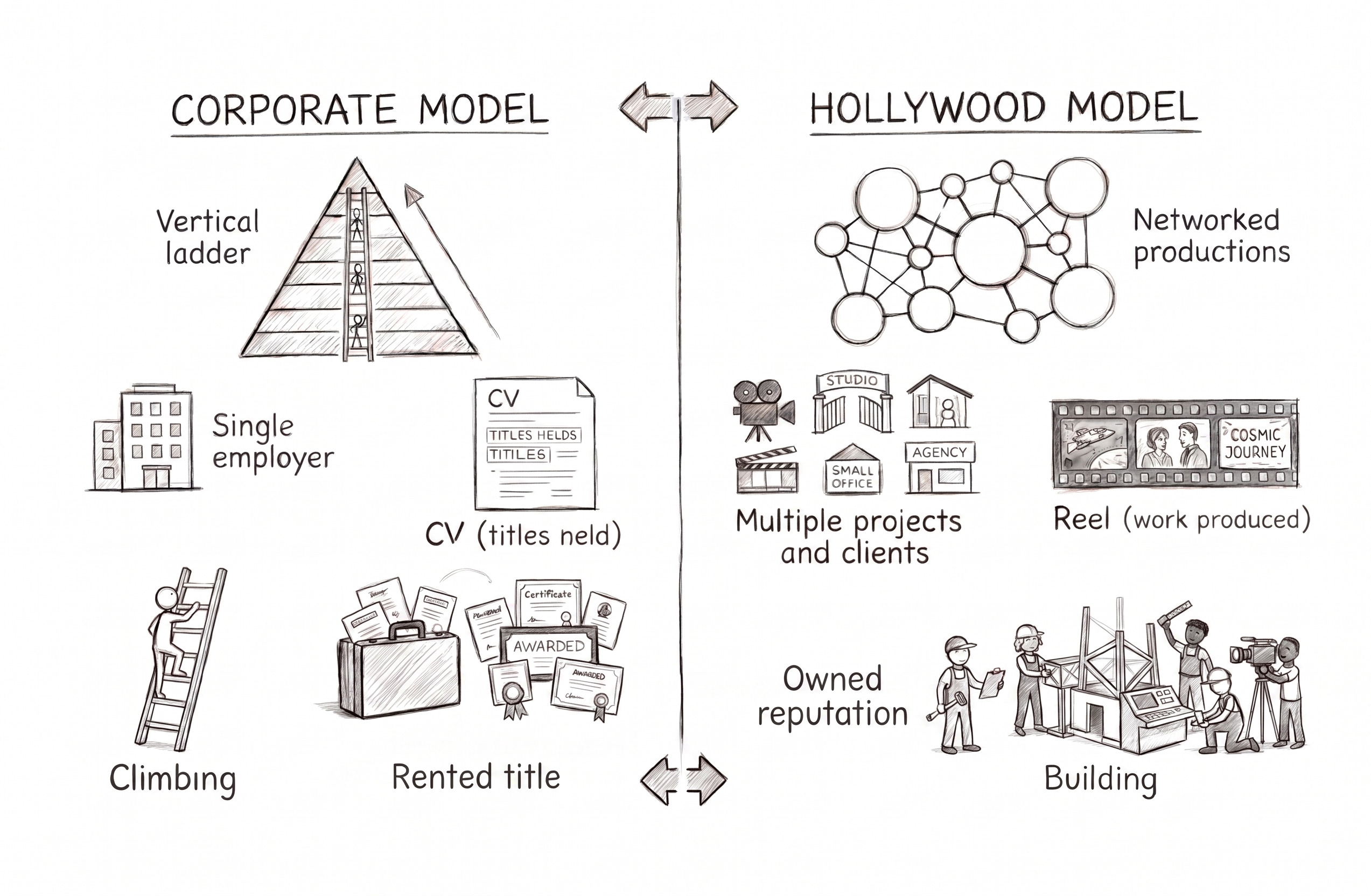
What Armstrong is describing is the structure of a film set. It’s how the talent in Hollywood has worked since the studio system collapsed in 1948.
For anyone reading this from inside a corporate role, none of it is abstract. Watching the shape of your work change in real time, while you’re still inside the old system, is genuinely disorienting. I know because that was me in 2019.
I started building my own Career Reel (aka: Portfolio Career) in 2019, while I was still in my executive role. However, I didn’t know that was what I was doing at the time. The first thing I built was a Human Design analysis service in the format of one-on-one sessions with no real plan beyond running them. I had no idea what it would become. It was the only thing I felt energised to start, so I started.
Most of my early energy went into things that didn’t actually matter. I spent weeks trying to get the pricing right. The offer page sat in draft for a month while I second-guessed every line of it. I’d compare my pricing against other practitioners, drop it when it felt too high, push it back up when it felt too low. The actual sessions, the work I was supposedly building, took up a fraction of that time in comparison.
What I didn’t know yet was that doing the work would teach me what the work actually was. After running enough sessions, I started seeing the same pattern: women used Human Design to understand themselves but missed the bridge to applying it commercially. That’s when I realised what was actually mine, the combination of energetic intelligence and a business brain.
Once I named it, things took off.
Like I say to all of my clients:
Momentum creates clarity. Not the other way around.
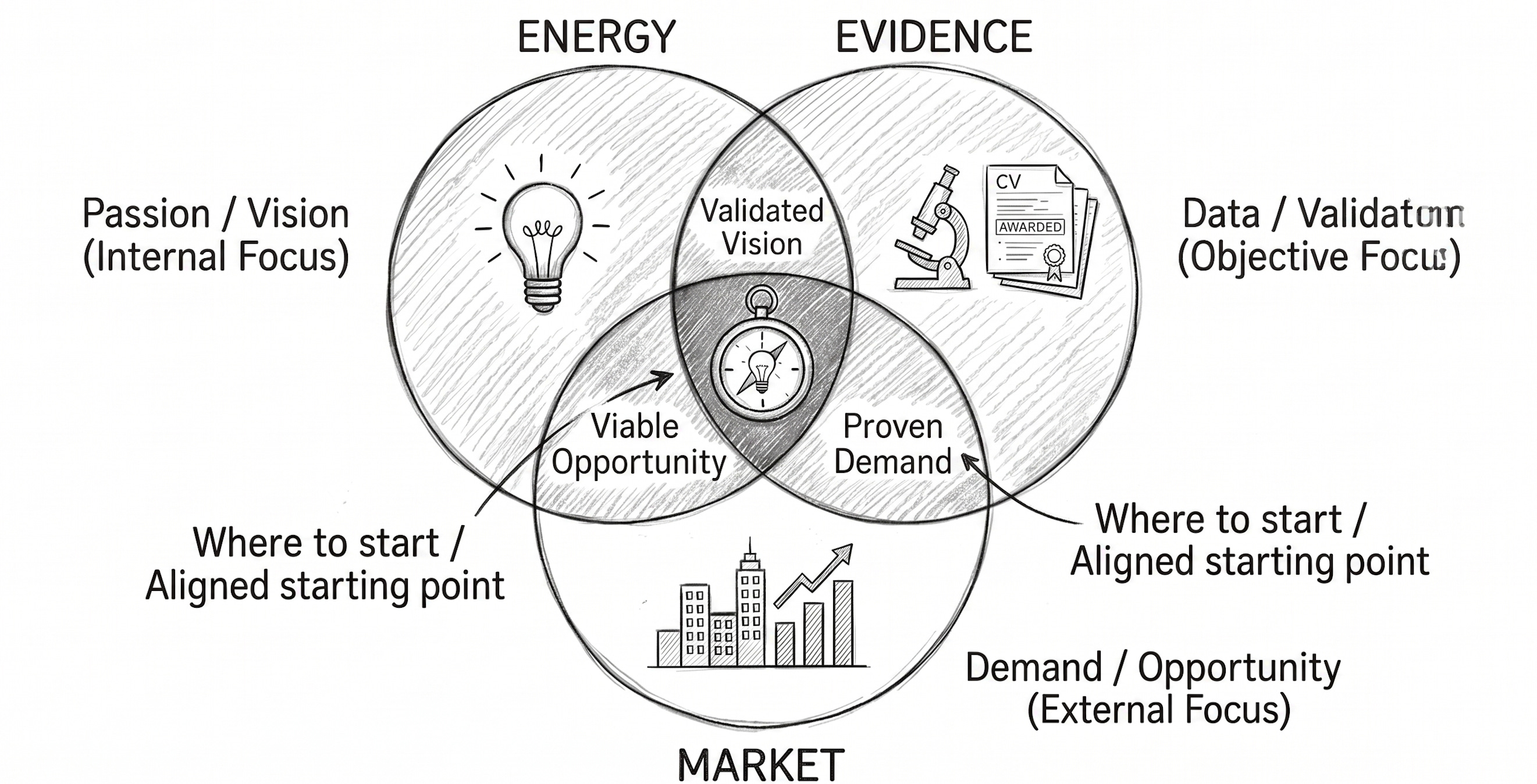
Most women I work with have plenty of ideas. The bottleneck is having a way to choose between them. So here are the three checks I run anything through before I commit time to building it.
Energy. Evidence. Market.
Each check asks one question: does the thing light you up, do you have any proof you can do it, and is there anyone who actually wants it? Once an idea passes all three, you have a starting point.
From there, the muscle of choosing, building, and learning is what you’re really developing. Income, when it comes, is the by-product.
Energy
The first check is energy. Whether you could imagine choosing this thing voluntarily, on a Tuesday night, after a long day in your corporate role. Commercial potential and credentials don’t enter yet. The only question is whether the thing has pull.
This is harder than it sounds. I’d say over 90% of the women I work with have spent fifteen or twenty years optimising for what was rewarded inside their company, not what their actual energy responds to. Promotions, performance reviews, projects that mattered to the business. The system trained them to read external signals, not internal ones. By the time they start thinking about a portfolio career, the internal signal has gone quiet. Reconnecting to what lights you up takes time and patience.
This is where Human Design comes in as a diagnostic tool. It tells you how your specific energy is wired: how you make decisions cleanly, where your sustainable energy comes from, and what kind of work environment will keep you moving without burning you out. If you’re choosing what to build, knowing this is a shortcut to alignment.
A question to ask yourself: would you do this if no one was watching, no one was paying, and no one had told you it was a good idea? If yes, you’re onto something.
Evidence
The second check is evidence. This is whether you have proof from your own past that you can actually do this thing. The proof shows up in the form of people you’ve helped, problems you’ve already solved, and work you’ve produced even when no one was paying you to do it. Qualifications and titles don’t count at this stage.
This is where most corporate professionals get stuck. They look for evidence in the language they were trained to speak: titles, promotions, formal qualifications. The actual evidence is sitting underneath that, but the corporate context held it together for them, and stripped of the title, they can’t see what they’ve actually built. I wrote about this last year in the essay The Translation Problem. The expertise is already there; what they’re missing is the language to make it visible.
Evidence is rarely sitting on your CV (contrary to what you have been taught). Look at the work you do that no one asked you to do, the people who keep coming to you for the same kind of advice, and the recurring problems your team pulls you into outside your formal role. Your CV captures what was assigned to you. Your personal body of work is everything else (and I bet there is a lot of it!).
A question to ask yourself: when people keep asking you for help, what do they ask for? That recurring ask is the evidence. Start there.
Market
The third check is market. This is where we look for demand for what you’re thinking of building. The simplest version is one person willing to pay for it, or one person willing to commit time to receive it. I’m not talking TAM analysis or market segmentation. One real person in your actual life, willing to say yes, is the entire test at this stage.
Most people overcomplicate this. They imagine they need a fully validated market, a tested product, and an audience built before they can charge anyone. So they spend months building content strategies and brand identities before they’ve ever sold a single thing. At this stage, the market check is about real-world signal, not scale. One person beyond your immediate circle, willing to say yes, is more than enough.
In practice, market demand often shows up in the same place as evidence does. The colleague who keeps asking for your advice on a specific topic is a potential market. So is the friend who keeps suggesting you should build something, and the peer who reaches out asking if you have time for paid work. None of this requires a market study. The signal is already there in your everyday work life if you look for it.
A question to ask yourself: who in your life has already, even informally, signalled that they want what you’re thinking of offering? They might have asked you already - like an old mentor once said to me, “make sure you listen twice as much as you speak” (not sure how good I am at this tbh).
Run an idea through these three checks, and you have a starting point. An aligned idea, with some proof behind it, and one real person willing to say yes. That’s enough to begin. From there, the doing teaches you the rest.
I started this post with Coinbase, but the bigger story is the new world of work that’s taking shape, and the muscle you’ll need to meet it. The corporate ladder is being dismantled in real time, and the Hollywood model is replacing it. The people who will move through this shift with the most agency are the ones who started building their Career Reel before they had to.
The smartest way to start is from where you are, with one small idea. No overthinking.
My advice? Build the reel before you need it.
This is the territory I'm writing about in Off Script, the book I'm working on about what happens when the career model breaks and what we build instead. I wrote about why I'm writing it here. More coming.
If this landed, share it with someone who’s sitting on raw materials and doesn’t know what to do with it yet.
Comments
Nothing yet. Say the first thing.
Sign in to join the conversation.