
Before we start: Founding Member pricing for Polywork ends in 24 hours. Details at the bottom if you've been thinking about joining.
I started building income streams in 2020, while I was still working in Private Equity. My first offer was a £50 human design analysis for corporate women who wanted to leave, and people bought it. That one offer grew into more, and eventually into a multi-six-figure portfolio career I run now. Along the way, women kept asking how I was doing it, so for the last six years I’ve been supporting them through it as well.
So when career advice comes across my feed now, I check it against what I’ve actually watched work, and here are 6 claims that keep coming around that I don’t buy any of them.
“We’re in a millennial career crisis.”
There’s no millennial career crisis. There’s a whole-of-work identity crisis, and every generation is feeling it. The 55-year-old executive is applying for hundreds of jobs and being aged out of every shortlist. The 42-year-old is fifteen years into a career that was supposed to be the safe choice, watching her industry restructure underneath her. The 28-year-old has done everything right and worked out that the ladder she was promised has collapsed, and that she’ll never earn what her parents did.
Those three women are not having separate crises. The same deal has broken for all of them: the one where you gave an employer your loyalty and your best years, and the system of work gave you back a stable income, a career path, and an identity. That deal is gone at every age. Pinning it on one cohort makes a tidier headline, and it lets the system that broke the deal off the hook.
“Post your income to build trust.”
This is the one I’m still torn on. You can’t be what you can’t see. When no one shows real numbers, women stay underpaid and guessing, so part of me wants every figure out in the open. But a bare number with nothing around it doesn’t help anyone. It just makes the reader feel behind, and it tells her nothing about how the money was actually made.
And I watch people build a following on their pivot income and think: imagine regretting that. Once the number is your content, you have to keep beating it. One slow month is fine. A run of them, and the people who followed you for the climb start to feel uncomfortable and leave. The audience came for a rising number, and an audience like that doesn’t stay for a falling one.
So for now I share my full breakdowns, but only inside Polywork, where there’s room for the story behind the figures. How the money was made is the useful part anyway.
“You have to quit and leave that world completely.”
The dramatic exit makes a good story and a bad strategy. You don’t have to leave that world to build a portfolio. Take a side-step or a step down, look for a part-time role or a job share. These are all real income streams, and they’re often the sturdiest in the mix. I built mine over four years while still employed.
Build the income before you burn the boat.
“Once you’ve left, you can never go back.”
You can leave and still go back, and one of my clients just showed me how it’s done. She had three healthy income streams when a company tapped her for a full-time role. In our conversations she was 98 per cent sure she didn’t want it. But there was interest there, so I encouraged her to keep talking. Four months of conversations later, after both sides had properly got to know each other, she took the role.
She didn’t sell out. She went in with her list of non-negotiables, she kept her flexibility, and her portfolio is sitting there ready whenever she wants it. That’s what the portfolio gave her: she chose the role from strength, on her terms, instead of taking it because she had no other option.
In and out is a pattern, and the people policing the exit door were never going to pay your mortgage.
“Everyone needs to become a content creator.”
Somewhere, we decided a personal brand means being a content creator with a big audience. It doesn’t. Your personal brand is what the right people say about you when your name comes up, and for most portfolio careers, the right people are a few dozen humans who know exactly what you do.
Think about how most income streams actually arrive. Fractional work and consulting come through people who’ve watched you deliver, then mentioned your name to someone with a budget. The whole chain runs on a handful of relationships and a clear sentence about what you do.
Mass visibility is a real strategy when your portfolio sells in volume, a course, or a book. If yours runs on relationships instead, every hour spent feeding an algorithm comes out of the conversations that actually pay you. The follower count is optional.
Share rawmaterials by jules fedele
“Young people should have a portfolio career.”
The system of work is broken, and young people are paying for it. That’s exactly why I don’t push them toward a portfolio career. A portfolio pays when you’ve got depth someone will pay good money for. Mine took 15 years of building businesses before I could price at my rate.
A 24-year-old with three shallow income streams doesn’t have a portfolio. They have three casual jobs and no path to the depth that would ever let her charge properly for any of them. The gig economy already runs on people like that, and it calls the arrangement flexibility.
For young people, the strategy is still the old one: go deep in something, get so good that people seek you out, and let the portfolio come later, built on top of expertise the market is demanding.
Look out for the patterns
Every one of these myths is optimised for the same thing: a better story. A crisis makes a headline. A salary reveal builds a following. A burned boat gets applause on the way out.
Meanwhile, my client spent four months slowly deciding whether to take a role, with three income streams behind her and her non-negotiables in hand, and there is nothing in that story an algorithm would reward.
A woman with options making a calm decision has never once gone viral.
The careers I’ve watched actually work are like hers. Built slowly, tested privately, adjusted without an announcement. Most of them would make terrible content, and that’s how you know they’re real.
Things worth asking yourself:
Which of these six have you absorbed without noticing?
Whose career advice are you taking, and what does their income actually depend on?
If you never posted about your career again, what would you build?
What’s the smallest income stream you could test while everything else stays exactly as it is?
Build the career that’s true for you, not the one that’s trending. That’s career sovereignty.
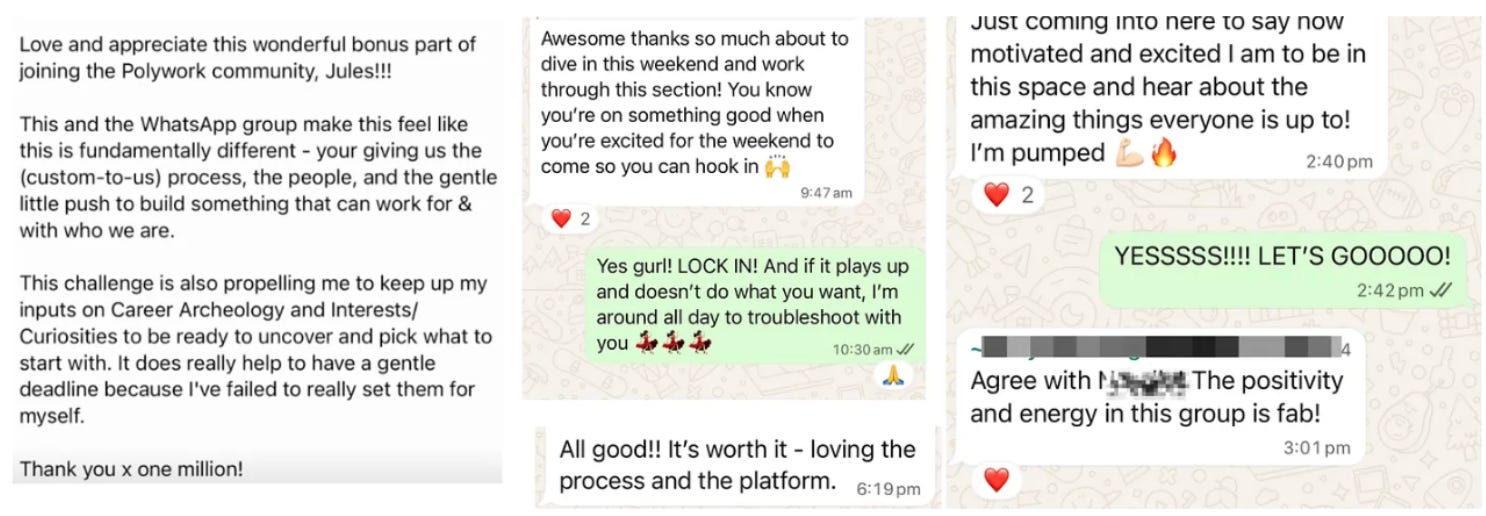
If you’re ready to build the real thing: Polywork is where I walk women through the whole rebuild, from excavating what you’ve actually got to testing priced offers with real people. Your Human Design runs underneath it all, so you build to fit how you’re wired, and Scout, our AI coach, works alongside you the entire way, with a community of women doing the same.
One practical note: Founding Member pricing ends in 24 hours, and after that it goes up by 30%. If you’ve been circling this for a while, this is the cheapest it will ever be.
I’d love to support you inside!
Comments
Nothing yet. Say the first thing.
Sign in to join the conversation.