Hi, I'm Jules. Welcome to Rawmaterials, where I write for experienced women monetising their expertise while building a life they love.
When I first heard about portfolio careers in 2018, the idea of multiple income streams felt like my answer to everything.
I pictured work that let my generalist instincts run free, income that didn’t rely on a single employer, and the flexibility I’d wanted my whole life.
All of that proved true. But the path from day job to a sustainable portfolio unfolded very differently from how I imagined. That should not surprise anyone; most lasting change has a way of surprising us.
I also loved the idea of a portfolio career because it let me step out of corporate without having to call myself a founder or be boxed in as a freelancer. It gave me practical permission to try something different while I kept one foot in the world I knew.
After 7 years managing my own portfolio and working with hundreds of women to launch theirs, I want to share the approach I teach: tried, tested, and intentionally boring. It takes time and consistent work.
But if you follow this, I promise it works: you will replace your income and be making money doing what you love, helping people you want to work with, and living a life you love.
I mean, who doesn’t want that?
Before I jump into the approach, it’s important I share my frame of reference and how I think, teach, and structure portfolio careers.
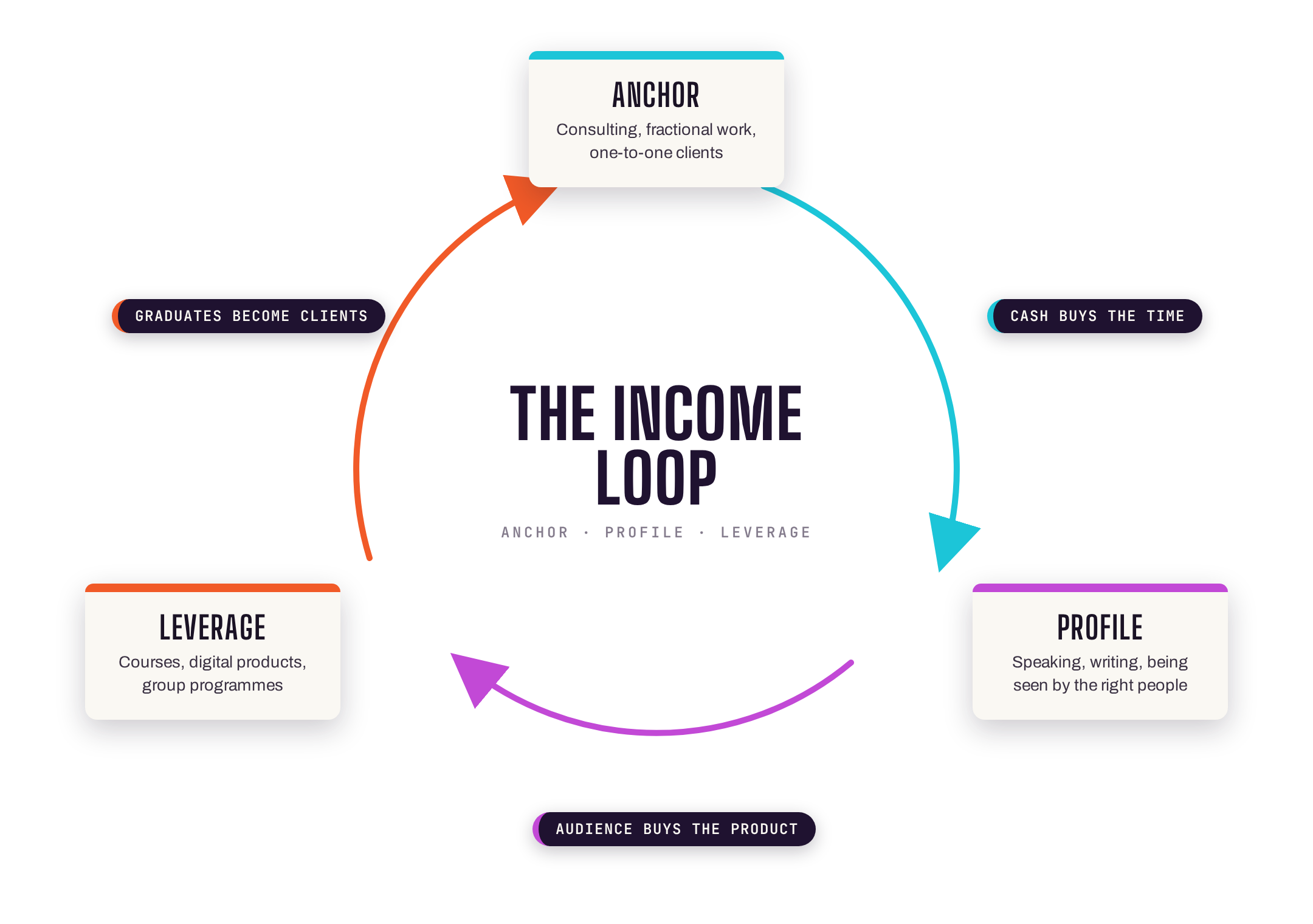
Every portfolio I build, mine and my clients’, sits on 3 types of income:
Fig 1.1: The Income Loop
Anchor Income Work that pays the bills now: consulting, fractional roles, one-to-one clients sold on your track record; this is a direct monetisation of your expertise. Its initial job is cash flow. It buys the time to build the other two streams.
The trade-off is it scales with your hours; that is why we work on building your Profile and then your Leverage.
Profile Income (indirect) Work that builds your name: speaking, writing, podcast guesting, and showing up where your buyers gather. It pays in attention that converts later, filling your anchor pipeline and creating the audience your Leverage offer will sell to.
The trade-off is it only compounds when it reaches people who will actually pay. And this takes time and consistency.
Leverage Income Work that earns without your hours: a course, a tech platform, or a group program. You build it once, then sell the same product to many buyers instead of trading hours for money each time.
The trade-off is the temptation to build Leverage first: everyone sells you on scalable income, but without a solid product or audience, it falls flat.
Those three streams get built in a deliberate order, across three modes.
Here's how it goes:
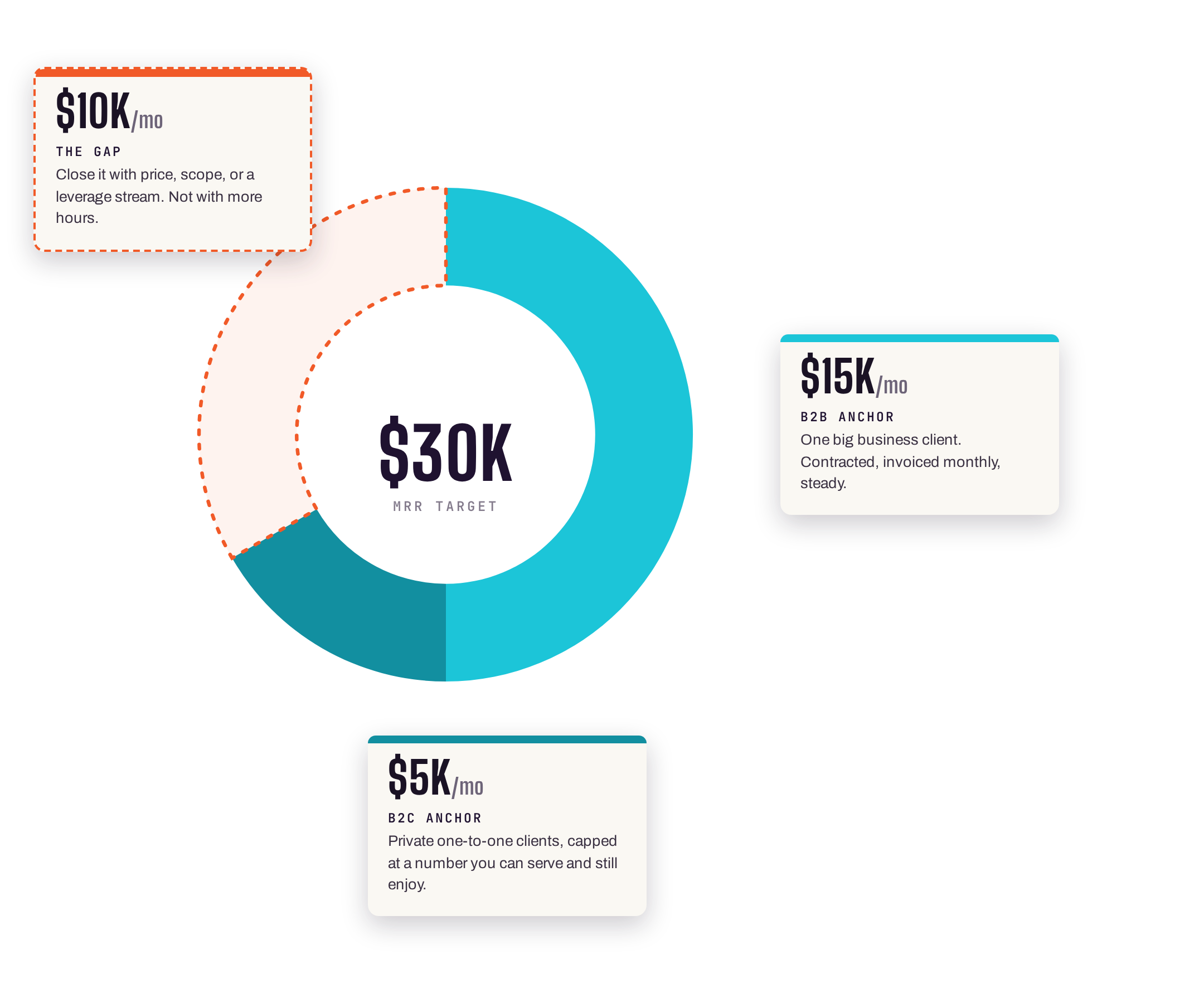
The goal of experimentation mode is a clear line of sight on your Anchor income and delivery model. Are you selling larger contracts to organisations, working with individuals, or both? What are you charging, and through which channels do buyers find you? We want an honest MRR baseline and the target number so you are not freaking the fuck out each month.
In the first two years, your job is not to land the perfect niche or polish your message. Your job is to run messy, small experiments. Try offers, prices, formats, and buyers. Ship imperfect tests, watch what gets bought, and cut what does not. Only through that mess do you see the shape your portfolio can take.
When I started, I monetised my business-building expertise with organisations that wanted new revenue streams. I had evidence, so fractional and project work landed. It did not light me up. It paid me well without full-time hours and bought space to build what did. I ran this entire phase while still employed, and I only resigned once my portfolio income was proven.
Once one Anchor was in, I could exhale and grow the stream I actually wanted: private work with women leaving corporate. It was slower because I was less known. With consistency over years, I built a profile, ran free workshops, had curiosity chats, and delivered great outcomes. Many of my clients begin the same way: a three‑day‑a‑week fractional role for stability while they test other streams.
Important note: If you are in an Identity Layoff, between who you were in corporate and who you are becoming, my advice is to rest, heal, and nurture this season. Do not join a 30-day challenge to launch a monetised Substack, build a new income stream, or join a Yap challenge. Let yourself be, without trying to earn worth from the outside. You cannot build something sustainable from this state. If you need income, take a side step into a simple, low‑stakes job that pays the bills while you recover.
Stabilisation mode is where self‑sabotage creeps in. You get bored of the reps and think, fuck it, I’ll spin up a $37 offer and sell it to millions of people because that’s what everyone online is doing. I call this the TikTokification disease, and it impacts 83% of business owners*. It looks fun, but it kills focus.
Your job here is simple: keep stacking Anchor wins and run your numbers. If your monthly target is $35k, what mix gets you there without 80-hour weeks? If it takes 8 to 10 Anchor clients at once, that is 12 hours a day on calls plus follow-ups. A fast track to burnout and "maybe I should just get a full-time job."
Your Profile work also makes your Anchor easier to buy. Say the problem your Anchor solves, show proof from your work, and show up where your people actually are. This is where you also stabilise your content cadence, the rooms you choose, and how you show up in them. Over time, it fills your Anchor pipeline and becomes the audience for Leverage.
Fig 1.2: Understanding your income sources helps you identify where leverage income can be built
Important note: Stabilisation often hits in years 2 to 3. Many women quit here because they expected stability or their target MRR sooner. Remember, a portfolio career is a business, whether you claim it or not. Give yourself time to learn how to work on the business and in the business, especially if you are a company of one after years inside a big team.
Now we get to the part everyone wants to start with: Leverage income. It hooked me too. Turning your work into a one-to-many offer instead of trading time for money sounds perfect. What is not to love?
Here is what the coach bros forget to tell you. Leverage offers are the hardest to sell and grow. The product has to be excellent. It must solve a very specific problem. It takes real upfront build time, and you need an audience to sell to.
This is why you build your Anchor first and your Profile early. Your Anchor gives you proof and cash, and your Profile gathers your people. Then you turn what works one-to-one into a one-to-many offer. I know, super boring, but it works every single time.
My path looked like this: I spent the first 4 years honing Anchor streams and building consistency. As I saw patterns repeating themselves, I codified the process. This is how I built the Portfolio Career Club (now retired) and Polywork.
Only after the one-to-one work delivered repeatable results, and my Profile had gathered the right people, did the one-to-many offer make sense. That is Leverage income done in order: proof, then product, then scale.
You are likely sitting on Leverage income already. Not new ideas. The repeatable outcomes you deliver in your Anchor work.
Client examples: My client is a senior FMCG consultant who took her loss‑prevention playbook and turned it into a manager training that clients’ HR teams licensed for their curriculum. Another client left a head of L&D role, picked up a fractional L&D position, and with a business partner spun her in‑house leadership pathway into a programme for aspiring leaders.
We identify the pattern first, then package, then distribute. Take one outcome you deliver on repeat, name the buyers, outline a simple curriculum, run a small paid pilot, then decide if it earns your time to build out in full.
I did not leave a high‑paying executive role I hated to build a business I also hated, with no one to blame but me.
I was never chasing a pile of income because I'd done that in my corporate life and I became a shell of myself. I wanted a portfolio life. Money from work I actually enjoy, with clients I like, and the flexibility to be a soccer mum for the first time in my life.
That is what freedom looks like to me.
A lot of women I work with come to me hating their portfolio - the picture in their head and the thing they built are often miles apart. They chase Leverage first (because that is what the online gurus tell them to do), they say yes to the wrong Anchor clients, unconsciously rebuild corporate patterns, and fill the week with work that pays but drains.
The fix every time is design: remove the junk that doesn't add value.
Pick Anchor income that lights you up, and know your numbers so you cap your client load before you hit burnout. Put a simple profile-building cadence in place, and test your Leverage income only after the proof is real.
And that, my friends, is how you end up loving your portfolio sick.



Comments
Nothing yet. Say the first thing.
Sign in to join the conversation.