
The winter solstice does not arrive with ceremony, which feels exactly right.
There is no visible hinge in the sky, no moment you could point to and say there—there it turned, no audible click as the dark finally loosens its grip. The earth simply completes its long exhale into shadow and pauses, and the longest night settles in not dramatically but thoroughly, the way cold does when it moves past your coat and into your bones, the way it lingers even after you’ve come inside.
For centuries, people have watched this day not because it felt hopeful, but because it didn’t, because light had thinned to almost nothing, because the fields were bare and the stores uncertain and survival itself felt newly exposed. The solstice mattered not because things were improving, but because they had not gotten worse, because the dark had reached the farthest place it could go.
The dark had reached its limit.
I keep thinking about how little the solstice asks of us, how it does not demand optimism or declarations or any sort of emotional resolution, only presence, only staying, only the willingness to remain inside a night that does not yet feel redeemable.
The earth does not rush this turning. Trees do not strain toward budding or apologize for their bareness. Fields do not pretend to be fertile. Everything visible agrees to look exactly like what it is—open, quiet, exposed—while the real work slips underground, hidden from monitoring and measurement, happening where no one can praise it or hurry it along.
Winter seems to understand that some kinds of life can only be made where no one is watching. The animals know this. The deer gather themselves into familiarity when winter comes, moving less, choosing known paths over exploration, trusting memory more than possibility. Their bodies thicken. Their range narrows. They do not waste energy on what cannot feed them.
The bear tells the truth most plainly of all. He lies down. His breath slows. His heart rate drops. The world contracts to what is necessary and nothing more. Winter does not shame him for this retreat or question his ambition. It shelters him.
Last week, I wrote about Much Afraid, the central figure in the old allegory Hinds’ Feet in High Places, a story many of us encounter quietly and at exactly the right moment. Much Afraid lives in the Valley of Humiliation, shaped by fear and injury, surrounded by voices that have named her small and fragile, yet still she longs for the High Places, for a life that feels wider and truer than the one she has known. When she is invited to begin the journey, she does not stop being afraid, and she is not healed all at once. She walks slowly, accompanied not by ease but by Sorrow and Suffering, learning as she goes that fear does not disqualify her from the path, and that walking with fear may, in fact, be the way forward.
And then there is the fox. The fox does not hibernate, which matters to me more than I can fully explain. He does not disappear into the dark, but he does not confront it either. He lives inside the winter, alert and precise, never careless with his energy. If you see him at all, it is usually at the edge of things—between forest and field, between concealment and exposure—never fully hidden, never fully visible, always listening, always orienting.
The fox understands liminality.
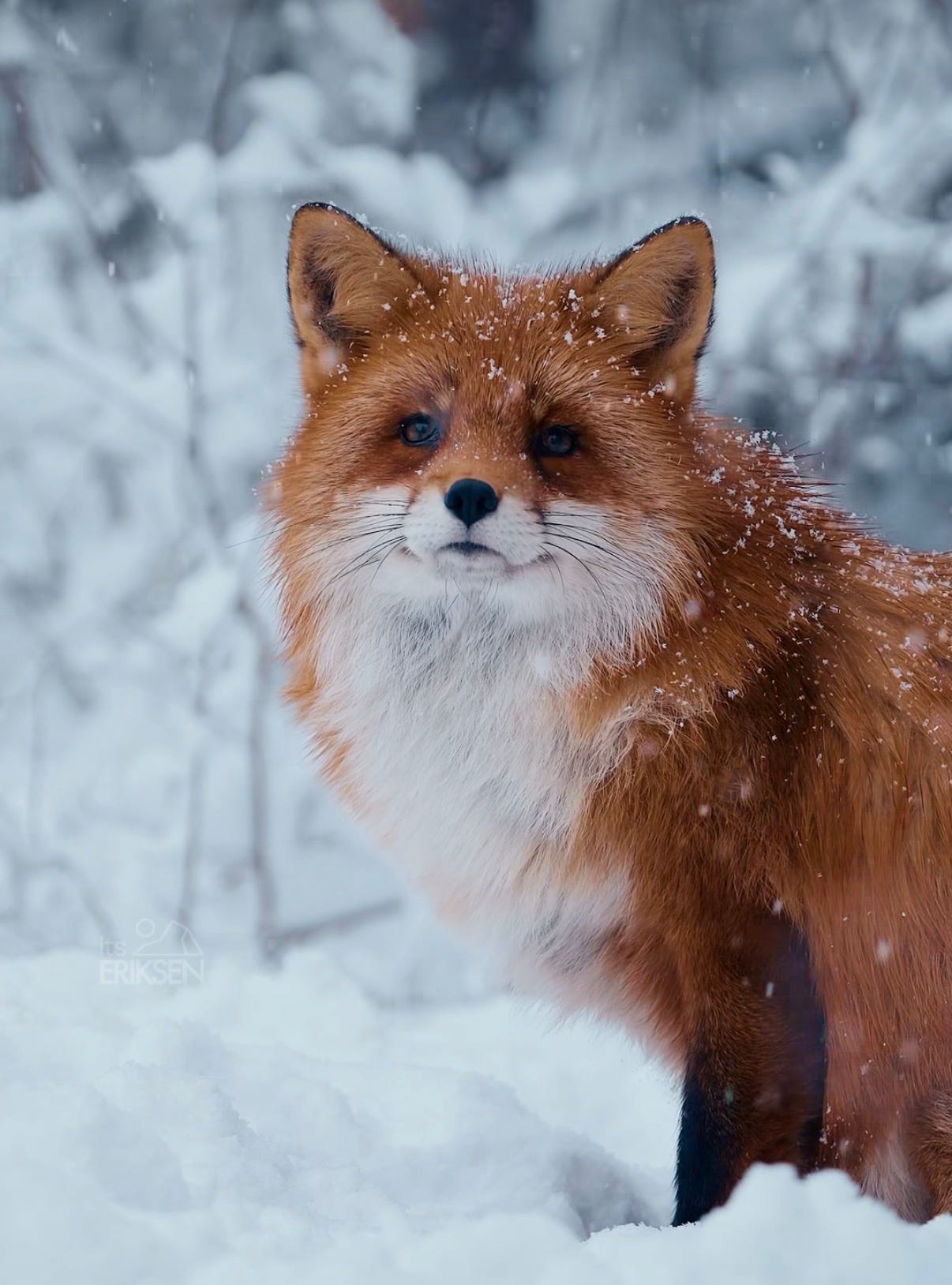
In winter, his coat thickens and brightens, a sudden red against the snow, though he does not seem interested in being seen. He moves low to the ground, pauses often, listens longer than he walks, his ears constantly swiveling toward life beneath the frozen surface—a mouse under the crusted snow, a subtle shift in the air, danger arriving before it can be named.
The fox survives winter not by force, but by attention, by a kind of listening that is patient enough to wait and disciplined enough not to wander.
Much Afraid would understand him immediately. She would recognize him not because he is bold, but because he is careful, because he lives at the edge too—between fear and faith, between longing and limitation, between the life she has known and the one she hopes for but cannot yet imagine clearly. She does not rush because her body remembers what it has endured. Her feet do not move quickly because they have been injured. She does not cross open fields lightly because she knows what exposure costs.
She walks close to the tree line, close to her companions, attentive to what the terrain is asking of her now rather than what it once promised.
She is not afraid because she lacks faith.
She is afraid because she has learned how fragile joy can be.
We misunderstand this kind of fear, often badly. We call it weakness when it is actually memory. We urge courage when what is required is discernment. We forget that fear, when it is honored rather than shamed, sharpens the senses and teaches timing and restraint and survival.
The fox knows this. Fear does not dominate his life, but it informs it. He does not argue with it or try to outgrow it. He lets it teach him how to live well in a hard season, how to remain awake without becoming reckless, how to stay alive without wasting himself.
There is a passage I return to often in Let Your Life Speak, especially in winters like this, when fear feels less like an obstacle and more like a landscape we are already standing inside. Parker Palmer writes:
“Our inward winters take many forms—failure, betrayal, depression, death. But every one of them, in my experience, yields to the same advice: ‘The winters will drive you crazy until you learn to get out into them.’ Until we enter boldly into the fears we most want to avoid, those fears will dominate our lives. But when we walk directly into them—protected from frostbite by the warm garb of friendship or inner discipline or spiritual guidance—we can learn what they have to teach us. Then we discover once again that the cycle of the seasons is trustworthy and life-giving, even in the most dismaying season of all.”
What stays with me is not the boldness of that invitation, but the tenderness of the protection.
The fox does not enter winter unguarded.
Much Afraid does not walk alone.
Both understand that entering the dark without care is not courage but recklessness, that winter requires garments and companions and practices that keep the soul from freezing over.
Friendship.
Discipline.
Prayer.
Rest.
Even the animals know this. The fox chooses dusk over daylight, the long way over the exposed one, stillness over spectacle. He wastes nothing—not energy, not attention, not risk—and trusts that winter will yield what he needs if he listens long enough to hear it.
Much Afraid walks this way too. She does not demand that fear disappear before she moves forward. She carries it with her like a warning bell, like a memory stitched into her steps, letting it orient her without letting it name her.
This is where the solstice matters. Because the solstice does not promise immediate light or emotional resolution or a sudden sense of relief. It does not resolve the season. It simply tells the truth: the dark has reached the farthest place it can go.
The fox does not celebrate this.
He does not change his behavior overnight.
He keeps listening.
Much Afraid would do the same.
She would not rush into the open field simply because the calendar turned. She would stay near the edge, trusting that the world knows what it is doing even when she cannot yet feel the change in her own body.
I am Much Afraid at this solstice.
Not because I am faithless, but because I love, because I remember, because I have learned what exposure costs and what vigilance preserves.
And still, I walk.
Like the fox, I listen for life beneath the frozen ground.
Like Much Afraid, I stay on the path even when it is long and unremarkable and unfinished.
The solstice does not resolve my fear.
It simply tells me the dark has done its worst.
The light has turned back toward us.
And tonight—quiet, cold, unceremonious—that is enough.
This piece is part of an unfolding wintering series. If some of the language here feels mid-conversation—Much Afraid, the long road, the companions—you haven’t missed anything by arriving late. But you may want to return to Parts I and II, where the journey begins.
If you’d like to read from the beginning:
I should say this plainly.
I have always been drawn to creation—not sentimentally, but with a kind of reverent fascination—the sense that God’s created order carries wisdom whether or not we are paying attention, that the seasons preach whether or not we are listening, that there is a deep intelligence at work beneath the surface of things.
Winter, especially, has taught me this.
Over the years, I have been shaped by writers who helped me trust that instinct—who gave language to what the natural world has been saying all along—that rest is not failure, that darkness is not absence, that endurance is a form of faith.
Writers like Katherine May, author of Wintering, who helped name the inward seasons when life asks us to slow and shelter rather than strive.
And Parker Palmer, author of Let Your Life Speak, who taught me to see the seasons of the soul not as interruptions, but as teachers—even the hard ones.
They are not the origin of these ideas, but companions along the way. Fellow witnesses. People who helped me accept wisdom, think more deeply, and perhaps most importantly, walk through winter seasons with a little more trust that the world remains ordered, that the cycle is still trustworthy, that spring has not been lost simply because it is delayed.
This series is my own walking of that terrain—shaped by Scripture, by story, by the quiet instruction of the natural world—and offered in the hope that if you are wintering too, you might feel a little less alone, a little more oriented, a little more willing to believe that the light, however slowly, will return.
No posts
Comments
Nothing yet. Say the first thing.
Sign in to join the conversation.