
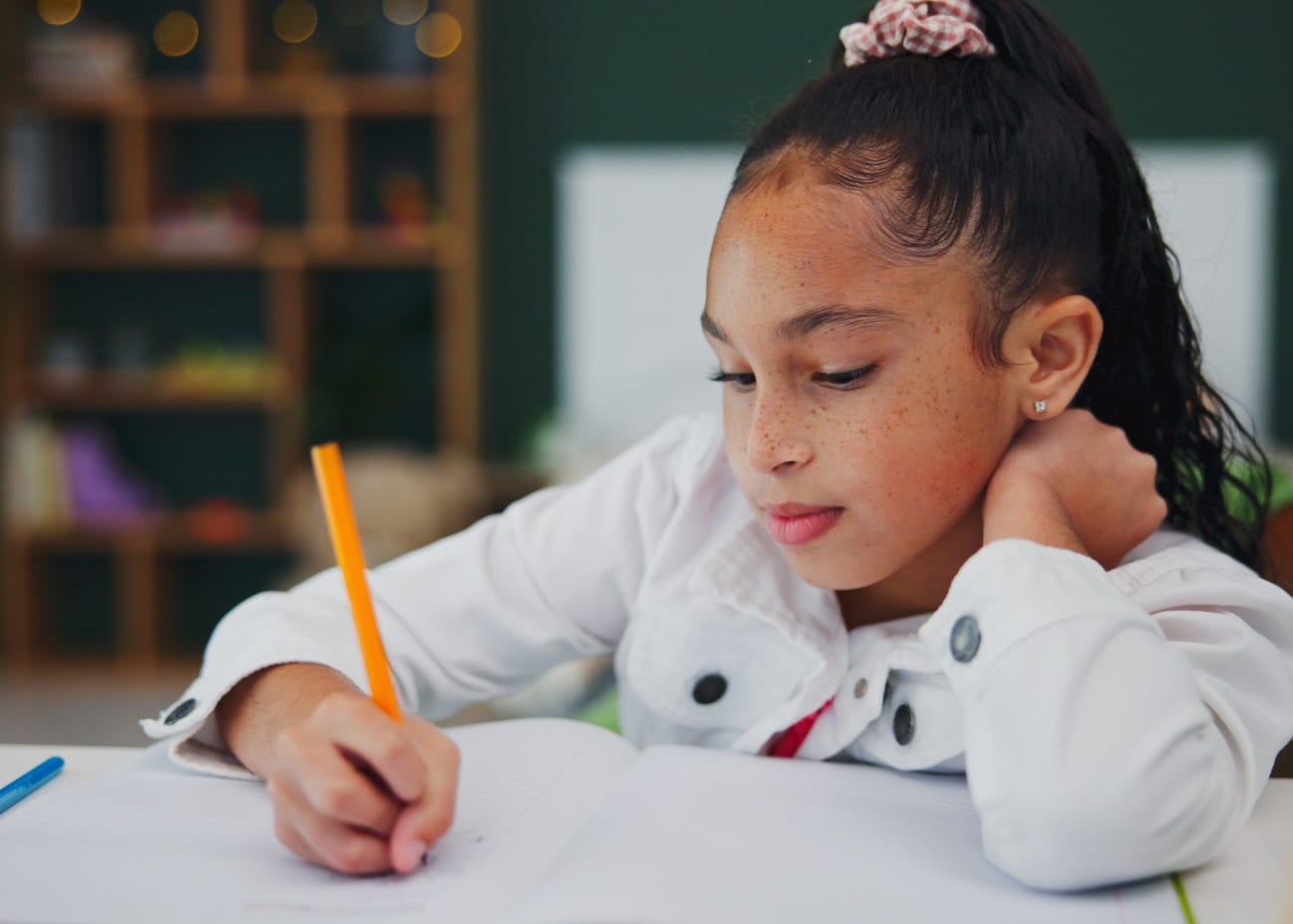
Freewriting is the act of allowing your hand to type or handwrite exactly what you are thinking as you think the thoughts. It can be timed or untimed, though for beginners, writing to a timer is a lovely support. It allows you to know an end is coming and to put all energy into transcription of your mind’s active thinking.
Let’s look at the benefits of freewriting. I hope to help you see that you aren’t just killing time until your kids do “real” writing. Freewriting is real and valuable and the foundation of all future writing.
Besides being the easiest way to get locked up words unlocked, freewriting is also the best way to help your kids stay fluent with their handwriting skills. In this age of computer use (where sometimes I go days without holding a pencil in my hand), it becomes important to give your children the chance to keep their handwriting legible while speedy. They will handwrite more than you or I do as they move through their academic careers. Freewrites can be typed but it’s nice to continue to include freewriting by hand as well.
Today in universities, more and more professors use the “in-class timed essay” as a way to gauge student progress in the material. With the rise of Internet fraud and plagiarism, professors have one sure way to guarantee that they are getting student work (not a purchased or stolen product). They can ask their students to write in-class essays. Those essays are invariably in hand-writing. Not only that, they are written to a “time limit” (sounds like writing to a timer, right?) and they are written without the aid of resources to reference as students pour ideas onto the page.
Freewriting, early and regularly, puts your children at a real advantage in the academic world. Your kids will grow comfortable expressing themselves on paper with pen in hand, they become aware of how quickly they need to write to fill a page in a number of minutes, they aren’t intimidated by the blank page and they know they can gather their thoughts and express them on command as they grow adept at writing.
Additionally, even for those papers that occur outside of the classroom, where research, computers, and time offer students the possibility of revision, freewriting still serves a powerful purpose. It allows kids to write their thoughts and ideas in short, powerful bursts. They can tackle one aspect of a topic and really hone it in freewriting before they start crafting an essay.
Too often kids fall into the trap of lifeless, point-by-point writing where they lull their professors and teachers to sleep with the predictable pattern of points and supports—no freshness, no originality. Freewriting disturbs this trend. It helps kids get back in touch with the capable, insightful person inside and dislodges the words that would be overlooked if applying them to a format too quickly.
Finally, freewriting can be a lively and poignant opportunity to get to know your child’s passions and viewpoints.
Freewriting has often served as a way for me to know my kids:
what they’re thinking,
how they are processing something,
why they are worried or exuberant.
Even when it seems that the academic purpose is lost in the freewriting, the person that is your child never is.
See freewriting as a multi-faceted chance to enhance your child’s comfort with handwriting, the ability to write under pressure, preparation for a life of insightful writing, and the chance to express an interior life on paper.
It does all that, and more! Freewriting is the core of a healthy writing life.
Need more support? I share a freewriting prompt every Friday here on Substack!
No posts
Comments
Nothing yet. Say the first thing.
Sign in to join the conversation.