
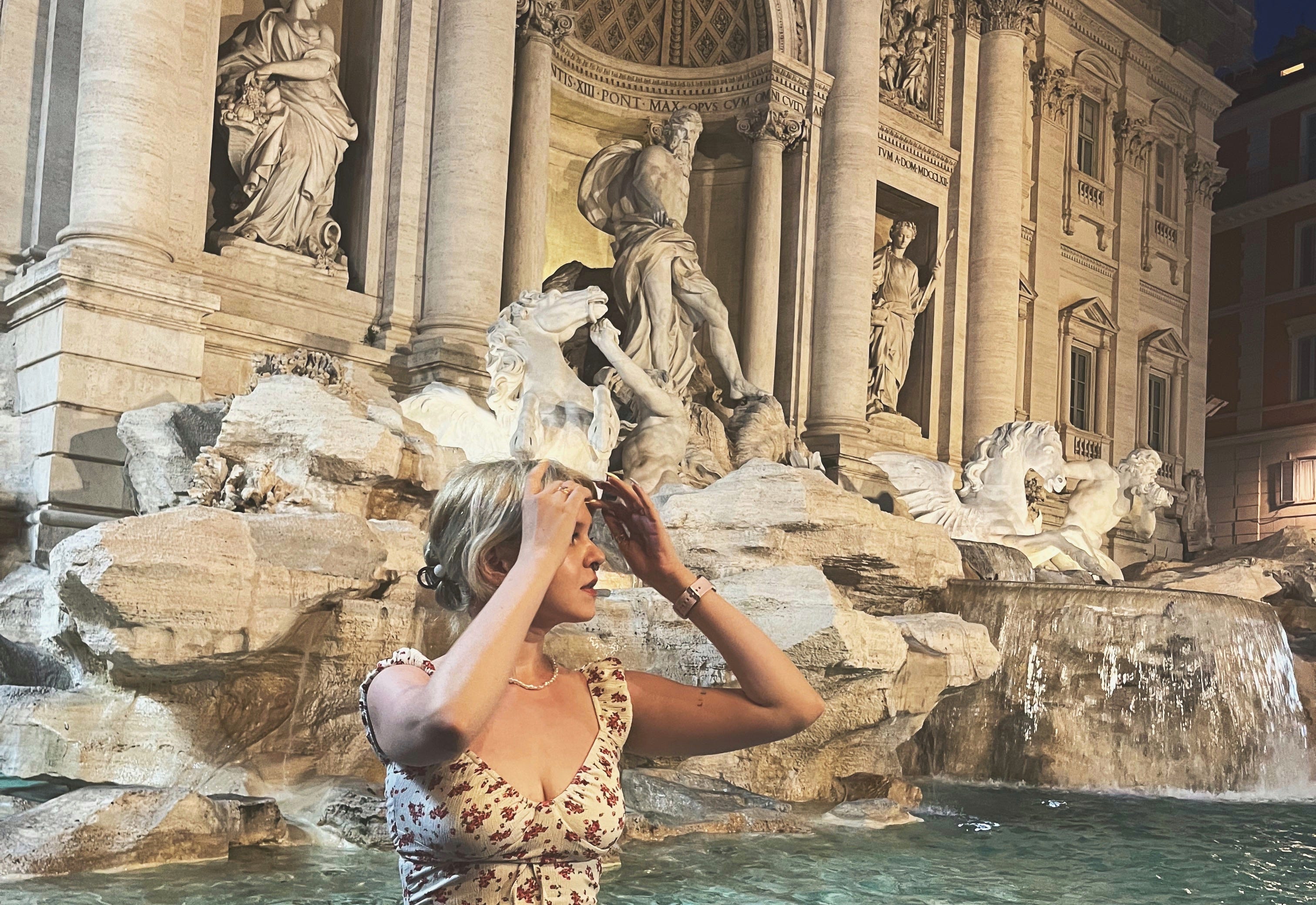
On my last night in Rome, I wanted to soak in as much of the city as possible. I had cacio e pepe, took photos next to the Fontana di Trevi — content from the trip secured — and slowly walked toward the Colosseum.
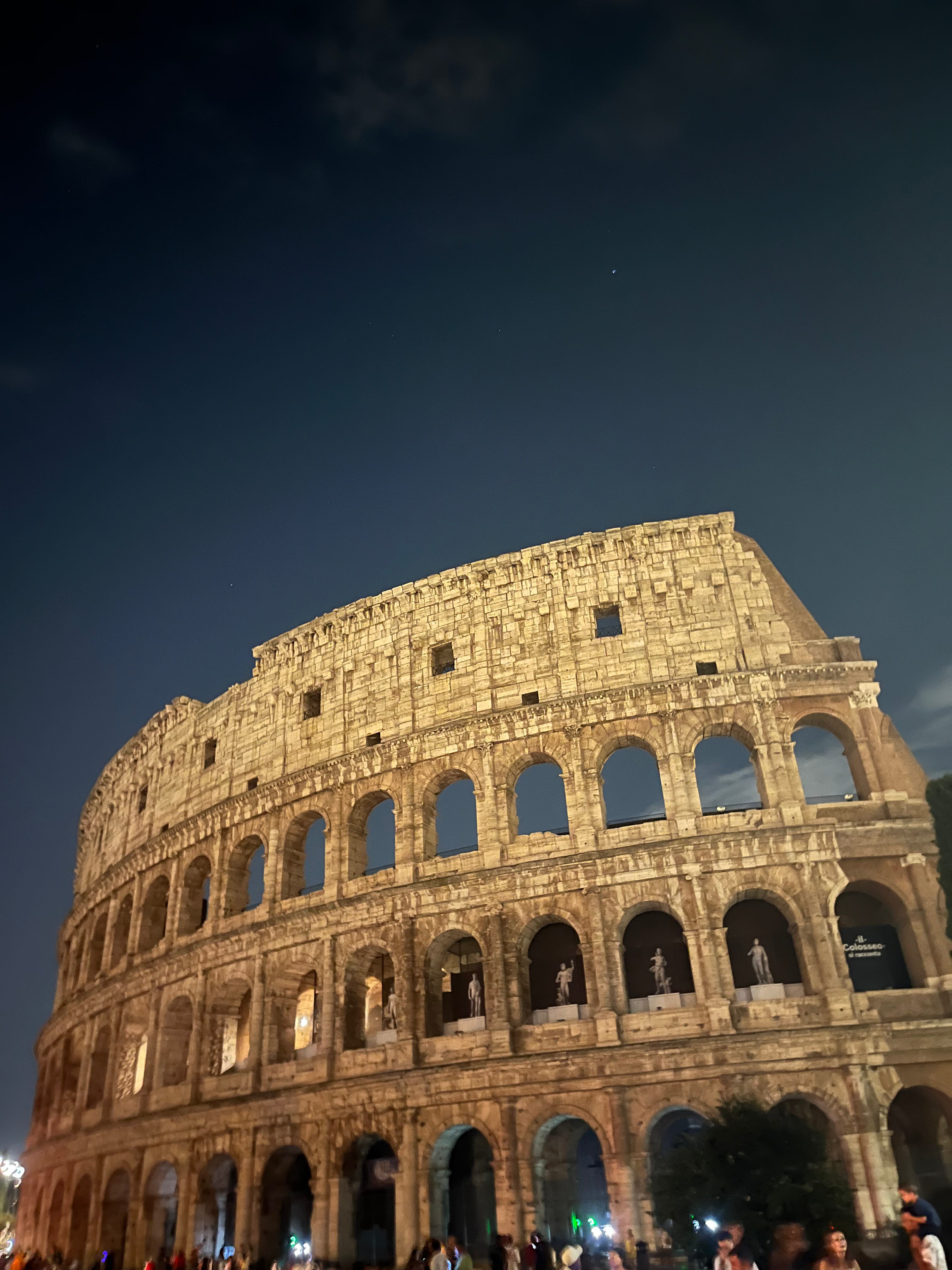
It was already dark, but the place was full of people, of course. An August night — children running around, sellers of random knick-knacks, tourists trying to take photos of the Colosseum in complete darkness (just like me, to be fair).
I closed my eyes and tried to imprint the Colosseum in my mind — a habit I brought with me from childhood.
“I will remember this,” I thought.
“Scusi, signora,” I heard in front of me.
I opened my eyes. A short, broad-built man in his 70s stood there, his shirt slightly unbuttoned in that Mediterranean-grandpa way, his hair white. He looked like someone I couldn’t quite place.
“Scusi, signora,” he repeated. “Potrebbe fare una foto di me? Siete italiana?”
“No,” I replied. “Però capisco e parlo abbastanza bene.”
Here we go — another accidental Italian practice. I took his phone — it was an old Samsung. After snapping a few pictures of him posing in front of the Colosseum with his arm raised (no, not in the way you might think), I quickly realised the darkness and the phone’s camera were not cooperating. The old gentleman looked so respectful that I didn’t want to do a bad job.
“Mi dispiace, ma non è possibile, perché la qualità non è buona,” I said. “Ma posso farle con il mio telefono.”
“Ah, va bene. Sei molto gentile, signorina,” he said.
I took a few photos with my phone instead — flash on, flash off. I always get this strange urge in moments like this, like I should suddenly become the unofficial photographer of strangers’ memories.
“Io posso inviargliele,” I said. It quickly became apparent that he wasn’t very comfortable with technology.
“Mi può dare il Suo numero?” I asked and sent the photos to him.
“Sei molto gentile, signora,” he repeated. “Come si chiama? Io sono Pasquale.”
“Julie, piacere,” I said.
And so the conversation started.
I don’t mind talking to strangers.
In fact, I sometimes think I do it too easily, as if I forget there are supposed to be boundaries between people who don’t know each other yet. Sliding into my DMs, for example, is the least intimidating thing ever — I’m endlessly curious and open-minded, ready for whatever the Universe throws at me at any given moment.
Pasquale was from Rome. A retired professor of sociology and psychology — he said it casually — as I would later find out. He was also a writer, though when I asked what his recent book was about, the answer expanded instead of clarifying. I concluded that it was something philosophical and that my Italian level was not strong enough to talk about such matters yet.
We talked about politics, art, society, history. He painted as well — what couldn’t he do. He showed me his works on the phone, zooming in carefully. I showed him some of my paintings too, slightly embarrassed in the way you are when you’re not sure whether something you make is worth being seen — and whether you’re going to be smiled at condescendingly.
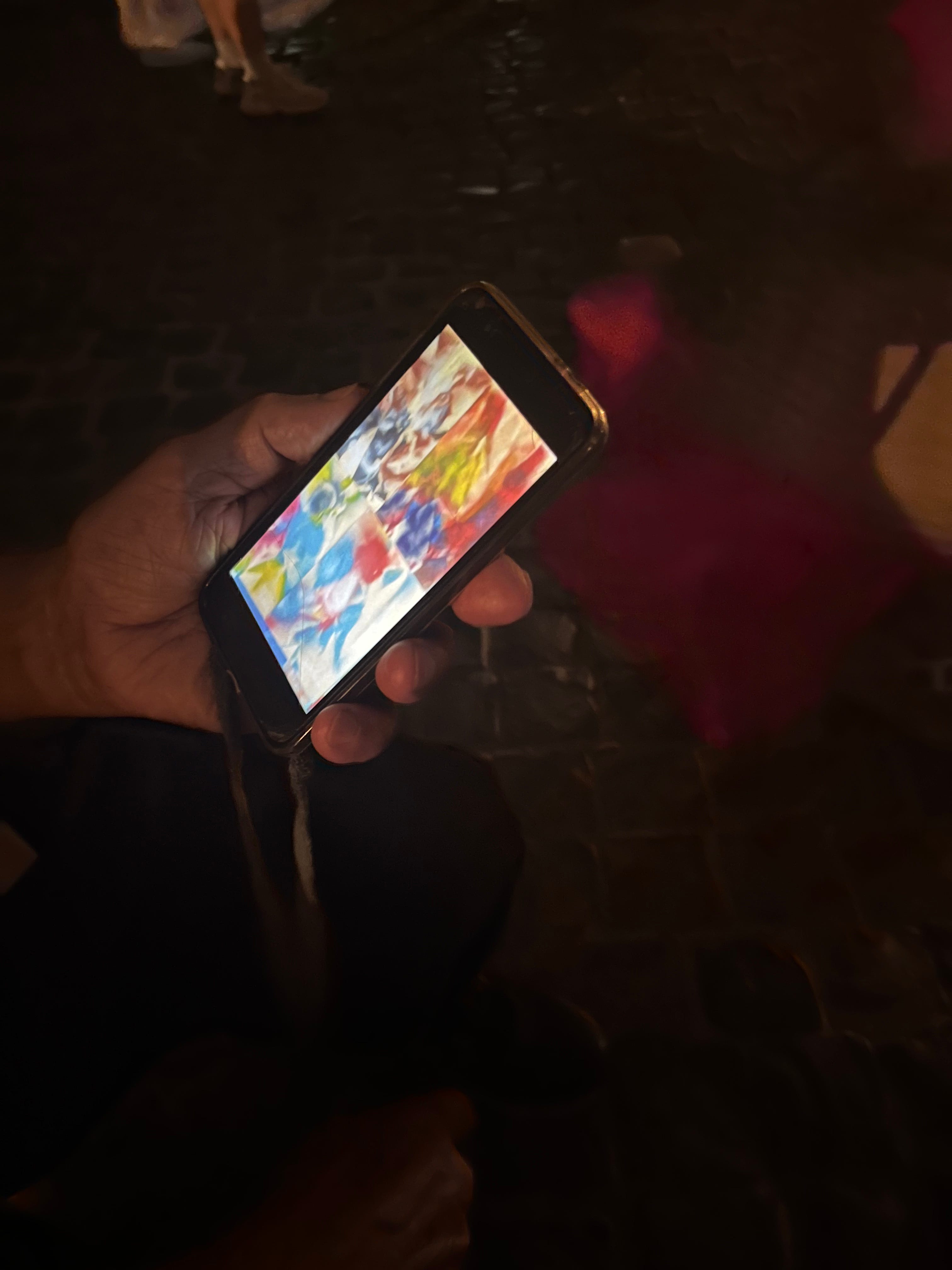
“Sei molto brava,” he said.
“Non è vero,” I snorted. “Non ho una formazione professionale. È solo per me.”
He shook his head as if that distinction didn’t matter very much.
“C’è una competizione di ***, conosci…?” he asked, already googling it to show me the website.
“No, perché?”
“Ho partecipato qualche anno fa,” he said. “Dovresti provarci anche tu.”
I laughed, he didn’t.
“Il premio è quindicimila euro. Anche se non vinci, puoi essere selezionata ed esposta…”
“Grazie, signore,” I said. “Ci penserò.”
Then I remembered something.
“Anzi...” I said. “Una volta un mio quadro è già stato esposto al Museo di Arti Decorative di Mosca. Era una mostra collettiva, dopo un plein air.”
His eyes lit up immediately.
“Davvero?” he said. “E non me l’avevi detto?”
He looked genuinely pleased, almost personally invested, as if my life had suddenly become more legible to him.
“Bravissima,” he said. “Vedi? Devi crederci di più.”
I shrugged — it was the easiest reaction.
He paused for a moment, then looked at me again, more carefully.
“Ho notato che sei geniale,” he continued. “Scusami se ti ho disturbata, ma mi sei sembrata una persona davvero buona. È stato molto gentile da parte tua fare le foto e inviarmele. Posso ringraziarti? Posso offrirti una pizza?”
I glanced at my phone screen — already past eleven. And I had had pasta not long before...
“È molto gentile da parte Sua, veramente” I said. “Ma ho già mangiato la pasta, non credo di riuscire a mangiare anche una pizza,” I laughed.
“Oh, che peccato,” he said. “Allora un gelato?”
I hesitated.
“È qui vicino,” he added, gesturing vaguely in the direction of the Roman Forum.
The night was still bright in that artificial summer vacation way, where darkness never fully settles because there are always people, lights, movement, noise. Everything felt temporarily unanchored from consequence.
“Va bene,” I said.
I don’t know why I said yes.
Actually, I do. At that moment, I remembered something I hadn’t thought about in a long time.
My teenage boyfriend used to joke that my ears were always cold. It was his own interpretation of the Russian slang word otmorozhenny — literally “frostbitten”, figuratively someone who’s a little unhinged, detached from common sense. The sort of person who follows curiosity before caution, who ends up in situations they didn’t plan but don’t quite regret either.
Whenever I did something reckless, he’d touch my ears like he was confirming a diagnosis.
They were always cold.
“Va bene,” I said. We started walking.
The gelateria was, in fact, nearby. The young woman behind the counter looked up when Pasquale entered and nodded, as if this was a routine arrangement.
“Sono qui con un’amica,” he said, gesturing toward me.
“Buonasera,” I said. “Come sta?”
The woman smiled back. We got our 11 pm gelato. I remember he got me something with blueberries (my choice was only motivated by the colour). He had something intensely chocolatey.
“C’è una panchina,” he said.
We sat in front of the Roman Forum and the conversation continued. Society. Politics. Art. The kind of topics people fall into when there is enough time and no practical reason to stop, you know.
At some point I realised I had stopped tracking time properly. It didn’t feel like an exhausting conversation, it only became long when I checked my phone again and saw that it was almost midnight.
We had been sitting there for nearly two hours.
I don’t actually remember the full shape of the conversation anymore, I wish I did. That part has blurred in the way long night conversations tend to blur, when you are no longer tracking what is being said.
I remember fragments. Pasquale insisting that cities have personalities, and that Rome was not a place but a kind of memory machine. Me arguing — half-heartedly — that people just project meaning onto things that are large enough to hold it. Him smiling and nodding like that was exactly the kind of answer he expected. Me asking him about fascism, him responding.
I remember the sound of cutlery and Aperol glasses from somewhere behind us, the Forum half-visible in the dark, the blueberry gelato that was genuinely so delicious I didn’t even think of tracking the calories (which is very rare).
And I remember, very clearly, that I wore a white dress with small red flowers and a pearl necklace.
At some point I checked the time again — past midnight this time.
I slowly returned to the fact that there was a world outside this bench and the Roman forum and gelato, and that I would eventually have to re-enter it.
I don’t remember how we said goodbye, the encounter ended without leaving a clear edge.
There was no closure, just a natural disappearance of continuity, like the conversation had simply exhausted the time it was allowed to occupy.
I remember walking back to my hotel alone, completely knackered from a full day of walking — luckily, the hotel was just in twenty minutes by foot.
And I remember thinking that nothing about the evening had been planned, and yet nothing about it felt accidental either.
Later I looked him up.
Pasquale really had been a professor — that part was real.
Modern life is engineered against interruption.
We optimise routes, filter messages, book encounters. Even boredom — not inherently a bad thing, I must say — becomes something to eliminate. There is very little room left for someone to simply appear in your day, interrupting your routines, and take up two hours of it.
When you are travelling solo, however, you become available — in a structural way, not romantic one.
During the trip, you are temporarily disconnected from your obligations and unprotected from your own godforsaken efficiency.
That evening in Rome, I wasn’t looking for a conversation — I never am. I was just sitting in a city where I had no responsibilities beyond being present in it, and that was more than enough.
The question that stays with me is not why I met Pasquale.
It is why this kind of thing almost never happens at home, in Paris.
Why the same openness that feels natural in a foreign city starts to feel impractical, awkward, slightly irresponsible, or simply unavailable in the place where life is supposed to be lived.
After all, nothing about Pasquale was exceptional. A man asked for a photo. A conversation started. A gelato replaced a pizza. There was no significance in any of it.
And yet, none of it would have happened if I had said no.
I don’t remember the Colosseum the way I expected to. I remember the interruption instead — and that my ears were cold.
No posts
Comments
Nothing yet. Say the first thing.
Sign in to join the conversation.