
If you have a Facebook group, there is a good chance you started it because you saw the opportunity to bring your ideal clients together in one place, build relationships with them, and create a community around your expertise.
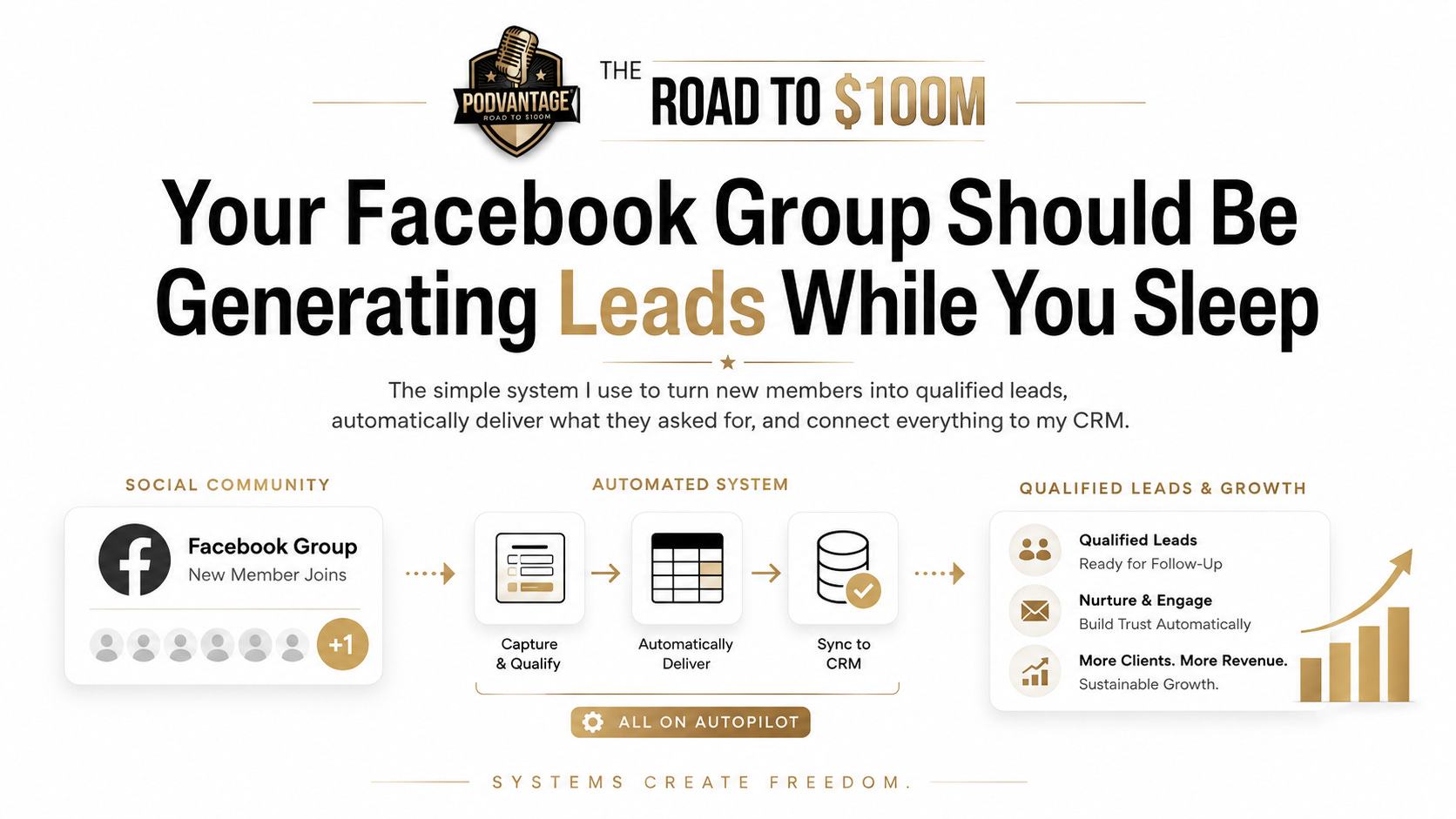
Then the group started growing, and suddenly someone had to approve new members, read their answers, collect email addresses, figure out who might actually be a good lead, add people to your CRM, send them whatever you promised them, tag them correctly, and make sure someone followed up.
What was supposed to become an asset for your business can quickly become another job for you and your team.
As I build Podvantage on my Road to $100 Million, I keep coming back to one question: How can I build bigger while simplifying everything else?
That question has changed the way I look at almost every system in my business, including my Facebook group.
If hundreds or thousands of the right people are coming into your community, their information should not just sit inside Facebook while your team manually copies and pastes it into different systems. Your Facebook group should connect directly to the rest of your business.
I spent a lot of time looking for the best way to make that happen, and the system I am using now is surprisingly simple.
Think about what is happening when someone requests to join your Facebook group.
They are already raising their hand and telling you that they are interested in your topic, your expertise, or your community.
Facebook also allows you to ask prospective members questions before they are approved into the group, and those questions can tell you a lot more than simply asking how they found you.
I use my membership questions strategically so I can understand what someone wants, determine whether they are aligned with the clients we serve at Podvantage, and give them an opportunity to get something valuable from me.
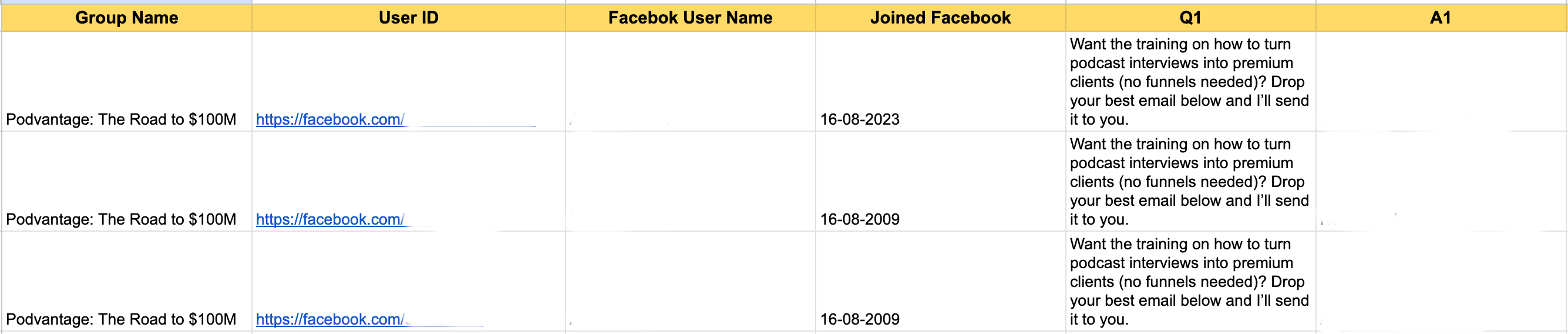
For example, one of the questions in my group asks, “Want the training on how to turn podcast interviews into premium clients? Drop your best email below and I’ll send it to you.”
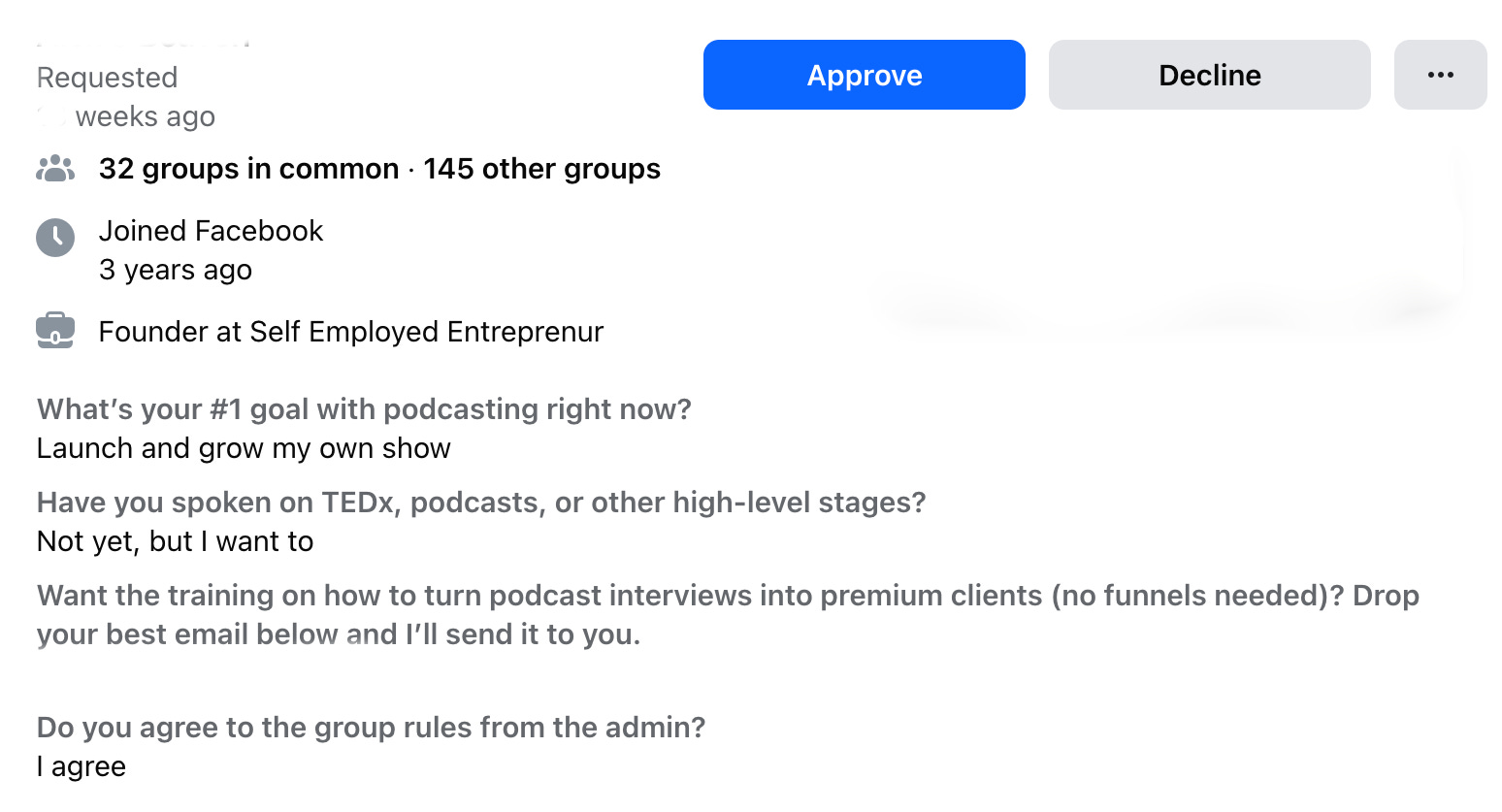
I am not asking for an email address simply because I want another person on my email list. I am offering something that directly relates to why they joined the community in the first place.
The other questions can help me understand what they want from podcasting and what they are struggling with right now.
That means those three membership questions can tell me who is coming into my world, what they want, and how I may be able to help them.
The challenge is making sure something actually happens with that information after they answer.
I did not want my team manually copying every new member’s answers into a spreadsheet or CRM, so I started looking for a way to automate the process.
The best solution I have found is Yunapro.
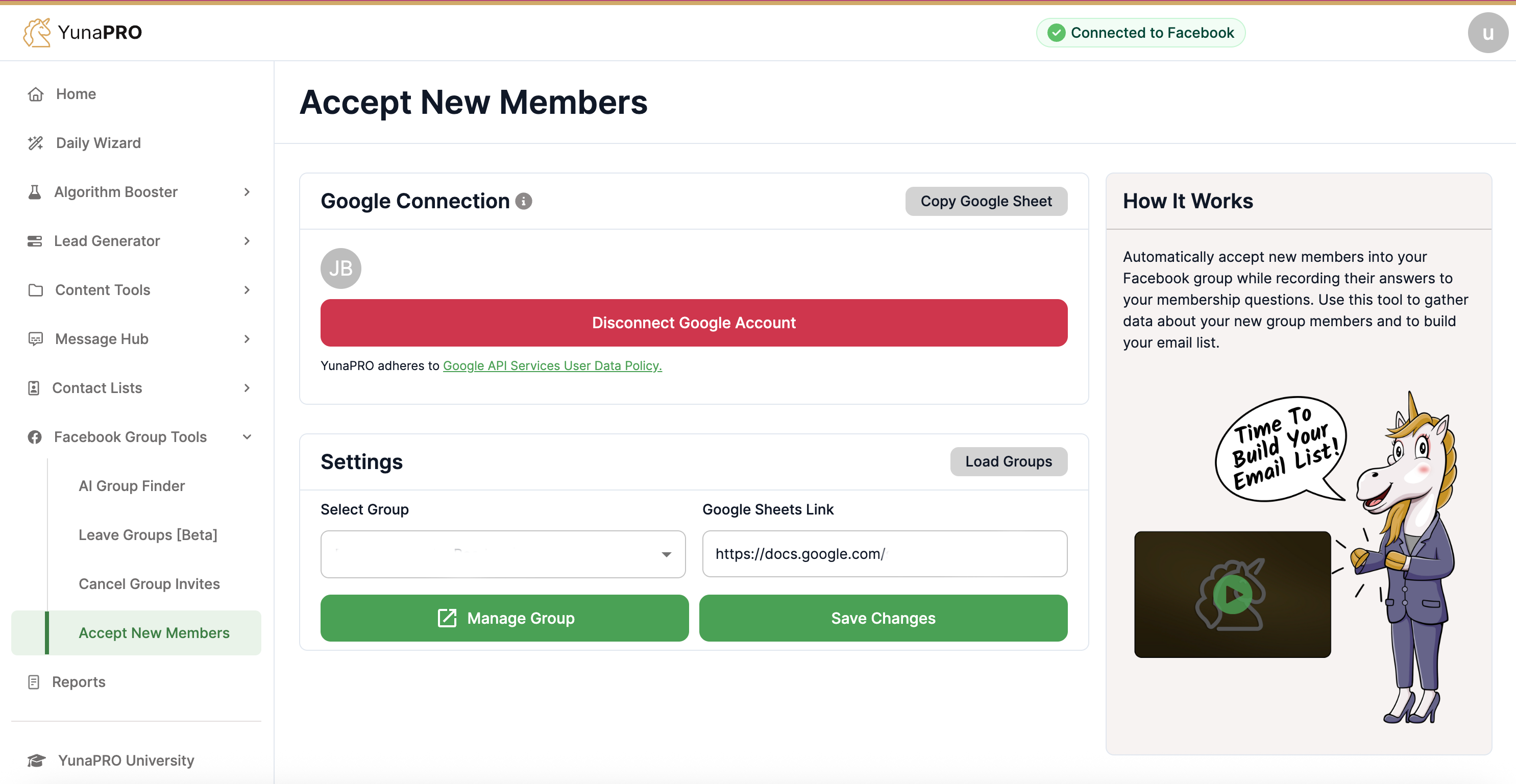
Yunapro has Facebook Group tools that can capture the information people provide when they request membership and automatically add those answers to a Google Sheet.
From there, I can connect that information directly to the rest of my business.
I use HighLevel to run a large part of Podvantage, and I also use it with my clients. It has become one of the most important marketing systems in my business because it allows me to connect leads, automations, email campaigns, tagging, nurturing, and follow-up in one place.
When the Facebook group, Yunapro, and HighLevel are connected, my team does not have to manually move every new member through the process.
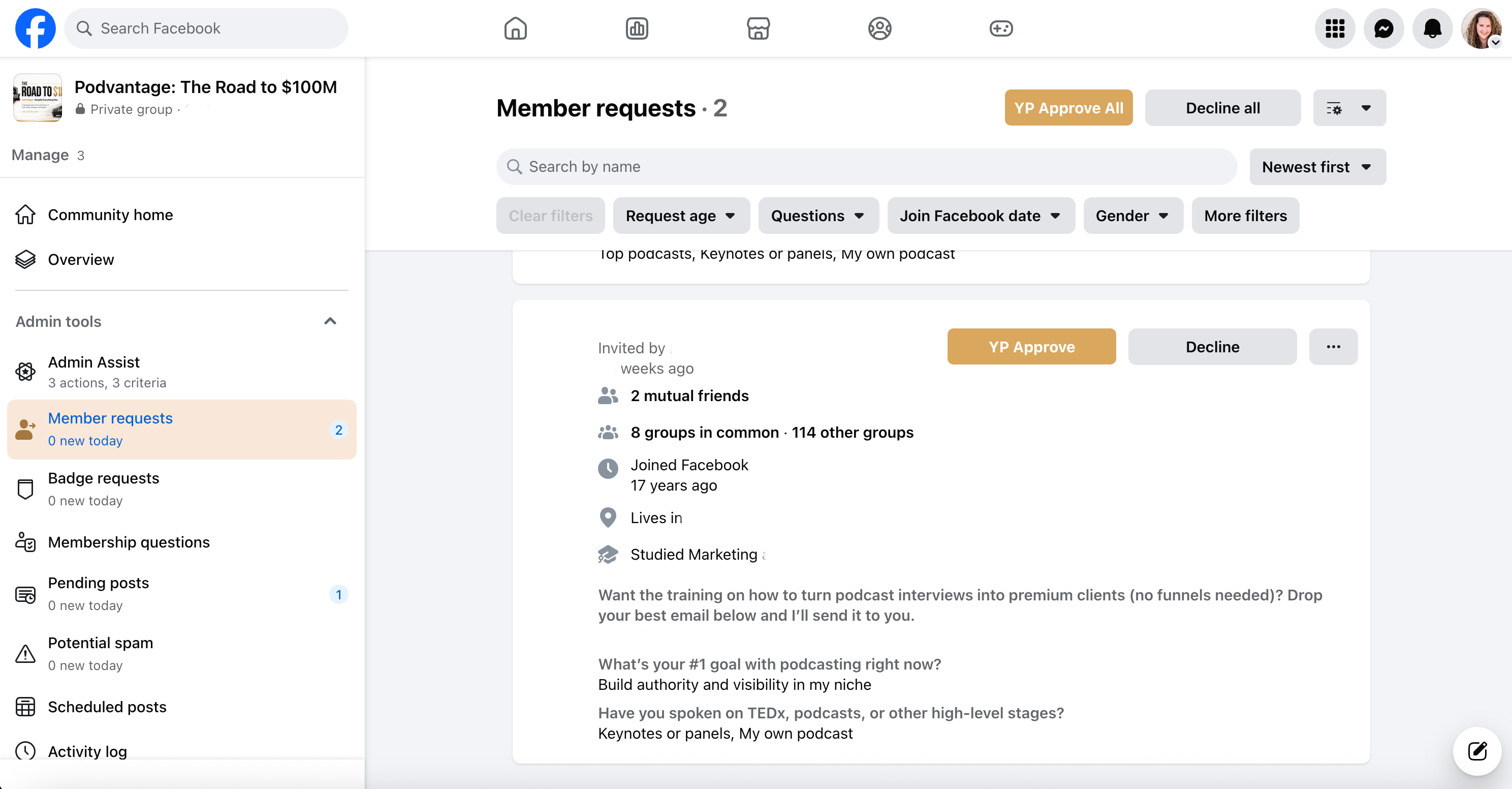
They can simply approve the member.
Once that person is approved, their information can be captured, added to the CRM, tagged appropriately, and placed into the correct automation. If they requested a training, resource, lead magnet, or other material, that can be delivered automatically.
We can also continue nurturing that person and see how many leads are actually coming from the Facebook group.
That turns the group from an isolated community into a connected part of the business.
One of the biggest shifts I am making on my Road to $100 Million is looking at every piece of the business and asking what happens next.
If someone finds me on Instagram, I want to know where that relationship goes next.
If someone subscribes to my Substack, I want there to be a natural next step if they want more help.
If someone joins my Facebook group, I want to understand why they joined and what they are trying to accomplish.
If someone tells me they want help turning their podcast appearances into clients, I want my systems to recognize that they raised their hand.
I am not interested in building large audiences simply to have large numbers.
I want connected systems that help me identify the right people, serve them well, and create opportunities for real conversations.
If you have 10,000 people in a Facebook group but have no idea who needs what you do, you have an audience.
If you have 10,000 people in a Facebook group and your systems can identify when one of them tells you exactly what they need, you have a business asset.
That difference matters.
When people talk about scaling, the conversation often becomes about adding more leads, more content, more employees, more ads, and more platforms.
I am increasingly interested in creating less manual work around more valuable activity.
If another hundred people join your Facebook group, your team should not suddenly have another hundred manual tasks to complete.
Your systems should be able to handle the repetitive work so your team can focus on the conversations, relationships, and decisions that actually require a human.
You should also be able to look inside your CRM and understand where people came from, what they were interested in, what they received, and what happened next.
That is how a community becomes something much more valuable than another social media channel.
The process can be very simple:
Someone discovers your Facebook group and requests to join.
You ask a few strategic questions to understand what they want and whether they are aligned with the people you serve.
You offer them something useful and give them the option to provide their email address to receive it.
Your team approves the new member.
Yunapro captures their answers and information.
That information flows into your CRM.
HighLevel can tag the person, deliver the resource they requested, begin a nurture sequence, and help you track what happens next.
Your team does not have to spend its time copying and pasting information from one system to another, and the person joining your community receives what they requested without waiting for someone to manually send it.
I want marketing that connects to sales, communities that connect to the CRM, and content that creates real conversations.
I want technology handling the repetitive work so my team can spend more time doing the things humans are actually better at.
Most importantly, I want to know what is working.
That is one of the biggest themes I am exploring as I build Podvantage on my Road to $100 Million.
I do not believe building bigger should automatically mean creating more complexity.
If you have a Facebook group that is growing but still requires too much manual management, this is one of the first systems I would look at.
If you are not using HighLevel yet and want to see the system I use to run Podvantage and connect these automations, you can grab a free trial here:
If you are looking at your own business and know there are opportunities sitting inside what you have already built, but you cannot quite see how everything should connect, come talk with me directly at Podvantage.ai.
Sometimes the next level of growth does not require another marketing strategy. It requires connecting what you already have so your business can finally work together as one system.
No posts
Comments
Nothing yet. Say the first thing.
Sign in to join the conversation.