
Healthcare professionals often treat networking as an event.
A conference.
A LinkedIn message.
A coffee.
A favor requested when a role opens, a referral source goes quiet, or a partnership suddenly becomes urgent.
That is too late.
In healthcare, many of the relationships that eventually produce growth are built long before they appear on a dashboard. A referral is the visible result of confidence. A difficult hire is often easier because familiarity existed before the requisition. A strategic partnership can look sudden from the outside even when it was built through months of shared context, introductions, problem-solving, and follow-through.
Healthcare growth is relational before it becomes transactional. And increasingly, it is operational before it becomes scalable. That distinction matters because healthcare is becoming more interconnected, not less. The work increasingly depends on coordinated relationships across providers, payers, schools, community organizations, technology partners, and talent markets.
Those are not networking activities. They are relationship systems.
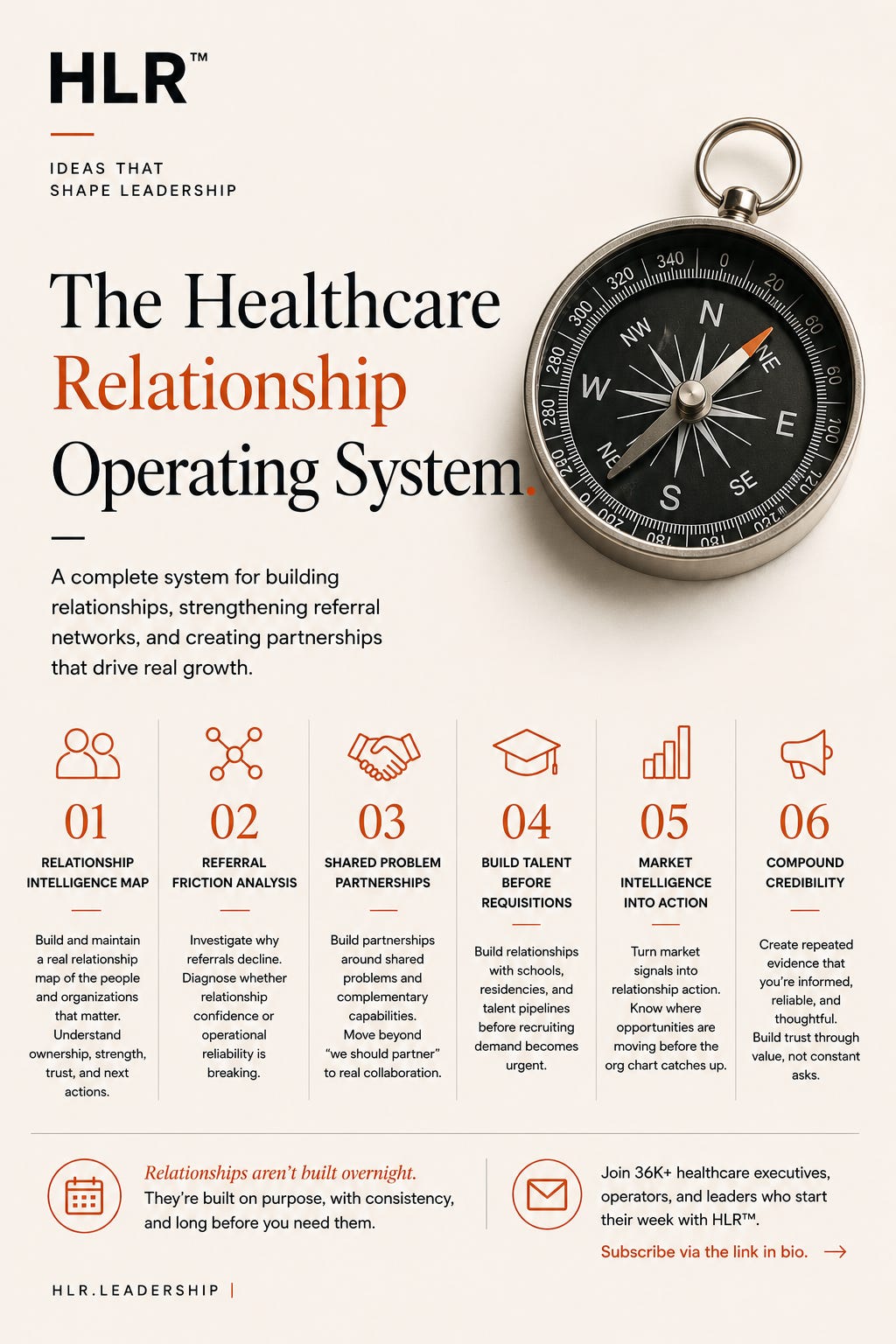
A Healthcare Relationship Operating System is the set of routines, ownership structures, intelligence practices, and operating measures an organization uses to create, sustain, and activate trust at scale.
That difference changes how leaders build and manage relationships.
Most organizations already have contacts. Sales has a CRM. Recruiting has candidate databases. Executives have LinkedIn networks. Physician liaisons have referral lists. Community-relations teams have partner directories. The problem is rarely the absence of names.
The problem is whether anyone understands the strength, relevance, ownership, and next action attached to those relationships.
An executive with 5,000 LinkedIn connections but no credible relationships with referral leaders, educational partners, community organizations, payer decision-makers, physician influencers, or future talent does not have a relationship advantage. They have a directory.
A relationship operating system asks a more useful set of questions:
Who do we know?
Who trusts us?
Where have we created value?
Where are we overdependent on one relationship?
What information moves through the network?
Which relationships connect directly to strategic priorities?
And when an opportunity appears, can we move from conversation to action?
That is relational capacity. And like any other organizational capability, it can be built deliberately.
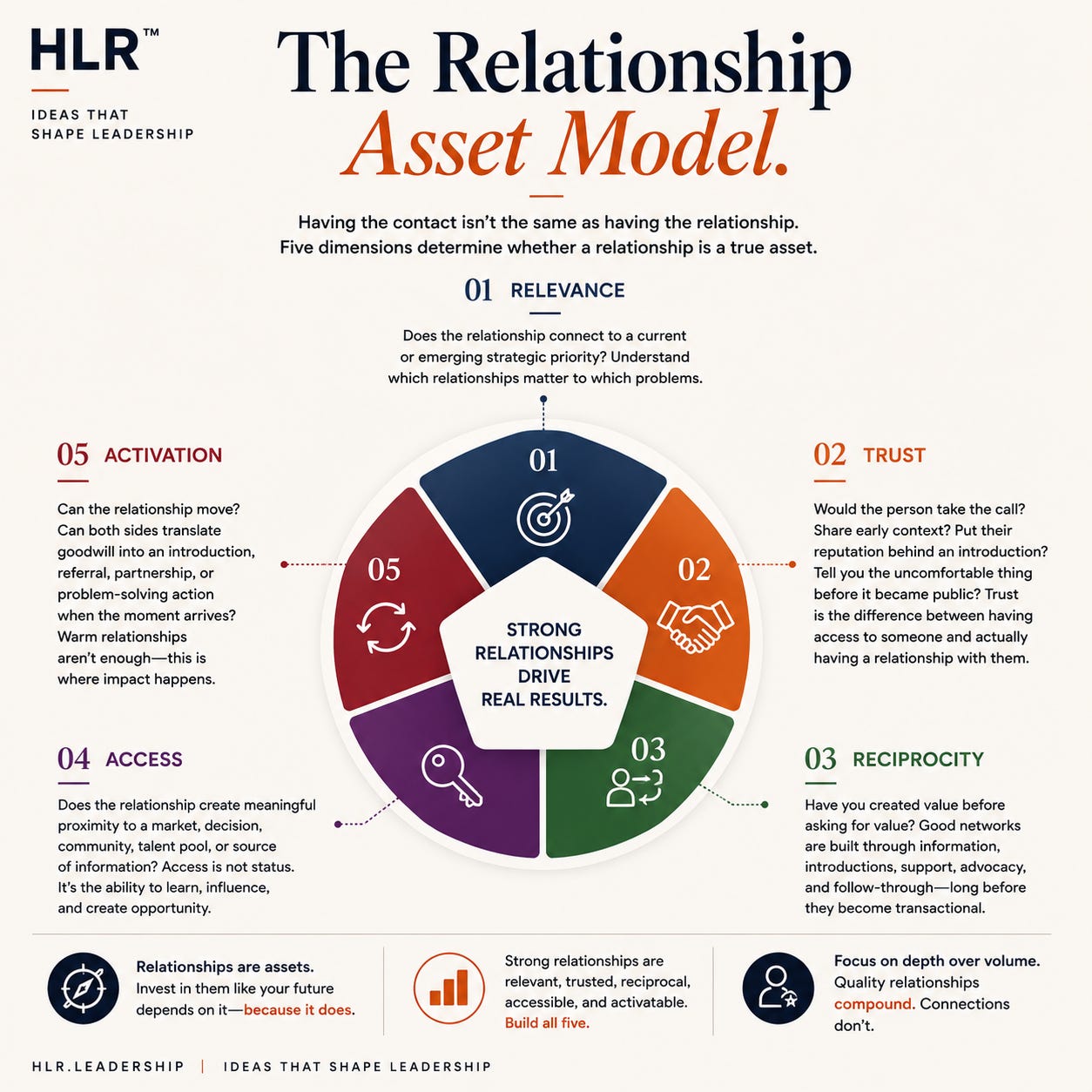
I do not like reducing human relationships to scores. But organizations do need a disciplined way to understand whether strategically important relationships are healthy. Five dimensions are useful.
Relevance
Does the relationship connect to a current or emerging strategic priority? That might mean referral growth, market entry, a workforce shortage, payer strategy, community access, a new service line, or an operational need. Not every relationship needs to be commercially useful. But leaders should understand which ones matter to which problems.
Trust
Would the person take the call? Would they share early context? Would they put their reputation behind an introduction? Would they tell you the uncomfortable thing before it became public? Trust is the difference between having access to someone and actually having a relationship with them.
Reciprocity
Have you created value before asking for value? A relationship becomes fragile when every interaction contains an ask. Good networks are built through information, introductions, support, advocacy, and follow-through long before they become transactional.
Access
Does the relationship create meaningful proximity to a market, decision, community, talent pool, or source of information? Access is not status. A trusted nursing-program director may matter more to your workforce strategy than a hospital CEO. A local community leader may understand an access problem better than anyone in the executive suite.
Activation
Can the relationship move? Can both sides translate goodwill into an introduction, referral, hiring partnership, shared initiative, or problem-solving conversation when the moment arrives? That final dimension separates a relationship that feels warm from one capable of producing coordinated action.
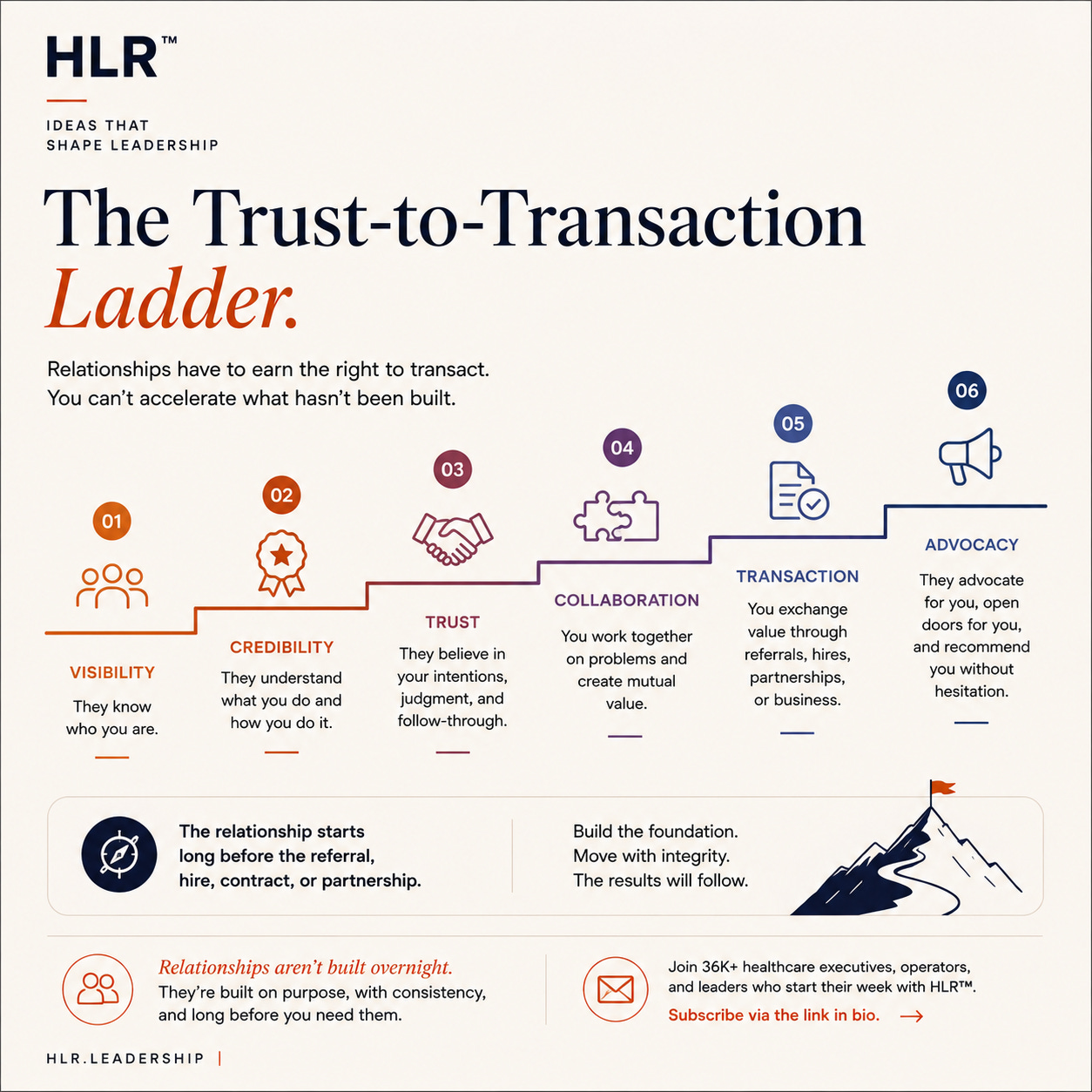
One of the mistakes healthcare professionals make is trying to accelerate relationships past the stage they have actually earned. You meet someone at a conference. Two weeks later:
Can you introduce me to your CEO?
Send us referrals.
Consider this candidate.
Partner with us.
People feel the leap.
A healthier relationship progression looks more like this:
Visibility → Credibility → Trust → Collaboration → Transaction → Advocacy
Visibility
They know who you are. That may come from professional visibility, mutual contacts, events, shared communities, or repeated exposure.
Credibility
They understand what you know, what you do, and whether your judgment is useful. This is where thoughtful visibility matters. Not constant posting. Useful contribution.
Trust
They believe you will follow through and handle their reputation carefully. That matters enormously in healthcare because referrals, introductions, and recommendations carry reputational risk.
Collaboration
You have done something useful together. An introduction. A shared event. A working session. A candidate referral. A market insight. A community initiative. A problem solved.
Transaction
A referral, partnership, hire, contract, agreement, or project occurs. This is where most conventional business-development systems start measuring. The relationship began much earlier.
Advocacy
They bring your name up when you are not in the room. That is the real asset. A strong relationship does not merely respond when you ask. It creates opportunity before you know to ask.
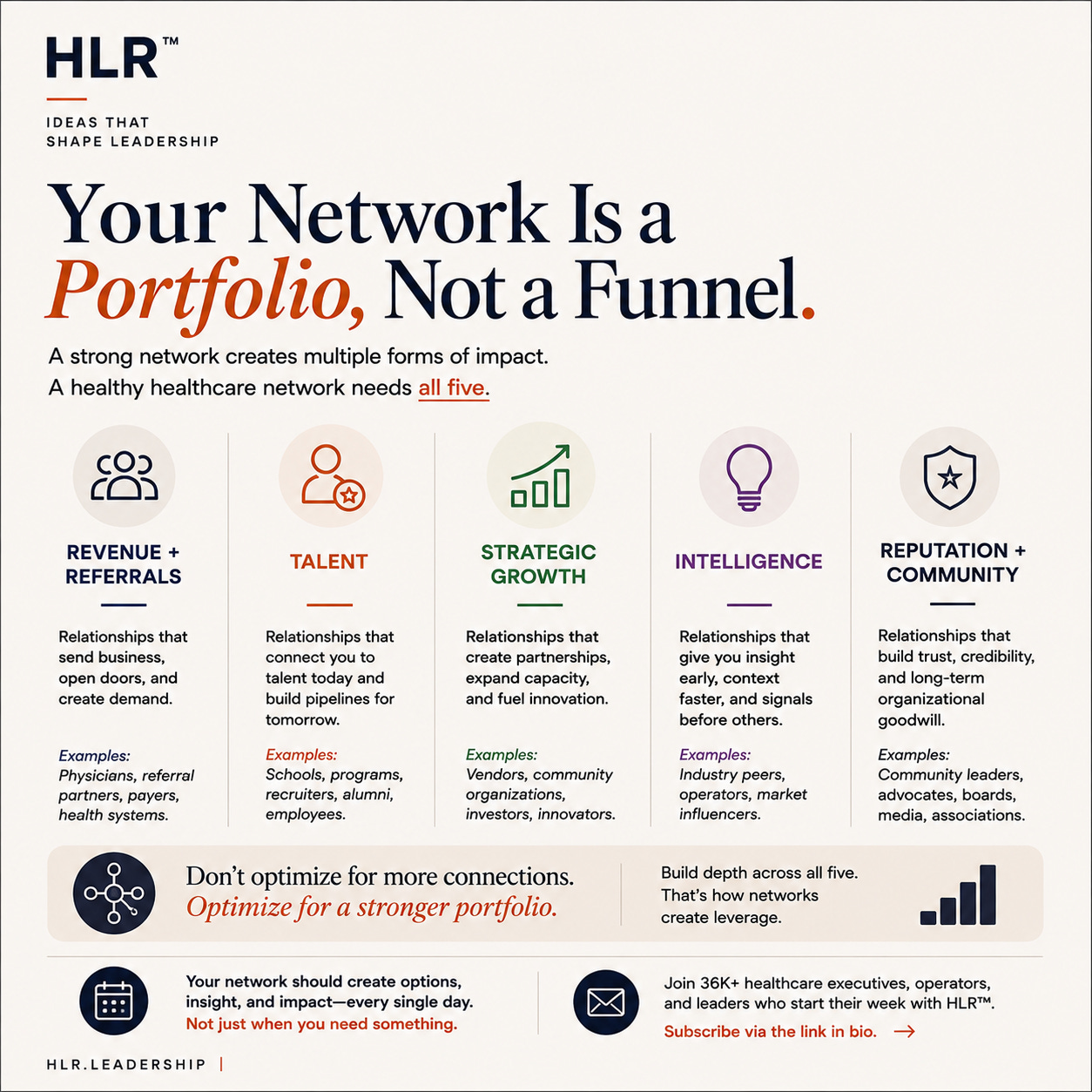
Another mistake is treating every relationship as though it should produce the same outcome. It should not. Healthcare leaders need different relationship systems operating at different time horizons.
Revenue and Referral Relationships
Physicians. Discharge planners. Practice leaders. Employer groups. Payers. Community providers. These relationships may influence near-term patient flow, service-line growth, or business development. They require reliability. If a referral partner sends someone into a slow, confusing, or inconsistent process, relationship equity gets spent immediately.
Talent Relationships
Schools. Residencies. Program directors. Associations. Faculty. Career centers. Alumni. Former candidates. Former employees. These relationships may produce nothing today. That is exactly why they matter. The best talent systems are built before demand becomes urgent.
Strategic Growth Relationships
Health-system leaders. Vendors. Technology partners. Community organizations. Adjacent providers. Industry innovators. These relationships help organizations identify opportunities neither side could pursue alone.
Intelligence Relationships
Operators. Recruiters. Policy leaders. Journalists. Association leaders. Local executives. These relationships provide context. Sometimes the most useful market intelligence is not secret information. It is early interpretation from someone you trust.
Reputation and Community Relationships
Nonprofits. Workforce boards. Professional organizations. Civic leaders. Community groups. These relationships influence legitimacy, local understanding, access, and trust.
A healthy relationship portfolio contains all five. Overinvesting only in people who can produce immediate revenue creates a brittle network.
A relationship map should tell you more than who is in the database. For each strategically important relationship, leaders should know:
Who owns the relationship internally?
What shared problem or strategic priority connects the organizations?
When was the last meaningful interaction?
What is the next value-creating action?
How strong is the trust?
What introductions are available in both directions?
Is the relationship dependent on a single person?
That final question matters more than most organizations realize. A company may say: “We have a great relationship with that health system.” What it actually means is: “Our VP knows their COO.” That is not organizational relationship strength. That is single-thread risk.
If either executive leaves, the relationship may disappear. Mature partnerships become multithreaded. Executive to executive. Operations to operations. Clinical to clinical. Recruiting to workforce development. Finance to finance. The relationship survives because the organizations know each other—not merely two individuals.
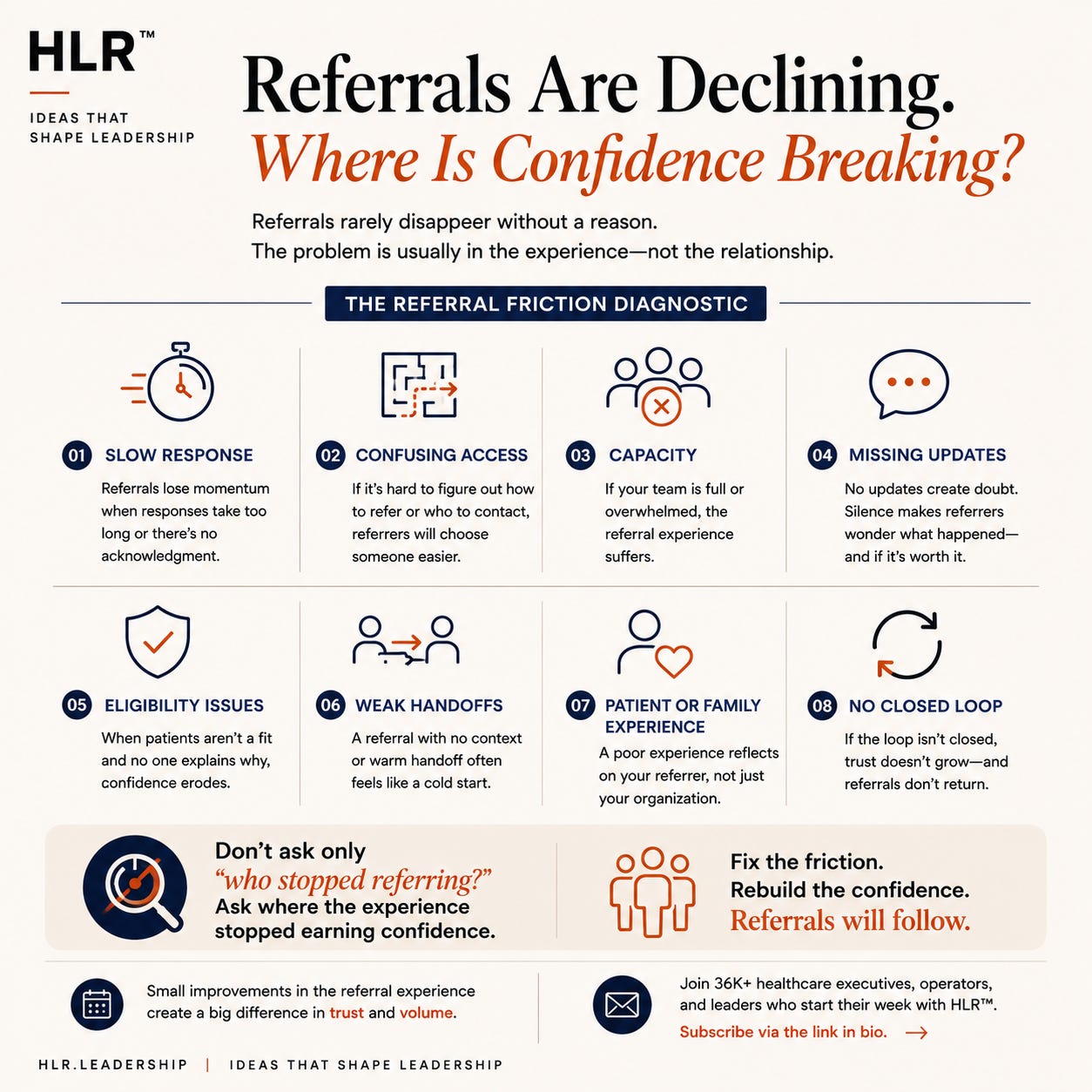
When referrals decline, leaders often assume the relationship has weakened. Sometimes it has. Sometimes the relationship is fine and the operating system is failing it. A trusted referral source may stop sending patients because:
Response times are slow
Access is confusing
Capacity is inconsistent
Updates disappear
Eligibility is difficult to understand
Handoffs are weak
Families complain
Nobody closes the loop
That creates a critical distinction:
Relationships open the door. Operational reliability keeps it open.
A declining referral relationship should be investigated through two lenses at once: relationship confidence and service performance. A business-development team cannot outreach its way out of an access problem. And an operations team should not assume every lost referral is simply a service failure. Leaders need to know which system is breaking.
When referral volume falls, do not begin only with:
Which partner stopped sending?
Ask:
At what point in the referral journey does confidence break?
That turns referral management from relationship maintenance into operational diagnosis. And it keeps organizations from asking business-development teams to compensate for service problems they do not control.
Healthcare is full of conversations that end with: “We should find a way to partner.” That is not a strategy. A partnership becomes strategic when both sides can define:
A shared problem
A complementary capability
A measurable outcome
An owner on each side
A first experiment
The better opening question is:
What problem can neither organization solve as well alone?
Maybe it is a workforce gap. A maternal-health access problem. A rural referral issue. A patient-navigation challenge. A clinical-training shortage. A chronic-disease population falling between care settings.
The Administration for Community Living describes community care hubs as organizations that centralize administrative and operational infrastructure across healthcare and community partners, including contracting, payment operations, referral management, service delivery, technology, data collection, and reporting. That is partnership as operating infrastructure. Not networking.
Healthcare organizations should stop pretending recruiting begins with an approved requisition. By then, the clock is already running. The more durable workforce strategies begin upstream.
Nursing programs. Allied-health schools. Residencies. Community colleges. Career centers. High schools. Professional associations. Internal employees pursuing advancement. Former employees. Former candidates.
The American Hospital Association has highlighted these kinds of build-the-pipeline strategies as hospitals confront persistent workforce shortages. One concrete example is Jefferson Health’s collaboration with the School District of Philadelphia and Esperanza College, which provides students with 1,000 hours of classroom instruction and hands-on training at Jefferson Einstein Philadelphia Hospital for in-demand entry-level healthcare jobs. That is not simply recruiting. It is labor-market infrastructure.
And it changes the recruiter’s role. Instead of asking:
Who can we find this month?
The organization begins asking:
Who knows us before they enter the market?
Which future clinicians have already experienced our organization?
Where are our education relationships strongest?
Which specialties have no pipeline at all?
What internal talent could be developed instead of replaced?
A talent pipeline is not a list of résumés. It is a community of people who understand your organization before either side urgently needs the other.
Business development is partly information advantage. Healthcare leaders are constantly absorbing signals:
A new ambulatory site. A leadership transition. A health-system acquisition. A workforce shortage. A payer-policy change. A technology investment. A new service line. A market expansion.
But information has little value if it never changes behavior. The useful question is:
What relationship action does this signal create?
A new service line may mean reconnecting with clinical and operational leadership before staffing or referral needs become public. A workforce shortage may mean deepening relationships with schools and professional associations before recruiting demand peaks. A technology initiative may create openings with clinical-adoption, change-management, workforce, and governance leaders—not merely IT.
Deloitte’s 2026 U.S. health care outlook identifies three strategic imperatives: improving digital consumer experiences, scaling generative and agentic AI, and joining forces with other industries. Deloitte reports that about 80% of surveyed executives view collaborations with other industries as a C-suite or board priority, while 63% expect strategic partnerships and joint ventures to become a higher priority in 2026.
Technology changes the market. Relationships tell you where the market is moving before the org chart catches up.
Visibility is not the same as constant promotion. The goal is not to stay in everyone’s feed. The goal is to create repeated evidence that you are informed, reliable, useful, and thoughtful about other people’s interests. That may mean:
Sending a relevant article with one sentence explaining why it matters
Making an introduction with no immediate benefit to yourself
Congratulating someone on a meaningful promotion
Sharing a concise market observation
Hosting a small conversation around a problem leaders actually care about
Following up after an event with something useful instead of “Great meeting you.”
The standard is simple:
Would this interaction make someone more willing to trust me with their reputation, patient, candidate, colleague, or opportunity?
If yes, credibility is compounding. If every interaction contains an ask, it probably is not.
None of this works if relationship management happens only when someone remembers. The cadence should be simple enough to use and consistent enough to matter.
Weekly — Relationship Pulse
Five purposeful reconnections; one valuable introduction; five meaningful engagements; one market scan; capture one relationship insight. Purpose: Keep trust, reciprocity, and intelligence active
Monthly — Network Review
Review priority relationships; revive dormant high-value connections; add contacts tied to market shifts; attend or host one relevant gathering. Purpose: Prevent relationship drift and rebalance the portfolio
Quarterly — Relationship Operating Review
Audit the relationship map, referral friction, talent pipelines, partnership gaps, and single-thread risk; select 10 relationships to deepen. Purpose: Align relationship infrastructure with strategy
The word purposeful matters. “Checking in” is rarely useful on its own. There should be a reason. Context. Insight. Congratulations. A resource. An introduction. A shared problem.
The danger of turning relationships into an operating discipline is creating another dashboard full of meaningless activity metrics. Do not measure coffee meetings. Measure outcomes.
Depending on the function, useful indicators might include:
Referral-source retention
Referral conversion
Time from referral to response
Partner-generated opportunities
School and residency relationships
Quality and retention of hires by talent source
Strategic introductions made and received
Percentage of priority partnerships with multiple cross-organizational relationships
The number of meaningful opportunities discovered before they became public
Metrics should tell leaders whether the network is becoming more useful and resilient. Not whether everyone was busy.
The biggest risk in healthcare relationship strategy may be that organizations assume they own relationships they have never actually institutionalized. A physician liaison leaves. A recruiter changes companies. A CEO retires. A partnership executive gets promoted. And suddenly a relationship everyone thought belonged to the organization turns out to have belonged to one person.
That should concern leaders. Because relationship capital is real. So is relationship concentration risk.
The leadership task is not to turn every human connection into corporate property. It is to build enough organizational trust, shared value, and cross-functional connection that strategic relationships can survive normal leadership and workforce transitions. That is what makes the network an asset rather than a collection of personal favors.
Your network should not be something you remember when you need a job, a referral, a candidate, or a partnership. It should already be there. Alive. Useful. Reciprocal. Connected to the work.
Healthcare growth is relational before it becomes transactional. But relationships alone are not enough. The organization still has to respond. Deliver. Follow through. Make the hire. Serve the patient. Execute the partnership.
Relationships create access. Operations determine what happens after the door opens.
The leaders who understand both will build something more durable than a large network: an organization that knows how to create trust before it needs to spend it. That may be one of healthcare’s most underestimated growth capabilities.
HFMA — Value-Based Care Adoption
HFMA reports that participation in value-based care and shared-risk arrangements among hospitals, health systems, and health plans reached 45.2% in 2023.
American Hospital Association — Workforce Pipelines
The American Hospital Association has highlighted health-system partnerships with education providers and internal workforce-development strategies as ways to build more durable nursing and healthcare talent pipelines.
Administration for Community Living — Community Care Hubs
The Administration for Community Living describes community care hubs as organizations that centralize administrative and operational infrastructure across healthcare and community partners, including contracting, payment operations, referral management, service delivery, technology, data collection, and reporting.
Jefferson Health Workforce Development Program
The Jefferson Workforce Development Program, developed with the School District of Philadelphia and Esperanza College, provides students with 1,000 hours of classroom instruction and hands-on training at Jefferson Einstein Philadelphia Hospital for in-demand entry-level healthcare roles.
Deloitte — 2026 U.S. Health Care Outlook
Deloitte’s 2026 U.S. health care outlook identifies three strategies: improving digital consumer experiences, scaling generative and agentic AI, and joining forces with other industries. Deloitte reports that about 80% of surveyed executives viewed collaborations with other industries as a C-suite or board priority, while 63% expected strategic partnerships and joint ventures to become a higher priority in 2026.
Editorial Note
The Healthcare Relationship Operating System, Relationship Asset Model, Trust-to-Transaction Ladder, Network Portfolio framework, and operating cadence presented here are HLR editorial frameworks informed by the cited healthcare evidence and the author’s professional experience. They are intended as management tools rather than validated clinical or academic models.
Comments
Nothing yet. Say the first thing.
Sign in to join the conversation.