
By Julia Weingartner | Healthcare Leadership Review™ | August 2026
A project misses its deadline.
Someone gets blamed.
Turnover rises.
Recruiting is told to fill positions faster.
Employees stop speaking up.
Leadership schedules a workshop on psychological safety.
Customers complain about slow service.
Management tells employees to work faster.
Sales decline.
The sales team gets reorganized.
Organizations are remarkably good at responding to what they can see.
We are less disciplined about asking what produced it.
That distinction sits at the heart of systems thinking—and, increasingly, at the heart of good leadership.
Systems thinking examines how the parts of an organization influence one another—and how incentives, structure, information, authority, and consequences combine to shape behavior over time.
The practical shift is straightforward.
Instead of asking:
Who caused this?
Ask:
What made this outcome possible—or even likely?
Instead of:
How do we fix this problem?
Ask:
What happens elsewhere when we fix it?
And instead of:
Why aren’t our people performing?
Ask:
What conditions have we created in which they can perform well?
Those are harder questions.
They are also better ones.
The Problem Behind the Problem
Most organizational problems arrive disguised as isolated events.
A resignation.
A missed target.
A failed launch.
A difficult manager.
A disengaged team.
A customer complaint.
And sometimes the explanation really is local.
Someone made a poor decision.
A leader failed to lead.
An employee was wrong for the role.
Systems thinking should never become an intellectual excuse for avoiding individual accountability.
But neither should accountability become an excuse for avoiding the system.
Because when similar failures recur despite replacing the people involved, recurrence becomes information.
Imagine three managers occupying the same role over five years.
All three struggle with retention.
At some point, asking What’s wrong with these managers? becomes less useful than asking:
What is it about the role, workload, authority, incentives, expectations, structure, or culture that makes success so difficult?
The manager still matters.
But now we are looking at the whole picture.
That is the first discipline of systems thinking:
Do not confuse the most visible part of a problem with its cause.
Why the Obvious Fix Can Make the Problem Worse
Suppose a project is repeatedly late.
Leadership responds by asking for more reporting.
More status meetings.
More approvals.
More checkpoints.
The intention is reasonable: increase visibility and control.
But what if the additional reporting consumes the execution time the team is already short of?
What if more approval points slow decisions?
What if employees begin waiting for meetings rather than resolving issues themselves?
The intervention can appear sensible locally while making the larger system slower.
That is one of the central insights of systems thinking:
An action does not end where it is taken.
The first-order effect may be desirable.
The second-order effect may not be.
A cost reduction can create a service problem.
A productivity target can increase rework.
An approval designed to reduce risk can slow innovation.
A restructuring can solve today’s coordination problem and create tomorrow’s information problem.
The intervention worked.
And still made the organization worse.
Both can be true.
Think About a Bathtub
There is a simple way to understand this without turning systems thinking into an academic exercise.
Imagine a bathtub.
Water comes in through the faucet.
Water leaves through the drain.
If the tub keeps overflowing, you could spend all day mopping the floor.
That may be necessary in the moment.
But it is not much of a strategy.
Eventually you have to ask:
How quickly is water coming in?
How quickly is it leaving?
Is the drain blocked?
Did somebody turn the faucet higher?
Are we fixing the floor while ignoring what is filling the tub?
Organizations work like this more often than leaders realize.
Think about turnover.
People leave the organization.
Recruiting brings people in.
If departures continue to outpace hiring, leadership can demand greater recruiting productivity indefinitely.
But perhaps the real problem is not the speed at which people enter.
Perhaps it is the rate at which they leave.
Or the quality of onboarding.
Or manager capacity.
Or compensation.
Or the amount of time it takes to make an offer.
Or a job that has quietly become unsustainable.
Systems thinking encourages leaders to examine what is moving into and out of the problem—and what is influencing both.
Healthcare Makes This Especially Visible
A health system facing persistent vacancies may increase recruiter activity, add another sourcing tool, offer referral bonuses, or push harder on time-to-fill.
Those interventions may help.
But suppose the real constraint sits somewhere else.
Compensation has fallen behind the market.
Interview scheduling takes two weeks.
Hiring managers delay decisions.
Onboarding creates unnecessary friction.
The schedule candidates are being offered no longer fits the labor market.
Experienced clinicians are leaving faster than recruiters can replace them.
Recruiting harder may improve one part of the system while leaving the system itself unchanged.
The better question is not simply:
How do we hire more people?
It is:
What is producing the gap between the workforce we need and the workforce we can attract, hire, develop, and retain?
That changes the problem completely.
It also changes what leadership is responsible for.
Recruiting may own sourcing.
It does not own compensation strategy, managerial quality, workload, advancement opportunities, operational delays, or the experience employees have after they join.
When the same hiring objections and retention problems continue appearing, leaders should stop treating each vacancy as an isolated recruiting event.
The vacancy is the event.
The workforce model may be the system.
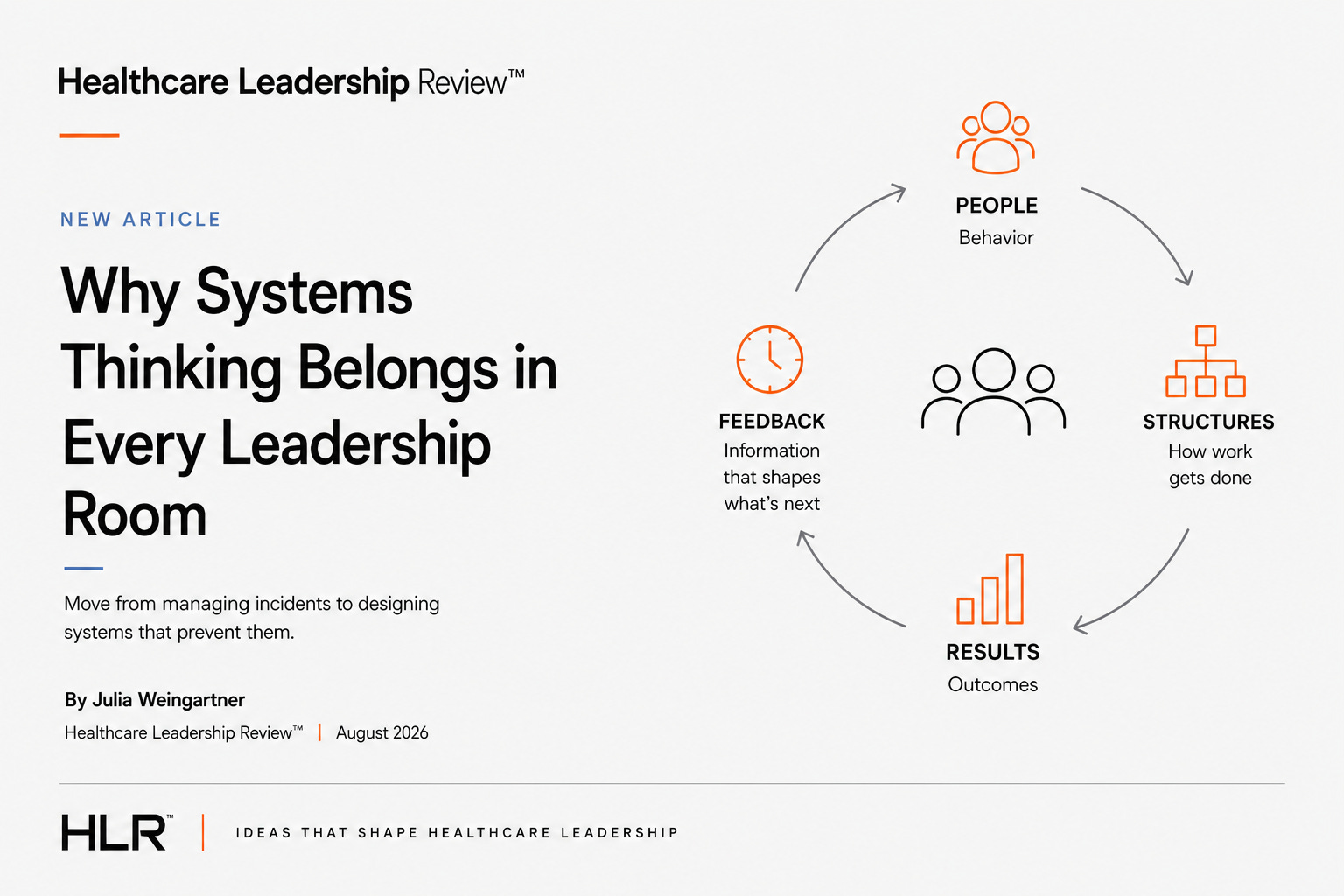
Organizations Don’t Run on Strategy Alone
We like to imagine organizations moving neatly from strategy to execution.
Reality is messier.
Strategy influences incentives.
Incentives shape behavior.
Behavior affects culture.
Culture affects what people feel safe saying.
That determines what information reaches leadership.
Information influences decisions.
Decisions shape execution.
Execution produces results.
And those results influence the next strategy.
The organization is constantly talking back to itself.
This is why smart people inside well-funded, well-intentioned organizations can repeatedly produce outcomes nobody wanted.
The components may be excellent.
The relationships between them may not be.
A world-class team inside a dysfunctional decision structure can look mediocre.
A capable employee working under conflicting incentives can look inconsistent.
A thoughtful manager operating with an impossible span of control can look ineffective.
Change the context and sometimes the behavior changes with it.
That does not mean people are powerless.
It means performance is rarely produced by people alone.
Systems Are Human
The language of systems thinking can sound mechanical.
Structures.
Flows.
Feedback.
Inputs.
Outputs.
But organizational systems are experienced by human beings.
A reporting structure influences who feels heard.
An incentive influences what someone prioritizes when objectives compete.
An approval process determines whether initiative feels worthwhile.
A performance-management system affects whether an employee experiments or plays safe.
A leader may never say:
Don’t take initiative.
But require seven approvals for every meaningful decision and the system communicates the message perfectly.
An organization may never say:
Don’t bring us bad news.
But punish the first person who surfaces a problem and people will learn.
Systems teach.
Usually without saying a word.
Watch What the System Rewards
If you want to understand an organization, do not begin with the values painted on the wall.
Watch what happens on Monday morning.
Who gets promoted?
Who gets heard?
What gets funded?
Which mistakes are tolerated?
Which ones become career-ending?
What happens when someone disagrees with a senior leader?
What happens when someone misses a target for the right reasons?
What happens when someone hits it for the wrong ones?
Organizations reveal their priorities through consequences.
A company can say collaboration matters while rewarding only individual performance.
It will get competition.
A company can say long-term thinking matters while evaluating leaders almost entirely on short-term results.
It will get short-term behavior.
A company can celebrate innovation while treating every failed experiment as evidence of poor judgment.
It will get caution.
People are remarkably good at learning unwritten rules.
Then leadership becomes frustrated when employees behave according to them.
Consider an organization that says collaboration matters while measuring every function independently.
Marketing is rewarded for lead volume.
Sales is rewarded for closing.
Operations is rewarded for efficiency.
Customer success is rewarded for retention.
Each team can optimize its own metric and still make the organization perform worse.
Marketing can produce leads sales considers poor quality.
Sales can close customers operations cannot serve efficiently.
Operations can optimize cost in ways that make the customer experience worse.
Customer success inherits the consequences.
And every function can plausibly argue that it did what leadership asked.
That is one of the uncomfortable lessons of systems thinking:
Rational behavior inside individual parts of an organization can produce irrational outcomes for the whole.
The solution is not another teamwork workshop.
Leaders have to examine the incentives, handoffs, information flows, and measures that make siloed behavior perfectly rational.
The Feedback Loop Leaders Don’t See
Now consider a manager who does not trust the team.
Oversight increases.
Employees learn that independent decisions carry risk, so they begin seeking more approval.
The manager sees fewer independent decisions.
That becomes evidence that the team cannot operate autonomously.
Oversight increases again.
Both the manager and the employees are participating in the pattern.
But the leadership insight is that the system has begun reinforcing the very behavior everyone says they want to eliminate.
Nobody necessarily intended to create dependency.
But the system did.
This is what a feedback loop looks like in organizational life.
Results do not simply appear and disappear.
They often return to influence the conditions that produced them.
That is why recurring problems deserve a different level of attention.
Why Quick Fixes Feel So Good
Symptoms are visible.
Systems usually are not.
The customer is angry today.
The project is late today.
The employee resigned today.
Revenue is down today.
Leaders are rewarded for acting.
So action feels responsible.
Announce something.
Reorganize something.
Hire someone.
Fire someone.
Launch an initiative.
Add a meeting.
Introduce another metric.
Sometimes decisive action is exactly what leadership requires.
Systems thinking is not an argument for endless diagnosis.
It is an argument for better diagnosis before repeated intervention.
Because when leaders respond to every recurring problem as though it were appearing for the first time, organizations become extremely busy without necessarily becoming better.
Before You Solve It, Map It
When a persistent problem appears, leaders should delay prescription long enough to understand what surrounds it.
Not indefinitely.
Long enough.
Ask what keeps producing the outcome.
Ask where work slows.
Ask what information people have when they make decisions.
Ask what they are rewarded for doing.
Ask what they are afraid of doing.
Ask where authority actually sits.
Ask what happens immediately after an intervention—and what happens six months later.
Ask who benefits from the current arrangement.
Ask who absorbs its hidden costs.
And perhaps the most revealing question:
If we changed none of the people involved, what would we need to change to produce a different outcome?
That question forces leadership away from personality and toward architecture.
It does not assume the person is innocent.
It simply asks whether replacing the person is enough.
Accountability Still Matters
There is a danger in taking systems thinking too far.
If everything is systemic, nobody is responsible.
That is not serious leadership.
People make choices.
Managers abuse authority.
Employees underperform.
Executives sometimes make poor decisions despite having good information and reasonable incentives.
A systems perspective should not eliminate accountability.
It should make accountability more precise.
There are two questions, not one:
What did the individual do?
And:
What conditions shaped, enabled, rewarded, tolerated, or failed to prevent it?
Leaders should be capable of asking both.
Sometimes the answer is to change the person.
Sometimes it is to change the system.
Often it is some combination of the two.
The system explains behavior. It does not automatically excuse it.
Leadership Is System Design
This leads to a more demanding definition of leadership.
Leadership isn’t merely getting people to perform. It is creating conditions in which good performance becomes more likely.
What information can people see?
What authority do they have?
What behavior gets rewarded?
What creates unnecessary friction?
What happens when someone makes an intelligent mistake?
How quickly can bad news travel upward?
Who can challenge whom?
How much autonomy exists at the edge of the organization?
What does the company measure?
What does it ignore?
These decisions form an invisible architecture around human behavior.
Senior leaders are designing that architecture whether they realize it or not.
Every incentive is design.
Every reporting line is design.
Every meeting is design.
Every approval threshold is design.
Every metric is design.
Every tolerated behavior is design.
Even doing nothing is design, because the existing system remains in place.
The higher a leader rises, therefore, the less the job can be about personally solving every problem.
The work increasingly becomes creating an organization capable of solving problems without waiting for the leader.
The Best System Does Not Remove Humanity
There is another trap.
Once leaders discover systems thinking, they can become obsessed with optimization.
Every inefficiency becomes something to eliminate.
Every variation becomes something to standardize.
Every behavior becomes something to measure.
But organizations are not machines.
They are communities of human beings trying to coordinate around a purpose.
Good systems do not remove judgment.
They make room for it.
They do not eliminate autonomy.
They support it.
They do not try to predict every exception.
They create enough clarity for people to navigate exceptions intelligently.
And they do not assume human beings exist to serve the system.
The system exists to help human beings accomplish something together that they could not accomplish alone.
That distinction matters.
An efficient system that exhausts its people is not a good system.
A profitable system that destroys trust is not a healthy system.
A fast system that consistently produces poor decisions is not high-performing.
Optimization without humanity eventually becomes another form of failure.
Change the Conditions
Perhaps this is the most useful leadership lesson in systems thinking.
When you want different behavior, do not only ask people to behave differently.
Change the conditions surrounding the behavior.
If you want candor, examine what happens to people who disagree.
If you want speed, examine where authority sits.
If you want collaboration, examine what gets rewarded.
If you want innovation, examine what happens when an intelligent experiment fails.
If you want accountability, examine whether ownership is actually clear.
If you want better decisions, examine how information moves.
If you want people to think like owners, examine whether they are trusted like owners.
Culture rarely changes because leadership announces a new culture.
Behavior changes when different behavior becomes possible, rational, and safe enough to repeat.
Repeated behavior eventually becomes culture.
The Question Behind the Question
The next time something goes wrong, there will be pressure to identify the problem quickly.
Sometimes you should.
But when the problem feels familiar, resist that instinct for a moment.
Look one level deeper.
The missed deadline may be the problem.
Or it may be telling you something.
The resignation may be the problem.
Or it may be telling you something.
The failed initiative.
The difficult meeting.
The customer complaint.
The declining engagement score.
The manager everyone struggles to work with.
Treat the event seriously.
Hold people accountable where accountability belongs.
Then ask:
What is this event revealing about the system around it?
Because the purpose of systems thinking is not to absolve people.
It is to see more clearly.
And perhaps that is ultimately what leadership requires.
Not having an answer for every problem.
Not finding someone to blame.
Not redesigning everything every time something goes wrong.
But developing the judgment to recognize the difference between an isolated failure and a recurring pattern.
Between a people problem and a context problem.
Between a symptom and a cause.
Between an intervention that makes us feel productive and one that actually changes what happens next.
Leaders do not merely solve problems inside organizations.
They shape the systems that make certain problems more—or less—likely to recur.
And when they finally intervene, they do not just ask:
How do we fix this?
They ask the harder question:
What do we need to change so that this problem becomes less likely to happen again?
That is the shift.
From managing incidents to understanding patterns.
From correcting behavior to examining conditions.
From repeatedly fixing problems—
to building better systems.
Sources & Further Reading
MIT xPRO — System Thinking. MIT’s professional-education materials examine systems as interconnected wholes, with attention to relationships among components, patterns, complexity, and the effects changes can have on overall system performance.
Berman, Adam. “Bringing a Systems Approach to Leadership.” MIT Sloan School of Management, November 18, 2020. A practitioner-oriented discussion of organizational context and the ways structures and systems influence behavior and culture.
Bansal, Tima, and Julian Birkinshaw. “Why You Need Systems Thinking Now.” Harvard Business Review, September–October 2025. Examines interdependence, secondary effects, and the unintended consequences that can emerge when leaders intervene in complex systems.
Senge, Peter M. The Fifth Discipline: The Art & Practice of the Learning Organization. Doubleday/Currency, 1990; revised edition, 2006. A foundational work connecting systems thinking with organizational learning, mental models, shared vision, and leadership.
Meadows, Donella H. Thinking in Systems: A Primer. Chelsea Green Publishing, 2008. A foundational introduction to feedback, delays, resilience, system behavior, and leverage points.
Sterman, John D. Business Dynamics: Systems Thinking and Modeling for a Complex World. McGraw-Hill, 2000. A comprehensive treatment of system dynamics, managerial decision-making, feedback, complexity, and unintended consequences.
Editorial Note
This article draws on established scholarship and current leadership thinking in systems analysis and organizational design. The workplace examples, healthcare application, interpretations, and leadership conclusions are HLR editorial analysis intended to make the discipline accessible to practicing leaders rather than reproduce a formal systems-dynamics curriculum.
HEALTHCARE LEADERSHIP REVIEW™
IDEAS THAT SHAPE LEADERSHIP

Comments
Nothing yet. Say the first thing.
Sign in to join the conversation.