
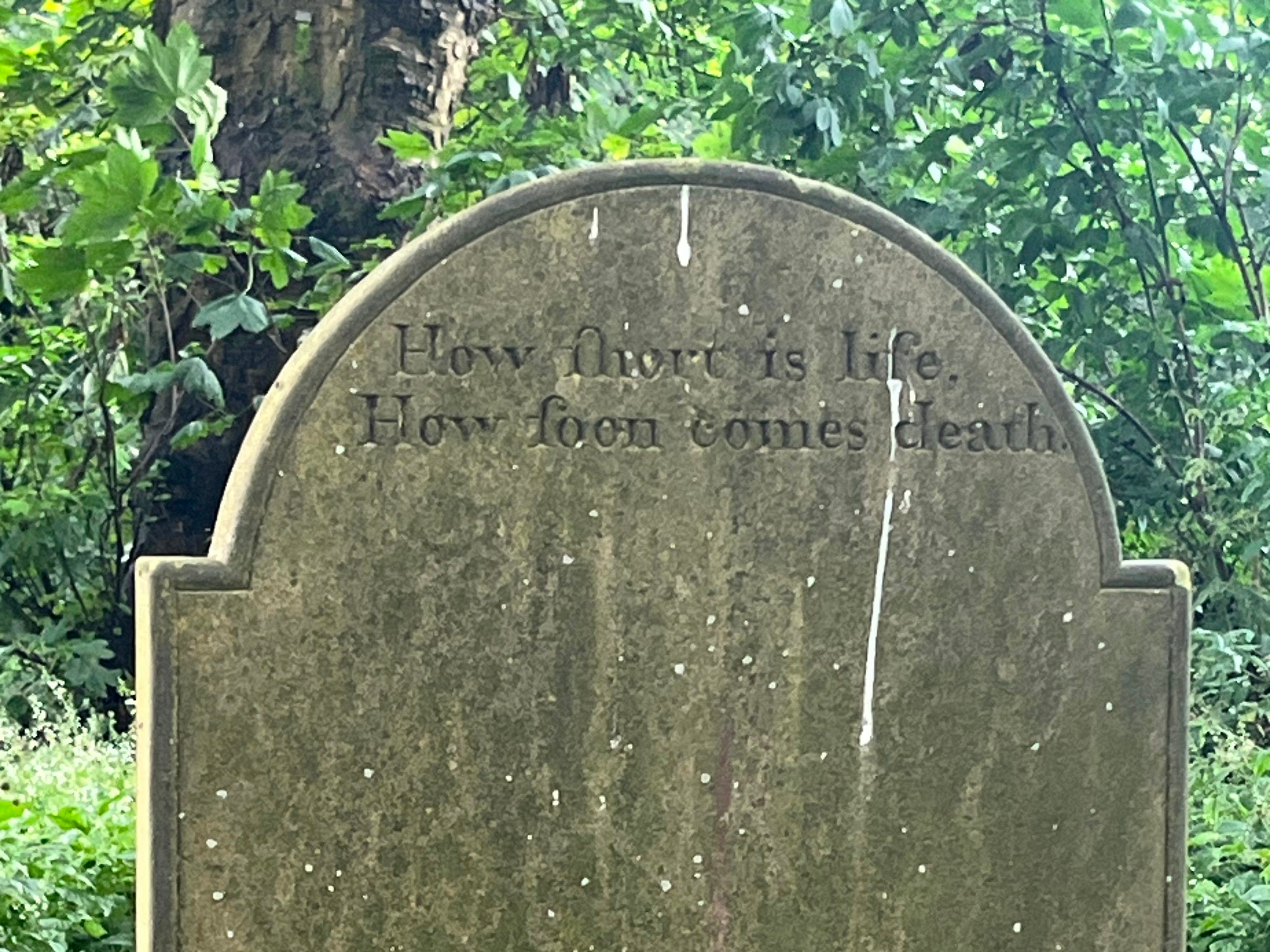
What do you do when someone awful dies?
I’m talking about famous people here, the ones we all recognise and have a thumbnail idea of, our parasocial nextdoor neighbours.
I’m not talking the kind of awful that involves a few mistakes along the way. I mean the kind of awful revealed by a lifetime of ill intent, covert meanness, cruelty or abuse.
Some famous people are loved and some are hated, in modern internet discourse, those extremes are even more closely adhered to. Some openly court our hatred like wrestlers in the ring and some turn out to be awful when you’d always thought they were OK.
So much I’ve seen online about one particular man, now the algo has decided I’m interested in his death, feature pictures of much younger women gazing up at him in awe, his arm around their shoulders, dozens of them from all over the world.
I loved him when I was young too. Watched him, listened to him, saw something special in him. Years later, I realised everyone had seen it, even though he gave the impression of being a humble sort with that trick of making you feel like you were the only one he was talking to.
And it is sad, his death. Someone gone before their time, so much still to live for. A family in grief. You’d have to be a monster not to feel it.
The papers and social media sites flood with the golden rays of fond eulogy until the light almost blinds you.
He was good. Fact. He gave of himself. None could argue. He brought people together. He was love in human form. Better than human, because so many looked to him for guidance and approval.
Someone who brought that much light couldn’t ever be dark.
But just under the shining surface of this sun-dappled lake of remembrance are the writhing, angry naiads, pulling at their hair and screaming their pain noiselessly into the weeds.
Because what they have to say is not for now. It’s too soon. It will always be too soon and if you have nothing nice to say…
Better to watch a false legacy take hold.
Show some respect, because he’s dead now and what good would it do anyway? Besides, they can’t hear you over the chorus of their global lament.
I’ve watched, as most of us have, the digital churn of late, the people saying they’re ‘disappointed’ to see public criticism of the recently dead. Those people, they say, should stop because no one wants to hear it.
In the UK, I’ve seen people disparaging those posters unafraid to say how much they loathed journalist Rod Liddell and former MP Ann Widdecombe.
Obviously, it isn’t better to pretend admiration for someone you virulently disagreed with just because they died. It’s not hypocricy the complainers want, it’s silence.
In life, both Liddle and Widdecombe held forth, sans restraint, on groups of people they had no time for, their lack of empathy becoming a trademark, but I suppose they called it plain speaking or common sense. Two avatars for their side of the culture war, proudly expressing their lack of compassion as the grown-up and sensible choice while the pant-wetters whined about refugees and trans rights.
We don’t want you to lie, the fast-fingered say. We want you to hold your tongue.
Is death really the time to start lying about them? We don’t want you to lie, the fast-fingered say. We want you to hold your tongue. And that is one option. We’re not all required to publish our opinions on every bloody thing but we sometimes seem to act that way.
A lot of people certainly think death is a time for omission of difficult things.
If we silence the detractors for ‘an appropriate period’, in years to come will the search engines be able to find a balanced picture of the deceased in the face of all of this praise and lionisation? Does it matter? Does anything?
The musician Neko Case wrote this incredibly brave thing about a famous death in her industry recently. And even by calling it brave, I’m making myself want to scream because she was just telling the truth about someone, a truth that many won’t ever acknowledge because that isn’t the guy they knew.
I’ve heard so many women say the same thing Case says. So many women. So many rumours. Should the rumours die with that guy? Because the rumours involve a lot of real, living women who are still here, still carrying their stories.
Is it like those childhood games where no one can get you if you make it all the way back to base?
Over at Conquest of the Useless Mic Wright offers a realistic citation for Liddle following his death this week. It’s a parade of one man’s cruelty and entitlement, of careless vandalism towards the people Liddle clearly didn’t consider to be important or worthy of mercy.
I remember Giles Coren crowing about the death of journalist Dawn Foster because she had tweeted that he was a nepo baby. He posted his obvious delight that the 34-year-old had died suddenly and then deleted it again.
Reversing the polarity on the culture war for a second, do I think he was right to? No. And clearly neither did he following the huge public backlash. He wiped his words away again, but the smear remained.
In this case, he wasn’t decrying someone who’d shown cruelty during her life, who’d caused harm, just someone who’d disagreed with him.
I’m talking about genuine bad intent, which is hard to judge when so much of it happens away from our view.
I think it’s because, when death comes, we’re all children again.
But this demand for purity of memory, as though crossing the river washes a person clean and sees them arrive on the other bank in white linen, is weird. Is it for the loved ones left? That makes sense. Don’t add to their suffering. But what about the suffering of people who have to watch the world agree that their reality doesn’t exist? That he was perfect and that they were wrong. No returns.
I think it’s because, when death comes, we’re all children again. Death is too final and too shocking. When someone took up such space in the world, how can they just be gone? So we begin to fill the space, like kids desperately piling up snow to make a giant, white man with a carrot nose and coal eyes.
He only has to last for a few days, but we need him to stand there in the space that’s left. There can’t just be nothing.
It is inherently childish to want only the good things, just the pudding, a simplified version of the world that doesn’t admit darkness. That lets us hide under the duvet so the monsters can’t get us.
Adults don’t admit enough that we still feel like scared children sometimes.
And no matter how many books we read and films we watch, we refuse to shake the childish notion of goodies and baddies.
Someone can be a celebrated joy-spreader and social nexus, a stand-up guy who offered you his spare room in a time of need, a huge presence in every room who does a lot for charity, and also a seedy, cruel bastard behind closed doors.
He could have invented the enormous, glowing persona that you loved so much in order to hide the BTS awfulness that he never wanted you to see. In fact, in showbiz, it’s much more likely that he did exactly that.
I’m not saying the coffin should be followed by shouting protests from the hoards of The Wronged.
But people can and will write and speak and own what they experienced. That belongs to them and they don’t owe the rest of us their silence.
For them, sitting back and watching the redrawing of history is to feel the harm all over again.
If you don’t want to know who that person really was, 360, and you prefer to hold onto your two-dimensional version, just don’t read what they say.
That’s your right too.
If you got something out of this post, I’d love it if you’d share it or click on the heart below. It really helps other people to see it.
Thanks for supporting my writing.
Comments
Nothing yet. Say the first thing.
Sign in to join the conversation.