
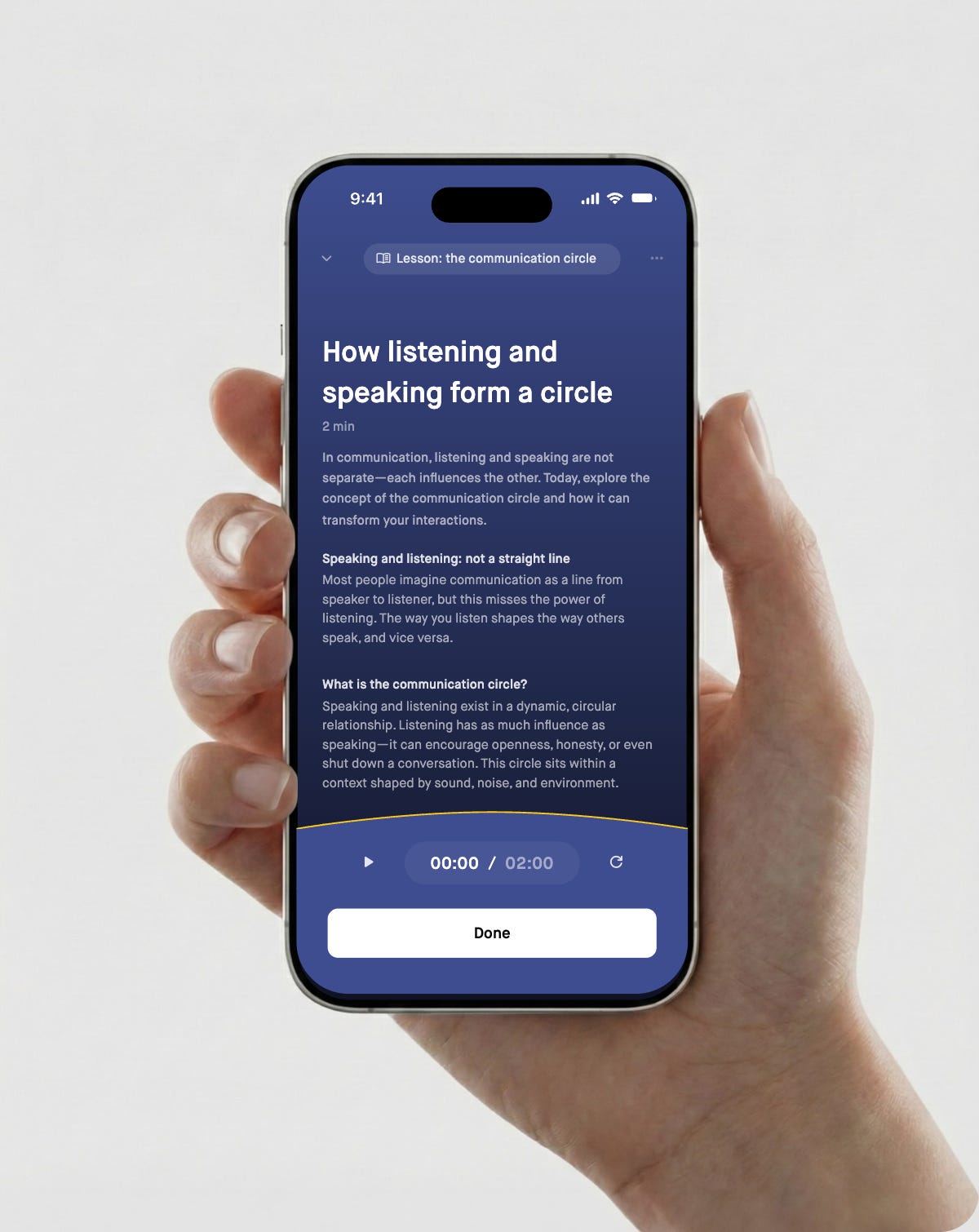
For the past few weeks, I've put endless hours into creating my app, and I am thrilled to let you know that today I have declared it finished. It’s going into testing for a small group now, and you will be able to access it on September 1.
I am genuinely proud of and delighted by its richness and depth, and the way it really feels like me, not some faceless AI. If you want to listen consciously, speak powerfully, or present masterfully, I have put everything I know into this intelligent and responsive app. It’s like having me in your pocket (is that an attractive analogy???). Anyway, more to come in the next two weeks… watch this space!
And now for the news on sound, listening and speaking…
The analogue revival is producing some interesting data. Vinyl revenue in the US reached $1.04 billion across 46.8 million units in 2025, a nineteenth consecutive year of growth. More interesting than the money is the motivation. Seventy-six per cent of Gen Z buyers say they purchase vinyl specifically to own a physical copy. Sixty-one per cent say listening to records improves their mental wellbeing, and around half describe it explicitly as a break from digital life. Sixty per cent of Gen Z listeners reported playing music from the 1990s or earlier in the first half of this year, up forty-two per cent since 2021. CD sales growth has now overtaken vinyl in the US, which suggests the driver is not nostalgia for a particular format but appetite for any format that requires a decision, a physical object, and roughly twenty minutes of not being interrupted. So this is a conscious listening practice, not a shopping habit, and I find it both reassuring and encouraging.
Most people picture hearing as a one-way street (sound arrives, then the brain interprets it) but there is traffic in the other direction too. The ‘auditory efferent system’ carries signals from the brain back to the ear, continuously adjusting sensitivity, and it is the subject of new work at Creighton University funded by a half-million-dollar grant from the National Institutes of Health, announced on 31 July. Hui Hong, who leads the study and has tinnitus herself, summarises the relationship thus: our brain has control over our ears.
This raises interesting possibilities. If that control could be manipulated, it might open routes to treating tinnitus, hyperacusis and the difficulty many people with hearing loss have in decoding speech, even with well-fitted aids; however, Hong admits that clinical trials are decades away. In my book Sound Affects I make the point that listening is not passive but active. It turns out that this is true right down to the level of the cochlea.
A study in the Journal of Environmental Psychology asked 195 students living in Germany to listen to two forest soundscapes, each with either low or high richness of vocalising animals, and each drawn from either a local or a distant forest. Acoustic diversity lifted mood in both cases, but the effect was noticeably stronger when the forest was local. Greater perceived species richness was associated with more feelings of awe, and with higher reported wellbeing, among those hearing the soundscape of a forest they might plausibly walk into. This is a useful corrective to the idea that nature sound is interchangeable, and that any rainforest recording will do. Familiarity appears to be part of the mechanism. The soundscapes that will most effectively restore people are the ones that include the sounds they grew up with and identify as home.
Phys.org: Soundscapes from nearby forests are more uplifting than those from faraway places
The transparency provisions of the EU AI Act covering machine-generated audio are due to take effect this month, requiring AI-generated speech to carry a watermark or equivalent marking. The timing is apt. Industry testing now puts leading text-to-speech engines at mean opinion scores of 4.3 to 4.8 against a human baseline of 4.5, and roughly thirty-eight per cent of listeners cannot reliably tell synthetic speech from real in blind tests. Some models will clone a recognisable voice from three seconds of audio.
Europe is not acting alone: the NO FAKES Act, Tennessee’s ELVIS Act and FTC disclosure rules all push the same way, and YouTube now requires creators to declare synthetic voices. Whether inaudible watermarking survives contact with re-encoding, compression and determined bad actors is another matter entirely. What interests me is the fundamental paradigm shift. For all of human history, your voice has been the one thing that could not be forged. That is no longer true, as I found recently (see last week’s newsletter). If it’s not the voice itself, then perhaps characteristic prosody, vocabulary and personal idiosyncrasies will become key identifiers. As I’ve written before, less-than-perfect voices may be the ones we really identify with in future.
An international team led by Simon Kirby at Edinburgh, Inbal Arnon at the Hebrew University of Jerusalem and Kazuo Okanoya at Teikyo University has found that the songs of Bengalese finches obey Zipf’s law, the same statistical distribution that governs human language. Frequently used chunks of syllables tend to be short, rarer chunks longer, exactly as in speech. The researchers borrowed methods developed to study how babies discover word boundaries, and found the patterns already present in the birds’ earliest attempts at singing. The same team recently found the structure in humpback whale song. This will come as no surprise to my friend David Rothenberg, author of Why Birds Sing and Thousand Mile Song, who has demonstrated the similarities between the songs of humpback whales and nightingales when you speed up the first, or slow down the second.
Kirby’s summary is that humans and songbirds both pass their communication on culturally, and it is culture, not biology, that generates the pattern of it. Language may be uniquely human, but it seems the scaffolding it rests on is shared across the singing species.
News-Medical: Birdsong study reveals shared foundations of complex communication
Scientific American: Birdsong follows a fundamental law of human language
‘Quiet hours’ may be going mainstream in retail. Sephora is rolling out store quiet hours globally, turning down music and dimming screens at set times, and it has found that ninety per cent of customers think it makes the stores more inclusive. In the UK, Aldi, Asda, Morrisons and Tesco all run quiet shopping periods, though Lidl, Sainsbury’s and Waitrose currently do not. Target has trialled dimmed lights, fewer announcements and reduced music at selected stores. The protocol is much the same everywhere: music off, announcements suspended, trolley movement reduced, checkout beeps turned down.
This all began as a provision for autistic and neurodivergent shoppers, which is how it is still framed, but the adoption rate suggests something broader. Given the choice, many (or even most?) people would rather shop in something closer to silence. In my book Sound Business I argued that most commercial sound is accidental rather than designed, and that the cheapest improvement available to most retailers is simply to turn the noise down. It is oddly satisfying to watch the market discover this on its own.
A scoping review published this year in Intensive and Critical Care Nursing, drawing on searches completed in February, maps what is known about alarm sounds and sleep in intensive care, and finds that surprisingly little is. What is well established is the scale of the problem. UK intensive care units consistently exceed 45 decibels with peaks above 85, against NHS guidance recommending a good deal less, while a famous Johns Hopkins study found noise levels by day running at twelve times the WHO’s recommended level.
Nurses identify monitor and ventilator alarms as the dominant internal noise source. An observational study in an Oxford emergency department found bedside alarms sounding twenty-nine per cent of the time, many requiring no intervention at all, which produces two harms at once: patients kept in a state of low-grade alarm, and staff steadily desensitised to the sound that is supposed to summon them (this is known as ‘alarm fatigue’). A ward is one of the few environments where sound design is a clinical matter, so it’s shocking that it’s left almost entirely to equipment manufacturers. See my TEDMED talk for an in-depth discussion of the problem of noise in healthcare.
Acoustic designers have started calling the ceiling the fifth wall, and the phrase is catching on for a reason. It’s usually the single largest uninterrupted surface in a room, but in most schools it is doing nothing at all. A piece in School Construction News this spring argues that treating it properly is the fastest route to better speech intelligibility without sacrificing daylight, flexibility or the look of the room. Improving schoolroom acoustics is so important, because a child who mishears one word in five is not just learning slowly: they are learning from a corrupted signal, and the effort is making them stressed and tired; on top of this are the effects on teachers, who, as I have already reported in previous editions of this newsletter, are probably shortening their lives by working in constant noise levels of 65 dB or worse. In a classroom with hard surfaces and long reverberation time the loss is severe, particularly for younger children, second-language learners and anyone with even mild hearing loss.
A recent paper in Applied Acoustics makes the case for universal acoustic design in schools, on the same principle as a ramp: design for the child who needs it most and everybody benefits. This echoes the dynamic work of Marion Marincat’s Sownd Affects, which is proving the same assertion with its new certifications for audio inclusivity.
My TED talk Why architects need to use their ears discusses this huge missed opportunity, and in my book Sound Affects I set out the evidence on classroom acoustics at some length. It remains, to my continuing frustration, one of the cheapest and yet largest unclaimed wins in education.
Auracast, the Bluetooth broadcast standard that streams audio straight into hearing aids, cochlear implants and ordinary earbuds, has moved from demonstration to deployment. The UK’s National Theatre, Shakespeare’s Globe and St Paul’s Cathedral, along with the Sydney Opera House and Oslo Central Theater have all installed or demonstrated it, and Frankfurt Airport is testing it at selected gates so that announcements arrive directly in a passenger’s ears rather than bouncing off a concourse. This is a sea change for public address: one broadcast, going to any device, in multiple languages, with no neck loop and no queueing at a desk for a receiver.
However (there’s always a however!), the international standard governing Auracast assistive listening installations isn’t expected until late 2027, many hearing aids still in use don’t support it, and Apple has not yet enabled it on any device, so real ubiquity is years off. But for anyone who has sat through a performance straining to catch dialogue, this story is one that’s definitely worth watching.
Hearing Health & Technology Matters: The real reason Auracast could finally change hearing access
Bluetooth SIG: How Auracast broadcast audio is expanding audio streaming
Comments
Nothing yet. Say the first thing.
Sign in to join the conversation.