
The long-promised Value for Investment book has reached another milestone: it’s entered the production phase. A few weeks ago I submitted the full manuscript to Routledge. It’s both a relief and a little surreal to reach this point. Now comes copyediting, typesetting, proofreading, indexing, cover design, final corrections, printing, and distribution. I’ll keep you posted.
For a bit of fun while we wait, you’re invited to use the comments on this post to nominate your best guess for the book launch day, month, and year. Once I have the official launch date, I’ll pick the person whose prediction is closest and send them a copy of the book. Subscribers only, no purchase necessary, and one entry per person. Nominations close at the end of August 2026.
I’ve shared progress with you along the way - an early outline in 2023 (it’s evolved a lot since then), the news that I’d completed a first draft in Feb this year, a draft overview in March, and announcing the book contract in May. And, of course, the book distils three years’ worth of Substack blogs (alongside workshops, academic publications and guidance documents), so you’ve been with me every step of the way.
This post offers a little peek at what’s inside. I’ll sketch the arc of the book, how it connects to what I’ve been writing here on Substack, and what I hope it contributes. I’ll also share a few snippets along the way.
Value for money (VfM) assessment is often fixated on the financials, vague about the value, and treated as a technical exercise rather than a balanced judgement. I think we can do better. As I say in the Preface:
At its heart, VfM is about how well we make use of all of our resources – time, energy, relationships, know-how, and more – to create things that matter to people. Some of the most significant investments we make, as individuals or societies, yield benefits that can’t be fully appreciated within the confines of a spreadsheet – a young person regaining hope, a community rebuilding trust, a river slowly coming back to life.1
The book offers a practical system for answering questions like, how well are we using resources, and what does that mean for people? It brings economics and evaluation into the same conversation, drawing on mixed-methods evidence and different stakeholders’ perspectives, and making them coherent through a rubric-based synthesis that is transparent, credible, and usable.
The book is for anyone navigating the realities of allocating resources and especially those who conduct, commission, or rely on VfM assessments: evaluators, public sector leaders, analysts, project and program managers, development professionals, NGO leaders, economists, funders, board members, and community leaders.
This is not a book for finding a single impressive number for a glossy brochure. It is for people who want to make rigorous, transparent, and useful evaluative judgements about resource use. It is also not a soft option; a VfI assessment should be willing to conclude, when warranted, that something isn’t good enough.
A bit like this Substack, yet also quite different
When I started writing on Substack, I naively thought it would take not much more than a stapler to eventually turn my posts into a book. How wrong I was. Writing a new post each week for three years was a crucial part of how the book developed, but the book isn’t just a stapled-together reprint of my posts.
I used this blog to think out loud, crystallising core ideas and inviting your feedback. The book organises the foundational, long shelf-life elements of VfI into a coherent package, in brand new words and structure, including some things I haven’t covered before. Book language is a bit more formal than blog language, but it’s still me - I’ve worked hard to make it clear and accessible, interesting, useful, and (I hope) engaging.
There are 12 chapters, grouped into three parts. The first part sets the scene, the what and the why. The second part dives into the how. And the third part looks at the big picture of adopting and adapting VfI in different contexts.
Part I reframes what good use of resources means in public and social investments, why default approaches fall short, and introduces the foundations of the VfI approach.
I open the book by naming the problem. Technical framings often treat VfM as a cost-benefit analysis or similar. Alternatively, indicator-driven performance regimes reduce VfM to a few data points and rarely reach a judgement, smuggling hidden values inside a veneer of objectivity. There is more to VfM than that.
The chapter defines VfM as an evaluative question about the merit, worth, and significance of resource use. That framing is the launch pad for everything that follows.
This chapter outlines VfI as a system. At the centre is evaluative reasoning, where explicit criteria and standards act as a “prism” to help deliberate on diverse evidence and reach a clear value judgement. VfI differs from other VfM guidance in the way it uses evaluative reasoning as the backbone, incorporating economic tools (where feasible and appropriate) and other methods within an evaluative wrap-around.
Four core principles and the eight-step process provide the foundations. The rest of the book builds on these.
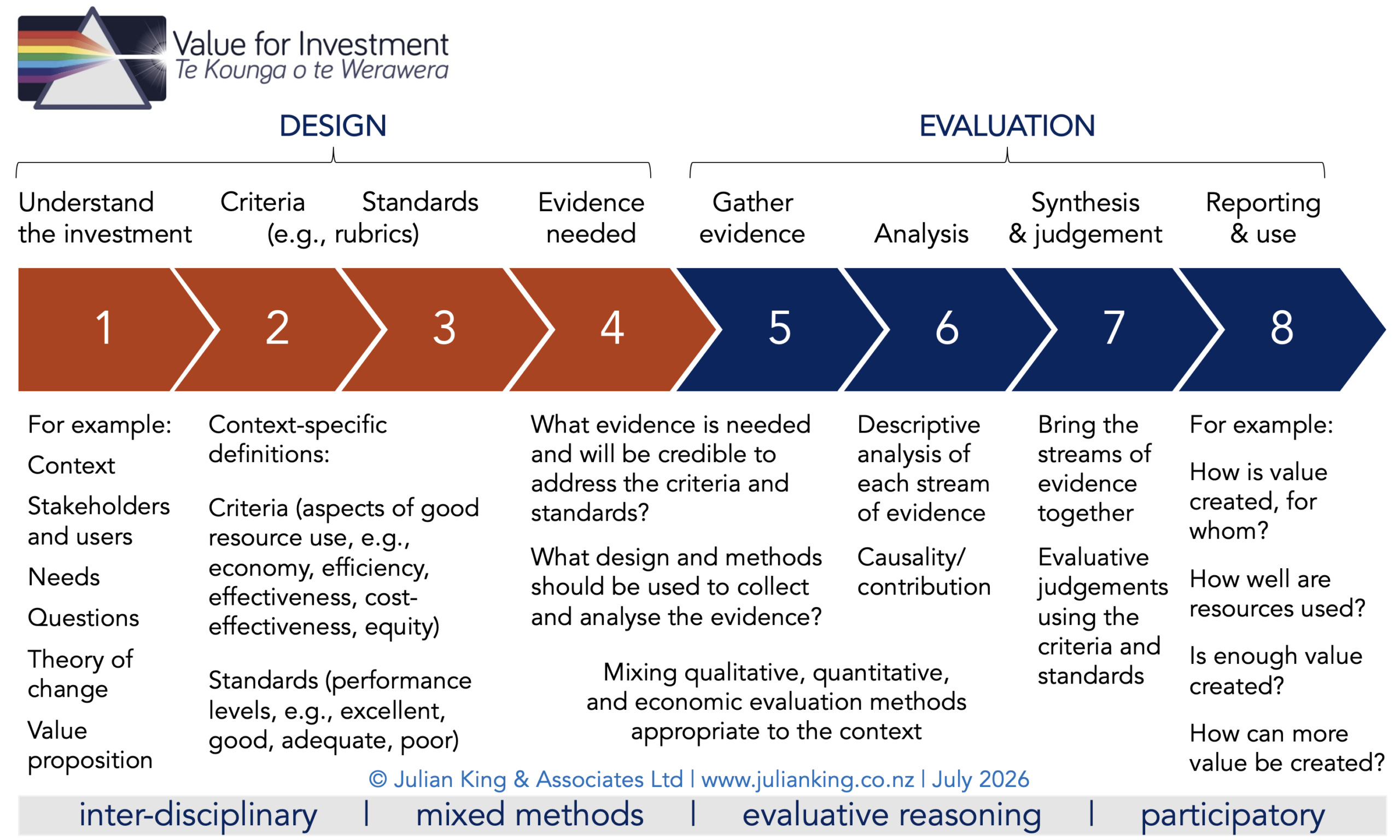
This chapter shares the theory that underpins VfI in practice, highlighting four core principles: interdisciplinary (economics and evaluation working together, plus other relevant disciplines as needed); mixed methods (selecting the right mix based on its probative value); evaluative reasoning (synthesising evidence through the prism of explicit criteria and standards to judge value); and participation (whose values, whose voice, whose power). These are the pillars that make VfM judgements credible and usable, especially in complex, contested settings.
Evaluation involves judging merit and worth, and those judgements are grounded in values. Criteria and standards express those values – they describe what aspects of value matter to people, and what good value looks like. That makes evaluation inseparable from questions of whose values are represented, whose voices are heard, and who gets to influence the basis for judgements. Evaluative reasoning may be the backbone, but participation is the lifeblood of good evaluation.
Part II is the how. It’s where you’ll probably spend most time if you’re grappling with how to actually do VfI in your context. It’ll walk you through the eight-step process, share operating guidelines for doing VfI in the real world, then dive deep on value propositions, rubrics, and economic methods, before showing the whole system at work in a composite case.
This chapter is about the design decisions we make in the first four steps of the process: clarifying the investment and its value proposition, surfacing criteria and standards with stakeholders, and determining what mix of evidence and methods is needed. It provides detailed practical guidance for each step, going further than existing guidance on how to design a VfI evaluation in your context.
Chapter 5 covers steps 5-8: collecting and analysing data, the synthesis step, and reporting findings in ways that actually get used.
A good VfI report gets straight to the point and provides clear answers to value for money questions. It shows its working so readers can understand how judgements were reached, provides enough evidence to make findings traceable, and isn’t torture to read.
While chapters 4 and 5 walk through the overarching logic of the step-by-step process, Chapter 6 is about navigating the approach in the real world. Evaluations run into politics, time pressures, data gaps. Unexpected issues emerge. We learn things during steps 5 and 6 that send us back to steps 2 and 3 to refine rubrics. Chapter 6 offers operating principles for working proportionately and adaptively with VfI while staying true to its core principles.
For instance, a VfI report poses evaluative questions about value for money, such as:
“To what extent does the program provide good value for the resources invested in it?”, not just “What has been delivered?” or “What outcomes have been achieved?”
And when it answers those questions, it provides explicit judgements, such as:
“good value for money overall”, “excellent stewardship of resources”, or “adequate value for money – achieving meaningful equity improvements, with room to reduce the environmental footprint”.
Without evaluative questions and clear, upfront answers, it may still be useful work, but it departs from a core VfI principle.
This chapter deepens two of VfI’s core innovations: value propositions that articulate what counts as valuable, for whom, and why, and theories of value creation that unpack how the value is generated. Get clear on those, and the rest of the steps flow intuitively from these foundations.
The chapter shares a set of practical questions that you can answer to develop a value proposition. I won’t walk through those here - they’re best read in context - but they’re designed to be directly usable in your own work. It also provides examples of value creation mechanisms and how they can help you frame up what the evaluation should focus on.
One thing I’ve learned from Substack: any time I write about rubrics, those posts travel. They’re clearly a topic of interest. This chapter brings key points from those posts together with new material to share fundamental concepts and practical approaches to rubrics.
Done well, rubrics become a kind of social contract. They set out, in plain view, what will be valued and how performance will be judged. Investing time in co‑creating well‑formed rubrics pays off throughout the evaluation – clarifying design, focusing evidence collection and analysis, and supporting credible sense‑making. In my experience, when stakeholders have been meaningfully involved in determining how judgements will be made, they are more likely to engage constructively with the findings and accept them as fair, even when some of the messages are challenging.
This chapter demystifies economic methods like cost-benefit analysis (CBA) and cost-effectiveness analysis (CEA), their strengths (e.g., for modelling and exploring scenarios), limitations, and how to interpret their findings as pieces of evidence within a VfI evaluation rather than as the final verdict.
There are plenty of “how to” texts on economic evaluation already for those who want to become practitioners. This chapter contributes something different - how to navigate economic methods of evaluation, for users such as commissioners, evaluation teams, and decision-makers.
CBA and other economic methods of evaluation are important tools in the VfI toolkit. They belong in evaluation, and when used well, they can tell us things we very much need to know: whether an investment generates outcomes efficiently or makes society better off overall in monetary terms.
But VfM is almost always more than that. It involves multiple criteria, diverse forms of value, and judgements about equity, legitimacy, and fit with context. So the question often is how to embed CBA and related tools inside a broader evaluative system.
To bring the principles to life in a concrete way, this chapter steps through a worked example, telling a story of evaluators and stakeholders working together and navigating challenges in a relatable case. This is where all the pieces come together - value propositions, rubrics, mixed methods, economic modelling, participatory synthesis, dealing with the unexpected, making sense of uncertainty, and reporting for real decisions.
No single real-life case could illustrate every twist and turn I wanted to bring into the story, so I had a lot of fun creating a composite worked example, drawing on over a decade of VfI experience across multiple settings and sectors. Can’t wait to share it with you.
Part III takes the helicopter up. It looks at how VfI can live in organisations and across systems, and how frameworks can remain flexible and alive over time.
This chapter is where VfI meets different organisational realities and needs, from one-off evaluations to portfolios and organisation-wide frameworks. Government agencies, NGOs, consulting firms, and international development programmes have integrated VfI into business-as-usual. More than just adding a new tool to the toolbox, embedding VfI is an organisational development and culture change project, and it can change how people talk about value and evidence. I share practical pathways into VfI, such as pilots, working groups, and communities of practice, and what different adoption journeys have looked like.
One section looks at Indigenous-led work, and what it means for VfI to be a “useful guest”:
Te Kounga o Te Werawera is a Māori‑led adaptation of VfI in which Māori values, concepts, and tikanga (protocols) define what counts as value and how evaluative criteria, standards, and questions are framed. Te Kounga o Te Werawera retains VfI’s four principles and eight steps, re-expressing them in Māori terms and putting them to work under Māori leadership. VfI is invited in to support that work only where it helps to express and assess value as Māori, in kaupapa Māori processes grounded in Te Ao Māori (the Māori world) and mātauranga (Māori knowledge systems).2
Prepared under the mentorship of Māori colleagues, I’ll be excited to share this section with you. I’ll say more about this closer to launch.
The final chapter explores the use of VfI across the policy cycle, treating appraisal and evaluation as connected endeavours. It also makes the case for treating VfI frameworks as living documents. Value propositions, rubrics, and methods need to evolve as contexts, evidence, and perspectives change. The chapter covers planning light-touch and deeper reviews, documenting changes, maintaining comparability over time while staying relevant, and using feedback and surprises to refine the framework.
More news as it comes to hand - I’ll let you know when I have a publication date, web page, and cover design. In the meantime, if you’re new to VfI or want to share it with colleagues, the following free pieces on Substack are a good starting point.
All excerpts are drawn from: King, J. (forthcoming). Value for Investment: an evaluative system for government, public services, and social investment. Routledge.
Te Kounga o Te Werawera refers to the quality and value that come from all the resources invested in a policy, program, or service – such as the people, relationships, know-how, dollars, inspiration and perspiration. The name and the whakaaro (thinking) that sits behind it were gifted by Kirimatao Paipa and signify ongoing work to critically interrogate the VfI approach, privileging Māori ways of knowing and being as the starting point for asking “value to whom, on whose terms, and for what purposes?”. Detailed description, rich examples, and any future publication in this space properly belong with Māori authors. My task in the book is to acknowledge, not to define, their work and leadership. My obligation and privilege is to continue the ongoing collaboration, to honour the whakaaro of Te Kounga o Te Werawera, and support evaluation that is mana-enhancing and advances Māori wellbeing and self-determination.
Comments
Nothing yet. Say the first thing.
Sign in to join the conversation.