
One of the biggest problems I have with many books is that they just don’t really want to be about something. And I don’t mean the idiotic prattle of being about “found family” or “work on your mental health” or “bigotry is wrong,” I mean being actually, deliberately, intentionally about concepts far too big to fit onto a bumper sticker, like criticizing the box of society that people are cast into, using a world where little dolls ping pong around in painful and exciting ways. There’s a reason Ninth House is one of my favorite books, despite my only reading it last year. Bardugo had things to say about higher education, and she’s direct about all of them.
Bad cyberpunk so easily slips down this hole. The aesthetics are so striking, with the glitzy neon and cyborg parts, that it’s easy to forget the genre is about wealth disparity. Rick Deckard doesn’t just gun down androids, the androids themselves are more like people than he thinks. They have memories, ambitions, relationships. The killer is a victim, if anything; never asking to be born, let alone into bondage and a limited shelf life of servitude.
The Body Scout easily earns its slot on the cyberpunk shelf. It’s a biting, incredibly intelligent neo noir digging into questions of corporatism, scientific progress, entertainment, business, and the self. All told via the seedy world behind America’s favorite pastime. And through it all there’s a real heart amid the despair, an upbeat and optimistic belief in humans and their ability to be better.
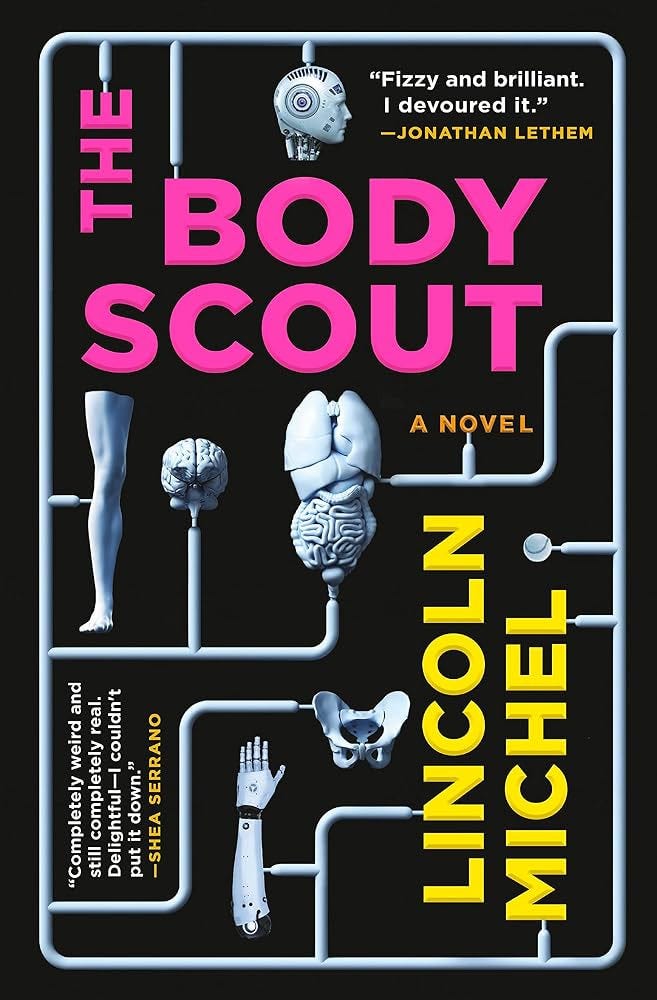
Kobo is a talent scout (hence the title) for the Monsanto Mets, and he’s a terrifically arch detective lead. His parents died when he was young, he got injured in a disaster, he owes a lot of money to powerful people (specifically medical debt for his robotic arm), he’s resourceful and insightful, and he’s inching up on being far too old to be doing a young man’s job. The opening chapters have him bungling a talent investigation (scouting trip) for Monsanto, specifically biochemists. Ones who can specialize in augmenting their baseball stars, such as Kobo’s adoptive brother Zunz.
Things are tough for him, but workable. In the middle of one of Zuns’s games, Zunz suddenly and violently dies. Kobo can only watch as his beloved brother, the national icon, collapses in a pool of his own blood and gore. The nation mourns, and Kobo swears to find out what happened. Like any neo noir, his investigation unspools an entire web of money, power, lies, and profiteering.
And yes, I said “Monsanto Mets.” Welcome to one of my favorite things about this book: worldbuilding is a delicate art, because bad worldbuilding is a busy box for the insecure creative, wasting your time fiddling with knobs and levers rather than making the world matter via the people inside it. Good worldbuilding, meanwhile, can make a good story fantastic.
Body Scout dances elegantly between plot and world details, one informing the other then back again. Kobo pops down to the street to buy a pack of painkiller cigarettes, and as he does we get a nice little Blade Runner scene depicting living conditions in this far flung New York.
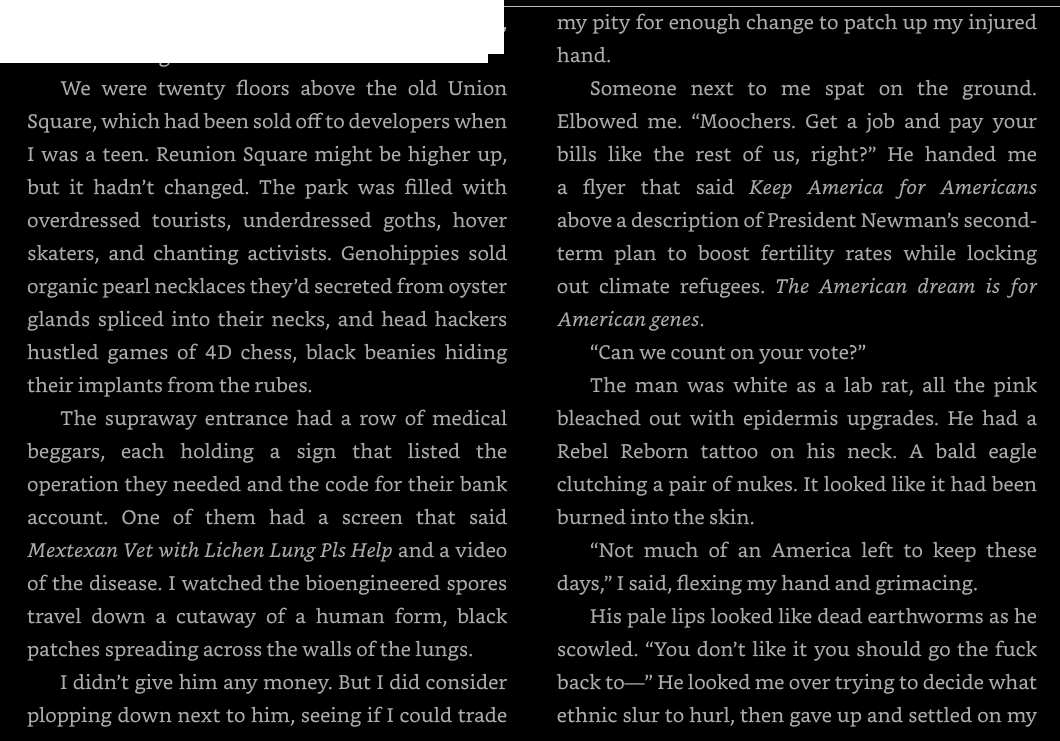
The centerpiece of the story is about baseball, but politics, money, and power all intersect with it, because of course they do. So the Monsanto corporation buying a baseball team is simply mentioned and moved on from, just like the current president, climate collapse, ecological decay, modern medicine, and political divisions. It colors in a bleak world enough to make Kobo’s feeling of ‘just getting by’ spread across the neighborhood, the city, and globe.
And what makes the world feel like it’s worth living in, for him and his community? The great American sport, of course.
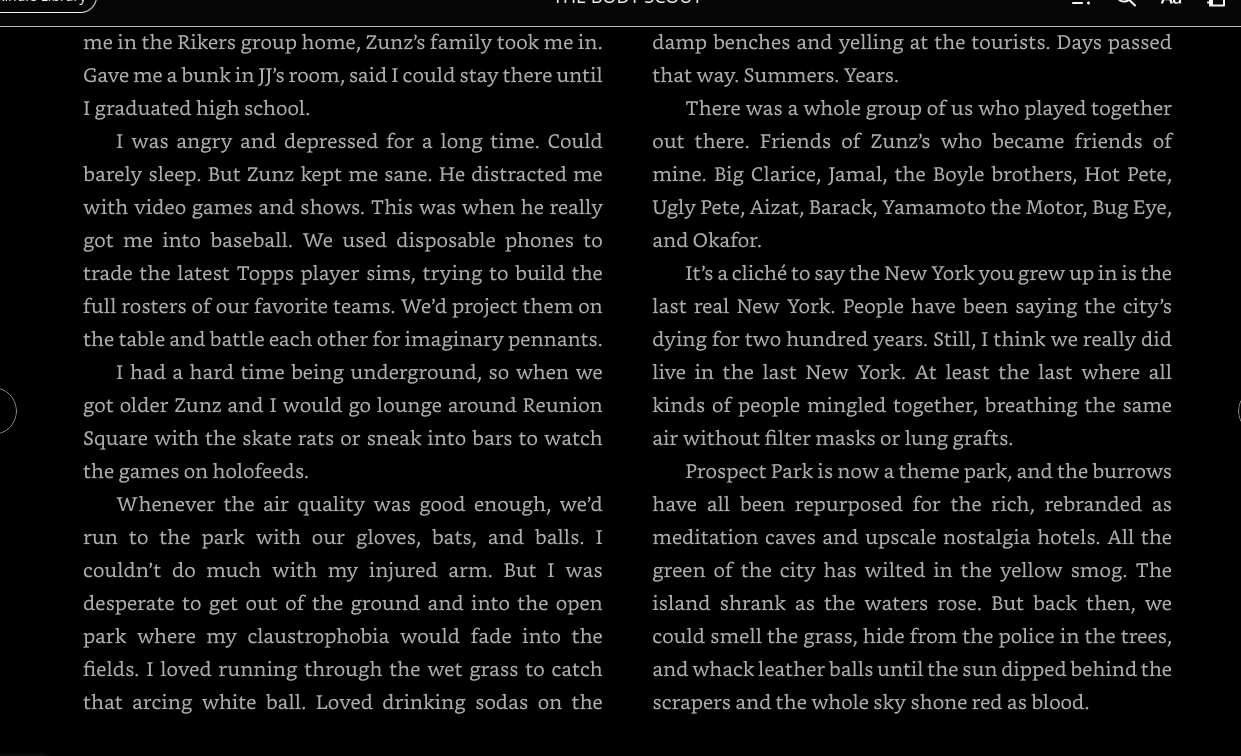
It would be so easy to present this sort of thing as a truism about the prelapsarian time, before corporatism took over baseball and corrupted it into something it isn’t. But Body Scout wisely uses this Field of Dreams style nostalgia to paint Kobo as a romantic idealist. He dreamed about being a baseball star, but his home collapsing on him as a child took his arm, his parents, and his dreams all at once. He only got a moment in the short-lived Cyber Leagues, teasing him with the world denied to him. With no career in sight, Kobo is reduced to yet another has-been hustling behind the scenes at the MLB to make ends meet. All while his nationally famous brother slams home runs out of the stadium.
Kobo, in so many ways, is a man stuck in the past.
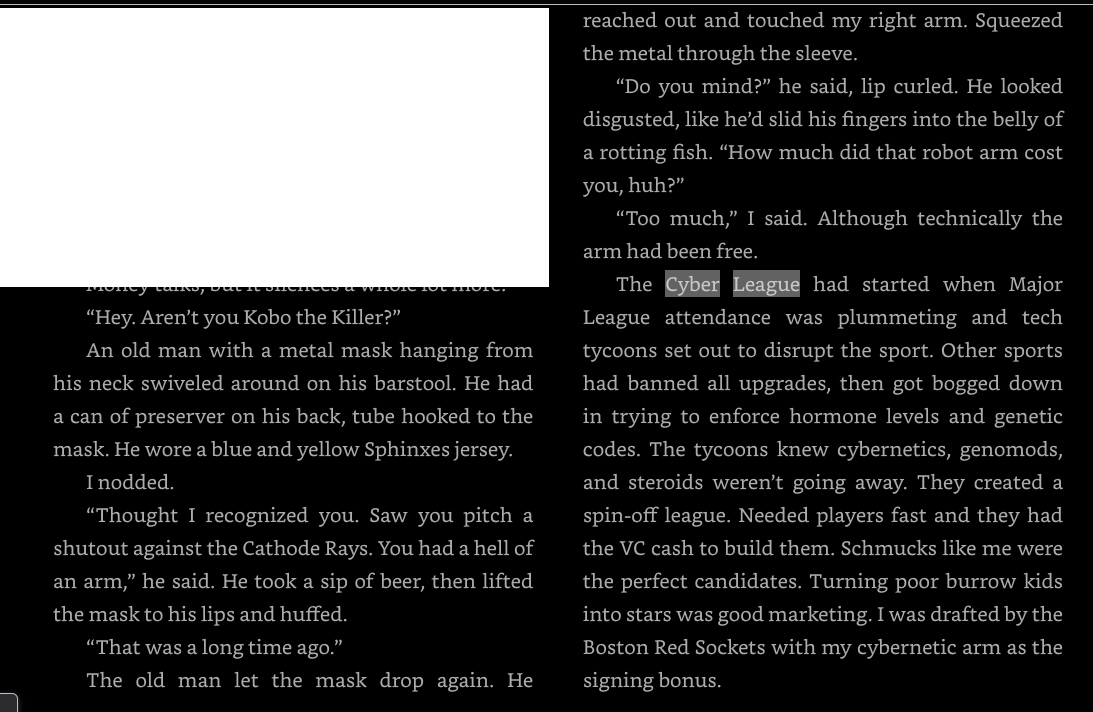
The Cyber League got him a shot at his dream, and they fitted him with a new arm that would give him a chance to live out the person he thought he should’ve been. And of course, that led to more maintenance, more upgrades, and more debt. Kobo can’t let go of what he thought his life was supposed to be. So here he is; a man caught between past and future, forever.
There’s a ton of grotesque cyberpunk in this dystopia too, which makes my dark little heart happy. Clean, sleek Deus Ex this is not. There’s nasty detail about all the modifications and serums being pumped into baseball stars to make them the best athlete they can. And it’s not just the MLB, either – it’s Hollywood too.
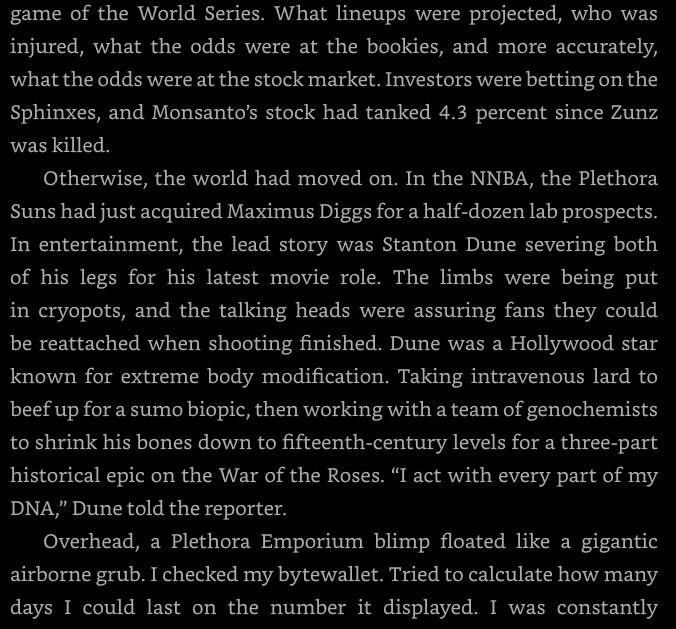
Damn, wonder what that might be a metaphor for! Anyway let me go buy tickets to the next Marvel movie, I heard Chris Hemsworth’s biceps are so big in this one he needed aides on set to help him wipe his ass.
This kind of biological meddling is grotesque in the way scientific discovery always is, made twice as icky by the profiteering going on at every level of society. It could be altruistic, but how long would that even be the case when someone has a bottom line to think about? Again, that elegant cyberpunk critique in action. The world is only as charitable as can be exploited and sold to the highest bidder.
There’s even some Jurassic Park ‘tampering in God’s domain’ themes running in the background. Neanderthals have been revived by cloning, with multiple named ones walking around. Animal species tampering is all over the book, including horribly morose lines about single-use slugs that can be bought to fry electronics, with their own planned obsolescence “shelf life.” Was profit the reason they created those? Or was it sheer human curiosity and excitement, later turned into a way to make a buck? Body Scout says, “Man, I dunno. Humans do a lot of awful stuff.”
And hell, sometimes you just get a real freak who loves swapping out his own body pieces for something weird.
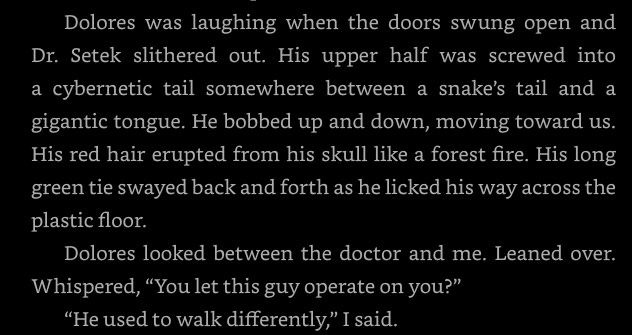
Grotesque and weird, yes, but as a counterpoint – is he wrong to want to fuck with his own body and pick new parts? Kobo has his robotic arm replaced and upgraded, how different is that? Kobo’s on-again-off-again girlfriend is a woman who is deaf and needs special ocular implants to read lips and get by in society. A trans character shows up and it’s mentioned once and moved on from as barely worth commenting on. Those are things that this same radical science did for people. Are they really “wrong” for wanting to do it? Are they made worse by society?
The brevity and speed of these counterexamples to the ‘malicious, profiteering science’ makes it all the better – why would political strife be about transgender people or the disabled, when there’s a doctor who replaced his robot legs with a snake tail?
Similar to Moonflow, the book doesn’t really try to come down as one side being more objectively correct than the other too. There’s a faction of radical body purity activists called “Edenists,” all of whom reject cybernetics and genetic tampering, on the grounds that it’s “impure” and “taints” the body in irrevocable ways. One character even rejects going to a hospital for a treatable illness, because she’s so strict in her ideology that even that is too far.
Allowing yourself to die from blacklung just because it’d be ‘tainting’ your body to go on antibiotics is obviously ridiculous, but the Edenist concept of body purity is entirely based on vibes, and it’s the only organization of resistance around. Where else would one go to demonstrate your hatred of pharma and cybernetic corporations? Just like in real life, political organizing is not nearly as simple as we’d like it to be, especially in a society that’s given up on the issue at hand.
Hilariously enough, the Edenists are accidentally right, because a major snag for Monsanto is that they have genetically tampered with their stars so excessively they’re hitting brick walls for further experimenting, necessitating ‘clean’ genes to start over. Edenists don’t know about this, and they’re never informed. The book just wants to make it clear that nothing can ever be neat and tidy for anyone, because that’s what real life is like.
Layers upon layers upon layers of nuance, with no real objective ‘truth’ to be found, just a lot of complex questions with no simple answers, other than ‘it shouldn’t be like this.’ Obviously you the reader can intuit how to improve things, but with this many invested interests fighting for dominance, it stops being a moral question and becomes a purely political one – like any good cyberpunk or noir thriller. Everyone feels like they exist in a world, and not merely as a reader surrogate here to march in and solve their problems for them.
If I had one criticism, it’s that the tight pacing has a downside; we don’t get to hang out with the characters enough. Chapters blitz through the important details they need to hit, conclude, and when the new chapter picks up we’re already moving into the next thing. I genuinely like the characters, and kind of want to see them hang out and just bounce off one another. Moments of levity and warmth are often brief, reduced to a few lines between Kobo and a stranger or Dolores, his on-again-off-again lover.
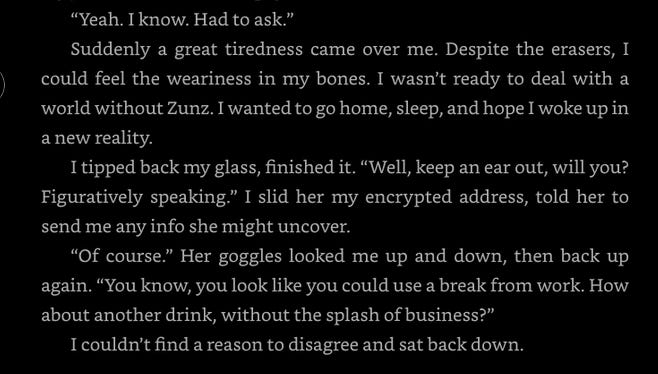
The chapter ends here, and we cut to them waking up in bed together the next day. Again, it’s not that we spend no time with Dolores, but they talk about work and then we’re off to the next plot point. I’d love to learn more about Dolores outside of Kobo’s view of her. She’s a beautifully developed character – cynical, warm, funny, and playful, and even shows her feminine side when she bonds with a young girl to tease Kobo for being a bit of a stick in the mud. Why can’t she and Kobo just pass cigarettes back and forth while reminiscing over pterodactyl meat burgers?
I could tell you all about the plot, but it’d be a waste of time since I want you to read it. I’ll just say the plot threads all wrap up nicely by the end, and the final twist legit got to me. Not just because it refocuses the events in a new light, but because it also reflects back on Kobo.
As I said in the beginning, Kobo is a man stuck in the past. Like so many men injured before their prime, he lives his life dreaming about the good days of the past and how he never got a real chance. The Body Scout is very concerned with ripping away that hazy, beautiful nostalgia that colors his perceptions and prevents him from living in the current moment as it exists – and by proxy, it rips away the reader’s nostalgia, too. Lincoln Michael clearly loves baseball, but he’s not defending the thing it is, either in his book’s depiction or in our time period right now.
As a non baseball fan, I wondered if this book would be for me at all, my mind full of images of Mutant League Football or Blood Bowl but with more robot arms and rainy nights. But now I understand the decision perfectly. Body Scout is a well considered, thoughtful, scathing bit of neo noir, and I can only imagine how great it reads if you’re a New York Mets fan. Fingers crossed Monsanto doesn’t buy them anytime soon.
No posts
Comments
Nothing yet. Say the first thing.
Sign in to join the conversation.