
Global governance refers here to the processes through which states and non-state actors coordinate collective action; global order denotes the underlying structure of power and legitimacy; and system, the network of institutional relationships that link them. The liberal hierarchical order constructed by Western powers after 1945 has plateaued not because it failed, but because it largely fulfilled its ambitions. By institutionalizing openness, legality, and interdependence, it expanded trade, codified norms, and embedded cooperation across regions. Yet these very achievements redistributed material and institutional capacity beyond the West's control, eroding the dominance of a single center and exposing the limits of a universalist model once the easy gains of integration were exhausted.
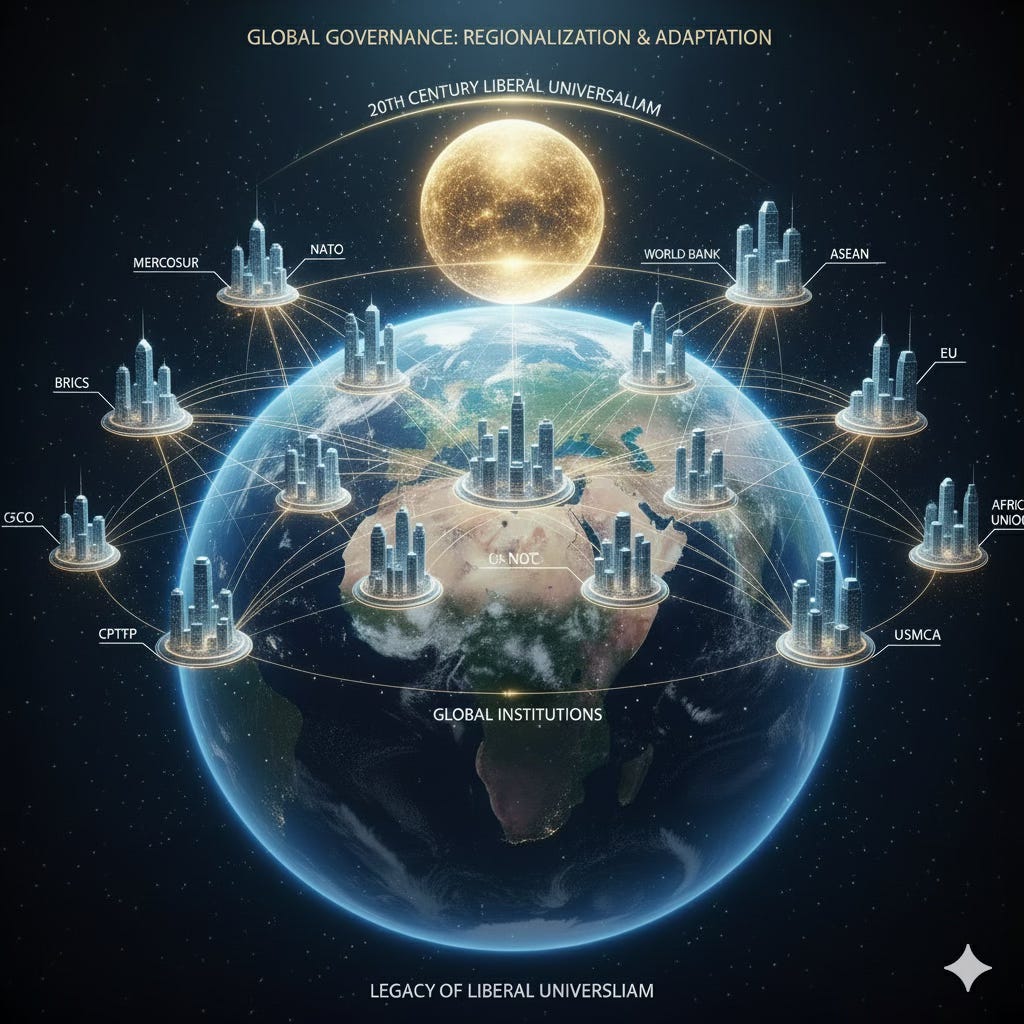
Twentieth-century liberalization, marked by lower trade barriers, privatization, and multilateral frameworks to ensure compliance and transparency, has generated unprecedented prosperity. But as integration advanced deeper into the domain of national sovereignty, such as regulatory harmonization and binding legal commitments, each successive agreement produced diminishing returns and heightened political strain. The liberal order thus created the conditions for its own evolution. By globalizing its rules and institutions, the West enabled governance to develop into a polycentric and interdependent system in which authority and initiative are increasingly dispersed and dynamic.
Regional organizations, cross-regional coalitions, and public–private partnerships now generate much of the policy innovation once monopolized by traditional multilateral institutions. The major global organizations, exemplified by the UN, remain integral. Yet, their function has shifted from directive control to providing frameworks of legitimacy and coherence that sustain an increasingly decentralized order. This transformation reflects what has been described as the adaptive complexity of global governance, an overlapping, continually reconfiguring architecture of authority shaped by deepening interdependence (Weiss & Wilkinson, Rethinking Global Governance…). The diffusion of capacity beyond the West, which Matthew Stephen interprets as global governance’s decline, instead signifies its maturation toward an equifinal order; a phase in which diverse institutional configurations generate comparable outcomes through both coordination and competition in norm production (Stephen, The Diffusion of Power…).
This dispersion of authority reflects what Sigrid Quack describes as transnational polycentric governance, in which multiple centers of rulemaking interact across public and private domains (Quack, Transnational Governance…). Yet polycentricity represents the culmination of an institutional trajectory set in motion by the liberal order itself, as the cooperative, legal, and interdependent norms it established have gradually diffused and taken root across a widening constellation of actors and institutions. Interpreting this evolution as decline reproduces Western-centric and presentist assumptions that equate order with hierarchy and legitimacy with the institutional forms of the post-1945 West. Such perspectives also conflate global governance with global government, presuming that authority must be centralized to be impactful and legitimate. The turbulence of the present instead signals the redistribution of governance capacity across a more differentiated and adaptive institutional landscape.
When the United Nations was founded in 1945, its universalist charter only partially reflected global realities: several Security Council members still presided over empires, and many states lacked democratic institutions or human rights protections. Yet these contradictions did not prevent the UN from redefining legitimacy through principles of peace, rights, and cooperation, enabling even nondemocratic states to participate in an interdependent legal order. Over time, these norms acquired autonomy, becoming institutionalized through instruments such as the Geneva Conventions, the Universal Declaration of Human Rights, and the Non-Proliferation Treaty, and in turn reshaping expectations of state behavior. The liberal order’s legitimacy crisis has emerged not only from institutional fatigue but from moral dissonance: the widening gap between its universalist ideals and exclusionary practices (Lawson & Zarakol, Recognizing Injustice). Contemporary disillusionment with global governance reflects the rising expectations of a system that has internalized ideals demanding continual reassessment and moral consistency.
Measured against 1985 rather than 1998, the world of 2025 is empirically far more open, institutionally dense, and interconnected. Data from the Varieties of Democracy Project show that the number of liberal democracies rose from about 35 (21 percent of states) in 1985 to around 70 (38 percent) by 2010, stabilizing near 60 (32 percent) by 2020. Even with some backsliding, most reversions have been limited, with closed autocracies falling from about 26 percent in 1985 to roughly 13 percent today. Economic openness followed a similar trajectory: World Bank data indicate that the global weighted-mean tariff fell from 12.4 percent in 1985 to 4.3 percent by 2020, while preferential trade agreements recorded by the WTO and DESTA database increased fivefold (from roughly 70 to over 350). The Union of International Associations records institutional growth from fewer than 300 intergovernmental bodies in 1945 to over 7,000 by 2020.
Since 2010, global governance has deepened through regionalism and overlapping coalitions that shape rulemaking in trade, security, health, and technology. Many analysts, however, remain Western-centric, overstating Western influence and overlooking how regional and functional institutions now sustain governance within an increasingly diffuse order. In recent years, the African Union has broadened its role in peacekeeping, pandemic response, and climate coordination, and the African Continental Free Trade Area has advanced economic integration across its 54 member states. In Asia, ASEAN and major trade pacts such as the RCEP and CPTPP provide overlapping frameworks that underpin regional economic governance. The Gulf Cooperation Council has restored cohesion in energy policy and regional dialogue. BRICS and the Shanghai Cooperation Organization have expanded their membership across Asia, Africa, and Latin America and extended their policy mandates into finance, infrastructure, and energy development. In Latin America, Mercosur has regained momentum through the conclusion of the EU-Mercosur agreement. The G20 has also emerged as a durable bridge linking regional and global governance.
Functional innovation in governance has accompanied regionalization, with new centers increasingly shaping global agendas and norms. The China-based Asian Infrastructure Investment Bank and the New Development Bank have diversified development finance, providing over eighty billion dollars in infrastructure and climate lending with greater access and fewer policy conditions than traditional lenders. In environmental governance, the African Union’s Climate Change and Resilient Development Strategy established the continent’s first integrated framework for adaptation and mitigation. The Middle East Green Initiative positioned Gulf states as emerging actors in global decarbonization and ecosystem restoration. In Latin America, the Escazú Agreement established the region’s first binding treaty on environmental democracy, codifying rights to transparency and participation in decision-making for ecological matters. The ASEAN Digital Masterplan has harmonized standards on data governance, e-commerce, and cybersecurity, advancing Southeast Asia’s integration into the global digital economy. In global health governance, the African Medicines Agency has unified pharmaceutical regulation across member states, and the Africa Centres for Disease Control and Prevention has strengthened continental capacity for disease surveillance, emergency response, and coordination. These developments demonstrate how contestation and diversification sustain global order, renewing coherence through engagement, adaptation, and renegotiation.
Authority is no longer monopolized by traditional centers but distributed across a plural landscape of actors that collectively generate legitimacy and innovation (Risse, Order-Making Through Contestations…). Western regionalization has likewise advanced, reflecting a broader recalibration of institutions within an increasingly polycentric order. The EU has expanded its competencies and strategic reach by centralizing crisis management, increasing joint fiscal authority, preparing for enlargement, and developing collective defense and foreign policy mechanisms in response to financial shocks, regional conflicts, and renewed great-power rivalry. NATO has expanded its membership while strengthening strategic capacity through increased defense spending, interoperability, and forward deployments. The G7 has intensified coordination on sanctions, infrastructure finance, and technology standards, and the QUAD has evolved into a structured framework for cooperation on maritime security and critical technologies in the Indo-Pacific.
Western commentators often interpret this diffusion as decline, projecting domestic unease in Washington, Brussels, and London onto the international order and global perceptions. Across much of the developing world, however, these same dynamics are viewed more optimistically, as a rebalancing of authority and a reclamation of historical agency within the international system. Even efforts to reassert national control, such as the “Liberation Day” tariffs, have inadvertently reinforced global governance’s increasingly polycentric structure, accelerating the diversification and regionalization of supply chains, political partnerships, and institutional alternatives.
Global governance need not rely solely on universal and hierarchical institutions such as the UN, IMF, World Bank, or WTO to be impactful and legitimate. Historically, governance has rarely been centralized; it has emerged through overlapping systems of authority—empires, religious hierarchies, and trading networks—that coexisted and competed while sustaining coordination. The post-1945 liberal order represented a distinct historical moment in which Western power and ambition extended legalism, collective security, and economic interdependence to a global scale.
In the twenty-first century, global governance has assumed a more plural and diffuse configuration. As authority, capacity, and legitimacy have become more widely distributed, it has grown more representative and resilient, though also more fragmented and complex. Greater diversity and decentralization may slow consensus but distribute agency and reduce systemic vulnerability, ensuring that no single failure can destabilize the whole. The twentieth-century liberal order embodied the opposite logic: its coherence rested on the narrow concentration of Western power, which amplified the shocks of financial, political, and strategic crises. The contemporary order, by contrast, operates through diffusion, exchanging coherence for adaptability and control for flexibility, and in doing so has become less uniform but more resilient.
No posts
Comments
Nothing yet. Say the first thing.
Sign in to join the conversation.